Confessions of a Top Trader: A Cryptic Survival Guide - Don't Let 'Get Rich Quick' Ruin You
Original Title: "Fearless in Bull and Bear: Crypto Survival Guide"
Original Author: @0xPickleCati, Crypto Trader
Rhythm BlockBeats Note: This article is a deep dive shared by crypto trader Pickle Cat. In the Chinese world, she is more commonly known as "Cucumber Cat." Entering the crypto market at the age of 12 (yes, you read that right, really 12 years old), she has experienced multiple complete bull and bear cycles, ranked at the top in perpetual coin-margined contract live trading profits, with a cumulative profit of over $40 million. Labels such as "Post-00s," "genius," and "female trader" have long accompanied her trading career.
But this article is not a bragging summary about gains, skills, or "how to succeed quickly." On the contrary, after experiencing a full cycle baptism, this is a systematic review of trading, survival, and cognition. There is only one core message: don't let "quick gains" destroy you. Below is the original content:
I bought my first Bitcoin in 2013.
As an old leek who has lived through more than a decade of cycles until 2026, I have seen the market drive people crazy in ten thousand ways.
I found that during this long time, there seems to be an undeniable iron rule:
That is, in this circle, the definition of "winning" is never about how much money you make. Everyone who has been in contact with this circle can make money at least once, even if they are a newbie, even if their capital is small, they can become a temporary "genius." So what is "winning" exactly? It's about making money and, even today after many years, still being able to hold onto that money.
In other words, if you want to change your destiny through the crypto world, you must first realize that this is not a competition of "who makes the most" or "who doubles the most," but a game of "who can survive till the end."
But reality is cruel. Most "geniuses" have become fuel, and only a small number of people can successfully survive to the next cycle. Among these survivors, those who can truly achieve the power of compound interest snowball are even rarer.
After October/November, the market sentiment returned to the dull period I am familiar with.
That day, I lost many friends whom I thought I would fight alongside in the crypto world for many years. Although this kind of "farewell" has been staged countless times, every time it happens, I instinctively reread some reflections I have intermittently written over the years.
I think it's time to tidy things up. To figure out that ultimate proposition: what exactly, whether there are some replicable traits, is needed to survive in the coin circle.
For this purpose, I also chatted with a few old friends who are still active in the coin circle, and thus, this article was born.
This article is my exclusive insight, a painstaking work, and it will attempt to explain the following points:
· Why can some people survive in this cyclical "bloody sea," while others can only leave in disgrace?
· How can you maintain hope when being tortured in a bear market?
· What do you need to do to become the person described above?
To fully understand this truth, we must first go back to basics and forget about what others have said about this circle to you.
"The only true wisdom is in knowing you know nothing." — Socrates
The article will briefly explain the history of the coin circle and the essence of the coin circle, most of which new players in the circle will ignore these elements because understanding them doesn't immediately make money (or lose money) as satisfyingly (painfully) as trading.
But in my personal experience, it is precisely these overlooked aspects that are the secret to fearlessly facing bull and bear markets, just as the philosopher George Santayana said: "Those who cannot remember the past are condemned to repeat it."
In this article, I will help you understand:
I. What exactly can cause the coin circle to bull run, how to distinguish between "market start" and "dying embers"? This includes 3 case studies and a basic version of "judgment criteria" that you can directly use.
II. What exactly should you do to increase your chances of catching the "next big opportunity"?
III. What are the replicable commonalities among those who can cross multiple bloody market cycles and continue to make money?
If you've ever had your wallet "decentralized" in the coin circle, then this article is for you.
Whenever people ask why the crypto market is stagnant, the answer is almost always the same: a new narrative has yet to emerge! Institutions have not fully entered the scene! The technological revolution has not erupted yet! Blame those rug pull market makers and KOLs! It's all because of some mishap with a certain trading platform/project/company!
These factors are indeed important, but addressing them has never been the root cause of ending the crypto winter.
If you have traversed through enough bull and bear cycles, you will see a clear pattern: the resurgence of the crypto market has never been because it became more like the traditional system, but because it reminded people once again of the stifling nature of the old system.
The stagnation of crypto is not due to a lack of innovation or just a liquidity issue.
It is fundamentally a failure of collaboration—more precisely, stagnation occurs when all three of the following fail simultaneously:
· Capital loses interest
· Sentiment is depleted
· Current consensus can no longer explain "why we should care about this space"
In such a situation, price weakness is not because crypto "is dead," but because there are no new elements to catalyze new participants into a collective force.
This is the root of most people's confusion.
They always believe the next cycle will be triggered by some "better, more explosive" product, feature, or new narrative. But these are all effects, not causes. The real inflection point only becomes visible after a deeper level of consensus upgrade.
If you cannot see this logic, you will only continue to be led by market noise, becoming the easiest prey in the hands of those who hold the reins, caught in the whirlpool of their pump and dump schemes.
This is why there are always people chasing after the "next big thing," trying to be the ultimate diamond hands, only to find themselves entering too late, or worse—buying the coin of a shitcoin.
If you want to cultivate a true investment instinct that allows you to spot opportunities early rather than be watered down into the fate of a wilted vegetable every time a new project launches its token, you first need to learn to distinguish:
The fact is, what has always dragged the crypto world out of winter is one thing: the evolution of consensus.
“Consensus” in this circle refers to humanity finding a new way to financialize some kind of "abstract element" (such as belief, judgment, identity, etc.) using cryptocurrency as a medium and coordinating massive collaboration around it.
Be sure to note: Consensus is by no means equivalent to narrative. And most people's cognitive biases start right here.
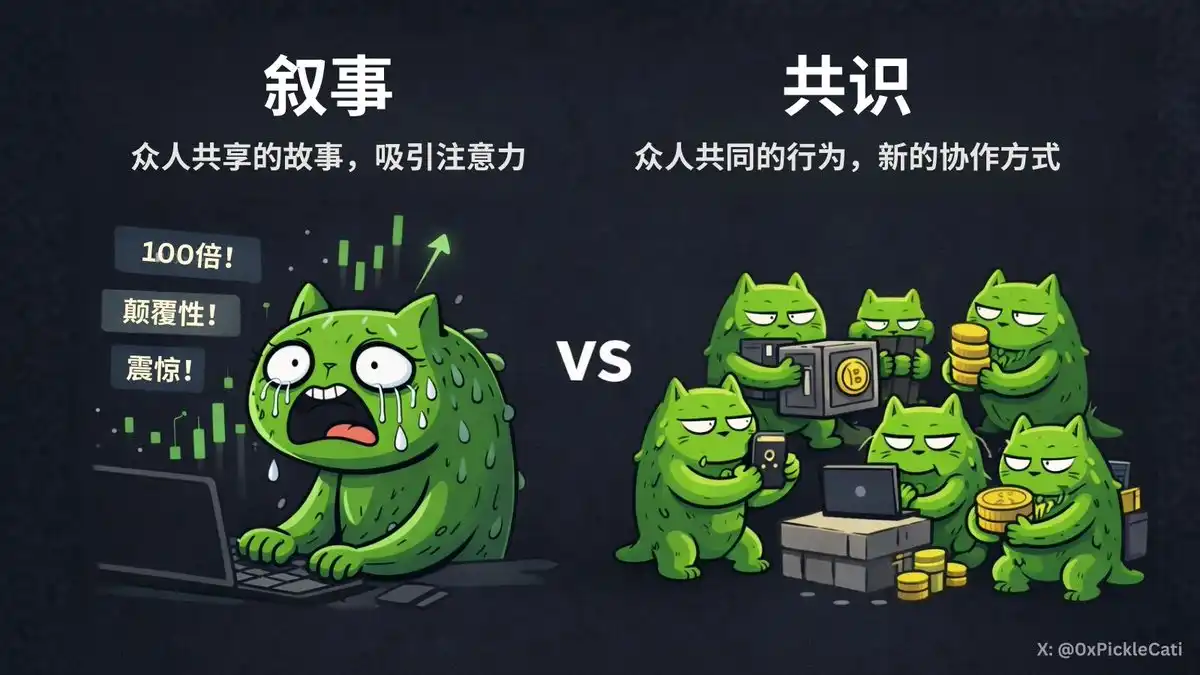
Narrative is a story shared by many.
Consensus is the collective behavior of many.
Narrative is about telling, consensus is about doing. Narrative attracts attention, consensus holds the crowd.
· Narrative without action → Short-term hype
· Action without narrative → Behind-the-scenes evolution
· When both are present → A true macro cycle begins
To understand the intricacies here, you need to take a longer view and approach it from a more expansive perspective.
At the core of all narratives is aggregation—and that is consensus.
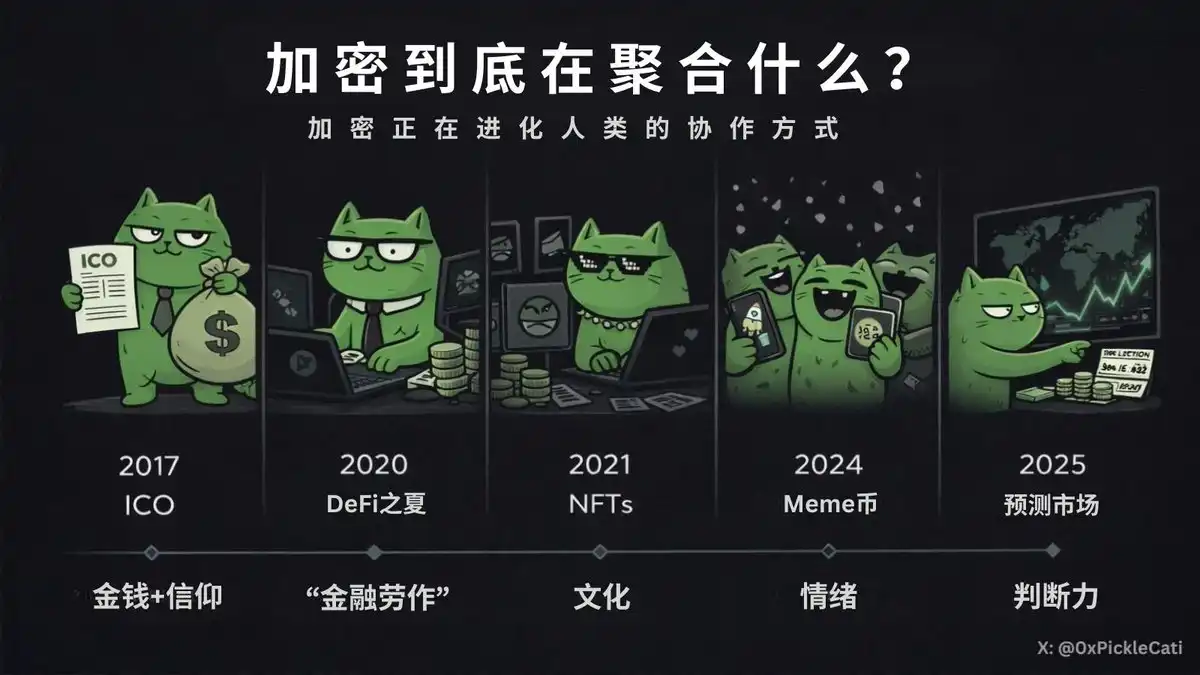
In 2017, the ICO was the ultimate "hype-building" technique of the time. It was essentially a coordination mechanism that brought together people who believed in the same story, pooling their funds and faith in one place.
It was basically saying, "I have a whitepaper and a dream, care to take a chance?"
Subsequent IDOs took this "hype-building" to decentralized exchanges, turning fundraising into a permissionless free-for-all "ritual."
Then came the DeFi summer of 2020, which aggregated "financial labor." We became the back-office workers of that never-sleeping bank: lending, borrowing, arbitraging, tirelessly seeking that 3000% APY, praying every night it wouldn't rug pull.
Next up was the 2021 NFT craze, aggregating not just capital, but people resonating with a shared culture, aesthetic, or idea. Everyone was asking, "Wait, why am I buying a picture?" "It's not just a picture, it's culture."
Everyone was looking for their "tribe," where your little picture is your passport, a digital "in-group" badge, granting you access to exclusive group chats and high-end gatherings.
By the time the 2024 Meme Coin era arrives, this trend is impossible to ignore. People are no longer concerned about the technology. What truly aggregates is emotion, identity, and insider jokes.
You're no longer buying a whitepaper. You're buying into that understanding nod and the reassurance that when the price drops 80%, you're not alone in the "community."
Up to now, we have witnessed the rise of prediction markets. They aggregate not just emotions anymore, but judgment, a common belief in the future. Moreover, these beliefs have truly materialized into borderless flows.
Take the U.S. presidential election, a global focal point. However, if you are not American, you don't have the right to vote. Yet, in a prediction market, even though you still can't vote, you can bet on your cognition. This is where the real shift becomes evident.
Cryptocurrency is no longer just about moving money around; it is about redistributing the power of "who calls the shots."
With each cycle, new dimensions are integrated into this grand system: money, faith, financial labor, culture, emotion, judgment, ____? What will be the next one?
You will find that every breakout in the crypto space fundamentally gathers people in a new way. Each phase brings not only more users but also a new reason for people to stay — that's the crux.
The focus has never been on the token itself; the token is just a topic that brings everyone together, allowing them to play together. What truly flows within this system is something that can carry an increasingly large-scale native consensus.
To put it plainly: what actually flows through that pipeline is not "money" at all. It's us, learning how to achieve larger and more complex consensus without a boss watching over us.
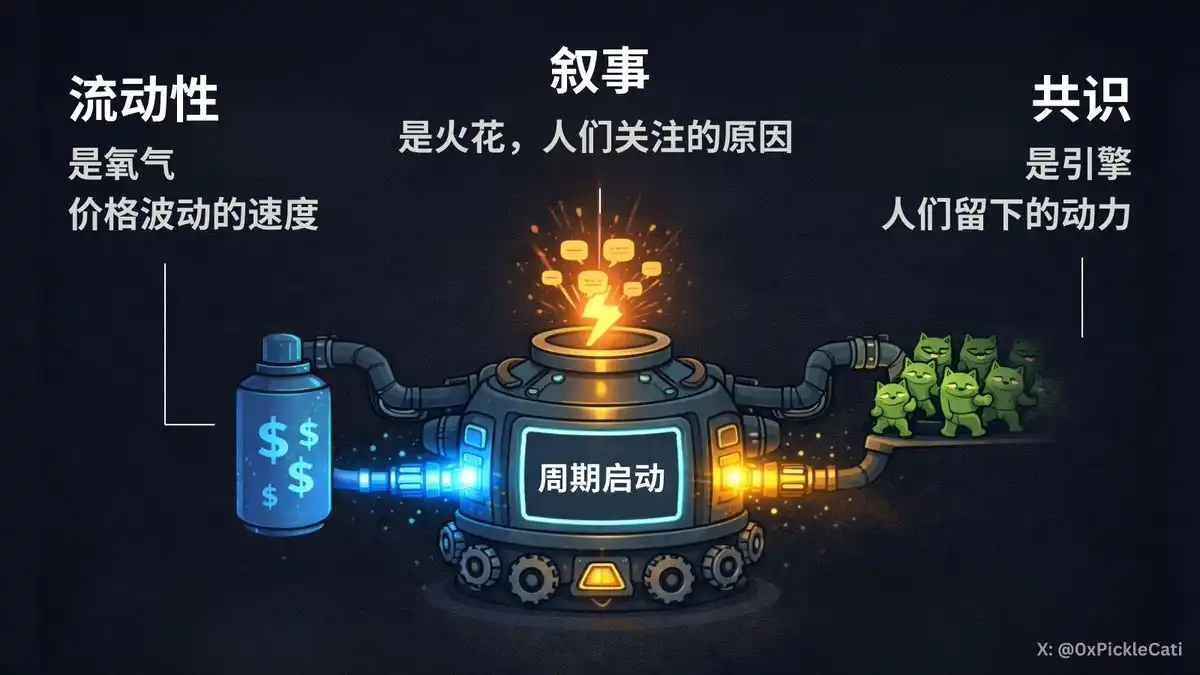
· Liquidity (macro risk appetite, USD liquidity, leverage capacity, etc.) acts as the oxygen injected into the market, determining how fast prices can move.
· Narrative (why people care, how it is interpreted, common language) attracts attention, determining how many people will look this way.
· Foundational consensus-building (common behavior, repeated actions, decentralized modes of cooperation) influences sustainability, determining who will truly remain when prices no longer reward,.
Liquidity may temporarily drive up prices, narrative may briefly ignite attention, but only new consensus-building can empower people with a collaborative action beyond mere buying and selling.
This is why many so-called crypto rallies often fail to become true rallies: they possess liquidity, weave compelling narratives, but people's actual consensus remains unchanged.
So, How to Distinguish "Dead Cat Bounce" from a True "Consensus Upgrade"?
Don't look at the price first—look at the behavior. A true consensus upgrade often shows similar signals over time, changing the way we, the folks, come together to "play."
It's always about behavior first, not price.
If you want to learn to distinguish it yourself, just looking at the ideology won't cut it; you have to go back and review crypto history, learn from it, and then maybe, just maybe, you'll be able to spot the patterns in the next consensus upgrade.
Below are 4 sections, including 3 expanded examples I've compiled, and finally, a basic checklist to help you identify whether the next consensus upgrade is on the horizon and how to determine if the narrative-driven behavior will truly stick.
Expanded Example 1: The Flourishing of ICOs in 2017 vs. Early Experimentation
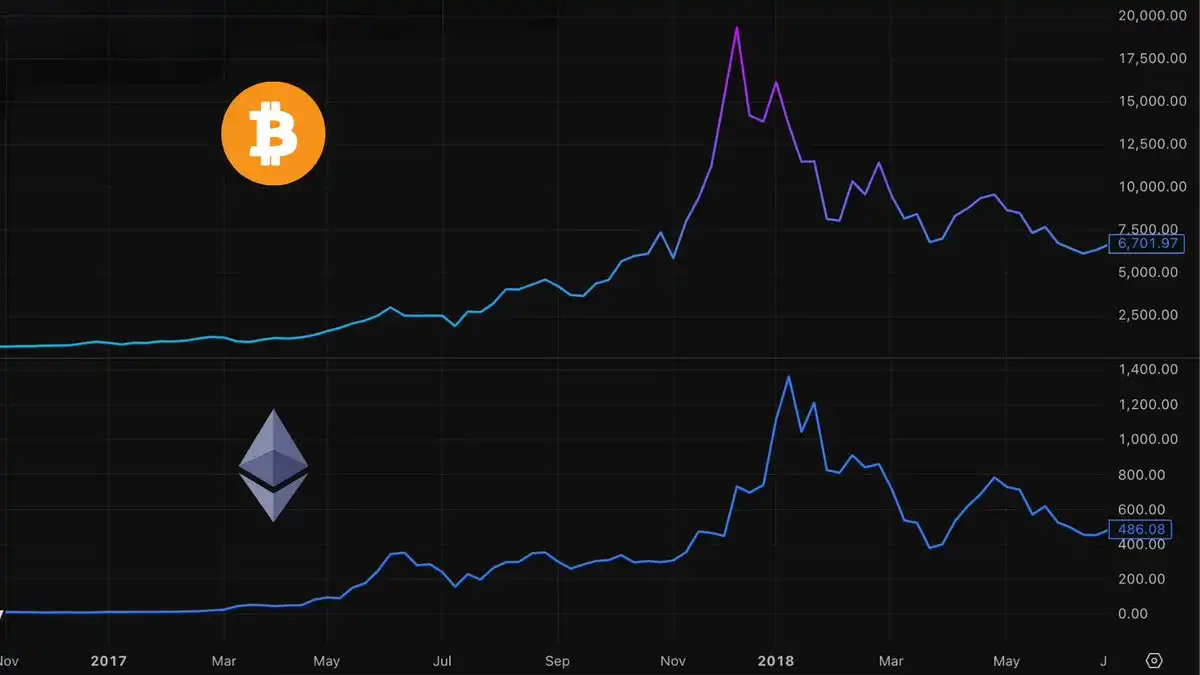
Prices of BTC and ETH during the ICO Boom (Mid-2017 to Mid-2018)
This was when the crypto world first figured out how to coordinate people and capital on a global scale. Billions flowed into the blockchain, not into mature products but into ideas.
Prior to this, there were, of course, early experiments. For example, Mastercoin in 2013, Ethereum's own crowdfunding in 2014, and others. These attempts were interesting but remained niche. They had not yet created a behavior that could pull everyone into the same orbit, a globally shared pattern of behavior.
In the early days of crypto, the gameplay was quite simple: mine, trade, hold, use it to buy things (like on the dark web).
Of course, there were also many "get-rich-quick" Ponzi schemes at that time, but we didn't have a defined standard way to let a group of strangers bet together on the same dream on the chain.
The DAO in 2016 was the true "enlightenment" moment for crypto. It proved that a group of strangers could pool funds based solely on code. But honestly... the tools were primitive back then, the tech was fragile, and it was ultimately hacked. A behavior pattern emerged, but it was not sustainable.
Then came 2017, and everything became "mass-producible."
Ethereum and the (now more mature) ERC-20 standard turned token issuance into a mass-production process. Suddenly, the "underlying logic" of participating in the crypto world underwent a revolution:
Funding activities are now fully on-chain, becoming the new normal. The whitepaper has become an "investment target." We swapped "Minimum Viable Product" for "Minimum Viable PDF." Telegram has directly turned into financial infrastructure.
This novel "trendy" behavior has brought millions of people in and fueled an epic bull market. But more importantly, it has permanently reshaped the DNA of the crypto world.
Even after the bubble burst, we never reverted to the "old ways." Anyone, anywhere can crowdfund for a protocol — a concept now deeply ingrained.
Yes, most ICOs back then were outright scams or Ponzi schemes. Such shadiness existed before 2017 and still persists in 2026. But the way people collaborate and allocate funds has been irreversibly altered, known as the "consensus upgrade."
Case Study 2: 2020 DeFi Summer vs. Fake Bull
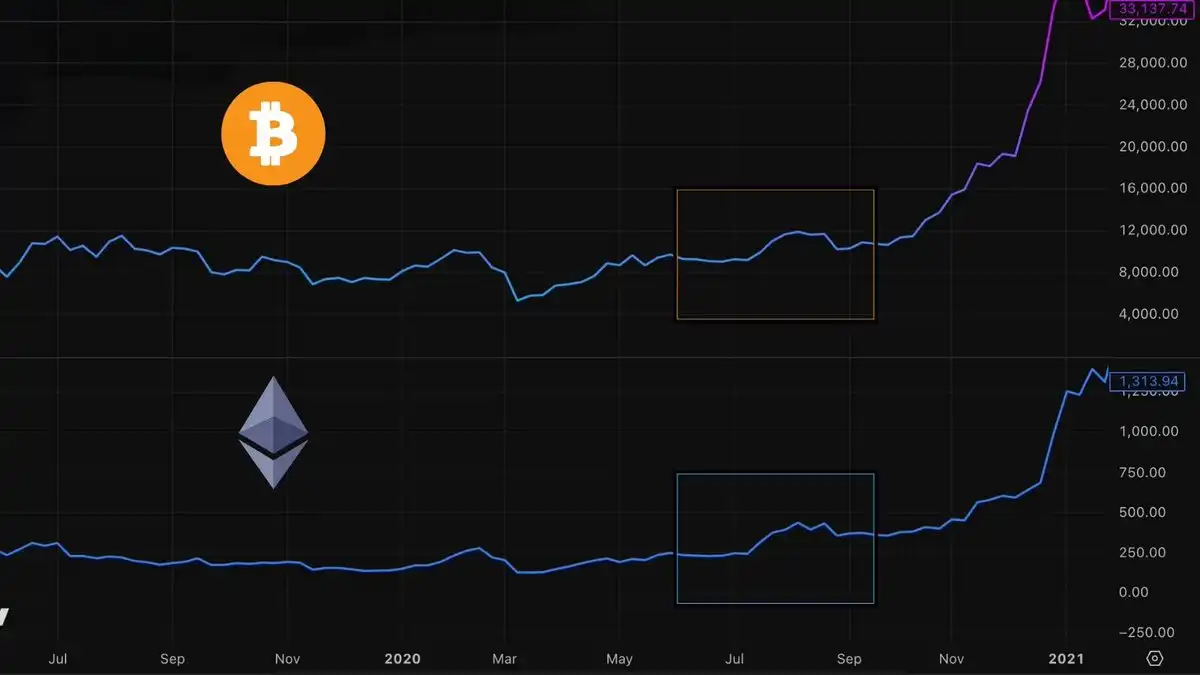
BTC and ETH prices during the DeFi Summer period (June 2020 - September 2020)
This era was also a genuine "consensus upgrade," as even without a rampant price surge, people began to use crypto assets as "financial tools." This was a stark contrast to the ICO era, where price spikes and user behavior fed off each other.
Prior to 2020, apart from the ICO frenzy, the crypto world's experience was essentially "buy, hold, trade, then pray." (Well, unless you were a miner... or engaging in some unspeakable activities.)
But now, we have gradually developed on-chain muscle memory, permanently transforming the industry. We learned:
· Lending: Deposit your crypto assets into a protocol to earn "rent."
· Collateralized Loans: Obtain purchasing power without selling your crypto assets, similar to taking out a mortgage against a house.
· Liquidity Mining: Weekly reallocation of funds to where the yields are highest, constantly shuffling funds.
· LP-ing: Place your chips on the table for others to trade and take a cut of the fees.
· Yield Farming: Collateralize, borrow, re-collateralize, re-borrow, stacking leverage and returns.
· Governance: Actively participate in voting on protocol rules, not just speculating on token prices.
During the DeFi Summer, even as ETH and BTC traded sideways, the whole ecosystem felt "alive," with activity not solely dependent on price pumps.
It broke free from the "pure casino" mindset as the crypto world, for the first time, felt like a productive financial system rather than just a speculative plaything.
DeFi projects like Compound ($COMP), Uniswap ($UNI), Yearn Finance ($YFI), Aave ($AAVE), Curve ($CRV), Synthetix ($SNX), and MakerDAO ($MKR/$DAI) became the "banks of the internet."
Even wild experiments like SushiSwap were significant. Its "vampire attack" directly drained liquidity from Uniswap, proving that incentive mechanisms could indeed marshal funds like commanding an army.
Then came the subsequent false revival, a fake bull market, a "dead cat bounce."
For instance, those food-named copycat farms—Pasta, Spaghetti, Kimchi. They didn't bring any new coordination behaviors, and most vanished almost as quickly as they appeared.
By 2021, DeFi remained vibrant (projects like dYdX, PancakeSwap seeing rapid growth), but the era of unchecked expansion had ended, with the crowd having already shifted focus to the next shiny narrative (NFTs).
Looking back from today (2026), you'd find that 2020 was the true birth year of the "on-chain economy." Nearly everything we’re doing now (from airdropping tokens, chasing TVL, to Layer 2 incentive schemes, etc.) follows the same playbook from 2020. Post-DeFi Summer, if a new product couldn’t offer users a substantial reason to "stay on-chain," it struggled to make a splash.
Incentives indeed drove short-term activity, but if these rewards didn't establish a lasting community habit (a new paradigm), then when the subsidies ran dry, the project quickly turned into a ghost town.
Case Study 3: NFT Era Resetting Social Norms
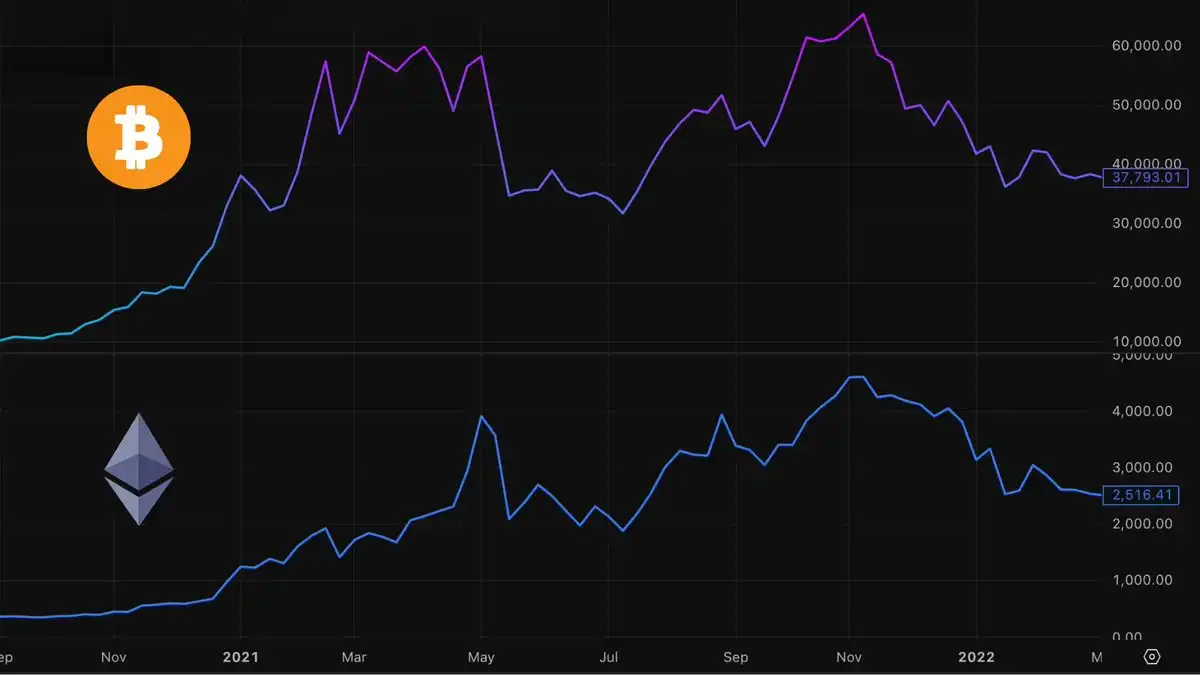
The BTC and ETH prices during the NFT frenzy period (early 2021 - mid-2022). 2021 was a "perfect storm": global monetary expansion with macro liquidity environment, institutional entry, NFT boom, DeFi growth, blockchain wars, all resonating at the same time propelling the market to its peak. This case study will focus on NFTs—one of the most impactful core catalysts during this period.
If the DeFi Summer was the geek age where everyone immersed themselves in studying liquidity curves, then 2021 was the year the crypto world finally gained its "personality." We are no longer purely engaging in a yield-chasing rat race, but instead, we are starting to seek ambiance, identity, and belonging.
For the first time, digital items are no longer just copy-and-pasteable "things." They now have verifiable provenance. You are not just "buying a piece of art"; you are acquiring a digital receipt that declares "you are the original owner," and the entire blockchain serves as your witness.
This has completely rewritten the social script. People are no longer trying to outcompute each other; instead, they are showcasing their identities.
Today, avatars have become passports. Owning a CryptoPunk or a Bored Ape Yacht Club (BAYC) has become a digital "tribal membership proof." Your avatar is no longer just your cat; it's your ticket to the "global elite circle."
With this shift, new barriers have emerged. Your wallet has become your membership card. If you don't hold the required assets, you can't access those private Discord channels, attend exclusive events, or receive special airdrops.
Then there's IP ownership. BAYC granted commercial rights to holders, leading to a successful "ownership revolution" that broke down barriers. Suddenly, strangers started collaborating around their apes, developing derivative merchandise, music, and streetwear.
Most importantly, it attracted a significant influx of "outsiders." Artists, gamers, and creators who don't care about APY or liquidation mechanisms suddenly found a reason to own a wallet.
Crypto is no longer just about finance; it has become the internet-native cultural layer.
From the dimension of consensus habits:
· Instead of liquidity pools, we have collectible series.
· Instead of total value locked, we have floor price and social capital.
· Instead of yield, we have a sense of belonging.
Of course, along with this, came the "last hurrah"...
First, we witnessed the wave of "imitators."
Once the Bored Ape model proved successful, imitators swarmed in. They had stories but no soul. Countless look-alike collectible series emerged, essentially being "Bored Ape but the protagonist is a hamster," offering a fairy-tale roadmap. Most of them turned out to be vaporware, or rather, priced air.
Next is the "Brushing" Craze.
Platforms like LooksRare and X2Y2 are trying to directly apply the logic of "DeFi Yield Farming" to NFTs, creating so-called "Transaction Mining." This has attracted a group of "scientists" engaging in wash trading, self-buying and selling, and other manipulative tactics. The reported trading volume is astounding, making it seem like there is market activity, but in reality, it's all bots wash trading to take advantage of incentives, driving genuine participants away.
Lastly, we have the "Celebrity Money Grab" frenzy.
Nearly every A-list and B-list celebrity has released a collection because their agents told them it was the "new cash cow." Due to a lack of real consensus or community backing, these projects disappear faster than TikTok trends.
So, what is the lesson here?
Similar to the ICO and DeFi summer era, the NFT bubble has burst. However, the behavioral residue of this era is permanent. It lasted long enough to fundamentally shift the industry permanently.
Crypto is no longer just a digital bank; it has become a native internet cultural layer. We no longer ask, "Why own a JPEG?" but instead, start to understand the implications behind this behavior.
For example:
· Brands are pivoting to "Digital Passports" and "Community-as-a-Service" (CaaS)
· In this AI-saturated age, provenance has become the standard for digital authenticity
· Community-first launch models are now the playbook for every new consumer startup
The habit of collaboration persists, and we have learned to embrace digital ownership, never reverting to the era of merely being a "user."
By now, everyone has read one-third of this article. I have provided three detailed examples above to demonstrate how to distinguish between false consensus upgrades ("froth") and real upgrades.
Needless to say, I could go on for hundreds of pages analyzing cases of meme coins and prediction markets. However, it's better to teach you how to fish than to give you a fish, so I leave this part of the analysis for you to reflect on.
Additionally, studying failed narratives, failed "consensus upgrades" is also worthwhile, such as the 2021-2022 Metaverse 1.0, 2023-2024 SocialFi 1.0, etc. Although only leaving behind the debris of a "hype cycle" without immediately reshaping behavior patterns, it does not mean their end. Genuine "consensus upgrades" rarely happen overnight. Just as Mastercoin pioneered the ICO concept in 2013 but remained obscure for several years until it truly erupted in 2017 and significantly altered industry behavior. Early failures are the stepping stones of understanding.
Don't turn a blind eye just because it has "cooled down." The next "consensus upgrade" may be something completely new, but it could also be a revival of a previously failed "old thing" in "some new form." When such a thing happens, this awareness will be your great opportunity.
The best way to hone your "investment insight" is to personally put in the effort to research, analyze, and verify.
Ask yourself whether you truly understand what the masses are doing. If you cannot observe changes in their behavior, then you will fail to notice the tide's turn.
Before concluding this first part, I have also prepared a basic checklist to identify whether the next consensus upgrade is on the horizon. I call it the "Retail Investor Self-Protection 5 Questions":
1. Are there "outsiders" entering?
A group of participants has emerged whose main purpose is not to make money. The people you see are no longer just here for speculation. They are creators, builders, or those seeking identity. If the room is filled only with traders, then that room is essentially empty.
(If you are a trader and are reading this—well, I am a trader too. You and I both understand that to sustain this game, PvP alone is not enough.)
2. Can it pass the test of "incentive decay"?
Observe what happens when rewards dry up or prices stagnate. If people stick around, it indicates a habit has been formed. If they vanish as soon as the "free lunch" ends, then you are facing nothing more than a pile of air with a price tag.
3. Are they choosing "daily habits" over "holding"?
Beginners only look at candlestick charts, while experts observe what people do every day. If they have built daily habits around this system, then it is a permanent upgrade.
4. Is there a phenomenon of "behavior > experience"?
True transformation occurs when the tool is still rudimentary, decentralized, and inefficient. If people are willing to endure a poor user interface to participate, then that behavior is "effective." By the time the application becomes smooth and refined, you will be too late.
5. (Most important point!!) Is there "love-powered"?
The framework consists of three parts: underlying logic of the encryption cycle + encryption knowledge structure + value anchoring system.
The first part has been covered. Now let's talk about the second part, which is "What exactly should I learn and how should I learn it?"
A thousand people, a thousand Hamlets; there is no such thing as an "absolute correct."
So below, I have included two personal recommendations.
Recommendation 1: Become a Sharp-eyed Conan on the Chain
Below is a list of essential skills that you can learn 100% for free online without the need for any paid courses or guidance from "gurus." The only thing you need to invest is your determination and time:
First, you need to increase your ability to identify the probability of "organized sniper events"; otherwise, you will never escape the fate of becoming a bag holder. Learn to adeptly review wallet history, position distribution, bundled transactions, fund sources and flows, and sniff out any on-chain shadiness.
Second, understand market mechanics, try to assess potential supply shocks, and avoid violent liquidation needles. You need to know where to look and understand: order book depth, spread, exchange net inflows/outflows, token unlock schedules, Mcap/TVL ratio, open interest, funding rates, macro fund flows, and more.
Third, if you don't want to be skinned alive in the "dark forest," at the very least, you should understand how MEV works; otherwise, one day you'll be "sandwich attacked" without even knowing it (my painful lesson).
If you want to delve deeper into learning and move faster than those around you, you also need to learn to identify false trades/volume washes, arbitrage washes, pitfalls of "low circulation/high FDV," etc. If you're into airdrop farming, you need to understand what an anti-whale mechanism is.
Another important aspect is that you should automate some information flow-related work, such as various data anomaly alerts, news filtering, narrative screening, noise reduction, etc. With vibe coding now available, the barriers to entry for all of this have been lowered, and anyone can learn.
As of today in 2026, almost everyone I know (including those with no CS background) is building their own tools to filter out noise and find opportunities. If you are still relying solely on "manual information search," that's probably why you are always a step behind.
If you don't invest the determination, time, and effort to lay this foundation, you are choosing the "hard mode." On a small scale, it means you are always a step behind or missing out on many opportunities; on a larger scale, it means being scammed, rug pulled, drained until you finally breach your defenses to start learning (or just accepting defeat and exiting the ecosystem).
I know because I've been through it all myself, stepping on all kinds of landmines, such as: being scammed by strangers and "friends," falling for various Ponzi schemes, receiving all sorts of insider tips, backdoor deals, hot wallet hacks, over-the-counter trading scams, and even being a victim of social engineering. Oh, and that's not even counting the 3 times I got liquidated.
In addition to these "semi-technical" experiences, I've also compiled some anti-scam tips that you can directly apply at the "social Conan level."
Let's start with the basics: Has the project's official account changed its name more than 10 times? Did its previous aliases have any connection to some trash projects that exit scammed? There are many tools to check an account's renaming history, so use them. Before investing, verify the existence of the team, check if the founders and core members have Twitter, LinkedIn, and GitHub accounts.
If they claim to have worked at a well-known company or graduated from a prestigious school, you need to verify that information. After all, fake Stanford or Berkeley degrees, as well as fictitious past at Meta, Google, or Morgan Stanley, are much more common than people imagine.
For those who claim "a certain VC has invested," "incubated by...," or "partnered with...," the same applies. Some "prominent investors" may never have actually put in any money. Some partners may only be indirect advisors but allow the project to use their logo. This kind of thing happens far more often than you'd expect — I've been a victim of it myself.
In today's AI-dominated world, fake engagement is becoming more and more frequent and increasingly difficult to discern. Can you tell if the ratio of followers to engagement is abnormal? Can you recognize bot responses on Discord, Telegram, and X, or AI-generated small talk?
If you couldn't do any of the above before, at least now you know where to start practicing.
Tip 2: Engage in the World to Build Good Karma

In essence, it all comes down to networking. Just like in the "finance world" or "tech world," your connections are your greatest asset.
I could write something like "50 Things to Look at When Researching a Project," but that would ultimately be a bunch of worthless nonsense. Why do I say that?
Because the real "core information" or alpha, when it still has the advantage of insider information, will never be publicly shared.
By the time a project is being hyped up by reputable voices in your information sphere, you might still make money, but that's no longer the "1000x life-changing gains" you came into the crypto world chasing; that "best entry" window has long been welded shut.
This is why in each cycle, most newcomers full of anticipation looking to strike gold end up becoming liquidity and then exiting the scene. Because the information they receive is "lag on lag" information filtered through layer after layer of private circles.
So, if you don't yet have a reliable "insider line" (or lines), then position management is your only safety net, so be sure to allocate most of your crypto assets to long-term targets.
Long-term targets have lower information asymmetry requirements and don't have the nerve-wracking time pressure of short-term trading, allowing you breathing room to research public data. You don't need to strive to be the first to discover a pattern, as long as a project can survive even just 1.5 cycles, you are likely to catch several waves of profit no matter when you enter.
At the same time, your long-term goal is to stop being a bystander and start being a participant. To do this, you need to have chips in the game. Apart from your family, the world aligns based on interests. Those you admire will not exchange information with someone who cannot provide equivalent value.
You need to become "someone of value" or possess "something of value" to exchange. Whether it's expertise, on-the-ground research, funds, or connections, no one knows everything, and that's why you can seize this opportunity.
The best approach is to sincerely and enthusiastically dive into an ecosystem: first, find a job in a project in your favored field. Whether you are a developer, in operations, or in business development, "getting your foot in the door." Working is the fastest way to build reputation and connect with the target audience.
Of course, merely having an entry-level web3 job will not immediately give you everything you want, but it is a good start.
"But what if I lack experience and can't find a reliable crypto job?"
The good news is: today, in 2026, the crypto industry is still not a "job market desert" like traditional finance or big tech firms, you don't need an elite degree and two stacks of elite internships, going through multiple rounds of interviews to get a job.
In this industry, your on-chain experience is your resume. If you have already dedicated a lot of time to experimenting, to "going all in," to actually doing things, you actually have more relevant experience than most career switchers from the corporate world.
Don't want a job? Then you still have two options (which still require significant effort): if you are super smart and lucky enough to achieve great results on-chain and are not ready to retire, you can "link" that wallet address to your Twitter account, without even needing to actively engage in social interaction, "like-minded people" will come to you. Build a personal brand on X, but be aware of the challenges and hardships of this process as this is not a universally applicable recommendation.
There's no such thing as a free lunch, nor a reliable shortcut. Giving 100% effort may not always lead to 100% success, but giving 0% effort will surely lead to 100% failure (unless your name is Barron Trump).
Based on personal experience, those who can withstand the trough periods without "skin in the game" possess the following two traits:
1. They all hold a strong conviction independent of price.
2. They have built a multidimensional value anchoring system.
First and foremost, we must clarify that Conviction is not the same as stubbornness or blind faith resulting from following "so-and-so guru."
It is not a "I will never sell no matter what in the future."
True conviction is structural. And structural itself entails flexibility. You can have immense conviction while taking profits in parts or adjusting position size.
The key difference is whether you can always, and consistently, come back to this table.
You do not leave when the music stops. The reason you came here in the first place was never for those green and red candles; it was for that underlying "why."
People who can stand tall through cycles never ask, "Hey, big shots, is it going up or down today?" They ask, "Even if the price continues to deviate significantly from my view in the coming years, does the logic of this thing still hold up?
This difference in mindset leads to a world of difference in outcomes.
The "get rich quick" mentality will not only empty your wallet. It will corrode your conviction and dismantle your belief system. And rebuilding belief is much more challenging than rebuilding capital.
So, what exactly is their "multidimensional value system"? And how can you build your own?
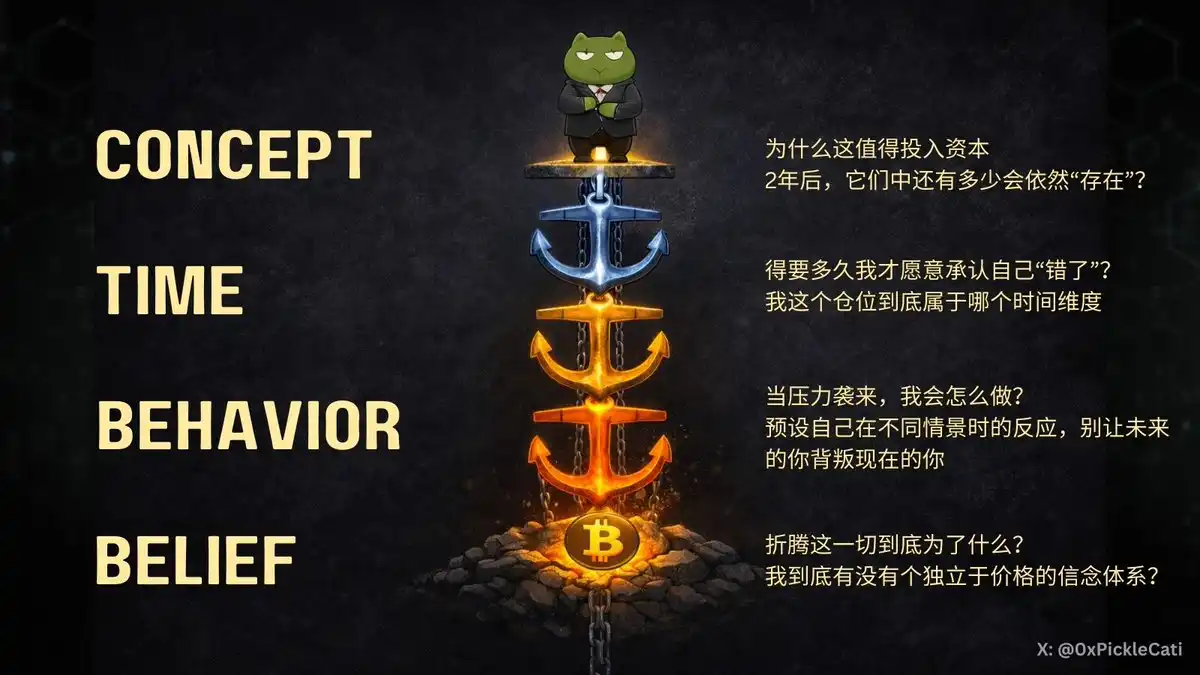
Layer One: Concept Anchoring
Stop staring at the dancing candles; start focusing on core principles. Ask yourself: What makes this thing worth holding, even if its price has fallen through the floor?
Think back to the last 10 tokens you traded. Now, fast forward two years. Ask yourself: How many of them will still "exist"? And how many will truly matter?
If, when you examine an asset, you cannot explain why it is worth investing long-term without mentioning "community" or "sending the bullish rocket to the moon," then what you possess is not belief. What you have is just a position.
Layer Two: Time Dimension
The behavior logic of the vast majority of people is chaotic, and their decisions are easily manipulated by herd sentiment, as in the following example:
· Today, they FOMO buy into 4 different meme coins that are said to definitely go to the moon on some top-secret Telegram channel
· Tomorrow, they bet on some projects on Polymarket because they saw a whale on Twitter shouting the wealth password
· Suddenly, they disappear for a while
· Then one day, they suddenly DM you, inquiring about a project that is about to get listed
· But somehow, they end up buying a privacy-focused project without even knowing what this sector is used for
· A few days later, they shout in the group chat "bulls are back" and "big cake accumulation completed, all in!" mindlessly go long on Bitcoin just because some news headline says "it will reach $200,000 next month"
Hey, this is not a strategy; this is completely handing your money over to someone else, maybe even losing the Holy Grail would have had a higher success rate than this.
Of course, I have seen people make money this way, but I have never seen these people still holding onto that money two months later. All they are left with is a glorious past and a +99999% psychological shadow.
The real problem with these people is that they are easily distracted by noise, losing their judgment, while also opening up multiple "battlefields" beyond their capabilities and cognitive scope.
Short-term speculation, mid-term positioning, and long-term investment each require completely different behavior patterns. Those who can span cycles know clearly which time dimension each of their positions belongs to and will never let emotions cross dimensions.
They will not deny long-term beliefs due to short-term price noise, nor will they use long-term narratives to justify their impulsive short-term actions.
If you are trying to transition from day trading to swing trading, here are some common "self-destruct" mistakes:
1. You tell yourself that you are now a "long-term investor," but 80% of your time is still spent chasing one-time news headlines.
2. You see a minuscule 3% dip that should have been well within your risk tolerance, yet you still panic.
3. Most importantly, you are still approaching position sizing and risk assessment with a "get rich quick" mindset, causing you to once again sell the trend short.
Time anchoring, in this sense, involves forcing yourself to answer an extremely uncomfortable question before clicking "Buy" to break this vicious cycle: "How long does it take for me to admit I am 'wrong'?"
Layer Three: Behavioral
You can't just claim to have "faith" in yourself when things are going well; the real test is when your account is bleeding red, and the voices in your head are screaming at you to "do something."
You need to establish a framework of self-inquiry to predict yourself, not the market.
Before entering each trade, you need to run through the following checklist to ensure that your future self doesn't trip up your present self:
· Do I have a plan in place for when the price drops by x%? Am I clear on whether to hold, scale out, or exit?
· Am I a gut-driven decision-maker? During a pullback, am I objectively reassessing my investment thesis, or am I subconsciously seeking reasons to panic sell?
· Am I frequently changing my target levels? When the price goes up by x%, do I get greedy at the sign of momentum and keep raising my take-profit target?
· Can I explain the reason for "HODLing" without using the term "hype"? Besides emotions and hype, can I clearly articulate the reasons behind holding?
· Is this "conviction" or "sunk cost bias"? If a position stagnates longer than expected, am I holding because the investment thesis still holds, or because I can't admit I was wrong?
· How long is my "time to admit fault" after a rule breach? When I break one of my trading rules, do I immediately notice and take action, or do I wait until the account is deep in the red?
· Do I easily fall into "revenge trading"? After incurring a loss, do I immediately feel the need to get back in the game to make up for it?
The purpose of these questions is not to predict candlestick patterns but to outline whether your future self will betray your present self when facing immense psychological pressure.
The so-called "Behavioral Anchor" is essentially pre-processing stress. Setting a course of action while calm is meant to prevent you from acting impulsively in moments of despair.
After all, if you haven't decided on a trading plan in advance, then ultimately, the trade will start "playing" you.
Layer Four: Belief Dimension
Have you ever noticed that the quickest-disappearing people are often those who were the loudest during a bull market:
"Now is the last chance to buy XX before it moons.""After this time, you won't see Bitcoin below $100,000 again!""Trust me, go all-in, not investing in XX means you're fighting against the future!"
As the price reverses, these people one by one vanish into thin air, as if their "belief" never existed.
This "get rich quick" mentality will not only ruin your investment portfolio through frequent trading but also erode your belief system. And a shattered belief system is much harder to rebuild than a bank account.
"Fast money always brings sad overreactions. It's nature, just like African animals feeding on corpses." — Charlie Munger
Sadly, most people exhaust their capital at the peak of the party, and when the real opportunity (the actual bear market) finally arrives, they have no more "bullets" left.
It is truly a cruel joke: the mindset that brought people into the crypto world, the desire for overnight riches, is precisely what kills their chance of wealth.
Most people don't even realize what they've lost until years later when Bitcoin once again skyrockets, and they slap their thigh, saying, "Why couldn't I hold on back then? I should have hodled."
That's why belief is the most critical layer: it is a creed that takes years to form.
Try this: If someone intensely questions your position right now, can you calmly defend it? Can you face sharp questions squarely instead of avoiding them?
Your belief should be extremely subjective and unique to you.
For some, it's the Cypherpunk spirit: a complete rebellion against control and centralization. For them, crypto is not just an investment but a dawn of exit from a broken system.
For some, it is another iteration of monetary history: they see the cyclical devaluation of fiat currency and financial pillaging, recognizing that crypto is the only hedge against a traditional system that crumbles in a similar manner every century.
For some believers, it is about sovereignty, neutrality, or the right to survive.
You must find your own 'why' rather than just renting someone else's Big V idea. I cannot tell you what your unique belief should be, but I can share mine.
Last year, when I only had 2000 followers and no one cared what I had to say, I wrote a post answering a simple question: why, after all the crashes and resets, do I still buy Bitcoin. I called it: 'The Fourth Covenant between God and Humanity'.
The first three covenants in human history all had a fatal flaw: they were never meant for everyone.
The first was the 'Old Testament', bound by bloodlines where belonging was predetermined before your birth. If you were not part of the chosen bloodline, you were never eligible.
The second was the 'New Testament', speaking of love and redemption for all, but history revealed the truth the words tried to cover up: if you were a poor Asian farmer in the 17th century, you never had a chance to set foot in a cathedral, the empire would block you at the door, with race, power, and status deciding who was worthy of redemption.
The third was the 'Declaration of Independence', the birth of the modern world, promising liberty, equality, and opportunity, but under the condition that you were born in the right land, held the right passport, and were in the right system.
Of course, in a sense, 'freedom of movement' exists, but for most, the cost is too high, the odds too slim, these rules seem never written for the common folk.
Most never even reach the starting line; they spend a lifetime proving they are 'worthy', with money, education, obedience, or luck, they beg the system layer by layer to let them 'belong'.
And now, the fourth covenant has arrived: 'Bitcoin'
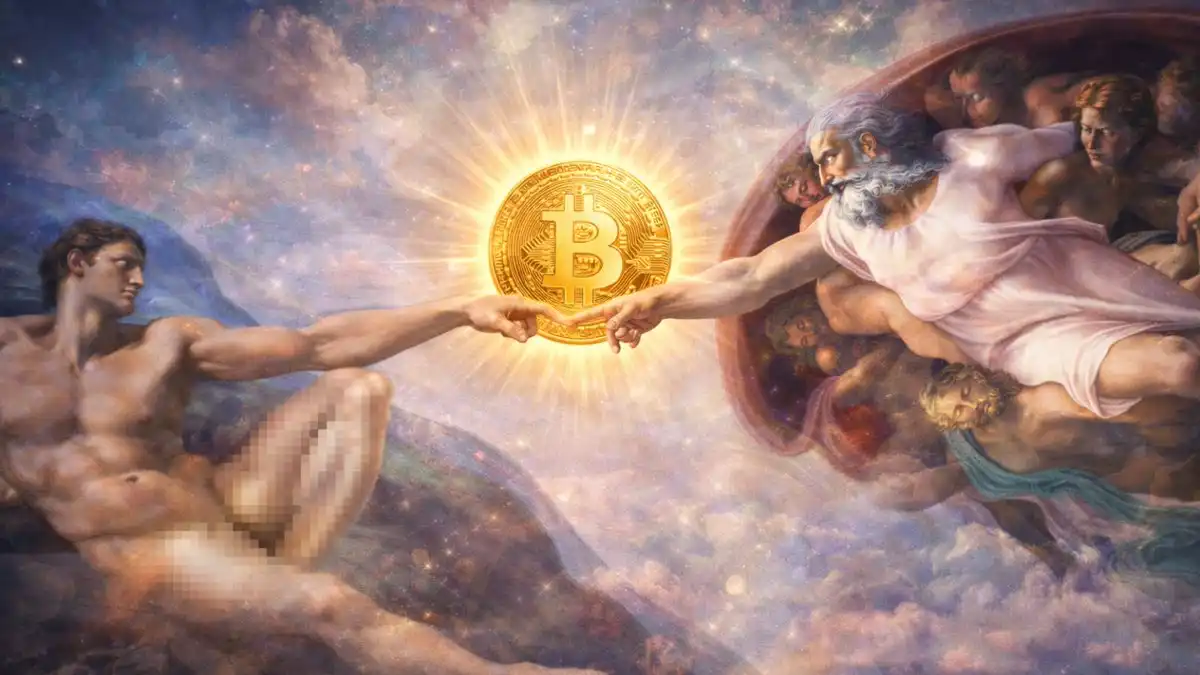
This is the first system in human history that does not ask who you are.
It does not care about your race. It does not care about your nationality. It does not care what language you speak or where you were born.
Here there is no priest, no government, no borders, and no permission needed, just you and a private key.
You don't need to be chosen, you don't need connections, you don't need approval, you don't need to prove yourself to Bitcoin. You either get it, or you don't.
This system doesn't promise you comfort, safety, or guaranteed success; it only offers something humanity has never truly had before: simultaneously, everyone facing the same rules, with the same access.
For me, this is not an investment thesis, not a transaction, not a gamble. This belief is the sole reason I can sit through the market's ebbs and flows, endure years of silence, doubt, ridicule, and despair, and still hold.
Then congratulations, you now hold the blueprint of the "Survivor".
You've learned how to identify "hard fork upgrades," you've learned how to use that "investigator toolkit" to improve your early entry rate, and you also know what elements are needed to build faith and maintain determination.
However, I still have to be honest with you: The Tao that can be told is not the eternal Tao. No matter how advanced your tools are, if you can't control the person using the tools, it will always be a case of strong brick, flying.
All that I'm sharing comes from the countless mistakes, lessons, and indelible scars I've experienced in the market's ebbs and flows over 13 years. The fragmented reflective notes I write stem from late-night conversations with friends who have similarly survived the battlefield.
Looking through my messy notes, I realize that the material at my disposal could easily fill a book, with each chapter able to delve into crypto from different angles.
However, these lessons cannot turn you into a master overnight, just as "get-rich-quick thinking" cannot truly make you wealthy.
I have witnessed the fall of those "geniuses" in every cycle... Losing money not because they weren't smart or made a wrong move, but because they all had a "mindset of quick gains," coupled with an arrogant yet "fragile upon touch" ego. Meanwhile, those still profitable in 2026 and those who preserved their gains and exited all share one cognition: The token itself has never been the focus.
The key point is the sovereign system we are building and the personal discipline it requires.
Crypto is the harshest, most honest teacher on this planet: it will bring out the devil inside you and pinpoint your weakest traits—be it greed, impatience, or laziness. And then charge you a hefty "tuition fee" for it. Mine, I think, I have already paid in full, haha. My only hope is that this article can spare you from paying as much as I did.
If you really read through all of this (instead of letting AI summarize it for you), then I truly believe you have the potential to become one of us, survivors of multiple cycles, the kind of person who can truly master the skill set I outlined in part two.
I sincerely hope you can become one of my new "old friends," able to grow with me, in the next cycle, the cycle after that, and countless cycles in the future, comrades growing together, witnessing Bitcoin completely reshape the world.
And to my long-time readers: thank you. It is your kindness and support that have led me to decide to recall my past and share these experiences.
The crypto world may often be frustrating, but it is still worth loving, still worth building for.
So, I'll take the first step, and I'll see you at the next "consensus upgrade."
Recommended
The Wall Street Journal: How is AI Trading Stealing the Limelight from Cryptocurrency?
Aug 15, 14:00
Tencent Still Has a Dream
Aug 15, 11:27
To Catch North Korean Hackers, They Set Up a Fake Project
Aug 15, 10:00
From Litigation to Settlement: Positive Signal Released by HTX's Negotiation with FCA
Aug 14, 19:32
11,742 Shipping Addresses Exposed Alongside Trezor Orders
Aug 14, 19:01
Founder Interview: FOMO Creator Explains How They Added 30,000 Users in One Day and Became One of the Fastest-Growing Crypto Apps
Aug 14, 18:37