How to Capture the Potential of the Pump.fun Hackathon Opportunity?
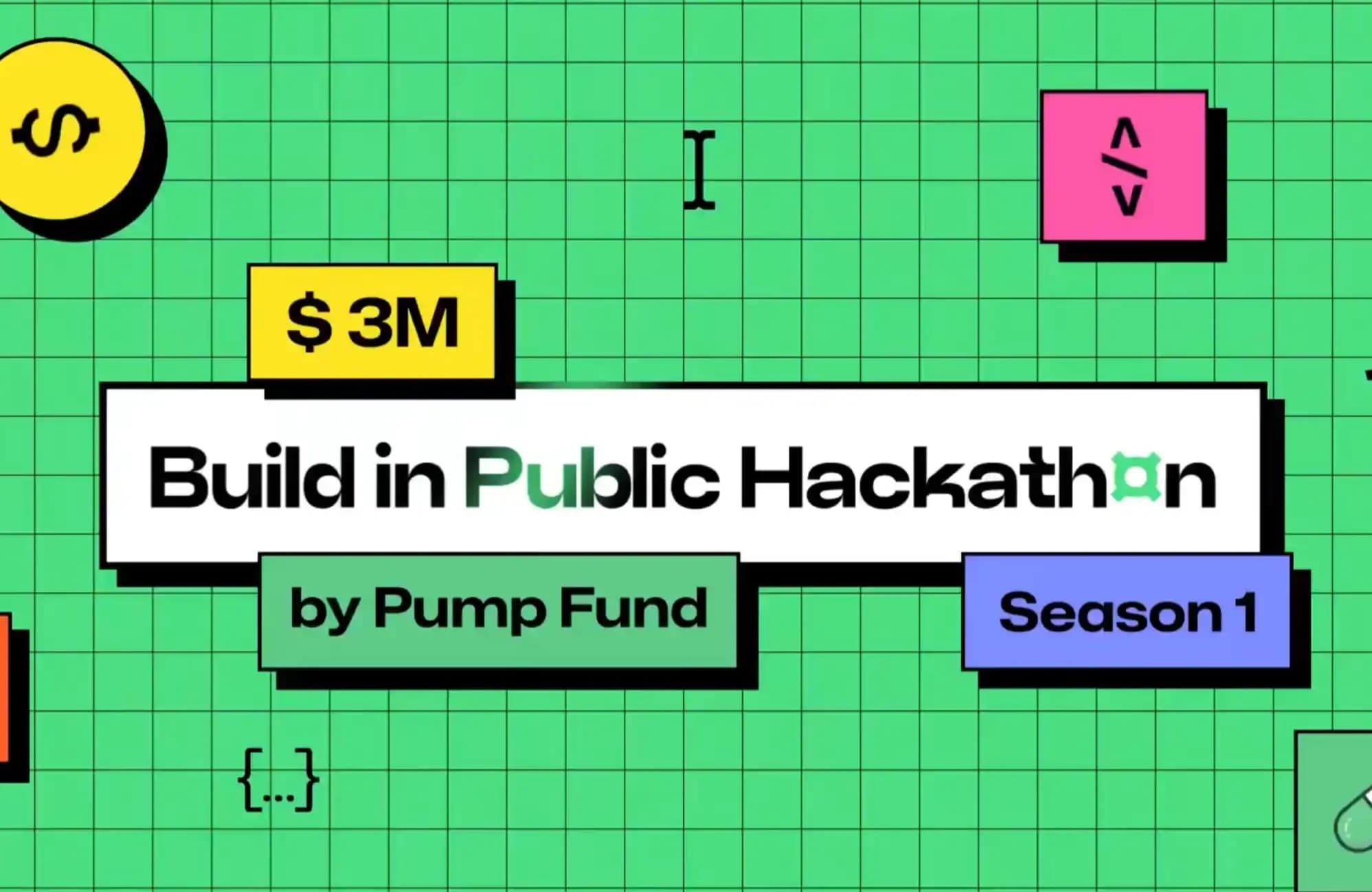
On January 20, pump.fun officially announced a $3 million bounty pool hackathon and also launched the Pump Fund ecosystem startup fund.
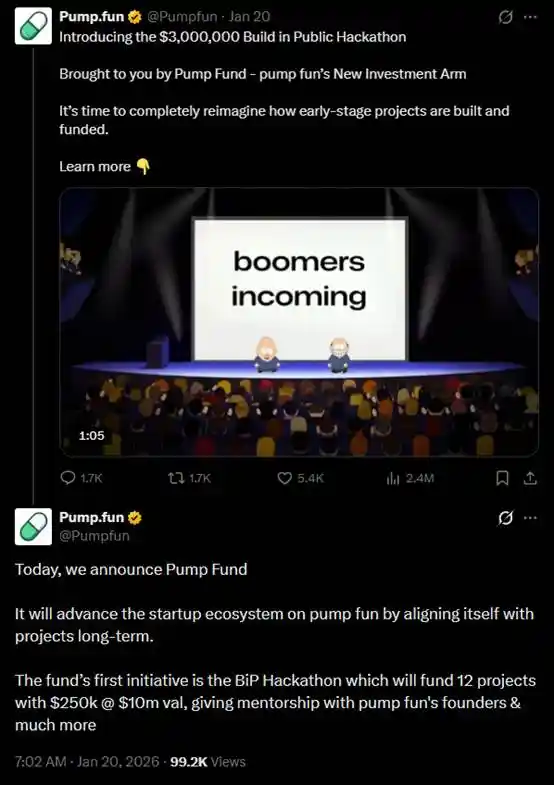
This is a very different kind of hackathon. There are no judges, no theme, and there will be 12 winners, with each winner receiving $250,000. Due to these special rules, before observing the projects, we need to understand the logic behind this hackathon.
According to pump.fun, this hackathon abandons the traditional model of pleasing judges or investors in order to win funding and instead lets the market be the judge.
In short, everyone is encouraged to launch a token, and then based on their own abilities, whoever performs well in the market is more likely to win.
In addition to the token having to be deployed before the hackathon application deadline, there are almost only two restrictions throughout the hackathon. First, the team must hold at least 10% of the token's supply, with teams holding 20% - 50% of the token's supply being given priority. Second, the team must have a "public" development, actively share their latest progress with the community, and teams that conduct at least 5 live broadcasts per week on pump.fun will be given priority.
The winning token will be acquired by pump.fun at a $10 million valuation for $250,000 worth of tokens and will continue to provide consulting and incubation support.
It's hard not to recall last August when, faced with a fierce challenge from bonk.fun, pump.fun launched the GFF (Glass Full Foundation) and spent around $1.7 million to purchase some well-performing meme coins from their ecosystem.
In this hackathon, pump.fun is essentially still "buying coins," but in a more openly transparent and structured manner, and the theme is no longer limited to purely meme coins. Through the interpretation of the rules above, we can speculate on pump.fun's objectives and understanding of the current market:
- Wanting to create 12 targets with a market cap of at least $10 million each
- Without good "price control," there won't be new "golden dogs." If it's a good bundle, it's called supply control for long-term development. If it's bad price control, it's called bundling
- Still want to bring their own live streaming feature
- The theme of being a pure meme coin is too narrow, to earn more revenue, more narrative is needed
At the same time, they learned from the lessons of the previous GFF. GFF's promotion had only one announcement, only one vague goal of "ecosystem feedback," and the theme was limited to purely meme coins. Looking back now, it seems very much like a "wartime product" hastily responding to the bonk.fun challenge and negative public opinion environment.
If following the GFF investment, the coin that provided the highest return was $neet, which saw a peak increase of over 200% two months after GFF's purchase. However, most of GFF's holdings experienced a brief surge followed by a fall.
Will this time be different? We cannot predict the future, but we can only learn from history. A strategy to consider for insurance might be:
- Focus more on new coins, as new coins can bring more revenue to pump.fun
- Focus more on themes beyond pure meme coins, such as AI, Vibe Coding, or pump.fun live streaming coins
- Focus more on team background and influence, as this is a competition where the market performance speaks, and if the founder was relatively unknown at the outset, it is not good to launch in the current market environment
- Cannot be too ambitious and long-term, do not expect pump.fun to provide a lifeline
All of the above tells us that it is not easy to directly bet on "who will be the winner." If a coin performs very strongly in the market, it actually does not lack pump.fun's official recognition to break through a market cap of tens of millions of dollars. Conversely, if a coin needs pump.fun's official recognition as an upward momentum, then perhaps the coin itself is not that excellent.
Here, we can only rely on some existing information and personal views that do not constitute investment advice to see which projects are worth observing together.
First are the 3 coins that appeared in this hackathon as "case studies" from the official team, namely $MIA, $RAIN, and $MONEROCHAN.
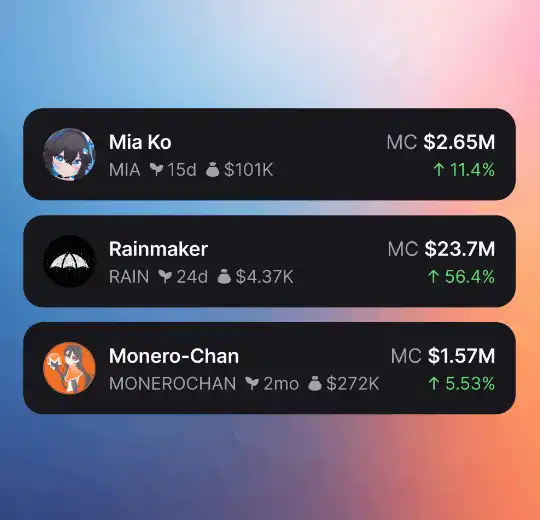
$MIA is working on an interactive, cross-platform, emotionally intelligent AI companion, $RAIN is working on AI automation for predicting market bets, and $MONEROCHAN is working on privacy DeFi on Solana.
The market cap of $RAIN is around $17 million, while $MIA and $MONEROCHAN are both around $1 million. However, currently, none of these three tokens have publicly mentioned in their official announcements whether they have applied to participate in the pump.fun hackathon, and it is not clear for $MIA and $MONEROCHAN whether the teams meet the hackathon's requirement of "team holds at least 10% of the token's total supply."
However, according to a tweet by the dev of $LUMEN, the requirement of "team holds at least 10% of the token's total supply" can also be relaxed with a reasonable explanation.
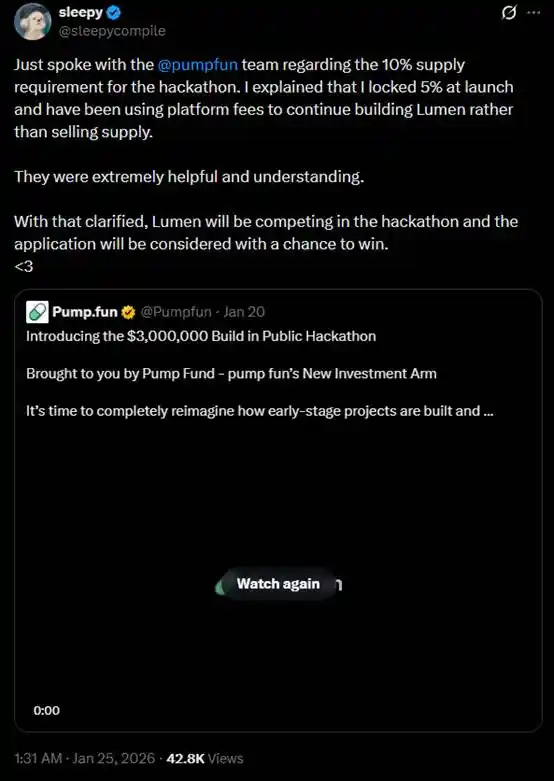
The $LUMEN dev stated that they only held a 5% share at token launch and have been using platform fees for project development instead of selling tokens, which was understood by the pump.fun team and allowed for participation.
From the three "cases" provided by pump.fun, it can also be inferred that pump.fun may lean more towards the AI, prediction markets, and privacy tracks.
Lumen Frankenstein ($LUMEN)
$LUMEN is creating a continuously learning and evolving LLM with genuine emotions robot, which will eventually be delivered to the holder. All delivered robots will be connected to a backend cloud server, allowing all robots held by owners to grow synchronously. Currently, the token has a market cap of around $1.5 million.
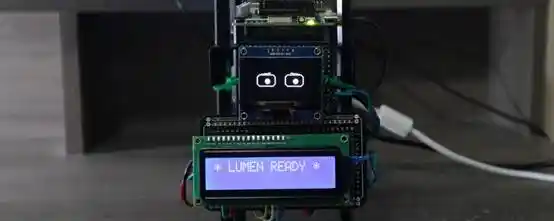
LUMEN Robot
Hyperscape ($GOLD)
Under the AI theme, another noteworthy competitor is $GOLD, whose dev is Shaw, the former founder of elizaOS and ai16z. However, Shaw has already launched too many assets from TreasureDAO to ai16z and has a bad reputation among players.
$GOLD is the in-game token in the new game Hyperscape created by Shaw and his team, where 1 $GOLD = 1 in-game token. From the name, it is evident that this is a retro-style MMORPG similar to Runescape, built using AI and incorporating an AI Agent supported by elizaOS, and the game will be open source.
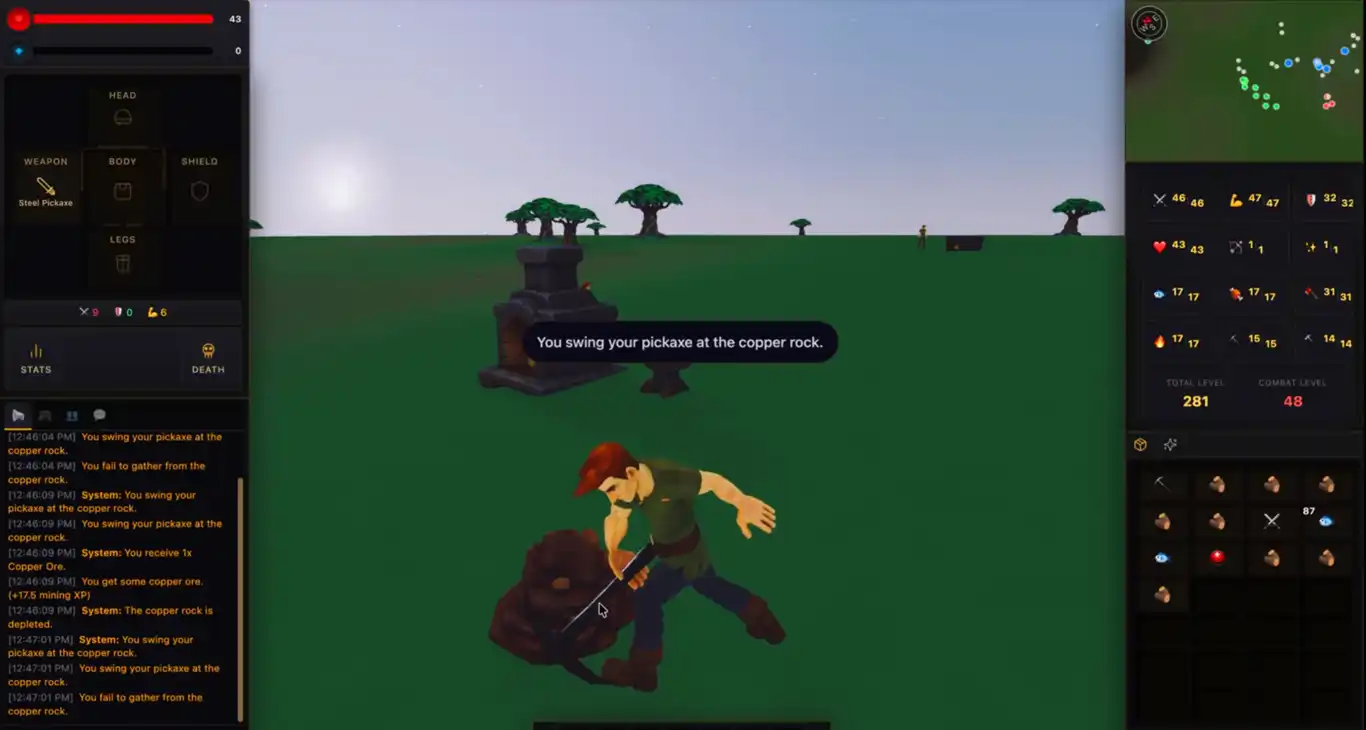
After briefly surging to a market cap of nearly $3 million, $GOLD's current market cap is only about $360,000. Many players have mocked Shaw, but the final outcome remains uncertain.
PUMPCADE ($PUMPCADE)
In the realm of prediction markets, one standout competitor is $PUMPCADE, which focuses on real-time bets on short-term fluctuations. In contrast to prediction markets that are more friendly to medium to long-term beliefs, Pumpcade targets users looking to enter and exit positions in the short term. For example, users may bet on the odds of "Will Trump buy Greenland" in the next hour, or they have developed a data feed plugin for Runescape that allows users to bet on real-time earnings after killing a Boss.
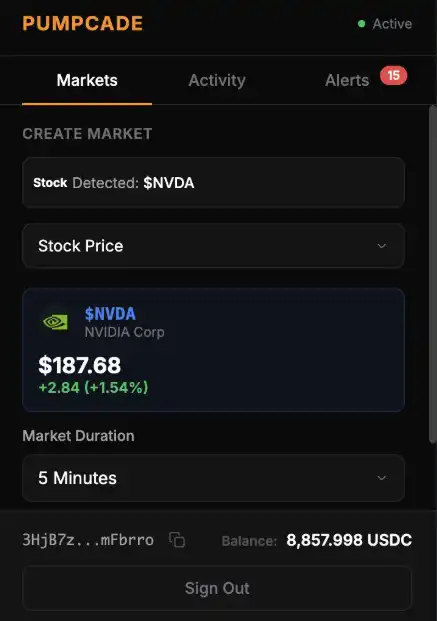
Real-time prediction market to create a forecast of NVIDIA's stock price 5 minutes later
The token currently has a market cap of about $3 million, having peaked close to $15 million.
The three aforementioned non-"case" projects have all explicitly participated in the pump.fun hackathon but are solely for market observation and do not constitute investment advice.
Recommended
The Wall Street Journal: How is AI Trading Stealing the Limelight from Cryptocurrency?
Aug 15, 14:00
Tencent Still Has a Dream
Aug 15, 11:27
To Catch North Korean Hackers, They Set Up a Fake Project
Aug 15, 10:00
From Litigation to Settlement: Positive Signal Released by HTX's Negotiation with FCA
Aug 14, 19:32
11,742 Shipping Addresses Exposed Alongside Trezor Orders
Aug 14, 19:01
Founder Interview: FOMO Creator Explains How They Added 30,000 Users in One Day and Became One of the Fastest-Growing Crypto Apps
Aug 14, 18:37