Crazy Buyout of Top Leagues: Why Is the Predictive Market Snatching Up Sports IPs?
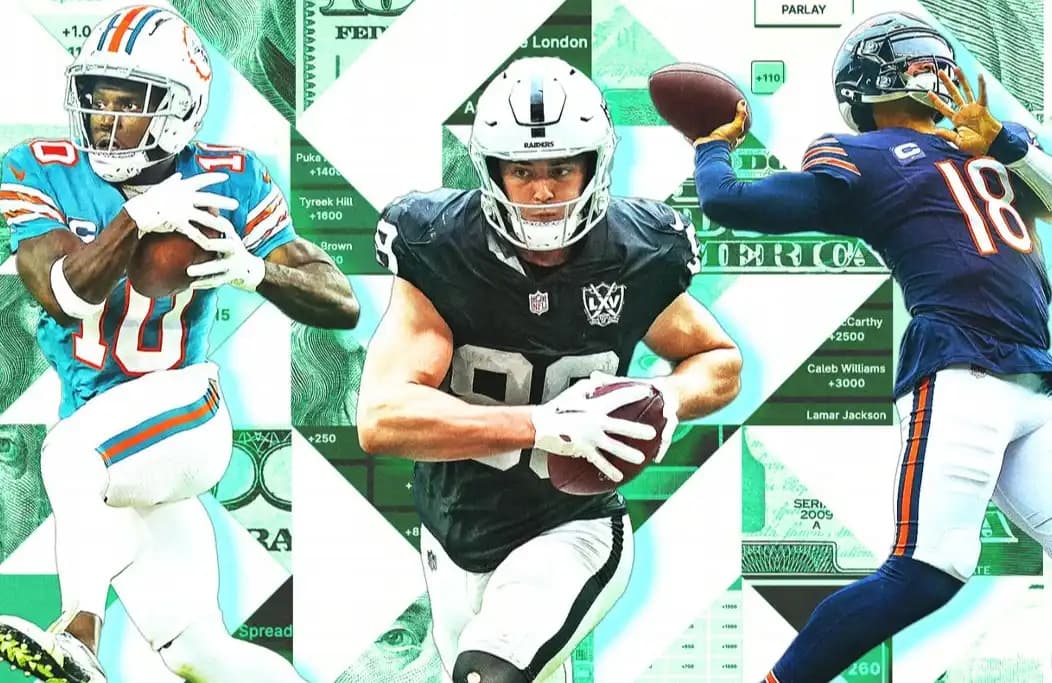
Original Title: "The Leaders of Prediction Markets Are Madly Snatching Top Sports IP"
Original Author: Azuma, Odaily Star Daily
On January 27, local time in the United States, the commercial department of the Major League Soccer (MLS) Soccer United Marketing (SUM) announced a multi-year partnership with the prediction market platform Polymarket. According to the agreement, Polymarket will become the official exclusive prediction market partner of the MLS league, MLS All-Star Game, MLS Cup Final, and the North American League Cup. The MLS will require Polymarket to use official league data and third-party integrity monitoring systems. At the same time, they must not offer betting projects that the league deems manipulable or easily involved in insider information.
This is not the first time a sports league has joined forces with a prediction market. As early as October last year, the National Hockey League (NHL) had reached multi-year licensing agreements with Kalshi and Polymarket respectively; later in November, Polymarket also reached an agreement with the Ultimate Fighting Championship (UFC) to become the UFC's official exclusive prediction market partner.
What does the so-called "official exclusive prediction market" mean? Does this mean that other unlicensed platforms will be unable to offer related odds in the future? What impact will this have on the future competition in the industry? Although there are limited mature cases of prediction markets cooperating with sporting events at present, and the observable sample size is small, we can find similar answers to these questions from the sports betting market, which has a very similar service effect.
Let's first answer the most crucial question—does the existence of exclusive authorization mean that other unlicensed platforms will be unable to offer related odds in the future?
The current situation of sports betting is that since the US Supreme Court overturned the federal law, the Professional and Amateur Sports Protection Act (PASPA), which had previously banned commercial sports betting on May 14, 2018, US states have obtained the authority to independently decide whether to legalize sports betting within their jurisdictions. In other words, the legality of betting services depends on state-level permits, not on the commercial authorization of leagues—in reality, when betting companies offer odds or provide betting services for various legal sports events, they do not need commercial authorization from the league operators.
However, in a few states like Tennessee, state-level sports betting regulators will require betting companies to use league official data when offering in-play betting services unless they can prove the data is not applicable or unavailable. This means that official authorization effectively impacts the service scope of betting companies—only with data authorization can the most comprehensive betting services be provided.
But this logic does not currently directly apply to the prediction market. Due to the unclear regulatory system in the prediction market (objectively more lenient), until the final appeal court and even Supreme Court rulings are made, platforms like Polymarket and Kalshi are not obligated to follow similar requirements in gambling regulations.
So, although Polymarket currently has exclusive authorization for MLS, at least at this stage, this does not mean that platforms like Kalshi are prohibited from offering MLS-related markets.
While it is not a "must-have authorization to open a market," in actual commercial operation, there are indeed many commercial partnerships and authorization agreements between major sports leagues and betting companies. For example, the NFL has signed a long-term partnership agreement with Genius Sports, authorizing real-time event data, including rosters, reports, technical statistics, etc., to betting companies through Genius as the sole official data provider.
For betting companies, the main significance of authorization is that they can directly obtain official data and brand authorization from the sports event organizers through commercial agreements to enhance their service quality and user experience. Exclusive authorization can add an additional layer of exclusivity on this basis.
The most essential significance lies in the quality and integrity of the data. Compared to data scraping through third-party channels, official data obtained through authorization agreements will undoubtedly be more accurate, timely, and comprehensive, which intuitively impacts improving betting service odds accuracy, accelerating settlement efficiency, and expanding betting categories. As for brand and trademark authorization, it allows betting companies to be more flexible in promoting related markets—using league, team, and player logos while avoiding infringement risks.
Conversely, for sports events, reaching authorization agreements directly with betting companies also helps reduce the possibility of market manipulation (sounds a bit abstract...). Both parties can standardize the scope of bets and share unusual betting data to promptly identify potential manipulation. For example, in the partnership between Polymarket and MLS, both parties have expressly agreed not to offer markets such as red or yellow card penalties that are prone to individual manipulation or related to inside information such as coach dismissals or player transfers.
Given the high degree of overlap in service delivery between the prediction markets and sports betting, the significance of licensing agreements for the sports betting market will similarly apply to the prediction market.
Sports betting has long been proven to be a large-scale, growth-certain business, and within the prediction market, sports-related events have gradually become the category with the highest trading volume.
Primitive Ventures founder Dovey Wan (@DoveyWan) yesterday posted the liquidity distribution of various types of events on major prediction markets. Among them, the betting volume share of sports events on Kalshi has exceeded 90%, and the betting volume share of sports events on Polymarket has also reached 43%—evidently, sports events have become the core traffic source of these two major prediction markets.
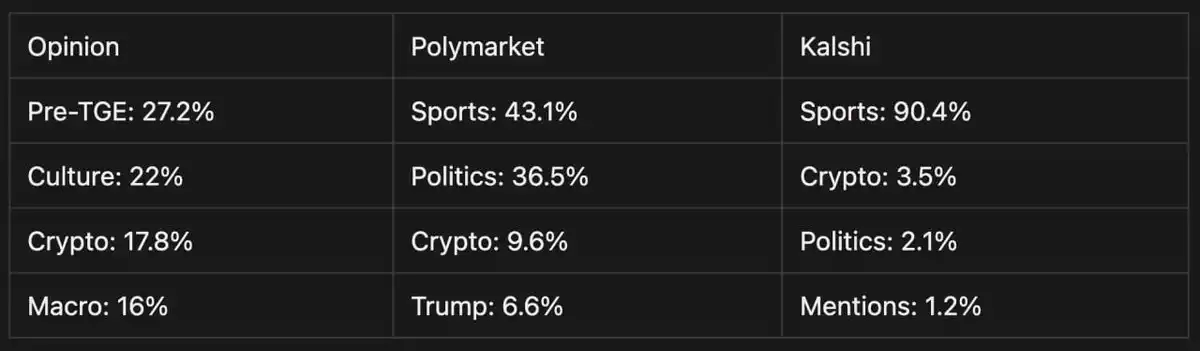
Faced with a massive existing scale and visible incremental space, market competition is inevitable. Currently, among the four major U.S. sports leagues, only the NHL has signed licensing agreements with Kalshi and Polymarket respectively, while the NFL, NBA, and MLB are still in a wait-and-see phase. It is expected that after Polymarket successively secured exclusive licenses for the UFC and MLS, Kalshi and Polymarket, these two leaders occupying compliance and funding advantages, are likely to engage in more intense competition around various top-level sports events, and more exclusive agreements are destined to emerge.
However, the data also reveals another interesting phenomenon—or perhaps due to cultural differences and user habits, emerging prediction markets on the other side of the world are embarking on a completely different path of differentiation. As shown in the previous graph, the liquidity share of events surrounding the native cryptocurrency market on Opinion is much higher than that on Kalshi and Polymarket. At a time when the giants are in a head-on collision over sports events, choosing to take a different approach may provide an opportunity for second-tier projects to catch up on a different track.
Recommended
The Wall Street Journal: How is AI Trading Stealing the Limelight from Cryptocurrency?
Aug 15, 14:00
Tencent Still Has a Dream
Aug 15, 11:27
To Catch North Korean Hackers, They Set Up a Fake Project
Aug 15, 10:00
From Litigation to Settlement: Positive Signal Released by HTX's Negotiation with FCA
Aug 14, 19:32
11,742 Shipping Addresses Exposed Alongside Trezor Orders
Aug 14, 19:01
Founder Interview: FOMO Creator Explains How They Added 30,000 Users in One Day and Became One of the Fastest-Growing Crypto Apps
Aug 14, 18:37