Before the Moonbirds coin launch, they conducted a One Billion Big Bird Plan.

Original Title: "Before Moonbirds Launched Its Token, It Had a Billion Bird Plan"
Original Author: jk, Odaily Planet Daily
Moonbirds has officially announced that its native token $BIRB will launch its TGE on Solana on January 28th, with a total supply of 1 billion. This blue-chip NFT project, which once generated over $1 billion in trading volume, has officially embarked on a transformation from a digital collectible to a "Meme+Physical" hybrid business model.
On the eve of the TGE, Moonbirds' parent company, Orange Cap Games, officially released the "Birbillions Thesis" whitepaper, outlining an ambitious goal: to build a $1 billion annual revenue crypto-native consumer goods company.
Dubbed the "Billion Bird Plan."
This is a very ambitious goal. Why is the team so daring to set this?
The Crazy NFT Era
Back to 2022, at that time, the NFT market was in its craziest phase.
Moonbirds emerged out of nowhere, with 10,000 pixelated owl PFPs, minting at a price of 2.5 ETH, roughly $7,500 at the time. Sold out within two days, the first-week trading volume surpassed $280 million.
Looking back, this number seems outrageous even today. How did Moonbirds manage to achieve this? I don't know how many still remember their "nesting" mechanism: holders could lock their NFTs on-chain to earn rewards, visual upgrades, and exclusive opportunities for certain subseries like Oddities and Mythics.
This staking system was indeed a very successful marketing case during the NFT frenzy of that year. It truly enhanced community stickiness, laying a solid foundation for the subsequent ecosystem expansion. As of now, the cumulative trading volume of the Moonbirds series has exceeded $1 billion, with the floor price around 2 ETH.
A Turn in the Story
But the bull market is not eternal. In the second half of 2022, controversies surrounding copyright, positioning, and communication accumulated, eroding community trust. By the end of 2023, Moonbirds and many once-famous NFT series were no longer the "talk of the town," often merely seen as relics of the past glory days.
The change occurred in May 2025: Moonbirds was acquired by Orange Cap Games from Yuga Labs. It marked a significant shift: Moonbirds transformed from a "managed IP" to a "operated product."
Since then, Moonbirds embarked on a transformation similar to Pudgy Penguins: trading card games, blind box figurines, graded collectibles, partnership with top global toy distributors. Expanding from Ethereum to multi-chains, from purely digital assets to a physical product matrix, Moonbirds underwent a qualitative metamorphosis. The number of independent wallets holding Moonbirds and birb IP surged from around 10,000 to nearly 400,000, spanning multiple chains including Ethereum, Solana, and TON.
Think about it, after the NFT craze, besides penguins and moonbirds, how many other NFTs have you heard of?
Even the name Moonbirds has gradually taken a back seat, replaced by the lighter, more colloquial, and easier to remix "Birb" and "Birbish."
What Is the $BIRB Token Exactly?
The issuance of the $BIRB token is a pivotal part of Moonbirds' transformational strategy. The token will serve as an "ecosystem coordination layer," linking meme propagation, physical product sales, community incentives, and more. According to publicly available information, the total supply of 1 billion $BIRB will be partially distributed through airdrops to Moonbirds NFT holders, sub-collection holders, and holders of soul-bonded tokens obtained through community activities. Over 256,957 unique addresses have claimed 419,039 SBT in preparation for airdrop eligibility.
In the "Birbillions Thesis" whitepaper released on the eve of TGE, if you have read the original, you will notice one thing:
It Really Reads Like an Academic Paper
"The central argument of this paper is that sustainable crypto assets must succeed in both of these aspects. It must be absurd enough to attract attention, drive participation, and enhance cultural transmission speed; at the same time, it must be authentic enough to translate this attention into lasting economic activity. More importantly, this economic activity should itself drive the propagation of memes during its generation, especially spreading beyond crypto-native circles. This is not a compromise between the two paths but a synthesis: viewing memetic and corporate aspects as complementary rather than antagonistic elements."
It doesn't really look like a whitepaper at all. Instead, it resembles a research report from a16z or a doctoral thesis studying the blockchain market.
In brief, the summary is quite simple:
On one side of the crypto industry is the meme: fast-paced, strong in propagation, low barrier to entry, high in emotion, but decays rapidly as well.
On the other side are businesses that can survive, generate revenue, but many crypto business models are essentially repeatedly charging the most active users.
OCG’s (Orange Cap Games, the parent company of Moonbirds and Birb IP) assessment is that these two paths fighting independently will eventually hit a ceiling. A truly sustainable structure must possess both abilities simultaneously: memes responsible for expansion, enterprises responsible for retention. Moonbirds aims not to "balance" the two but to view them as different stages in a flywheel. Memes create attention, attention is captured by tangible products, products bring in real revenue, revenue in turn expands distribution, and distribution further generates new attention.
Why Launch Now?
The reason this logic seems valid today is a very practical one: technology is no longer the primary differentiator. A faster chain, lower fees, a more complex virtual machine—there is almost no perceptible difference for edge users. What is truly scarce is something that can be understood, remembered, and talked about repeatedly.
You don't need to explain to an outsider what on-chain assets are; you just need to hand them a character they are willing to showcase and collect. "In this new era of cryptocurrency development, technology is no longer the bottleneck; the key to growth lies in distribution."
Simultaneously, "OCG generated approximately $8 million in revenue this year through the sale of physical collectibles, and this is only our second year of operation." From a revenue logic perspective, Moonbirds has already met the criteria for launching.
Where Did This $8 Million Come From?
To understand why Moonbirds dares to talk about a billion-dollar revenue, you must first grasp another trump card in OCG's hands, Vibes TCG.
Vibes is a physical+digital hybrid card game developed by OCG based on the Pudgy Penguins IP, officially launched in December 2024. It's somewhat similar to the collectible card games you remember from your childhood, but not quite the same; its collectible value and community recognition are entirely different.
Since its launch, Vibes TCG has performed beyond most people's expectations:
· Sold 8.6 million cards in the past year, generating $6 million in primary sales
· Over 350,000 online battles
· Entered 100+ global retail channels, including prominent card game retailers like Star City Games, secured partnerships with GTS and Asmodee (the world's second-largest toy distributor)
· Launched a digital version on the Epic Games Store, entering a mainstream game distribution platform
Choosing to do a physical card game was a seemingly traditional but actually extremely smart strategy. From Magic: The Gathering to Pokémon, from Yu-Gi-Oh! to Hearthstone, card games have always been one of the categories that generate the most sustained repurchase and community stickiness. Players don't just buy and leave; they continue to purchase booster packs, participate in events, and trade rare cards.
Secondly, TCGs are naturally suitable for IP extension. The cute image and rich character design of Pudgy Penguins can be naturally translated into card mechanics and visual design. Each card tells the story of a character, and each battle is an extension of the IP world.
In the Solana Birbathon, the team has confirmed that the third edition will feature Moonbirds.
More importantly, physical cards are true retail products. They can go into Walmart, into Carrefour, into any toy store, and card shop. This distribution capability is something purely digital NFTs can never reach. When a child sees Pudgy Penguins booster packs in a toy store, they don't need to know what blockchain is; they just need to find these penguins cute and want to collect them.
Looking at it from another perspective, TCG players are actually the world's most perfect "almost crypto users": used to paying a premium for scarcity, used to high volatility in the secondary market, used to authentication and collecting. For these card enthusiasts, transitioning from a $100 collector card to a $100 Birb card has almost no cognitive barrier. When these holders of millions of cards enter the ecosystem through $BIRB, this "buying pressure driven by consumption rather than speculation" is the most solid foundation supporting revenue.
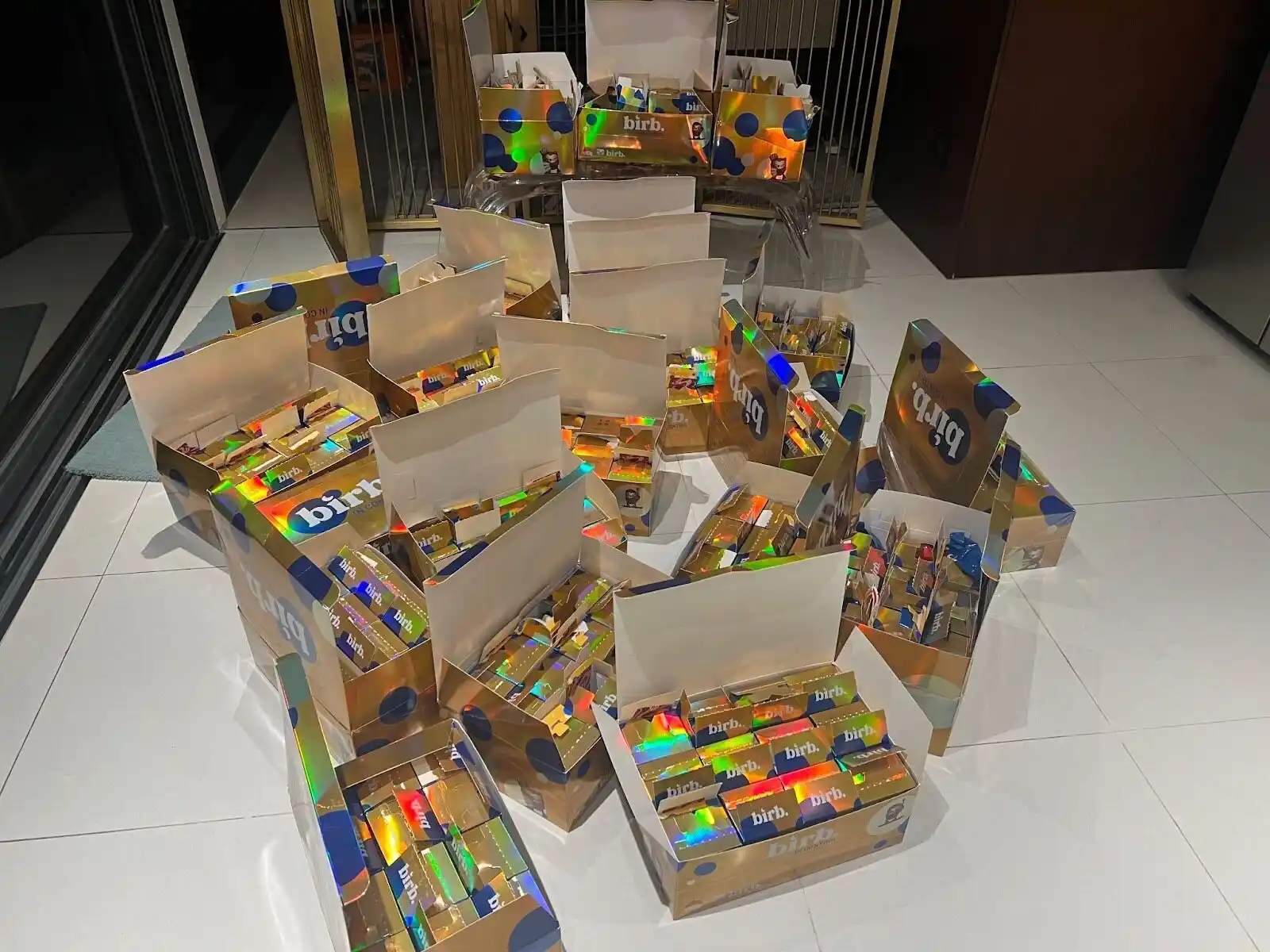
Someone unpacked 277 boxes in 6 hours
Not Benchmarking Penguins, Not Benchmarking BAYC, but Benchmarking Pop Mart
One goal repeatedly mentioned in the whitepaper is to build a crypto-native company that does not rely on transaction fees, liquidation, or token sales, but achieves scalable revenue through consumer product sales.
This is also why OCG started benchmarking Pop Mart. Pop Mart's publicly traded stock is an effective tool for measuring Labubu's revenue value, and the token plays a similar role relative to Moonbirds; Labubu has created significant cultural value—free marketing, social identity, vibrancy in the secondary market—but much of this value cannot be captured by stock prices. The design of $BIRB is intended to address this limitation.
Birbillions Goal: The One Billion Birds Plan?
The word "Birb" itself is quite interesting. It is brief, clear in pronunciation, and has its roots in internet culture. It is familiar enough to make people feel like the word should naturally exist; it is "silly" enough to spread quickly; and at the same time, it is specific enough to be "owned."
The core goal proposed in the whitepaper is very straightforward: to create the first $1 billion in annual revenue crypto-native consumer goods company that does not rely on transaction fees, leverage liquidation, or token issuance.
But this goal is achievable: Pop Mart generated approximately $900,000 in revenue in its second year of operation, reaching around $20 million in the two years before going public. OCG created around $8 million in revenue in its second year of operation through physical collectibles. In the past 12 months, Vibes card game has sold over 8.6 million cards, generating over $6 million in primary market sales. In the same period, Moonbirds' growth rate actually exceeded that of Pop Mart, despite having fewer SKUs, lower visibility, and an immature retail network.
"At the core of the Birbillions theory is the assertion that when these two are fused into a single flywheel—attention converted into product, product converted into revenue, and revenue reinvested into distribution—you can build the first crypto-native consumer goods enterprise to achieve an annualized $1 billion in revenue, this is how consumer companies have always won: by winning shelf space, winning repeat purchase behavior, and making culture spreadable."
Just this week, Moonbirds officially unveiled the tokenomics of $BIRB. This design is quite interesting, showing the team's deep consideration for long-term value creation.
65% Allocated to Community: Beyond the Expected Commitment
Moonbirds has chosen a rather aggressive community allocation ratio: 65% of the total supply.
There is a key design principle here: Moonbirds divides this 65% community share into five different incentive modules, each corresponding to different aspects of ecosystem development:
· Holder Rewards (27%): This is the core incentive for Moonbirds, Mythics, and Oddities NFT holders, used to build a stronger community cohesion;
· Ecosystem Partner Expansion (12%): Performance-based allocation mechanism used to acquire high-value partners, drive user growth, and execute regional brand activations;
· Value Chain Incentives (10%): Rewards community members contributing to the project's physical infrastructure, incentivizing operational excellence;
· Liquidity (8%): Ensuring healthy market depth and seamless trading experience, used for centralized exchange (CEX) listings, liquidity events, and market-making services;
· Innovation Reserve (8%): Strategic reserve reserved for the future development of the ecosystem;
It can be seen that Moonbirds' understanding of the concept of "community" is not just "holders," but includes partners, contributors, liquidity providers, and other ecosystem participants.
Nesting 2.0
Additionally, Moonbirds has introduced the Nesting 2.0 protocol, which is a design full of long-term thinking:
· NFT holders can deposit their Moonbirds, Mythics, or Oddities into the Nesting protocol
· Upon deposit, you will receive an SBT as proof
· Over the next 24 months, on the 28th of each month, the nested NFT can claim 1/24 of its total allocation
· If nested for only part of the time, rewards will be received proportionally
· NFTs nested in the first 7 days are considered fully nested for one month, providing early participants with a buffer
This design both prevents significant sell pressure at the TGE and gives holders a reason for long-term engagement. If you truly want to maximize your token rewards, you need to continuously stake your NFT for the full two years.
This restraint may actually reflect a more responsible attitude. After all, if you genuinely believe that this project is in it for 10 years or more, a true consumer brand, then what matters is whether the token and ecosystem are still around, still creating value one year, two years, five years down the line.
Community Response: Should You Be a Long-Termist?
Following the tokenomics release, the community response showed clear polarization.
Some holders expressed dissatisfaction. A user named Gomie bluntly criticized, "It's not 2021 anymore. Staking is outdated and troublesome. Packaging staking as Nesting 2.0 is just a gimmick. OG Moonbirds holders have been waiting for a 4-year airdrop, and now the Moonbird team says, 'I see your 4 NFTs, have 2 more'."
But there were also voices defending Moonbirds' choice. Well-known KOL Garga.eth (Greg Solano) tweeted in support of this design: "OCG is not the Moonbird team from 4 years ago. They did not receive any mint funds or royalties from 4 years ago."
He further noted, "You either want to long-term engage with the Moonbirds community and stay active in the game, or you don't. Your NFT is already worth much more than when Spencer took over this project, and in any case, you will receive some airdrop on day one."
Spencer and Orange Cap Games only acquired Moonbirds in June this year, and just 7 months later, they launched the token. "Many NFT projects and protocols promised an ecosystem token over 5 years ago, and today they still don't have a TGE (though many have point systems). Some protocols have completely abandoned their airdrop promises and gone straight to ICO."
He believes that many top-tier NFT projects like Azuki and Doodles launched tokens last year, but as it stands now, holders don't seem to resonate with ecosystem tokens, with most only caring about the NFT itself.
“Birb airdropped some tokens to NFT holders on day one and then allowed them to claim on a monthly basis for the next 24 months. It's a bold and risky move to make NFT holders vest because many NFT holders would rather view the airdrop as a cash-out moment, sell and move on. Some definitely will. So, I don't blame Spencer for trying to create a situation where NFT holders are tied to the token in the long term.”
The TGE of $BIRB is not the end but the beginning of a larger experiment. At the core of this experiment lies a simple question: What should a crypto project rely on to survive in 2025?
Is it based on fleeting hype and speculation? Or on real products and sustainable revenue? Is it reliant on short-term token price spikes? Or on the accumulation of long-term brand value?
The answer from Moonbirds is clear: The “Billion-Birb Plan” demands both but in a different manner.
· The team is betting on: Consumer logic can take root and blossom in the crypto world, and physical products can create real value for the token.
· The community is betting on: This team can deliver on promises, this brand can sustain growth, and the two years of waiting can yield a greater return.
· The market is betting on: This “not quite a token launch” token launch method can truly pave a new path for NFT project transformation.
A year from now, when we look back at the $BIRB TGE, what will we see? A case of value evaporation, community dissolution, and token worthlessness? Or a successful transformation of revenue growth, user expansion, and steady token value increase?
Regardless of the outcome, in an industry rife with fast money and speculation, there are still those willing to earnestly develop products, patiently build brands, believe in long-termism, which is an idealistic story in itself.
A $1 billion target may sound crazy, but if no one dares to dream this dream, how could anyone ever truly achieve it?
Recommended
The Wall Street Journal: How is AI Trading Stealing the Limelight from Cryptocurrency?
Aug 15, 14:00
Tencent Still Has a Dream
Aug 15, 11:27
To Catch North Korean Hackers, They Set Up a Fake Project
Aug 15, 10:00
From Litigation to Settlement: Positive Signal Released by HTX's Negotiation with FCA
Aug 14, 19:32
11,742 Shipping Addresses Exposed Alongside Trezor Orders
Aug 14, 19:01
Founder Interview: FOMO Creator Explains How They Added 30,000 Users in One Day and Became One of the Fastest-Growing Crypto Apps
Aug 14, 18:37