
Revenue Growth of 25%? Intel Delivers an Easily Misunderstood Financial Report
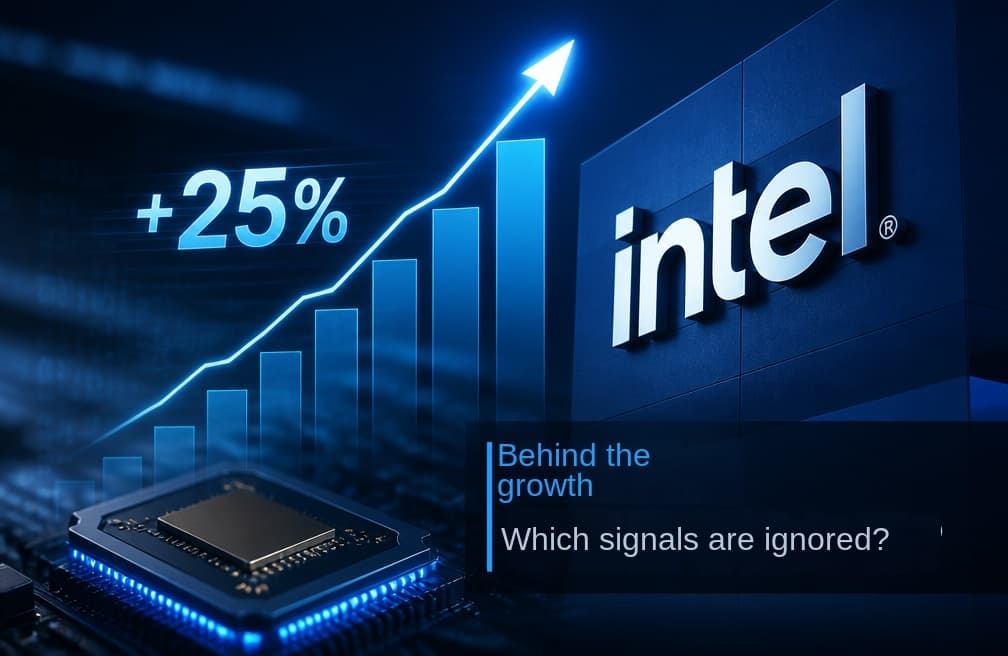
On July 24, Intel delivered a financial report that was easily misunderstood.
According to Intel's official press release, Q2 revenue was $161.28 billion. With a year-over-year growth rate of 25%, this was already a quite impressive figure.
What really excited the market was the guidance for the next quarter. According to Reuters via Investing.com, Intel's midpoint revenue for Q3 exceeded the analyst expectations aggregated by the London Stock Exchange Group (LSEG), leading to a post-market trading surge in its stock price.
At first glance, this seemed like a story of an old chipmaker hopping on the AI bandwagon. However, the details in the financial report were much more nuanced than this narrative. Intel simultaneously presented three charts: one showing growth in data center revenue, one indicating continued significant losses under GAAP accounting, and another revealing the dragging effect of the foundry business on the bottom line.
Who drove the growth?
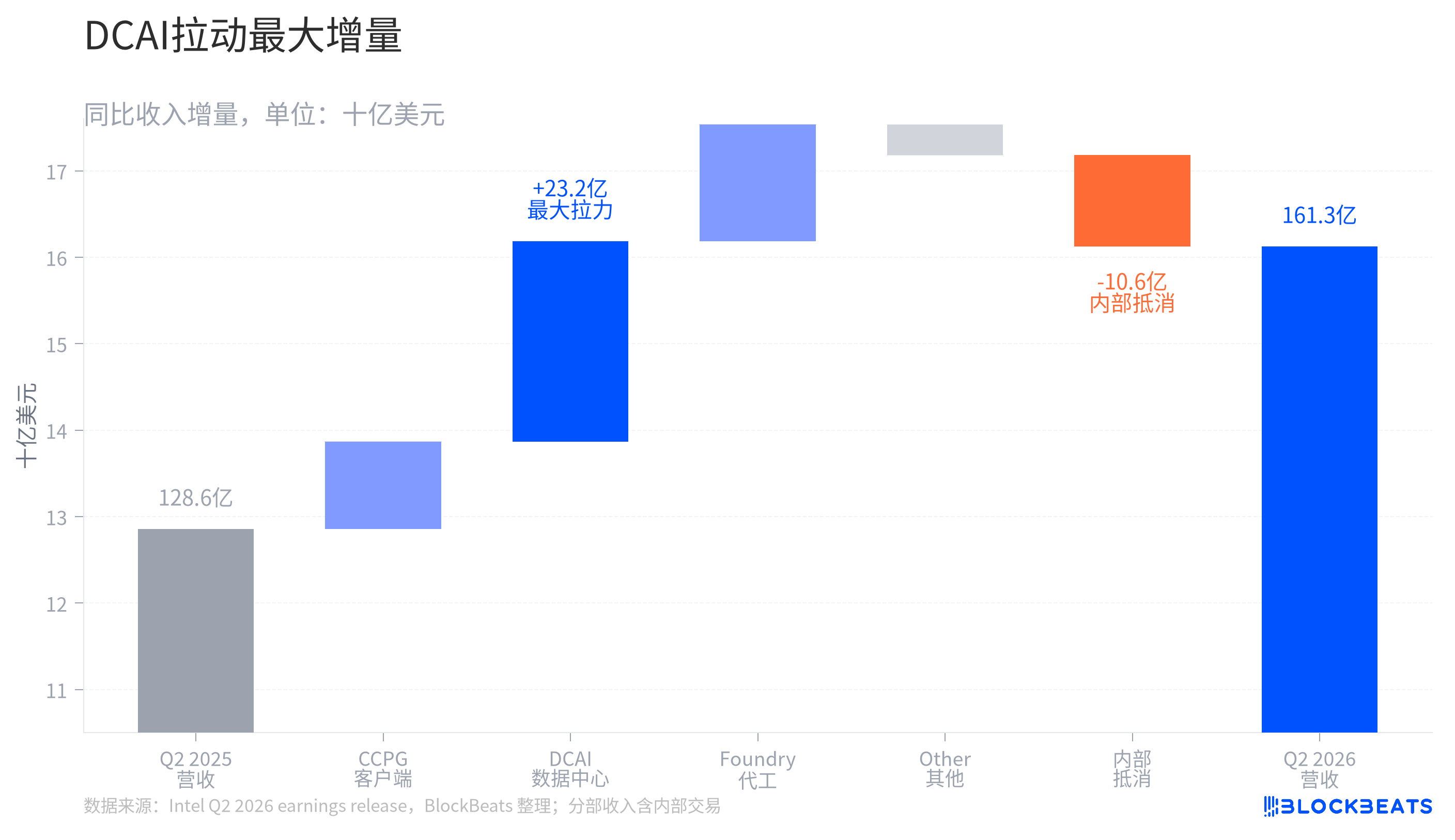
Let's first look at the revenue bridge. The most dissectible aspect of Intel's performance this time was not the total revenue itself but where the incremental revenue came from.
According to Intel's Q2 financial report, the combined net revenue was $3.269 billion higher than the same period last year. The largest increment shown in the chart came from DCAI, the Data Center and AI division. If this additional revenue is viewed as a rearranged seating chart, DCAI is the one who moved forward the most conspicuously this time.
This explains why the market was willing to react positively to the stock price initially. Intel didn't solely rely on the PC upgrade cycle to support its financials; it did tap into the CPU, platform, and related demand within the AI server cycle. However, this chart also highlighted another accounting issue. The Foundry, Intel's manufacturing division, also saw revenue growth, but internal transactions within Intel would be offset at a consolidated level. Simply aggregating the division revenues and then stating what percentage of the company's revenue it represents would skew the perspective.
This is why this financial report cannot be simplified as "AI business leading the charge." DCAI is the strongest driver, but it is not the entirety of the company.
Why did the revenue surge come with a $110 billion loss?
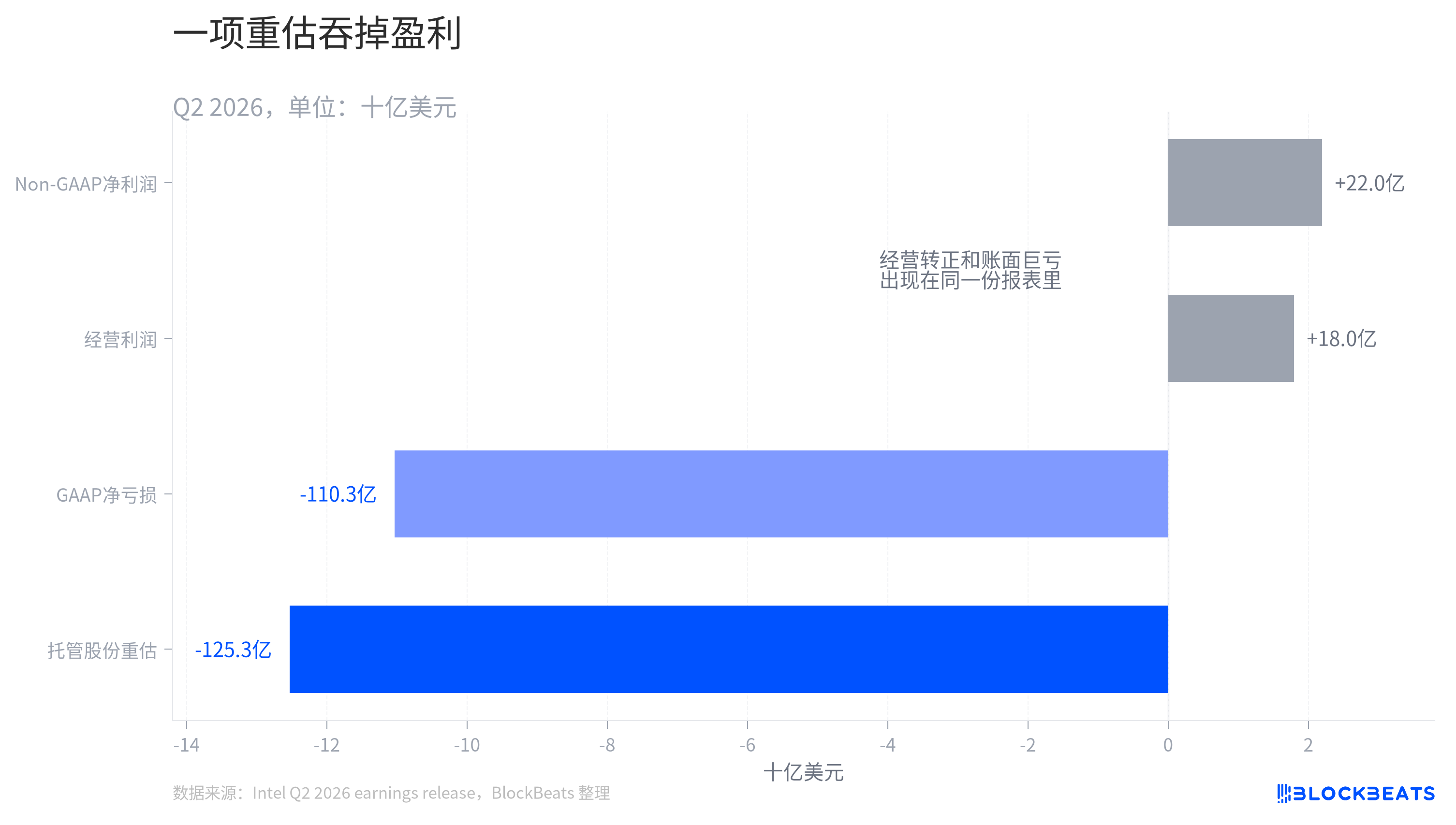
The second contrast can be seen on the income statement. Many financial report analyses may phrase it as "Intel's revenue surged but losses widened," which is correct but not sufficient.
According to Intel's official press release, Non-GAAP net income was $2.197 billion, while GAAP net loss attributable to the company was $11.033 billion.
Same company, same quarter, one side shows adjusted earnings, the other side shows a huge loss on the books. What readers really need to ask is, where did that crack come from in the middle.
The answer is mostly an accounting reassessment. According to Intel's Non-GAAP reconciliation, the loss on market valuation of government agreement-related escrowed shares amounts to $12.529 billion. This is not money burned in the wafer factory during the quarter or a sudden hemorrhage in the data center business. It's more like an asset on the balance sheet being revalued, a number big enough to overshadow the entire operational improvement.
So the market reaction doesn't seem contradictory. What it bought into was the turnaround on the operational front and the guidance for the next quarter, not the GAAP net loss headline number. For Intel, the trouble is that the average reader will see the loss first, while professional investors will first break down the adjustments. Two groups of people reading the same report, yet it's like looking at two different statements.
How much of Intel is really AI?
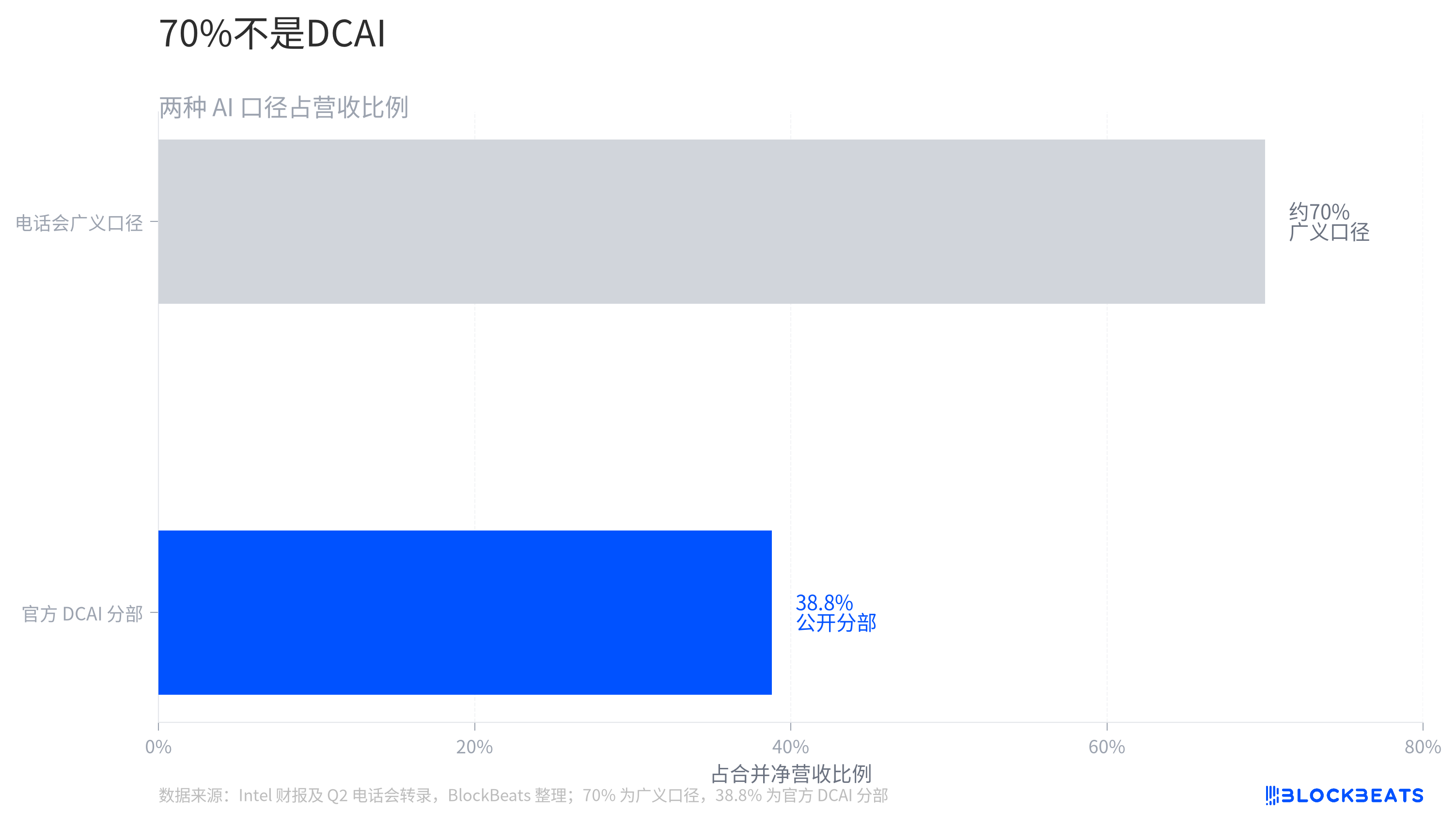
The third misunderstanding comes from the "70%."
According to the MarketBeat / Quartr conference call transcript, management mentioned that "AI-driven business" accounts for about 70% of the company's revenue. This expression can easily be transcribed as "Intel's AI business accounts for 70%."
However, in the publicly disclosed segment view, DCAI revenue is $6.262 billion, accounting for approximately 38.8% of the total net revenue.
These two numbers are not in the same basket. The former is the broad business view the management used in the conference call, while the latter can be traced item by item in the segment reporting. Mixing them together is like counting all the "dinner-related" revenue in a restaurant as main course revenue, making the main course suddenly seem all-encompassing.
This doesn't mean management is exaggerating. The impact of AI on Intel may indeed span beyond DCAI into client, packaging, foundry, and platform support. But as long as the company does not break down these components in the financial report, the broad statement from the conference call cannot be replaced with segment revenue share percentages when writing the article.
What needs to be corrected in this analysis is not the optimism but the bait-and-switch. Intel can say that a larger proportion of its business is being driven by AI demand, but it cannot be written as a company where DCAI accounts for 70% of revenue.
Where is the real unhealed wound?
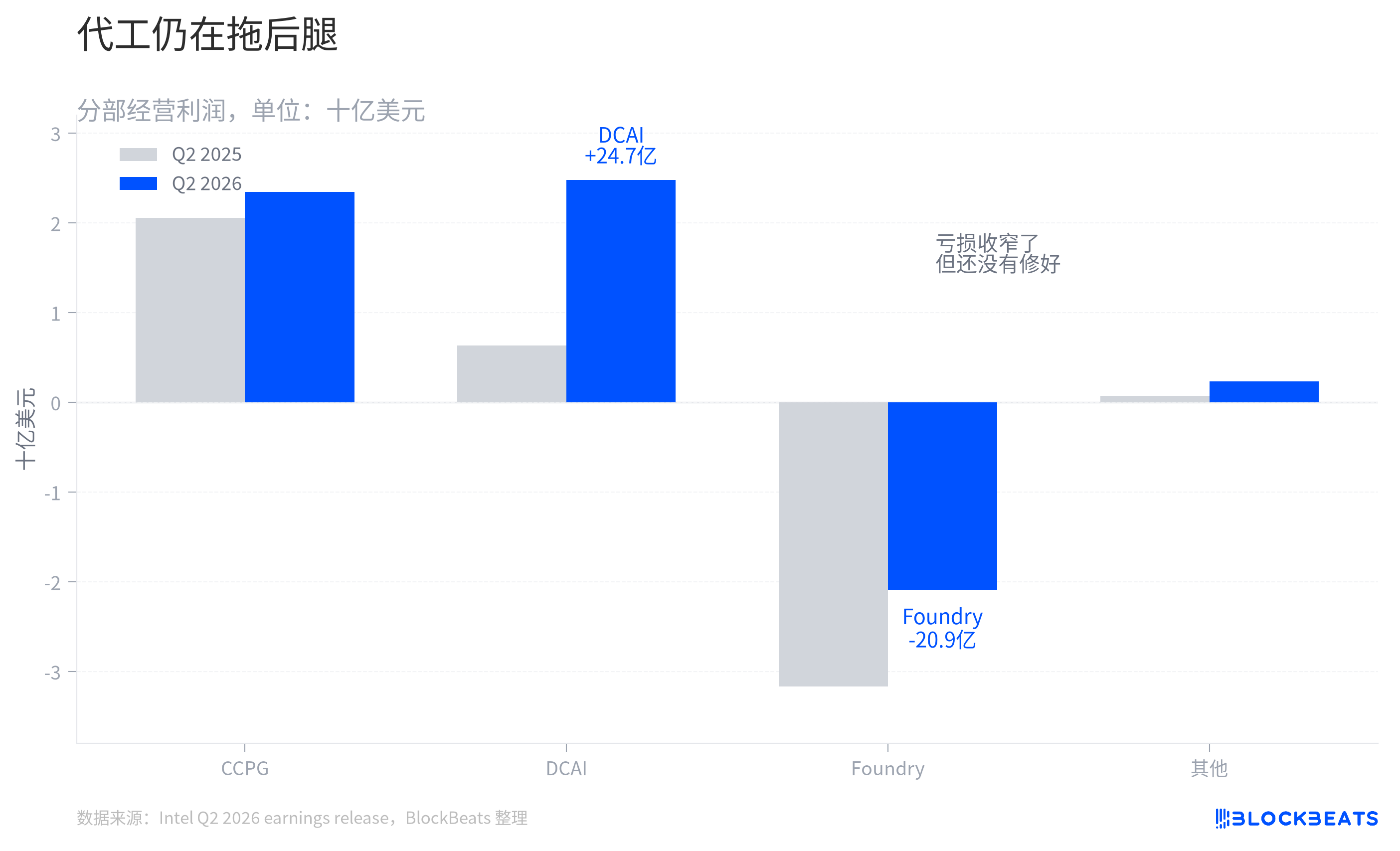
Finally, let's look at Foundry. It's the part of this financial report that is most easily overshadowed by the after-hours stock surge.
According to Intel's official breakdown, DCAI recorded a $24.74 billion operating profit, while the Foundry division incurred a $20.89 billion loss. The former is like the traction pulling the front of the car, while the latter is like the brake that has not been released yet.
Intel's issue is not the lack of AI revenue, but rather that this AI cycle has not yet turned the foundry business into a profit-making machine.
To be fair, the Foundry division has seen some improvements. It incurred a $31.68 billion loss in the same period last year, and the Q2 2026 loss has already narrowed. For a heavy asset manufacturing company, this kind of improvement is significant. Wafer fab depreciation, capacity ramp-up, and customer mix adjustments are not quick quarterly shifts like in cloud software.
However, when the market prices AI growth, it often subconsciously benchmarks against the NVIDIA model. NVIDIA's advantage is that the AI cycle directly translates into high-margin revenue from GPUs and networking products. Intel's path is more convoluted. It has to sell CPUs, maintain its client base, advance in process technology, and prove its foundry business can attract external customers.
This is the real tension in this earnings report. DCAI is putting Intel back on the AI transaction map, while the Foundry division continues to remind the market that Intel is not a nimble AI-only company.
This time, Intel has not received a resurrection certificate but rather a repriced admission ticket.
Welcome to join the official BlockBeats community:
Telegram Subscription Group: https://t.me/theblockbeats
Telegram Discussion Group: https://t.me/BlockBeats_App
Official Twitter Account: https://twitter.com/BlockBeatsAsia
Recommended
When even the well-known Robinhood account hack doesn't deter people from rushing in, is it a sign that the on-chain market sentiment has peaked?
Jul 24, 17:44
Interview with Matching Hearts Founder Xinxun Zeng: From Kimi's Departure to His AI Matchmaking Journey
Jul 24, 16:59
Trillion-Dollar SK Hynix Empire Inheritance Plot Revealed in Choi Tae-yoon's Divorce Case Closing
Jul 24, 16:51
In a year, its valuation has surged nearly 7-fold, and the large-scale model "Second-hand Dealer" OpenRouter is about to be acquired.
Jul 24, 15:50
Goldman Sachs Analysis: Intel's Q2 Exceeds Expectations Across the Board, Manufacturing Transformation Still Pending
Jul 24, 15:34
Abraxas Capital, the Institution Giving On-Chain Analysts Goosebumps | Meet the Hyperliquid Trader
Jul 24, 14:06