
How bad is the US stock market? Hedge funds are already losing so much they're laying off staff overnight.
The first week of November 2026 will surely go down in the annals of U.S. capital markets history. On one side, Democrats achieved a historic breakthrough in key states in the U.S. midterm elections; the very next day, U.S. stocks suffered their worst single-day decline since March 2020.
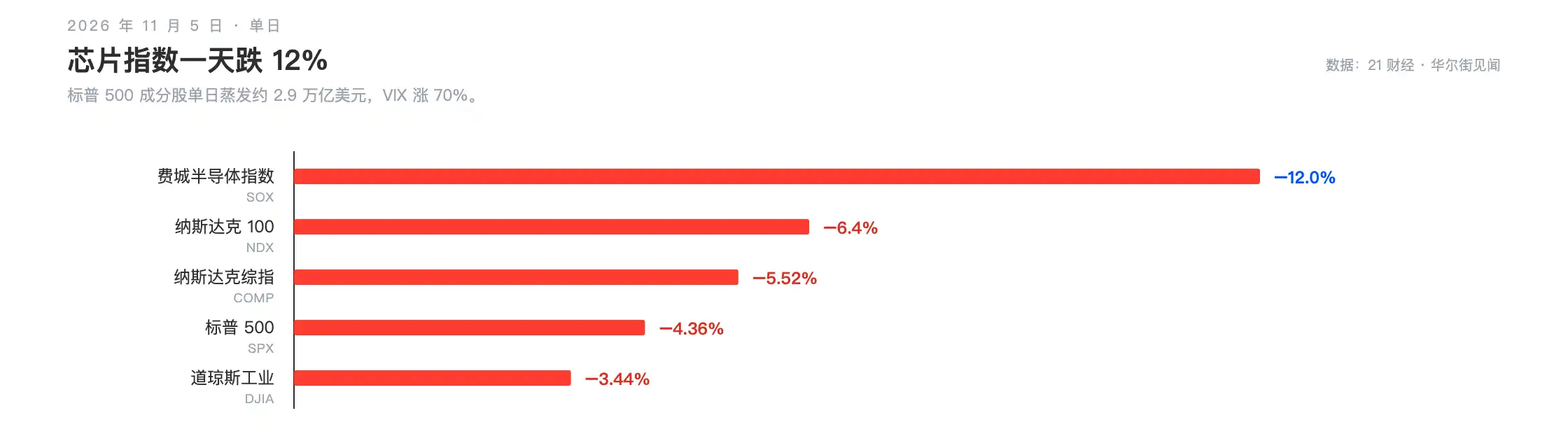
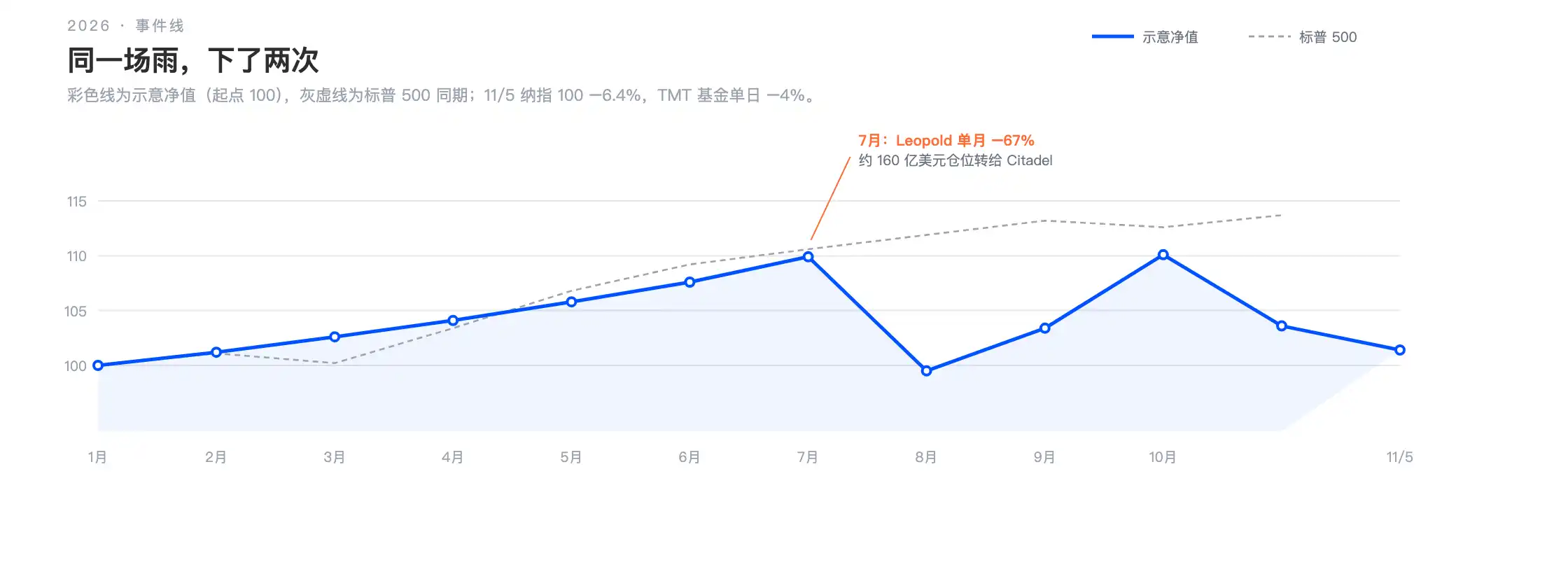
The S&P 500 fell 4.36%, with constituent stocks shedding approximately $2.9 trillion in market value in a single day. The Nasdaq Composite dropped 5.52%, pulling back 11% from its all-time high set in October and entering technical correction territory. The Nasdaq 100 plunged 6.4%, marking its largest single-day decline since March 2020, with approximately $2.3 trillion in market value wiped out in one day. The Philadelphia Semiconductor Index plummeted 12%, its biggest drop since 2020. The Dow Jones Industrial Average fell 3.44%.
In fact, the market didn't start falling on November 5 — it began declining in October when expectations for Republican gains in the midterm elections were not high.
In October, Goldman Sachs data showed that short bets against individual stocks rose to near five-year highs; Morgan Stanley data showed that stock-picking funds made their largest active de-risking in over a decade in October, with net market exposure down about 9% since June. By the end of October, more than 40% of funds had their year-to-date returns wiped out or turned negative.
Global hedge funds lost an average of about 3% in October. That doesn't sound alarming, but that's the average. Broken down, large multi-strategy and stock-picking funds were almost universally hit.
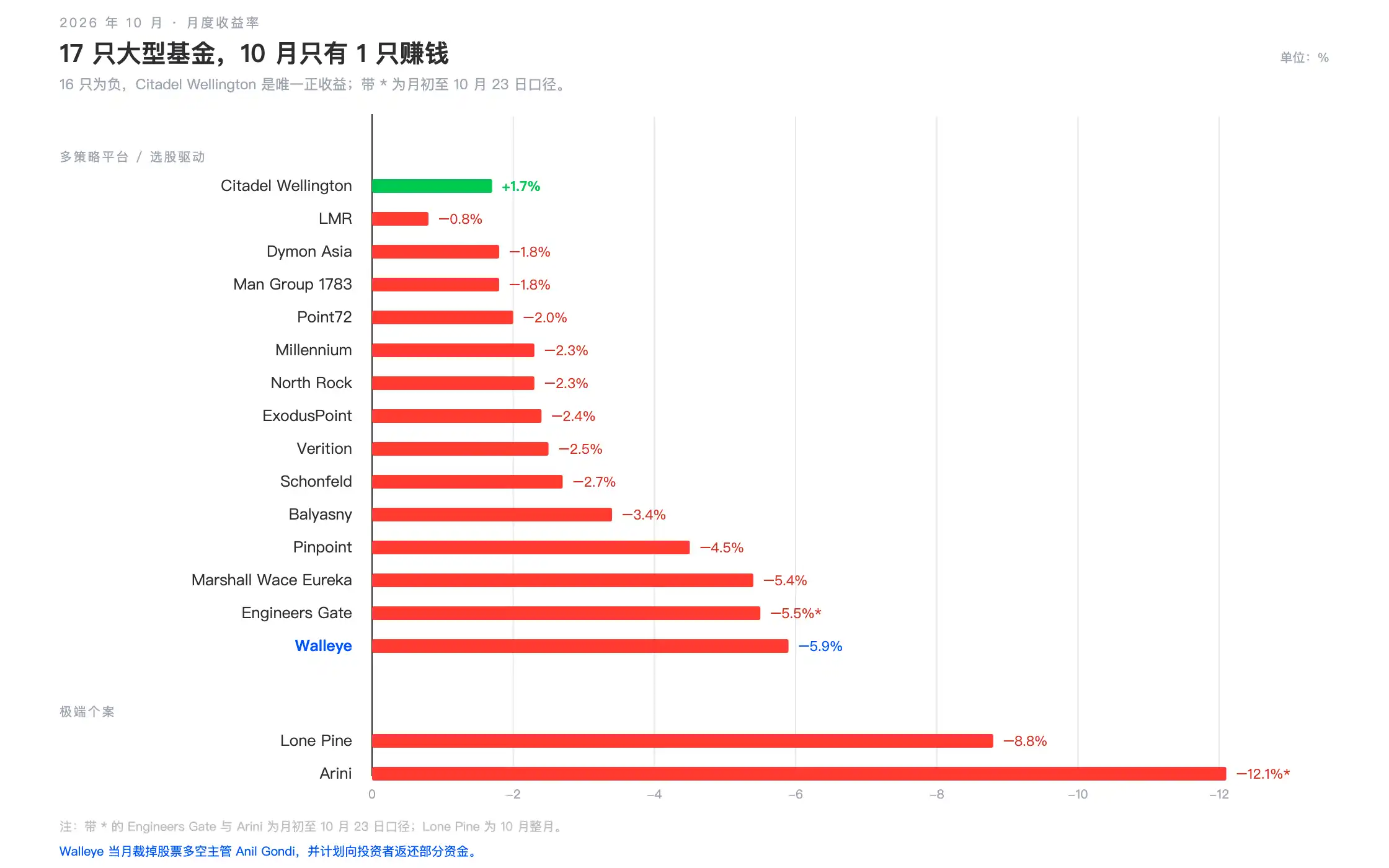
On the same scorecard, Citadel's Wellington fund was among the few positive performers, gaining 1.7% in October and 15.3% year-to-date. The vast majority of others were negative: LMR −0.8%, Dymon Asia −1.8%, Man Group's 1783 Fund −1.8%, Point72 −2.0%, Millennium −2.3%, North Rock −2.3%, ExodusPoint −2.4%, Verition −2.5%, Schonfeld −2.7%, Balyasny −3.4%, Pinpoint −4.5%, Marshall Wace's Eureka strategy −5.4%, Engineers Gate −5.5%, Walleye −5.9%.
Among extreme cases, Lone Pine fell 8.8% in October alone; Arini, which trades credit, had fallen 12.1% as of October 23, its worst monthly performance since inception.
Millennium, Point72, Schonfeld, Balyasny, ExodusPoint, Verition, Pinpoint, North Rock, Dymon, Man Group, LMR—names that typically appear in the context of "stable, low volatility, double-digit annualized returns"—lined up in a row of negative signs in October.
One Month, a Whole Year Erased
Just how devastating was October?
A multi-strategy fund managing tens of billions of dollars typically targets annualized returns of about 10%–15%, which translates to normal monthly fluctuations of just ±1%–2%. October's blow was 2%–6%—two to four times a normal month.
For a fund like Walleye, with roughly $17 billion in assets, −5.9% means about $1 billion evaporated in a single month.
A more intuitive way to look at it is to compare October's losses against the gains accumulated over the first nine months of the year.
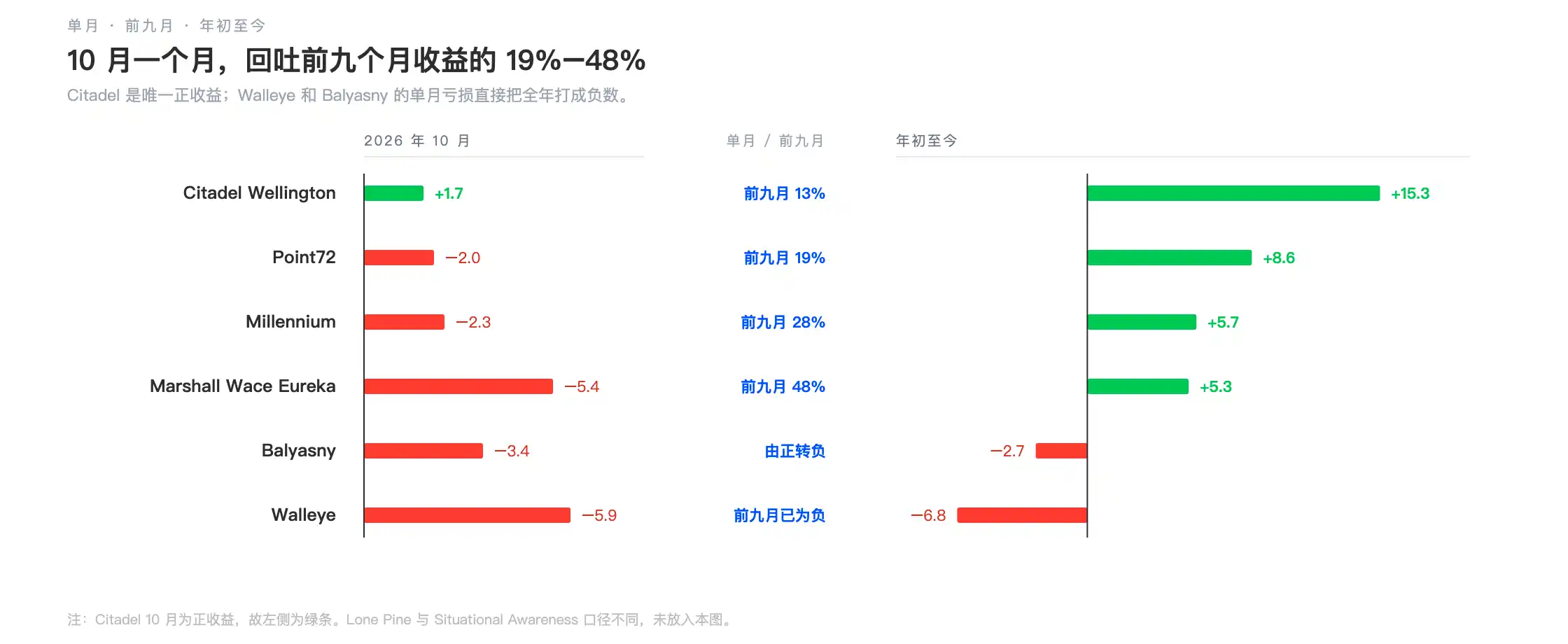
· Citadel Wellington: October +1.7%, year-to-date +15.3%—the single-month gain equals 13% of the prior nine months' returns, barely denting annual performance.
· Millennium: October −2.3%, year-to-date +5.7%—gave back 28% of the cumulative gains from the first nine months.
· Point72: October −2.0%, year-to-date +8.6%—gave back 19% of the cumulative gains from the first nine months.
· Marshall Wace Eureka: October −5.4%, year-to-date +5.3%—gave back 48% of the cumulative gains from the first nine months.
· Walleye: October −5.9%, year-to-date −6.8%—a single month's loss dragged the full year into negative territory.
· Balyasny: October −3.4%, year-to-date −2.7%—was still positive through the first nine months, then turned negative in a single month.
Not to mention Situational Awareness, which didn't even make it to October—it lost 70% in July and blew up entirely.
Losses Lead to Refunds, Layoffs, and Strategy Shutdowns
Losing money naturally sets off a chain reaction in the fund world: scrapping entire strategy lines and returning capital to investors.
1. Walleye Capital: Cuts Head of Equity Long-Short, Returns Some Capital
Cut Anil Gondi, head of equity long-short, and a "significant portion" of the internal long-short team. Gondi joined in July 2025, after a long stint at Balyasny Asset Management as a stock-picking investment manager and founding 6elm Capital.
CEO and Chief Investment Officer Will England acknowledged in an investor letter that investments over the past few years to improve the internal equity business (including bringing in new executives) "did not produce the expected results," with opportunity costs and resource consumption too high relative to returns. Meanwhile, the firm plans to return some capital to investors.
Engineers Gate: Cuts More Than Half of Synthesis Equity Team
After losing 5.5% in October, Engineers Gate directly cut most of its equity team called Synthesis, including the team head, leaving only 5 fundamental managers. In a client letter, they said: after the sharp reversal in AI and tech stocks, the team's performance was insufficient to continue in its current form; the firm also reduced capital or terminated cooperation on a small number of portfolios.
Samlyn Capital: Sells Nearly All Holdings Except Financial Stocks
Samlyn, with about $7 billion in assets under management, sold holdings in almost all sectors except financial stocks, cut multiple senior analysts, and shifted to focusing on the global financial sector.
Join the official Coincamps community:
Telegram: https://t.me/coin_camps
Recommended
After Robinhood, perhaps it's Elysium's turn.
Nov 6, 16:10
Nearly $200 Million in Lobbying Goes Down the Drain: Washington Turns, and Crypto Faces Headwinds
Nov 6, 16:10Immutable Announces Transition to Ethereum Rollup: Migration to OP Stack in 2027, Block Time Reduced to 1 Second
Nov 6, 16:01
Wall Street Hedge Funds Buckle as the Biggest Deleveraging Wave in Over a Decade Hits
Nov 6, 15:10October 2026: USDD Monthly Transparency Report
Nov 6, 15:01
Safe-haven sectors may also be sold off; why is it hard to avoid rotation in US stocks this time?
Nov 6, 14:46