Starting from Jensen Huang's extramarital affair, let's talk about narcissism, desire, and spy narratives in the Bay Area.

In early June 2024, during Computex in Taipei, several tech company executives were sitting in a local bar one evening.
After midnight, a Chinese woman at the table named Huang Le bet the people around her: "I can get Jensen Huang to come."
Not long after, Jensen Huang actually walked through the door. He was wearing his signature black leather jacket, accompanied by two Nvidia executives, and had a glass of whiskey with everyone. A group photo from that night later appeared on NetThunder's LinkedIn, with Huang Le standing right next to Jensen Huang in the picture.
Two years and five months later, on Sunday, November 8, 2026, 63-year-old Jensen Huang sent an internal email to all Nvidia employees.
"I was unfaithful to my wife. My actions hurt her and our children. There is no excuse for what I did." In the letter, he apologized to his wife Lori, to whom he had been married for over forty years, and acknowledged that he had let down his colleagues, the board, partners, and shareholders worldwide.
In the second-to-last paragraph of the letter, there was a sentence that seemed highly out of place in an infidelity apology letter: "I love our country, and I love our company. I am committed to protecting Nvidia and supporting U.S. national security. I am proud and grateful to be an American."
Jensen Huang did not name the woman in the letter, but everyone knew he was referring to Huang Le.
Just ten days before that email was sent, on October 29, The New York Times had just exposed another identity of Huang Le. The report said that Huang Le (English name Alice Huang) had served as managing director of Singapore-based computing power company Megaspeed; when U.S. intelligence agencies were investigating the company on suspicion of transshipping restricted Nvidia chips to China, they discovered that she had been directly passing information to Beijing, and concluded that she was a source developed by Chinese officials, tasked with finding out details about Jensen Huang and pushing Nvidia to supply its most advanced chips to China.
U.S. intelligence agencies conducted electronic surveillance on Huang Le for about a year, during which they intercepted frequent communications between her and a U.S. citizen. Under U.S. law, intelligence agencies cannot directly monitor American citizens without a court warrant; when monitoring foreign targets, if communications with U.S. citizens are intercepted, the American's name is redacted by default and can only be viewed through an internal approval process called "identity unmasking."
After the approval went through, the unmasked name was Jensen Huang.
On the very day the news broke, October 29, Jensen Huang was still distancing himself in comments to Bloomberg, saying that his dealings with Huang Le "were all related to Megaspeed's business, completely normal, nothing special." An Nvidia spokesperson also said firmly that if the company really were the target of some threat, they believed the U.S. government would have notified them long ago.
But that narrative only held up for ten days.
On November 4, three Republican chairs of the U.S. House Foreign Affairs Committee, the Select Committee on China, and the Intelligence Committee — Brian Mast, John Moolenaar, and Rick Crawford — jointly sent a letter to Jensen Huang, demanding that he appear at a closed-door congressional briefing on November 18 to explain his dealings with Alice Huang, and confirm by November 11 whether he would attend or arrange another time.
On November 6, the Financial Times reported that U.S. authorities had determined the two were actually in a romantic relationship. Two days later, the New York Times further disclosed that as early as May of this year, on the eve of Trump's visit to China, Secretary of State Rubio personally oversaw the drafting of a highly classified memo specifically warning senior White House officials about this relationship.
On November 8, Jensen Huang admitted the extramarital affair to the board. Nvidia's board announced that an independent director would lead an investigation with outside independent counsel, while emphasizing that there is currently "no reason to believe" that U.S. national security or company secrets had been compromised.
Looking at these reports together, my first reaction — and that of most people — was the same: Alice played the honey trap, and old Huang walked onto the guillotine.
But a closer look reveals that no prosecutor in any country has filed formal charges against Alice Huang; all espionage allegations come from intelligence assessments relayed by anonymous officials. And tracing Alice Huang's past through domestic business and regulatory records reveals not a traditional spy, but a capital markets veteran who, a decade ago, participated in hundred-billion-yuan leveraged raids in Shanghai and walked away unscathed from an 83 billion yuan illegal fundraising case.
But in today's American public opinion arena, whether Alice Huang is truly a "Chinese spy" is actually no longer important.
What matters is that the "Chinese spy" label itself serves the interests of American media, the U.S. government, and everyone in Silicon Valley's tech circles. When a label can simultaneously satisfy the needs of the New York editorial rooms, the Washington hearing rooms, and everyone at a San Francisco bar, what she actually looks like becomes the thing no one cares about least.
From Shanghai to Singapore: The Operator
First, let's look at who Alice Huang really is, and why American media and Washington need to define her as a spy.
Alice Huang worked as a journalist for four years at Hunan TV and CCTV, then became an assistant to the president at HSBC Private Bank, a vice president at CITIC Securities, and later deputy general manager and executive director at a Shanghai private fund called "Hexi Investment." When the New York Post checked, a Hunan TV supervisor said they had never heard of her, and neither TV station's official website had any record of her working as a journalist.
Her early journalism career may be difficult to verify, but the capital operation records she left behind at Shanghai Hexi Investment are solidly documented in the CSRC's penalty decisions and industrial and commercial archives.
In 2014, on the eve of the previous A-share bull market, Gu Guoping, a star businessman from Songjiang, Shanghai, and founder of communications equipment company "Feixun," was eager to find a listing shell for Feixun, which had annual sales of nearly RMB 10 billion. He set his sights on Guangxi-listed company Huiqiu Technology. After the backdoor restructuring was blocked in July of that year, Gu Guoping decided to directly buy control of Huiqiu Technology.
The firm that designed and executed this control battle for Gu Guoping was none other than Shanghai Hexi Investment. Hexi Investment's boss Kang Wei was once a star strategy analyst at Shenyin & Wanguo Research Institute, and Huang Le, as deputy general manager and executive director, directly participated in this project.
The shell-seizing plan was executed quite adeptly. At the end of October, Hexi Investment first established a private fund with RMB 52.81 million, of which Gu Guoping personally contributed over RMB 7.78 million. Immediately after, Hexi Investment approached Huang Le's former employer CITIC Securities and signed an equity return swap agreement, using RMB 50 million in margin to leverage RMB 150 million in financing, assembling approximately RMB 200 million to directly buy 3.8% of Huiqiu Technology's shares, and within less than two months installed Gu Guoping as chairman of Huiqiu Technology. From then until August 2015, Hexi Investment raised a cumulative total of over RMB 1.8 billion through return swaps and fund offerings, using combinations of multiple nominee holders to trade Huiqiu Technology, with the highest shareholding ratio reaching 8.3%.
During the summer 2015 stock market crash, Huiqiu Technology plummeted, and the highly leveraged asset management plans faced forced liquidation. By April 2016, a desperate Gu Guoping, in order to raise life-saving funds, was forced to sell Huiqiu Technology's official seal and control to the later notorious capital player Xian Yan.
At the very same time that Gu Guoping handed over the listed company's official seal, the "allies" who had originally helped him seize the shell—Kang Wei and Huang Le—turned around and took control of Feixun.
Industrial and commercial records show that on March 4, 2016, Huang Le founded Shanghai Yunxi Investment Management Consulting Co., Ltd., and one month later entered the shareholder list of Hexi Investment. Immediately after, between May and July 2016, Gu Guoping successively exited three holding platforms that together held 50.65% of Feixun's equity, and the recipients were precisely Hexi-affiliated enterprises associated with Kang Wei and Huang Le. By 2018, the Hexi group and suspected concert parties collectively controlled approximately 59.64% of Feixun's shares, squeezing founder Gu Guoping's stake down to just 20%.
By 2018, the CSRC first issued a RMB 17.7 million fine to Hexi Investment for information disclosure violations and illegal trading in the Huiqiu Technology transactions, and a RMB 400,000 fine to Kang Wei personally. Immediately after, the wealth management platforms "Lianbi Finance" and "Huaxia Wanjia Jin Fu"—bundled with Feixun's "RMB 0 router" promotion—completely collapsed, exposing a staggering case involving cumulative illegal fundraising of over RMB 83 billion and actual losses of RMB 12.573 billion to more than 1.1 million victims. Gu Guoping was sentenced to life imprisonment in 2021.
Yet throughout this string of fines, court rulings, and lists of failed companies, Huang Le's name never appeared. She had long since pulled out and left for Singapore.
If you understand this scene from Shanghai a decade ago, then look at Megaspeed, which she has been running in Singapore since 2023, you'll find the playbook is almost identical.
In October 2022, the U.S. government issued its first export ban on advanced AI chips to China. Five months later, in March 2023, Chinese web game company "7Road" renamed its Singapore-based overseas subsidiary to Megaspeed, with Huang Le appointed as managing director, and all company shares transferred to an offshore British Virgin Islands entity under Huang Le's name. And 7Road was precisely one of the target companies that Shanghai Hexi Investment had backed in its early years.
Just eight months later, in November 2023, Huang Le resigned from her director position at Megaspeed, and the shares were promptly transferred to a newly established Singapore shell company called Swiftdata. When a reporter from Singapore's The Straits Times followed the registered company address, they found it was merely a secretarial firm that handles company incorporations.
Just days after Huang Le vanished from business registrations, Megaspeed officially appeared on Nvidia's official website list of "cloud partners."
What followed was again the technique of leveraging a small principal to move a multi-billion-dollar operation. At the end of 2023, Megaspeed had only about $5.7 million in cash on hand; but just weeks after that bar gathering in Taipei, its Malaysian subsidiary Speedmatrix began receiving goods, taking in over 200 batches of Nvidia products in the first year, worth approximately $2 billion; by February 2026, cumulative purchases totaled at least $4.8 billion, vaulting it into the ranks of Nvidia's largest customers in Southeast Asia.
The bulk of these goods were purchased from Aivres, the California-based subsidiary of Chinese server giant Inspur Group, and shipped to a data center deep in a palm oil plantation in Johor state, where computing power was remotely rented to Chinese clients such as Alibaba. Bloomberg disclosed that as of November 2025, Megaspeed had imported approximately 136,000 Nvidia GPUs, but when Nvidia inspectors visited the server rooms for inventory, they found only a few thousand of the latest chips, with large quantities of equipment still in unopened packaging. U.S. officials suspect that a considerable portion of the hardware was ultimately transshipped into China. In 2025, Singapore police questioned Huang Le regarding Megaspeed, then released her without filing charges; to this day, Singapore police have only said publicly that the investigation into Megaspeed is still ongoing.
From A-share shell companies and total return swaps to offshore shell entities in Southeast Asia and a $4.8 billion chip flip, wherever there are policy barriers and windfall price spreads, Huang Le goes there to set up shells, add leverage, build networks of the powerful, and erase her name from the documents before the regulatory hammer falls.
But for American media and Washington politicians, "a Chinese capital fixer trafficking in computing power in the gray zone" is far from sensational enough. Only by directly labeling her as "a female spy executing a honey trap for the Ministry of State Security" can they maximize their own returns.

During Computex 2024 in Taipei, Huang Le and Jensen Huang appeared in the same frame at an industry gathering | Image source: NetThunder / LinkedIn
For American media, cross-border trade compliance and shell company equity shuffling are too dry—readers swipe away after two lines. But once paired with whiskey at a Taipei bar in 2024, footage from a May 2025 Taipei dinner livestream showing her kissing Jensen Huang on the cheek and placing her hand on his back, plus reports that the two left in the same car, and written up as "the extramarital affair between the head of a $5 trillion chip empire and a Chinese female spy," it instantly becomes the most sensational Cold War thriller. Moreover, the American public is already familiar with the 2003 Katrina Leung case, in which a woman maintained a twenty-year affair with an FBI agent, and the 2020 Christine Fang case, in which a woman befriended politicians in the Bay Area. Wrapped in this ready-made template, from The New York Times and the Financial Times to the New York Post, every outlet has secured the most traffic-generating headline of this autumn.
And those who need this "Chinese spy" label even more than the media are the China hawks in Washington.
Jensen Huang's first half of life is a standard American immigrant success story: born in Tainan in 1963, sent at age 9 to a rural boarding school in Kentucky for troubled youths, where he cleaned the boys' dormitory toilets after school every day; later educated at Oregon State and Stanford, and in 1993 founded Nvidia with two friends in a booth at a Denny's restaurant in San Jose.
But over the past two years, around chip export controls on China, this Chinese-American CEO has become the biggest obstacle for Washington hawks.
At Computex in Taipei in May 2025, he publicly criticized U.S. chip export controls as "a failure," saying bluntly that the controls had cut Nvidia's share of China's AI chip market from 95% to 50%. To preserve the market, he attended a dinner at Mar-a-Lago in Florida and donated at least $20 million to Trump's White House ballroom fund, in exchange for conditional government approval of some chip sales to China, with the U.S. government taking a 25% cut directly from sales revenue. In September of this year, at the White House state dinner welcoming the Chinese leader, Jensen Huang sat at the head table. The New York Times disclosed that Trump had received an intelligence briefing on Huang Le a year earlier but took no action, reportedly because he did not want to disrupt Nvidia's chip business and U.S.-China trade relations.
Before the scandal broke, Jensen Huang's persistent desire to sell chips to China originally had only one boring but defensible rationale: business. China is a hundred-billion-dollar market, and any white American CEO in his position would fight for it just the same.
Now, his opponents in Washington have a much more compelling argument.
As long as Huang Le is characterized as a "Chinese spy," Jensen Huang's opposition to export controls is no longer about fighting for American shareholders' interests—it becomes "pillow talk from a female spy." Texas Republican Congressman Michael McCaul has already publicly called for an immediate suspension of advanced AI chip exports to China "until we find out the truth about this." All the lobbying capital Jensen Huang accumulated over the past year at Mar-a-Lago and the White House turned into a negative asset overnight. Even because he himself has a Chinese face, Hong Kong media HK01 directly published a commentary after the story broke, titled "What If Jensen Huang Is a Chinese Spy."
This is why Jensen Huang had to write in an affair apology letter the line "I am proud to be an American." He knows full well that what Washington is really scrutinizing has never been his personal morals, but his loyalty.
The Missed Fourth Option
If Washington and New York media need a "Chinese spy" to serve political gamesmanship and headline traffic, then in San Francisco and Silicon Valley, young tech workers' fascination with this script is to satisfy their own narcissism.
At the end of October, a friend who had just moved to the Bay Area chatted with Dongcha Beating about the dating market there, saying the absurdities were so numerous "you could genuinely make a TV drama out of it." During the very days the Jensen Huang incident was fermenting, the friend sent four observations.
The first one read:
"Is this person really into me / a good person / or is she a Chinese spy? It's already become a super meme. But most people who say this are using it for narcissism."
"Narcissism." Suspecting someone is a spy presupposes that you think you're important enough to warrant a spy being sent to approach you.
This meme has a long history in the Bay Area, but it was truly pushed into the spotlight in October 2025. The UK's The Times published a report at that time saying that China and Russia were waging a "sex war" on Silicon Valley, sending young women disguised as investors, researchers, or romantic partners to approach tech workers—some married them, had children, and embedded for the long haul. In the report, James Mulvenon, chief intelligence officer at risk consulting firm Pamir Consulting, said his LinkedIn had recently seen many friend requests from "the same type" of young, attractive Chinese women.
Musk screenshotted the report and replied underneath: "If she's a 10, you're an asset."
The word "asset" happens to have two meanings here. In the intelligence world, it refers to a developed informant; in the financial world, it refers to an asset.
By 2026 in the Bay Area, this pun has become entirely literal.
In June 2025, Sam Altman said Meta was poaching OpenAI staff with signing bonuses in the hundreds of millions of dollars. In October of the same year, during a secondary sale of OpenAI shares, more than 600 current and former employees sold a total of $6.6 billion, with a cap of $30 million per person. In August of this year, OpenAI bought back approximately $7 billion of employee shares at a valuation of $852 billion. On October 13 of this year, the New York Post interviewed several matchmakers serving the Chinese community's dating market. Zhao Qinghua, founder of "Two Red Beans," which claims to be North America's largest Chinese dating site, said that engineers at Anthropic and OpenAI are her "first tier."
But if you follow this line of thinking, you'll notice that those three options are actually missing one.
Appreciates me, is a good person, is a spy. There's no "she's after my money."
Why is that one missing? In today's Bay Area, even homeowners listing properties in Duboce Triangle are saying buyers can pay with OpenAI and Anthropic stock — "after my money" is clearly the most probable answer. Yet when an engineer who just received a large options package makes a joke, he'd rather say the other person is a spy sent by a foreign government than say she's after his stock.
Being targeted by a nation means you're important. Being schemed against by one person only means you're rich. The former can be bragged about to friends over drinks; the latter you can only process on your own.
By mid-October, this mindset — a mix of narcissism and defensiveness — had actually become corporate employee training.

OpenAI's headquarters building in Mission Bay, San Francisco, photographed in June 2025 | Image source: Coolcaesar / Wikimedia Commons
On October 9, 35-year-old Saudi national Abdulrahman Alfozan, an engineer at OpenAI, was arrested by the FBI for secretly installing recording equipment in an executive meeting room. Five days later, The Wall Street Journal reported that OpenAI has been conducting counterintelligence training for employees, covering honeypot-style approaches, cash bribes, eavesdropping in cafes, and hypothetical scenarios such as a stranger who keeps striking up conversations at a children's playground in San Francisco.
Employees are advised not to wear logo-branded clothing outside the company, to use privacy screens, and to erase whiteboards after meetings to prevent cleaning staff from being bribed. One guideline says that if someone tries to entice you, first consider whether the person might be a spy.
The reaction to this news on X was particularly candid.
Some said OpenAI's HR really only needs to remind employees with one line: "Remember how ugly and boring you are." Some said most male employees at AI companies are a 2 to 5, and if a 9 shows interest in them, they should already be suspicious. Meta's Alexandr Wang also chimed in, saying the Superintelligence Lab office is in the South Bay, and "if someone you don't know approaches you, there's definitely something fishy going on." A former Hugging Face employee joked that OpenAI engineers will never encounter true love—only their system access will be coveted.
In today's Silicon Valley, the spy narrative has not only failed to cause panic but has instead become a badge of honor for tech upstarts to confirm their own worth.
Two 80%s
Since Silicon Valley men are so receptive to this narrative, how did operators like Huang Le crack open the doors of Silicon Valley's core in just a year or two?
Another observation a friend sent over points out the most real supply-demand structure in this circle:
"Some Chinese AI researcher events in WeChat groups are hilarious, because when you click into the group you find 80% are women, while most invitation-only networking parties are 80% men."
On first read, it's easy to interpret this through the lens of the New York Post headline "Gold Diggers Are Descending on Silicon Valley," assuming women are flocking to AI researchers. That article directly used the term "gold-digging." Matchmaker Amy Yang said Chinese women fly over every week; a divorced Chinese businesswoman in her forties said she pays special attention to men at AI companies preparing to go public, calling marriage an "asset restructuring."
But following this line of thinking further, something quickly starts to feel off.
First of all, on what grounds does one assume that the 80% of women in WeChat groups are not researchers or industry professionals, but are there to find a partner?
Thinking further, it still doesn't add up. If the goal really is to go after core resources, the fattest prey are clearly all in those invitation-only small gatherings, where the real founders, top researchers, and partners congregate. But why is it that at those private events, 80% are men?
Putting the two 80%s together, what this set of numbers really says is where the door of power opens.
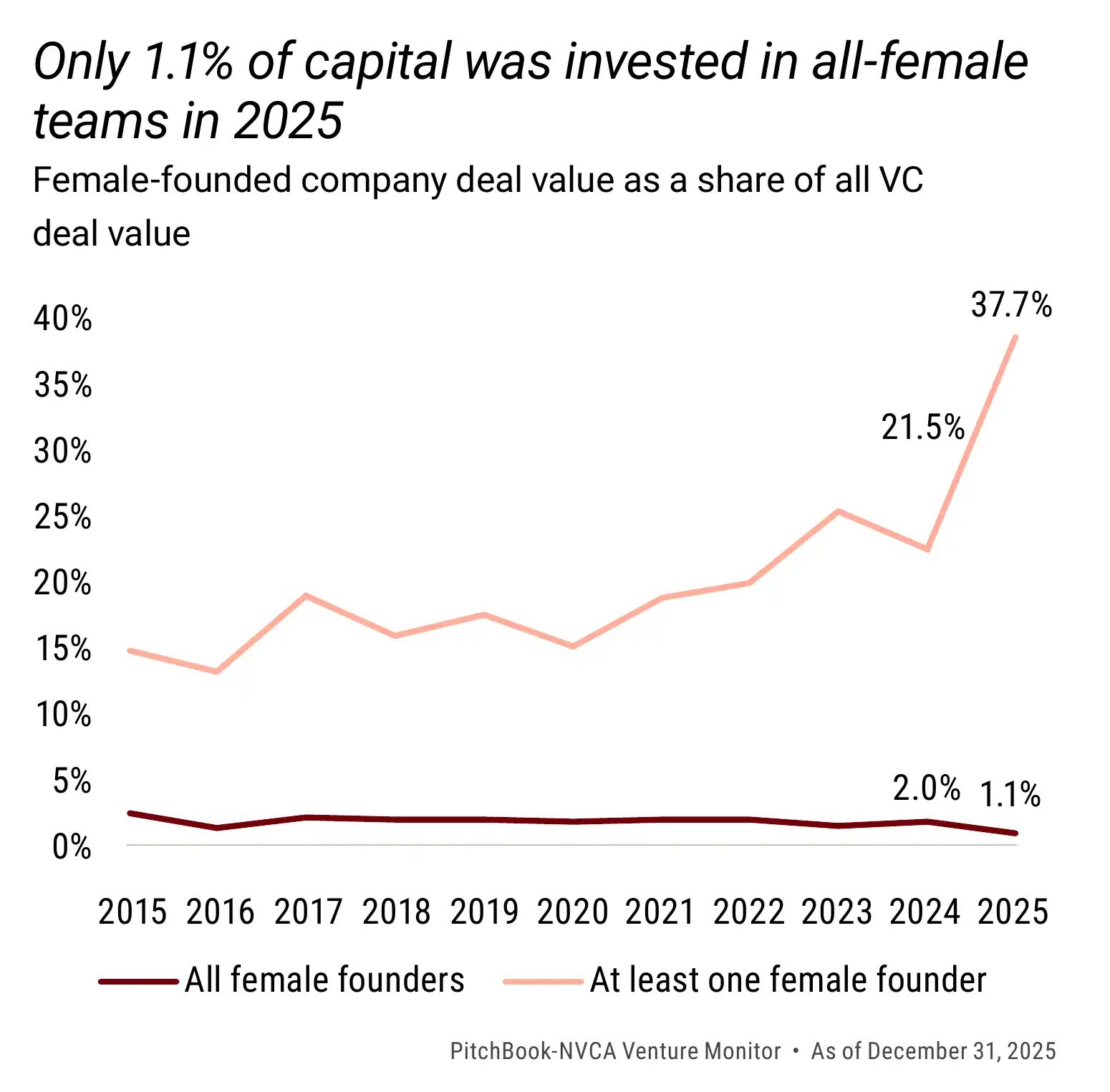
In 2025, all-female founding teams received 1.1% of total U.S. venture capital funding | Source: PitchBook–NVCA Venture Monitor, page 18
WeChat groups can be entered by scanning a QR code, while invitation-only events require someone to bring you in. In the outer social venues where the door is open, women are the majority; at the core card tables where the door is closed, men occupy 80%, and what is truly being allocated there—job opportunities, Term Sheets, early-stage allocations, and core compute—all happens in that room at the back. The flow of capital takes the same shape: according to PitchBook statistics, in 2025 all-female founding teams received only 1.1% of U.S. venture capital, down from 2.1% the previous year.
The 80-to-20 ratio is equally the norm inside tech companies. As of the end of fiscal year 2025, among Nvidia's 36,000 employees worldwide, men accounted for 77.5% and women 21.2%. When Jensen Huang himself studied electrical engineering at Oregon State University, there were only 3 women among the 250 students in his class. He once courted his future wife Lori with the line "Want to see my homework?" and promised to study with her every Sunday to make sure she got an A in every course.
It is precisely this closed structure—"80% men"—that provides players like Huang Le with the most suitable hunting ground.
In a room where wealth and power are highly concentrated and the male share has chronically exceeded 80%, women's attention, flattery, and intimacy are themselves extremely scarce chips. To set up a game here, there is no need at all for a perfect-10 stunning beauty; what she is really doing is an arbitrage on the gender ratio.
For a capital veteran who witnessed the A-share shell company battles in Shanghai in his early years and knows well how to leverage 50 million yuan in margin to control a 1.8 billion yuan capital pool, the soft spots of these men in the tech world are all too easy to figure out. A glass of whiskey, a few compliments, a photo squeezed into a booth together—and the founder of the world's most valuable company becomes your credit endorsement. The New York Times mentioned that Huang Le and her partner used her close relationship with Jensen Huang to go back and raise funds from the wealthy circles in Shanghai and Zhejiang.
Two Passports
The irony is that when capital players like Huang Le rake in fame and fortune at the table and then walk away unscathed, it is often the truly ordinary Chinese women professionals in Silicon Valley who bear the brunt of this "Chinese female spy" narrative.
The third observation a friend sent said:
"Lots of ppl here have Asian fetishes and very masochist. But it matters if you're 'Chinese Chinese' or you're 'ABC'."
What it means is that many men in the Bay Area have a special fascination with Asian women, even with a hint of masochism; but in their eyes, whether you are an American-born Chinese or a "Chinese Chinese" who grew up in China, holds a Chinese passport, or just recently got a green card, is a completely different matter.
In the Bay Area, the same Asian face gets sorted into two categories. ABCs are objects of fascination, with at most a bit of curiosity about "cultural differences" added on; but when facing women with mainland Chinese backgrounds, men have an extra layer of wariness on top of their fascination.
Jasmine Sun of Business Insider wrote a story in January 2025.
In November 2024, in Berkeley, at an after party for the AI conference The Curve. A 27-year-old woman born in China was also there; the report calls her Sarah. She had recently quit her job as a trader in London to switch to AI safety research. During conversation, someone mentioned the spy rumors in Silicon Valley, saying someone was "hunting" young software engineers, and then glanced at her. So she found an excuse to leave, and before going she told another guest that she was Chinese, but not a spy.
This sentence was heard by someone in the AI policy circle nearby, who posted it on X, and it got millions of views. Some people in the comments guessed she was a spy, and some said people like that should not have been let in. Sarah later explained that she left only because she was cold, and the same question had already been asked once that night. She never went to networking events again, and returned to China in December that year.
In the same report, another 26-year-old Chinese woman working at a startup in San Francisco said she was dancing with someone at a bar when the person called her a honeypot and said that because she is a Chinese citizen, there were certain things he couldn't tell her. She later turned down several AI-related job opportunities and deliberately suppressed her accent in the workplace.
This kind of scrutiny did not emerge only in recent years amid tensions between China and the United States.
In March 1875, the U.S. Congress passed the Page Act, the first federal law restricting immigration, seven years before the Chinese Exclusion Act. It mainly targeted Chinese women, with the law presuming that single women from China were mostly coming to engage in prostitution. Afterward, Chinese women had to answer questions about their "character" before boarding ships in Hong Kong and when disembarking in San Francisco, many of which were humiliating.
Before the law was passed, the ratio of Chinese men to women in the United States was roughly 78 women for every 1,000 men; after the law passed, it dropped to 48; by 1910 it was still 14 to 1, and San Francisco's Chinatown was called a "bachelor society."
The first judgment American law made about Chinese women was that they came here to exchange their bodies for something. One hundred and fifty years later, what they are suspected of taking away has changed from gold dust to chips.
As for the masochist a friend mentioned, it can be understood through another term that Hollywood has perpetuated for nearly a century: Dragon Lady.
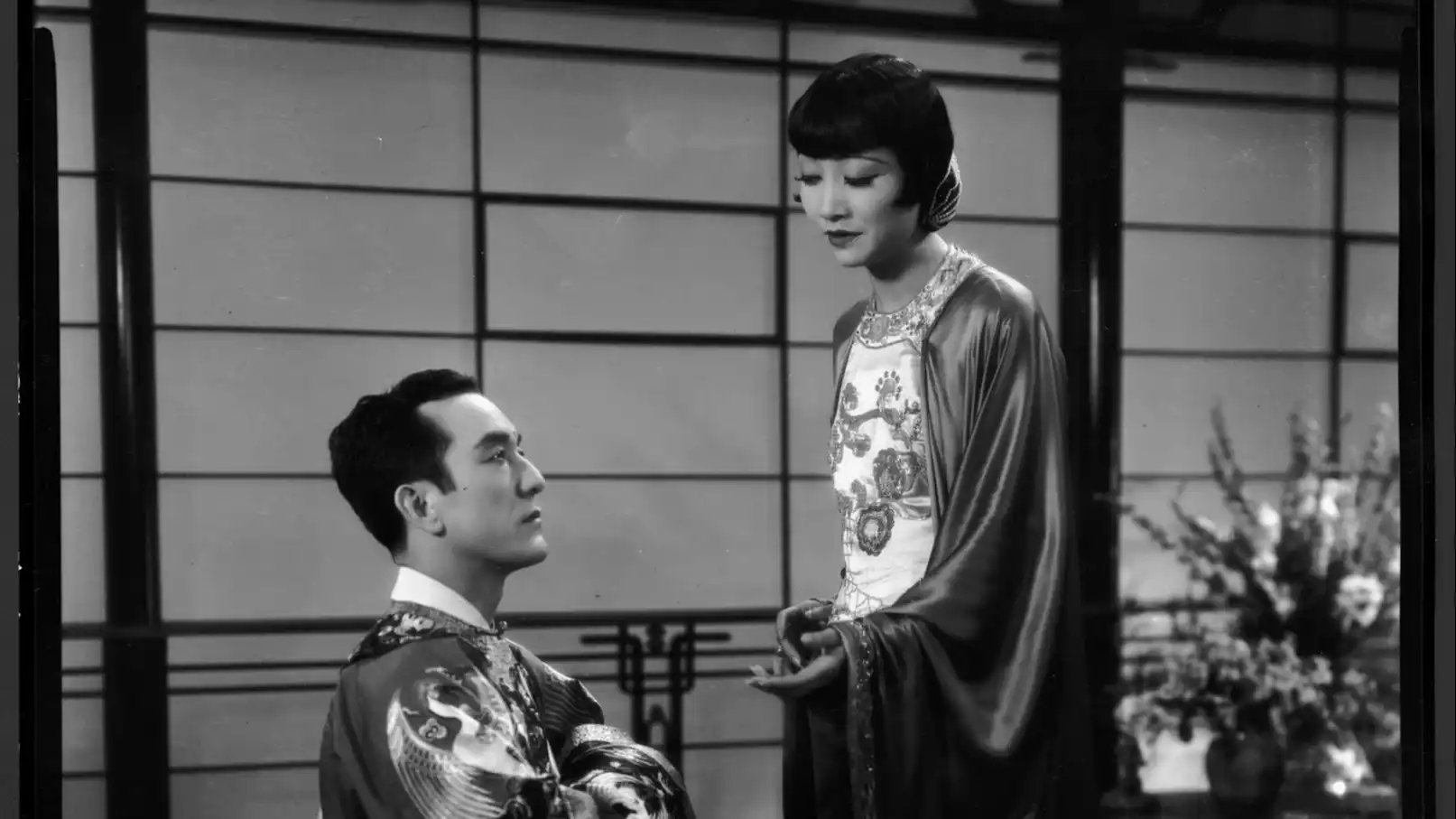
Anna May Wong in the 1931 film Daughter of the Dragon | Image source: Academy Museum of Motion Pictures
The term comes from Milton Caniff's 1934 comic strip Terry and the Pirates, modeled on a beautiful, cunning, and dangerous Chinese female pirate leader; three years earlier, Anna May Wong also played this type of role in the film Daughter of the Dragon. Hollywood has left two positions for Asian women: one is the submissive Madame Butterfly, and the other is the dangerous Dragon Lady. When Bay Area men say "she might be a spy," there is rarely fear on their faces—mostly a bit of excitement. Being chosen by a dangerous woman and used by her is, after all, part of their fantasy.
But Chinese people are precisely the group that Bay Area AI cannot do without today.
In September of this year, the director of the Carnegie Endowment for International Peace's China Center conducted a statistical analysis using 10,280 NeurIPS 2025 paper authors as a sample. 57% of top AI researchers did their undergraduate studies at Chinese universities, up from 46% in 2022, while only 13% did their undergraduate studies in the United States. Of the 44-person list from Meta's Superintelligence Lab that leaked in July 2025, half were from China.
From November 2018 to February 2022, the U.S. Department of Justice implemented the "China Initiative," investigating hundreds of scholars, with very few espionage cases actually substantiated. Starting September 21, 2025, new H-1B applications require an additional $100,000 fee. The Carnegie statistics also show that among this cohort of top researchers in 2025, 41% work in China and 34% in the United States, marking the first time China has surpassed the U.S. in this metric.
So what my friend said ultimately boils down to this: for a woman with a mainland Chinese background, as soon as she steps into San Francisco's social scene, people will assume she has a principal behind her—possibly a family, a sum of money, or a country.
The Men Nobody Talks About
If we look one step deeper, this espionage-and-utilitarianism narrative has an even bigger blind spot: why is it that in all these stories, the roles of sleeping one's way to the top or extracting intelligence for a country are默认 assumed to be female?
The fourth observation my friend sent directly punctured this:
"The male version of Wendi Deng is actually very common here too, it's just that no one talks about it."
The name Wendi Deng is often invoked in Silicon Valley and Washington because she carries two layers of labels simultaneously.
The first layer is using marriage to obtain status and achieve class mobility. Born in Shandong in 1968, Wendi Deng met the American couple Jake and Joyce Cherry while studying in Guangzhou, and later lived with them when she went to study in the United States. In 1990, 53-year-old Jake Cherry divorced and married 21-year-old Wendi Deng. The marriage lasted two years and seven months, and she obtained her green card. After that came a Yale MBA, Hong Kong's Star TV, and then in June 1999, on the yacht Morning Glory, she married 68-year-old Murdoch, who had been divorced just 17 days.
The second layer involves being suspected of working for the Chinese government after reaching high positions of power. In January 2018, The Wall Street Journal reported that U.S. counterintelligence officials had warned Trump's son-in-law Jared Kushner in early 2017 that Wendi Deng might be using her friendship with him and Ivanka to advance the Chinese government's interests, involving a project funded by the Chinese government to build a Chinese garden in the Washington National Arboretum at a cost of $100 million. Her spokesperson denied it, and the Chinese side also called it baseless speculation.
For a long time, the basic structure of Chinese immigrants in the Bay Area has been "engineer + family members," with H-1B for engineers and H-4 for family members. H-4 holders could not legally work until 2015; even with the new rules, only those whose spouses had already entered the green card process could apply for work permits, and more than 90% of those who obtained permits in the first three years were women. Women依附 an engineer to stay in the United States, to a large extent, was pre-written by the visa system before being narrated as some kind of money-worshipping personality.
Looking again at male spies in intelligence history, whether "using marriage to obtain status and resources" or "using emotions for espionage work," there has never been a shortage of examples of men.

Still from the film M. Butterfly (1993), adapted from David Henry Hwang's play of the same name | Image source: Eye Filmmuseum
Around Christmas 1964, Bernard Boursicot, a 20-year-old accountant at the French embassy in China, met Shi Pei Pu, a 26-year-old male Peking opera dan actor, at a party in Beijing. Shi Pei Pu told Boursicot that he was actually female and had been raised as a boy because his family wanted a son. Boursicot believed it, and the two had an on-and-off relationship for nearly 20 years; Shi Pei Pu even showed him a "son" adopted from Xinjiang.
For Shi Pei Pu, Boursicot handed over more than 150 embassy documents to the Chinese side. In 1983, the two were arrested in France, and Boursicot did not learn until a forensic medical examination that the other party was physiologically a man. David Henry Hwang later turned this into the Broadway play M. Butterfly, which won a Tony Award in 1988.
During the Cold War, East Germany also had a dedicated male spy unit. East German intelligence chief Markus Wolf had a group of "Romeos" specifically sent to Bonn to seduce single female secretaries in West German government departments. In 1968, West German graduate student Gabriele Gast fell in love with one of them while doing dissertation research in East Germany, later joined the West German Federal Intelligence Service, rose all the way to a senior position responsible for analyzing intelligence on the Soviet bloc, and was not exposed until 1990.
Given that men who advance through their partners are common in the Bay Area, and historically there have been many men who served as sexpionage agents, why does almost no one talk about it now?
First, there is no suitable term. When women take this path, Chinese has "marrying into a wealthy family," English has "gold digger," Wendi Deng's name can be borrowed directly, and in international politics there is "honeytrap." When men take this path, Chinese has only the insult "eating soft rice," which no one dares to mention openly; in the English workplace, it gets politely reframed as "networking," or praised as "he's very good at finding mentors."
Second, the position of Asian men in the American dating market. The dating site OkCupid published a set of backend data in 2014 showing that, apart from Asian women, women of almost every ethnicity rated Asian men at the bottom. A Chinese man in this position who advances through a relationship—others are unlikely to think in that direction, and he himself certainly would not bring it up.
There is another, simpler reason. In that Times report, all those sent out were women, and all those targeted were men. Because Silicon Valley assumes by default that the prey holding computing power, stock, and power are male—characters not written into the script, even if standing on stage, go unnoticed.
Valley of Heart's Delight
Whether it is Washington's political siege, the media's headline frenzy, capital brokers navigating transnational gray zones, or spy jokes at Silicon Valley drinking parties, everyone is using the same script to get what they need.
And this set of transactions and scrutiny surrounding Chinese women, wealth, and power had already played out on this land more than 170 years ago, when the California Gold Rush had just begun and the Chinese name "San Francisco" had just appeared.
In 1849, gold seekers poured into California from around the world. In the 1850 census, women made up less than 8% of California's population.
Around the same time, a Cantonese woman in her twenties stepped off a ship alone. Her name was later written as Ah Toy; in Chinese, Yazhen. According to research by May Jeong, a contributor to The New York Review of Books, she was the second Chinese woman to arrive in San Francisco.
Ah Toy quickly recognized the stark gender imbalance and built a wooden shack on Clay Street, four feet wide and six feet deep. Her earliest business was letting queued white miners spend an ounce of gold dust to lift the door curtain and look at her.
At the end of 1849, she took several white miners to court on the grounds that what they paid was not gold dust but brass filings. On the day of the hearing, she appeared in court holding a Chinese porcelain bowl filled with the brass filings as evidence. According to a contemporary account in the Alta California, she wore a short apricot satin jacket, willow-green trousers, and rice powder on her face. She ultimately did not win the case.
Later, the San Francisco Vigilance Committee sent an inspector named John A. Clark to investigate her brothel, with the goal of driving her out of the United States. Instead of expelling her, Clark began courting her, exchanging official protection for a relationship with her, and later beat her and extorted money. In 1852 she sued Clark, but Judge McGowan dismissed the case in court, calling it a private matter.
In 1854, the California Supreme Court established precedent in "People v. Hall" that Chinese people could not testify against white people in court.

In 1935, rows of flowering fruit trees on the hillsides of Santa Clara County. This place was once called the "Valley of Heart's Delight" | Image source: History San José / San Jose State University Library
In 1857 she returned to China, and came back two years later. In 1868, she moved to San Jose in the South Bay, and married in 1871. After her husband died in 1909, she sold clams by the wharf for a time. On February 1, 1928, she died in San Jose, three months short of her one hundredth birthday.
In the year she died, Santa Clara Valley had no semiconductors, and no one called it Silicon Valley yet. Its name at that time was the "Valley of Heart's Delight," filled with apricot and plum trees.
Join the official Coincamps community:
Telegram: https://t.me/coin_camps
Recommended
Jensen Huang's Crypto Past: From "Crypto Hangover" to On-Chain Opening
Nov 10, 10:59
A16z: From the Golden Gate Bridge to Exorbitantly Priced Public Restrooms, How Is the U.S. Rebuilding Its Engineering Infrastructure?
Nov 10, 10:55
Monad’s $909 Million Credit Economics: How High-Performance Public Chains Can Break Through via Lending?
Nov 10, 10:48
Canton Foundation launches official DAML 3 certification, expanding developer access and establishing institutional finance standards
Nov 10, 10:32
Crypto Morning Briefing: Coinbase Receives Official Trust Bank License from US OCC, Hyperliquid Ecosystem's Elysium Mainnet Officially Launches
Nov 10, 10:20
Bitget UEX Daily | US Stocks Broadly Rally, NVIDIA Drops Alone; Oil Prices Plunge, Easing Inflation Concerns; Tonight's CPI to Set the Tone
Nov 10, 10:20