Position is the viewpoint; why does trading need to be understood?

The name Hyperliquid, by October 2026, is no longer unfamiliar to anyone. After all, Trump personally named it and officially announced its cooperation with S&P and numerous traditional Wall Street financial institutions.
In fact, looking back, emotionally, there were two things that made Hyper "break out."
One was the last Saturday of February 2026, when the United States and Israel launched airstrikes on Iran.
Traditional oil markets were already closed. But the escalation of the conflict affected crude oil prices, and at that time, over that weekend, there was only one place in the world where crude oil could be traded. Almost all crude oil liquidity was shining on the Hyperliquid platform.
The second breakout came because of Cerebras's IPO. At that time, Hyperliquid launched pre-IPO contracts, pricing the IPO opening price in advance, and the price was so accurate that even JPMorgan traders had to take a look at Hyperliquid's pre-IPO price before the open.
The trend is obvious: cryptocurrencies, global commodities, and stocks are being poured into the same pool of liquidity. Investors are no longer guarding just one market; they are beginning to watch crude oil, gold, U.S. stocks, and Bitcoin simultaneously in the same account.
In the past, crypto money traded crypto, and Wall Street money traded stocks, gold, and crude oil. Between them were accounts, custody, regulation, and the opening bells of various time zones. Now these boundaries are disappearing. Bitcoin has entered ETFs, and pension funds and macro funds will also allocate to it; stablecoins have turned the dollar into margin that can circulate on-chain around the clock. A wallet holding USDC can simultaneously trade Bitcoin, crude oil, gold, Nvidia, and the S&P 500. With a traditional broker, you often have to open several accounts, exchange currencies several times, and wait for several time zones to open.
What connects these things together are crypto's TradFi products, such as perpetual contracts, RWA spot, and so on.
FTX did a preview of this idea back in 2021. It listed tokenized U.S. stocks including Tesla, Google, and more than 60 others. SBF's envisioned endgame at the time was to let users trade stocks, commodities, and cryptocurrencies with the same account and the same margin; in his mind, the benchmarks were Nasdaq and CME. FTX later collapsed, falling on trust and governance. But the direction and endgame he saw were right. People still need a more transparent place to put the world's trading on the same table. The chain happens to be able to provide such a settlement layer.
Thus, Hyperliquid appeared. And that in turn gave rise to another need: watching trades.
In A-shares, the first thing many people do after the market closes is open Tonghuashun to check the Dragon-Tiger List — which brokerage seats are buying, which are selling, and how much. Behind a seat could be hot money, or someone with a very distinctive style. Before the market opens the next day, these changes get read over and over again.
US stocks have their own "Dragon-Tiger List" too. Every quarter, 13F filings disclose what large institutions hold: which fund added to Nvidia, which one liquidated Chinese concept stocks — all of it can become headlines. Names like Buffett, Bridgewater, and ARK — a single rebalancing is itself news. Major investment bank research reports are even more a source from which many people build their understanding.
Why does everyone want to look? Because behind big money stand capital, information, and the power of interpretation. Major investment banks and large funds control where money flows, and also control how the story is told. But this information comes very slowly. They often finish buying first and speak up much later; 13F filings aren't published until 45 days after the quarter ends, and the Dragon-Tiger List also has to wait until after the close. You can't even see their real positions at the time. By the time you see it, the price may have already finished moving.
On-chain is a completely different rhythm.
Tens of millions of dollars, even hundreds of millions of dollars, opening a long on Hyperliquid, or closing a short — the next second it's written on-chain. The other party doesn't need to publish research or come out and state a view. If he bought, he's bullish; if he sold, he's bearish. Real money itself has already said everything.
In the past, when you wanted to see big money, what you often saw was stale news. Now when you want to see big money, the difficulty becomes: the information comes too fast, too fragmented, and the counterparty is just a string of characters starting with 0x. You see a $5 million short order, but you don't know who it is, whether it's a judgment or a hedge, how many times he added, how long he held, and even less whether he actually made money in the past.
TradingBeats' revamp this time is aimed precisely at this.
It has made the product look social. After opening it, you scroll down, like browsing a feed. What pops up one by one are updates traders have just written:
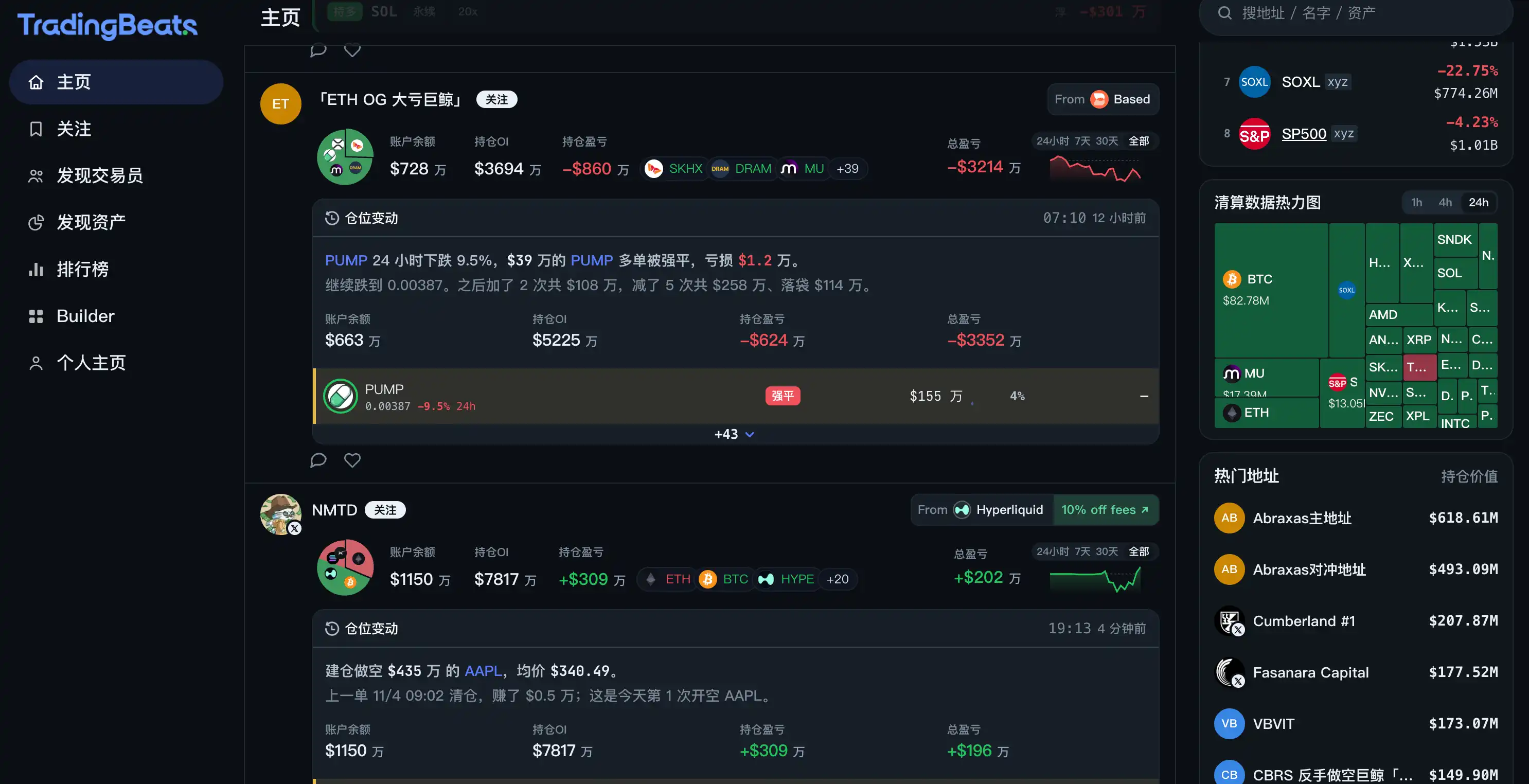
Opened a long position in GOOGL worth $4.37 million, average price $283.06.
As the 2nd-largest SKHX short position, rolled a short position of $3.94 million, total position $15.69 million.
Took profit of 16% on an INTC short, pocketed $520,000, still holding a $5.82 million short position; this short has been held for 28 days.
Behind every entry stands a real decision: how big the position is, where the average price sits, how many times it was added, how long it was held, and how far it is from liquidation. You can also click into someone's profile to see their historical actions, current positions, and realized P&L. Following them is like following a blogger who keeps updating. Every "status" of theirs is written in margin, and cannot be altered after the fact.
Built this way, it reads much more easily. You don't have to memorize an address first, and you don't have to become an on-chain analyst first. Large position openings, adds and reductions, take-profits and stop-losses, and liquidations will flow to you on their own. For ordinary readers, this is far friendlier than a dense spreadsheet; for traders, positions are the work, and P&L is the public report card.
Trading in the Z era is a form of socializing.
Perpetual contracts let almost any asset be bet on, and prediction markets let almost any event be bet on. Bullish on Nvidia, bearish on crude oil, thinking an IPO is underpriced, thinking a war will escalate—these judgments all ultimately converge into the same action: put up margin and take a side, long or short.
At this point, trading and socializing are already stuck together. Social media is about expressing, being seen, being discussed; trading is about judging, betting, being verified. Once positions are public and readable by others, these two things merge into the same information feed.
A post is an opinion, and a P&L is an endorsement. Screenshots can be edited, calls can be deleted, but positions cannot be deleted.
So TradingBeats has made itself into a social product. AI makes information production cheaper and cheaper, yet people increasingly need to see: who is standing on which side with real money. Perpetual contracts and prediction markets will turn more and more opinions into tradable things. Trading as socializing will only become more obvious. This is the big direction.
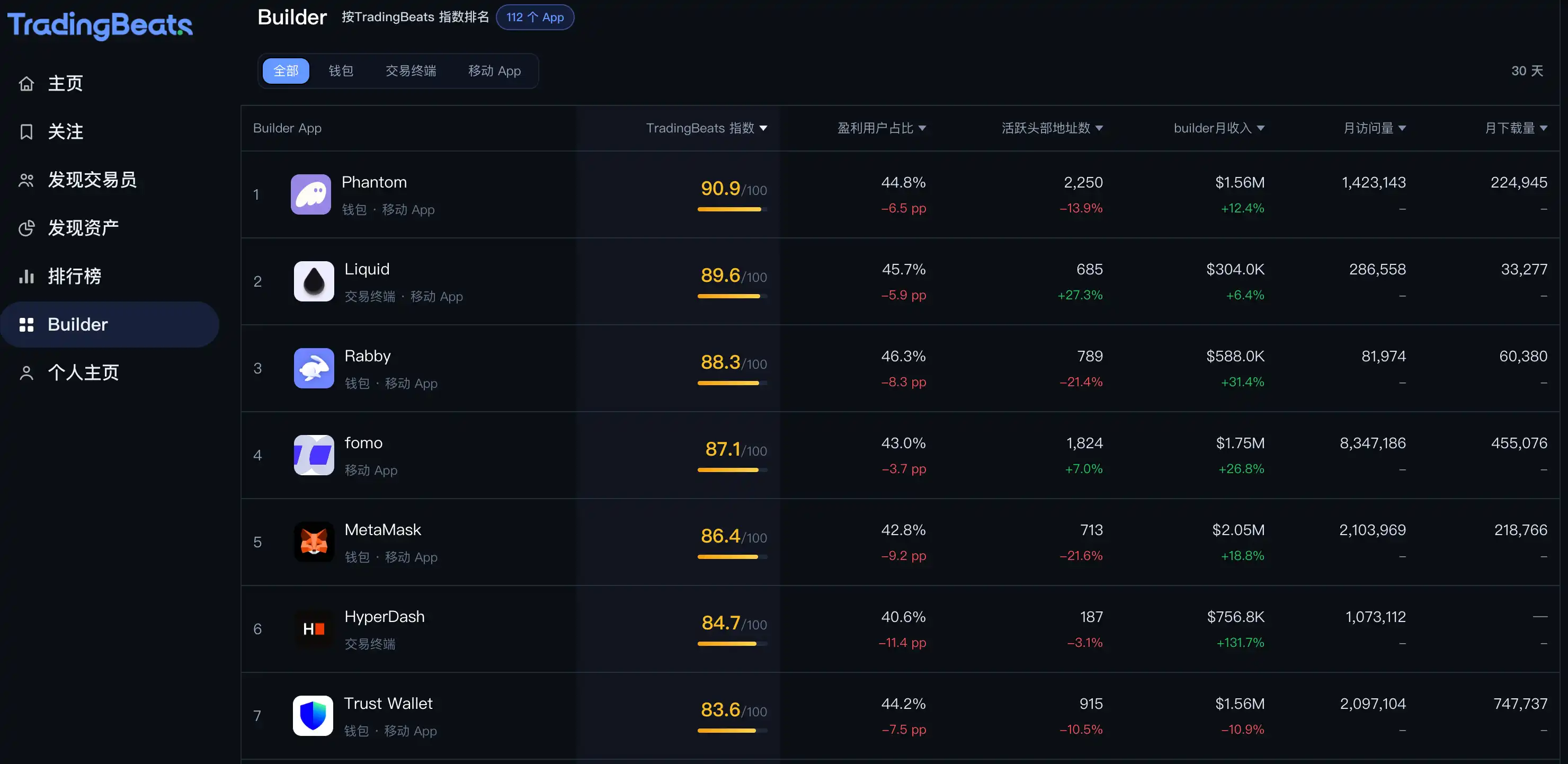
At the same time, TradingBeats has also joined the Builder rankings, and it is currently the only platform where you can see the Hyperliquid Builder rankings. Hyperliquid itself is a protocol. The protocol's door is open, so all kinds of third-party clients can plug in—much like the early internet. When Weibo first took off, there were quite a few third-party clients too; later the official side shut down its API, and the third parties had no way to survive. A protocol won't go down that road. Money will scatter across different entry points—some people come in through this client, some through that one. TradingBeats puts the best traders from these entry points into the same friends feed. At the same time, you can see each entry point's own data—which ones are profitable, which ones have the most traffic—making it easier for users to choose.
The direction is already clear. Crypto, commodities, and equities are converging; perpetual contracts have opened up markets that were previously inaccessible; large on-chain capital will write its views directly onto the order book the very next second.
The new version of TradingBeats is now live. Open tradingbeats.xyz and scroll down. You will see someone going long on crude oil over the weekend, someone bottom-fishing Tesla, someone who just took profit on a 28-day short position, and someone who got liquidated in the early hours of a certain morning.
Behind every trade is a person's judgment. Now, these judgments can be read just like scrolling through a social media feed.
Join the official Coincamps community:
Telegram: https://t.me/coin_camps
Recommended
The AI Window Is Closing: The Chain Reaction Between Work and Real Estate
Nov 10, 12:17
Wall Street Morning Brief: Market Surges on Oil Price and AI Repair, Nvidia the Sole Decliner, Data Centers Become a Political and Regulatory Flashpoint, CPI Missing YoY Adds Uncer
Nov 10, 12:14Ethereum Foundation's 'Loyalty Test': Seppuku, Discrimination, and a Court Battle
Nov 10, 12:08
JPMorgan: The New Investment Logic Under a "Blue Wave"
Nov 10, 11:46Focusing on OnChain Finance, 2027 Hong Kong Web3 Carnival Debuts Institutional Session
Nov 10, 11:39
Anthropic Presses Ahead With IPO Despite Sharp Plunge: Roadshow to Start as Early as Tuesday, Valuation May Face Another 20% Cut
Nov 10, 11:29