
QQQ Alternatives (2026): 6 Cheaper or Different Ways to Own the Nasdaq-100
Invesco QQQ is no longer the cheap way to own the Nasdaq-100. Its total expense ratio is 0.18% (Invesco), while two funds launched this summer track the same index for 0.10%: State Street's QNDX and BlackRock's IQQ. Invesco's own QQQM costs 0.15%.
That price gap is getting attention during a volatile week for tech stocks. Searches for "qqq" passed 50K+ in the US on Google Trends on 23 November 2026, alongside "nasdaq correction vs bear market". Nasdaq's index page showed the Nasdaq-100 at 26,769.72 during US trading that day, up 6.95% on the previous close of 25,028.98.
The short answer: switch new money to QNDX if you want the cheapest copy of QQQ with no fee waiver attached. Pick QQQM if you want Invesco's scale at 0.15%, IQQ if you already use iShares, QQQE if the mega-cap weighting worries you, and SCHG or ONEQ if you want a broader growth fund. Keep QQQ itself if you trade very often or in very large blocks.
Last updated: 23 November 2026. Expense ratios, assets and spreads re-read on each issuer's fund page on this date. All figures are in US dollars and apply to US-listed ETFs.
In Brief
- QQQ cut its fee from 0.20% to 0.18% when shareholders approved its conversion from a unit investment trust to an open-end ETF in December 2025 (Invesco press release). Rivals launched in 2026 have since undercut it.
- QNDX charges 0.10% with no waiver (State Street). IQQ charges 0.12%, cut to 0.10% by a waiver that runs to 31 July 2027 (BlackRock press release).
- On $100,000 held for 10 years at a flat value, QQQ costs $1,800 in fund fees and QNDX $1,000. That $80-a-year saving is too small to justify selling QQQ at a big taxable gain.
- Equal weighting is not a reliable sell-off shield. The equal-weight Nasdaq-100 beat the standard index in only one of the last eight calendar years, 2022 (Direxion).
Why QQQ holders are shopping around
QQQ holders are shopping around for two reasons: price and concentration. QQQ has traded since March 1999 (Invesco), and this year two of the largest ETF issuers launched direct rivals. State Street called QNDX's June 2026 launch a "low-cost, growth-oriented core equity allocation" priced at 10 basis points (State Street). BlackRock followed in July with IQQ (BlackRock).
Concentration is the second reason. In the standard Nasdaq-100, NVIDIA alone weighed 8.36% and Apple 7.38%, and information technology made up 59.89% of the index as of 30 June 2026, per Direxion's index comparison. When a handful of chip and AI names swing, QQQ swings with them. Our sell-off explainer tracked the Nasdaq-100 closing 49 points above bear-market territory on 20 November.
What QQQ still does better: liquidity. Invesco says QQQ was the second-most traded ETF in the US by average daily volume as of 30 September 2026 (Invesco). If you trade intraday or in large size, that depth can matter more than 0.08% a year.
Six QQQ alternatives, from closest copy to biggest change
The first three hold the same 100 stocks as QQQ, so you change cost and issuer, not exposure. The last three change what you own.
1. State Street SPDR Portfolio Nasdaq 100 ETF (QNDX)
Switch if you want the same index as QQQ at the lowest headline fee. QNDX's gross expense ratio is 0.10%, it held 101 stocks and $1,033.64 million in assets as of 20 November 2026, and it listed on Nasdaq on 24 June 2026 (State Street fund page).
You gain 0.08 percentage points a year versus QQQ, with no waiver that can expire. You give up history and size: QNDX is five months old and a small fraction of QQQM's assets. State Street's page did not show a median bid/ask spread when we read it, so check the live quote before a large order.
Verdict: the default pick for new contributions into a Nasdaq-100 position.
2. iShares Nasdaq 100 ETF (IQQ)
Switch if your broker or adviser leans on iShares. IQQ's prospectus expense ratio is 0.12%, with a 0.02% waiver bringing the net to 0.10% (iShares fund page). BlackRock says that waiver runs through 31 July 2027 (press release). Net assets were $1.17 billion and the 30-day median bid/ask spread was 0.04% as of 20 November 2026.
You gain the same price as QNDX today and an issuer with a disclosed trading-cost figure. You lose fee certainty: after July 2027 you pay 0.12% unless BlackRock renews the waiver.
Verdict: a near-tie with QNDX. Choose it on platform convenience, and diarise the waiver date.
3. Invesco NASDAQ 100 ETF (QQQM)
Switch if you want the smallest step away from QQQ. QQQM tracks the same index from the same issuer at 0.15%, had a market value of $97.29 billion on 20 November 2026 and a 0.01% median bid/ask spread (Invesco QQQM page). It launched on 13 October 2020.
You gain 0.03 points a year and a very tight spread. You give up the extra 0.05 points a year that QNDX or IQQ would save you.
Verdict: the safe choice if you value scale over the last few dollars of fees.
4. Direxion NASDAQ-100 Equal Weighted Index ETF (QQQE)
Switch if the main thing bothering you is that a few giants run QQQ. QQQE holds the same companies at roughly 1% each, rebalanced quarterly, and charges 0.35% gross and net (Direxion fund page). The equal-weight index had 44.88% in technology against 59.89% for the standard Nasdaq-100 as of 30 June 2026.
You gain real diversification inside the same 100 names. You give up almost double QQQ's fee and, on recent history, a lot of return in strong tech years (see the chart below).
Verdict: a concentration hedge, not a cheaper QQQ.
5. Schwab U.S. Large-Cap Growth ETF (SCHG)
Switch if you want growth stocks, not specifically the Nasdaq-100, at the lowest cost on this list. SCHG charges 0.04%, tracks the Dow Jones U.S. Large-Cap Growth Total Stock Market Index and held 190 stocks with $54.85 billion in net assets as of 20 November 2026. Its 30-day median spread was 0.03% (Schwab Asset Management).
You gain the lowest fee here and growth companies listed on other exchanges, which the Nasdaq-100 by definition leaves out. You give up the familiar benchmark: SCHG will not move in step with QQQ, in either direction.
Verdict: best for cost-focused long-term holders who are happy to swap one growth index for another.
6. Fidelity Nasdaq Composite Index ETF (ONEQ)
Switch if you like the Nasdaq brand but want more than 100 stocks, including financial companies the Nasdaq-100 excludes. ONEQ invests at least 80% of its assets in Nasdaq Composite stocks and charges 0.21% (Fidelity). Net assets were $10.45 billion at 31 October 2026, with a 0.05% median spread on 20 November.
You gain breadth. You lose on price, since ONEQ is the only fund here dearer than QQQ besides QQQE, and its top 10 holdings were still 56.55% of the fund on 30 October 2026, so the diversification gain is modest.
Verdict: hard to justify on cost alone. Pick it only if the Composite is the index you want.
Side by side: fee, index and trading cost
The table compares each fund's expense ratio, index and the trading-cost data its issuer publishes. QQQ sits in the last row as the reference. Each fund name links to the issuer page we read.
| Fund | Expense ratio | Index | 30-day median bid/ask spread |
|---|---|---|---|
| Our pick: QNDX (State Street) | 0.10% | Nasdaq-100 | Not stated on fund page |
| IQQ (iShares) | 0.10% net, 0.12% gross (waiver to 31 Jul 2027) | Nasdaq-100 | 0.04% |
| QQQM (Invesco) | 0.15% | Nasdaq-100 | 0.01% |
| QQQE (Direxion) | 0.35% | Nasdaq-100 Equal Weighted | Not stated on fund page |
| SCHG (Schwab) | 0.04% | Dow Jones U.S. Large-Cap Growth TSM | 0.03% |
| ONEQ (Fidelity) | 0.21% | Nasdaq Composite | 0.05% |
| Reference: QQQ (Invesco) | 0.18% | Nasdaq-100 | Not stated on fund page |
Two things stand out. Among the funds that hold exactly what QQQ holds, the cheapest is 0.08 points a year cheaper, and none of them is dearer. And the only funds that cost more than QQQ are the ones that change the exposure.
🔎How we picked these funds: we started from US-listed ETFs that either track the Nasdaq-100 or are common substitutes for it (equal-weight, broader Nasdaq, large-cap growth). On 23 November 2026 we read each issuer's fund page, the launch press releases and IRS guidance on capital gains and wash sales. We compared stated fees, index, size and published spreads. We did not trade these funds, and returns shown are index figures, not fund results. No provider paid for placement. See our methodology.
What the fee gap is worth, and when it is not worth selling
The fee gap is worth $8 a year on $10,000 between QQQ and QNDX. The assumptions are simple: the value stays flat and the stated expense ratio is charged every year, with no trading costs or taxes. Real balances move, so treat this as the scale of the saving, not a forecast.
| Fund | Expense ratio | Fee per year on $10,000 | Fees over 10 years on $100,000 |
|---|---|---|---|
| QQQ (reference) | 0.18% | $18 | $1,800 |
| QNDX | 0.10% | $10 | $1,000 |
| IQQ | 0.10% now, 0.12% after July 2027 | $10 | About $1,180 if the waiver ends after year one |
| QQQM | 0.15% | $15 | $1,500 |
| SCHG | 0.04% | $4 | $400 |
| ONEQ | 0.21% | $21 | $2,100 |
| QQQE | 0.35% | $35 | $3,500 |
Now the catch. Suppose you hold $100,000 of QQQ in a taxable account, bought years ago, with $40,000 of long-term gain. At the 15% federal rate that the IRS says applies to most individuals, selling costs about $6,000 in tax, before any state tax. Moving that money to QNDX saves $80 a year. It would take 75 years to earn the tax back.
So for most long-held positions, the practical move is to stop adding to QQQ and send new money to the cheaper fund. Sell only where the tax cost is small: inside a retirement account, in the 0% capital gains bracket, or on lots bought recently near today's price.
Does equal weight protect you in a sell-off?
Equal weight protected investors in 2022, and in none of the following three years. Direxion publishes calendar-year returns for both indexes on its QQQE page. In 2022 the equal-weight index lost 24.31% against 32.38% for the Nasdaq-100. In 2023 it gained 34.01% against 55.13%.
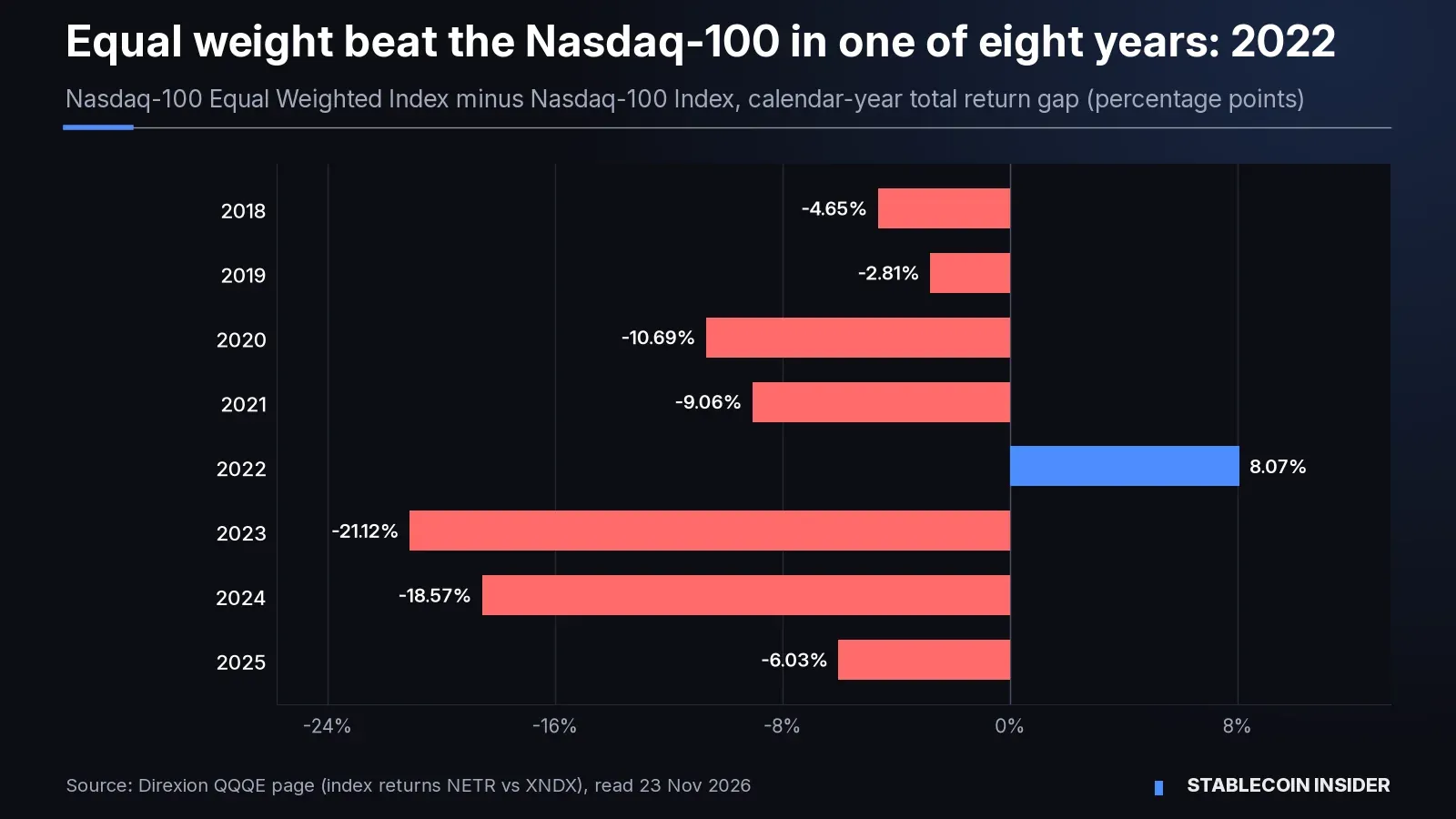
If you expect a long bear market, QQQE lost less in the last one, in 2022. If the giants keep leading, it will likely trail. Paying 0.35% for that bet makes sense only if you hold it with intent, not as a reaction to one rough week.
Moving money out of QQQ without a tax surprise
Moving money out of QQQ goes smoothly if you sort the account type and tax lots before you place a trade:
- Check which account holds the QQQ. In a traditional IRA, amounts including earnings "generally aren't taxed until distributed" (IRS Topic 451), so a swap inside the account is usually the cleanest place to switch.
- Look at each tax lot in a taxable account. Your broker shows the gain or loss per purchase. Lots with small gains are cheap to move; old lots with big gains usually are not.
- Redirect automatic investments first. Change any recurring buy from QQQ to the new fund. This is the fee saving with no tax bill.
- Be careful when you sell at a loss. A wash sale occurs if you buy "substantially identical" securities within 30 days before or after a loss sale, and the IRS says to consider "all the facts and circumstances" (Publication 550). It gives no ETF-specific test, and QNDX, IQQ and QQQM track the same index as QQQ, so ask a tax adviser before harvesting a loss into one of them.
- Use limit orders on the newer funds. QNDX and IQQ are a few months old. Check the live bid and ask before a large order.
If you are still deciding whether to own the Nasdaq-100 at all, our Nasdaq vs S&P 500 comparison looks at returns, drawdowns and fees for both. For how deep past Nasdaq falls went, see the Nasdaq correction tracker. For a similar fee-war decision in another ETF category, see IBIT vs FBTC.
💡Our take: the Nasdaq-100 price war is good news, but it is a reason to change where new money goes, not to sell a large QQQ position you have held for years. For most long-term holders, 0.08 points a year is less than the tax and trading friction of a full switch.
Common Questions
Is QQQM the same as QQQ?
QQQM is the same as QQQ in what it holds: both track the Nasdaq-100, both are run by Invesco. QQQM costs 0.15% against QQQ's 0.18% (Invesco). QQQ was the second-most traded ETF in the US by average daily volume as of 30 September 2026, per Invesco, which matters mainly for very large or very frequent trades.What is the cheapest QQQ alternative?
The cheapest QQQ alternative that holds the same index is QNDX at 0.10% (State Street), level with IQQ's waived 0.10% until 31 July 2027. The cheapest fund on this list overall is SCHG at 0.04%, but it tracks a different growth index (Schwab).Did QQQ's conversion to an open-end ETF create a tax bill?
QQQ's conversion did not create a tax bill, according to Invesco, which said there would be "no tax implications from this conversion for QQQ investors" (press release, 19 December 2025). The change also lets the fund reinvest income and lend securities.Will IQQ's fee go up in 2027?
IQQ's fee will go up to its 0.12% gross expense ratio after 31 July 2027 unless BlackRock extends the waiver, which currently cuts the fee to 0.10% (BlackRock, iShares fund page). On $10,000 that is a change from $10 to $12 a year.Wrapping Up: which QQQ alternative to switch to
For new money into the Nasdaq-100, switch to QNDX: 0.10%, same index, no waiver to watch. Pick IQQ if your platform favours iShares, and QQQM if you would rather stay with Invesco's larger, longer-running fund. Choose QQQE only as a deliberate bet against mega-cap concentration, and SCHG if any low-cost growth fund will do. Keep QQQ if you trade very actively or if selling would trigger a large taxable gain.
Sources: Invesco QQQ ETF page; Invesco: QQQ shareholders vote to approve modernization, 19 Dec 2025; Invesco QQQM fund page; State Street QNDX fund page; State Street QNDX launch release, 24 Jun 2026; iShares IQQ fund page; BlackRock IQQ launch release, Jul 2026; Direxion QQQE fund page; Schwab SCHG fund page; Fidelity ONEQ research page; Nasdaq Global Indexes: NDX overview; Google Trends, US, Business and Finance, past 7 days; IRS Topic 409; IRS Publication 550 (2025); IRS Topic 451. All read on 23 November 2026.
This content is provided for informational and educational purposes only and doesn't constitute financial, investment, legal or tax advice. Fund data for Invesco QQQ and QQQM, State Street QNDX, iShares IQQ, Direxion QQQE, Schwab SCHG and Fidelity ONEQ was read from issuer pages on 23 November 2026, uses the as-of dates shown and can change. The fee examples use only stated expense ratios under the assumptions given; the tax example uses the IRS 15% long-term rate and ignores state taxes and the net investment income tax. Past index returns do not predict future results. ETFs can lose value. Check each fund's prospectus and your own tax position before you trade.
Join the official Coincamps community:
Telegram: https://t.me/coin_camps
Recommended
Why did Washington agree to Jensen Huang's reinstatement at Nvidia?
Nov 24, 00:09
Jensen Huang, the imperial concubine returns to the palace.
Nov 23, 23:56
IBIT vs FBTC (2026): Fees, Custody, Liquidity and Which Bitcoin ETF to Buy
Nov 23, 23:36
Nvidia Officially Announces: Jensen Huang Reinstated as President, CEO and Board Member Effective Immediately
Nov 23, 22:32Nvidia Board Restores Jensen Huang as CEO Full Text: In the Best Interests of All
Nov 23, 22:20