Nvidia vs AMD Stock (2026): Growth, Margins and Valuation Compared
In the three months to late October, Nvidia booked $65.3 billion of net income (Nvidia). That is almost five times AMD's entire revenue for its latest quarter, $13.4 billion (AMD).
The scale gap frames the verdict. Nvidia is the better stock for most investors who want AI-chip exposure: higher margins, a dividend, and a far lower price for each dollar of current earnings. AMD is the better fit for investors who want the faster near-term growth story and a broader business across CPUs, PCs and embedded chips, and who accept a much higher valuation to get it.
Interest in the matchup jumped this week after Nvidia's board reinstated Jensen Huang as chief executive on 22 November 2026 (Form 8-K). "Nvidia stock" showed 1M+ US searches on Google Trends over the past seven days.
Last updated: 27 November 2026. Results, guidance and dividends re-checked against Nvidia and AMD investor releases on this date; share prices from Nasdaq (US listings, figures in USD).
At a Glance
- Growth: Nvidia revenue rose 103% year on year to $115.8 billion; AMD's rose 45% to $13.4 billion.
- Next quarter: AMD guides to about $17 billion, roughly 27% above Q3. Nvidia guides to $130 billion, about 12% higher, with an extra week in the quarter.
- Margins: 74.8% GAAP gross margin at Nvidia against 54% at AMD.
- Price for earnings: on our run-rate maths, Nvidia trades at about 14 times latest-quarter GAAP earnings annualised, AMD at about 70 times.
- Income: Nvidia pays $0.25 a share each quarter. AMD pays no dividend.
- Shared drawdown: both stocks closed on 25 November about 38% below their 52-week highs.
Nvidia and AMD in one table
The table sets each company's latest reported quarter against the other. Nvidia's fiscal third quarter ended 25 October 2026 and AMD's third quarter ended 26 September 2026, so the periods overlap but are not identical. Each row links to its source.
| Measure | Nvidia (NVDA) | AMD (AMD) |
|---|---|---|
| Our pick: Nvidia | Core AI-chip holding for most investors | Higher-risk growth bet |
| Quarter reported | Q3 FY27, to 25 Oct (release) | Q3 2026, to 26 Sep (release) |
| Revenue | $115.8bn, +103% y/y (Nvidia) | $13.4bn, +45% y/y (AMD) |
| Data center sales | $107.6bn, +110% (CFO commentary) | $8.5bn, +97% (AMD) |
| GAAP gross margin | 74.8% (Nvidia) | 54% (AMD) |
| GAAP net income | $65.3bn (Nvidia) | $2.4bn (AMD) |
| GAAP EPS | $2.70 (Nvidia) | $1.46 (AMD) |
| Guidance | $130.0bn ±3%, no China data center compute (Nvidia) | About $17bn ±3% (AMD) |
| Dividend | $0.25 a quarter, next paid 23 Dec (Nvidia) | None (Nasdaq) |
| Close, 25 Nov | $149.30 (Nasdaq) | $406.03 (Nasdaq) |
| Market value | About $3.54tn (Nasdaq, 27 Nov) | About $675bn (Nasdaq, 27 Nov) |
| 52-week range | $124.50 to $243.37 (Nasdaq) | $188.22 to $658.52 (Nasdaq) |
Two patterns stand out. Nvidia wins almost every line on size and profitability. AMD wins on the pace it expects next quarter, which is exactly what its higher share price multiple is paying for.
🔎How we compared: on 27 November 2026 we read Nvidia's Q3 fiscal 2027 results release and CFO commentary, Nvidia's 23 November press release and Form 8-K on Jensen Huang's reinstatement, AMD's Q3 2026 results release and earnings slides, and Nasdaq quote pages for prices, market value, 52-week ranges and dividends. Per-share, margin and run-rate valuation figures are our arithmetic on those numbers. We compared growth, profitability, valuation, business mix, shareholder returns and risks. We did not trade either stock for this article. No provider paid for placement. See our methodology.
Growth: who is expanding faster?
Nvidia grew faster over the past year, while AMD expects to grow faster next quarter. Nvidia's revenue more than doubled, up 103% from a year earlier and 20% from the previous quarter (Nvidia). AMD's rose 45% year on year and 16% quarter on quarter, to a record (AMD).
The guidance flips the order. AMD expects fourth-quarter revenue of about $17 billion, which it says is about 66% above a year earlier and about 27% above Q3 (AMD). Nvidia guides to $130.0 billion, plus or minus 3%. That is about 12% above Q3 on our arithmetic, and the quarter includes an additional week, which flatters the comparison (Nvidia).
However, the base matters. AMD's extra $3.6 billion of expected quarterly revenue is smaller than the $14.2 billion Nvidia expects to add. AMD's chief executive Lisa Su said she expects growth "to accelerate further in the fourth quarter as we scale Helios and 'Venice' production" (AMD).
Profitability: 75% margins against 54%
Nvidia is far more profitable than AMD on every measure in the two releases. Its GAAP gross margin was 74.8% and its net income was 56% of revenue (Nvidia). AMD's GAAP gross margin was 54% and net income was about 18% of revenue (AMD); the net-margin figures are our calculation.
On the other hand, the trend is moving in AMD's favour. Its GAAP operating margin rose from 14% to 21% in a year, and non-GAAP earnings per share grew 74% (AMD). Nvidia guides its gross margin down to between 71% and 72% next quarter (Nvidia), while AMD guides to about 55% on a non-GAAP basis.
Valuation: what $10,000 buys in each stock
A $10,000 purchase of Nvidia buys about five times as much current profit as the same amount in AMD. The table works this out under explicit assumptions:
- Purchase at the 25 November 2026 closing prices from Nasdaq: $149.30 for Nvidia and $406.03 for AMD.
- Latest-quarter diluted EPS from each company's release, GAAP and non-GAAP.
- "Run-rate P/E" means the price divided by four times the latest quarter's EPS. It is our simple yardstick, not a forecast or a consensus forward P/E.
- No fractional-share fees, taxes or price moves after purchase.
| On $10,000 | Nvidia | AMD |
|---|---|---|
| Shares bought | 66.98 | 24.63 |
| Your share of one quarter's GAAP profit | $180.84 | $35.96 |
| Same, non-GAAP | $179.50 | $51.47 |
| Dividends over a year | $66.98 | $0 |
| Run-rate P/E, GAAP | 13.8 | 69.5 |
| Run-rate P/E, non-GAAP | 13.9 | 48.6 |
The gap is wide on either accounting basis. AMD's GAAP profit is held down by acquisition-related amortisation and a $1.18 billion non-cash item for warrants issued to customers, both added back in its cash-flow statement, which is why its non-GAAP multiple is lower. Even so, an AMD buyer pays more than three times as much for each dollar of current non-GAAP earnings.
That premium is a bet that AMD's growth will close the earnings gap. If AMD's fourth quarter lands near $17 billion and margins keep widening, the multiple shrinks quickly. If growth stalls, there is little cushion.
Business mix: how dependent is each on data centers?
Nvidia is almost a pure data-center company now, while AMD still earns about a third of its sales elsewhere. Data Center was $107.6 billion of Nvidia's $115.8 billion, and Edge Computing the remaining $8.2 billion (CFO commentary). AMD's Data Center segment was $8.546 billion of $13.377 billion, with $3.722 billion from Client and Gaming and $1.109 billion from Embedded (AMD).
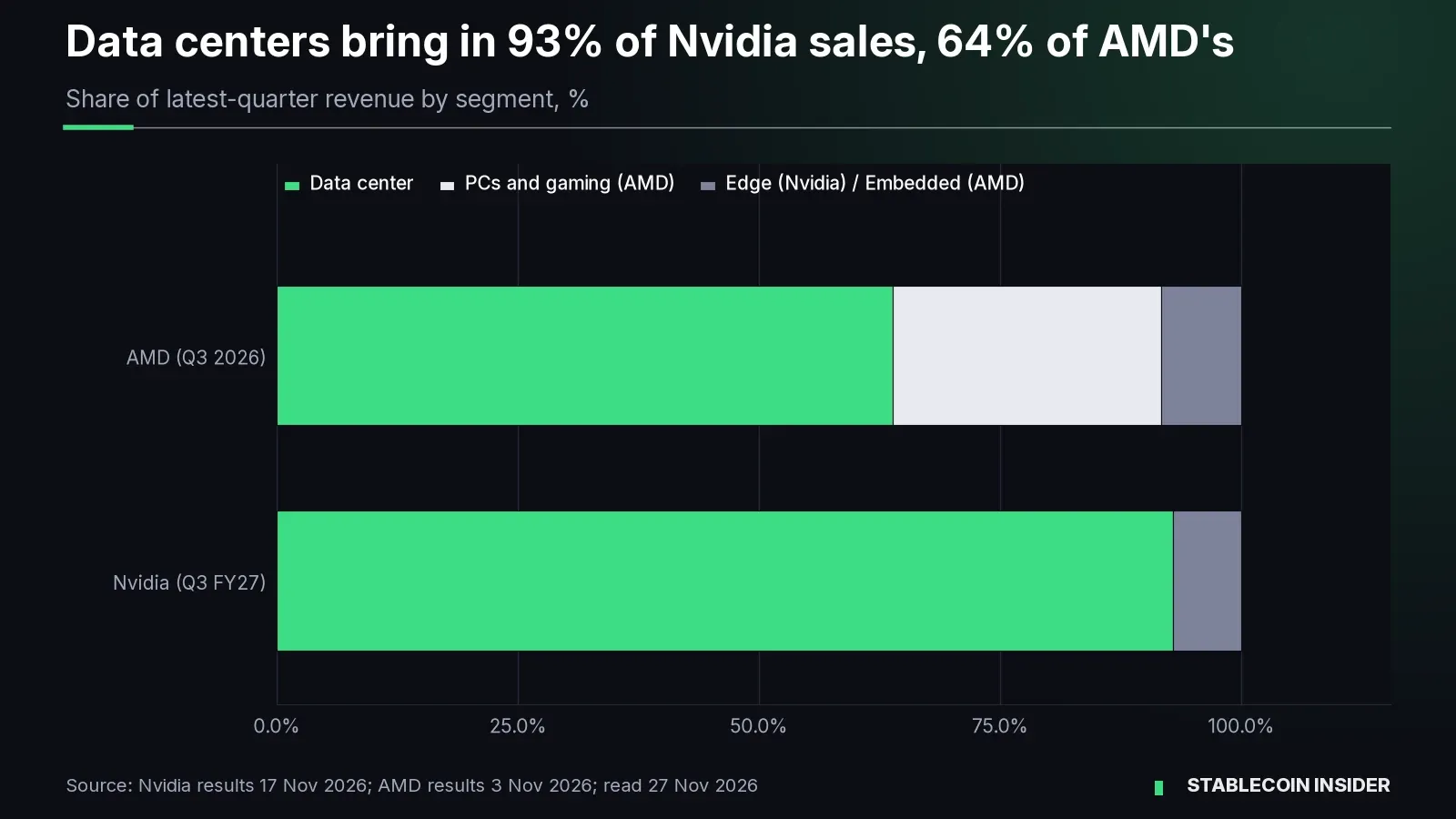
Diversification cuts both ways. AMD's PC business grew 7% but its Gaming revenue fell 40% to $773 million (AMD), so not every non-AI line helps. Nvidia's concentration means its results rise and fall with spending by a handful of cloud and AI customers; hyperscalers alone were $60.1 billion of its revenue (CFO commentary).
Dividends and buybacks
Nvidia returns cash to shareholders and AMD, for now, mostly does not. Nvidia returned $28.1 billion through buybacks and dividends in the quarter and had about $227.3 billion left under its repurchase authorisation (Nvidia). Its next $0.25 dividend goes to holders of record on 2 December 2026, a yield of about 0.67% at Nasdaq's quote (Nasdaq).
AMD pays no dividend (Nasdaq). Its cash-flow statement shows no share repurchases in the third quarter and $221 million in the first nine months of 2026 (AMD).
The risks each stock carries
Nvidia's biggest risks right now are governance and policy rather than demand. The board reinstated Huang after what it called input from "senior levels of the United States government", and said an independent committee's investigation into a reported foreign intelligence effort targeting him "will proceed to conclusion" (Nvidia). Its outlook also assumes no data-center compute revenue from China (Nvidia). Reuters reported the shares closed up 31.5% on the day of the reinstatement (Reuters), which shows how sensitive the price is to this story.
AMD's risks are execution and valuation. Its forecast depends on ramping its Helios rack systems and 'Venice' EPYC processors on schedule (AMD), and at roughly 49 to 70 times run-rate earnings, a miss would hurt more than at Nvidia's multiple. Both companies flag that guidance is forward-looking and that actual results could differ materially.
Who should choose which
Choose Nvidia if you
- want one core holding in the AI-chip leader, with the highest margins in the group;
- prefer to pay a lower price for current earnings (about 14 times on our run-rate yardstick);
- value a small, growing cash return through dividends and buybacks;
- can live with headline risk around leadership, investigations and China exports.
Choose AMD if you
- want the faster expected growth next quarter (about 27% against 12%);
- prefer a business with CPUs, PCs and embedded chips alongside AI accelerators;
- accept a far higher valuation and no dividend in exchange for catch-up potential;
- already own Nvidia through an index fund and want a different chip exposure.
If you would rather not pick one company, a semiconductor ETF holds both. Our SMH vs SOXX comparison shows how differently two chip funds weight Nvidia and AMD. For the background to this month's swings, see our coverage of Nvidia's Q3 earnings call and of Huang's resignation. If you are still choosing where to buy, our Robinhood vs Webull guide compares two popular US brokers.
FAQ
Is Nvidia stock cheaper than AMD stock?
Nvidia stock is cheaper than AMD stock relative to earnings, though not per share. At the 25 November close Nvidia cost $149.30 a share and AMD $406.03 (Nasdaq). On our run-rate yardstick, Nvidia trades at about 14 times annualised latest-quarter GAAP earnings and AMD at about 70 times.Does AMD pay a dividend?
AMD does not pay a dividend; Nasdaq lists its annualised dividend as not applicable (Nasdaq). Nvidia pays $0.25 a share each quarter, with the next payment on 23 December 2026 (Nvidia).Which company is growing faster, Nvidia or AMD?
Nvidia grew faster over the past year, at 103% against AMD's 45% (Nvidia, AMD). AMD expects faster growth next quarter: about 27% sequentially, against roughly 12% for Nvidia, whose quarter includes an extra week.Final Thoughts
Nvidia is the stronger company today and, on current earnings, the cheaper stock. AMD is the faster-accelerating challenger, priced for that acceleration to continue. For a single long-term chip holding, Nvidia's numbers make the stronger case. AMD makes more sense as a smaller position for investors who want the catch-up story and can stomach the volatility.
Sources: Nvidia: Q3 fiscal 2027 results, 17 Nov 2026; Nvidia: Q3 FY27 CFO commentary (SEC); Nvidia: Huang reinstatement release, 23 Nov 2026; Nvidia Form 8-K, 22 Nov 2026 event; AMD: Q3 2026 results, 3 Nov 2026; AMD: Q3 2026 earnings slides; Nasdaq: NVDA quote; Nasdaq: AMD quote; Reuters: Huang reinstatement, 23 Nov 2026; Google Trends, US, Business and Finance, past 7 days. All read on 27 November 2026.
This content is provided for informational and educational purposes only and doesn't constitute financial, investment, legal or tax advice. Figures were read on 27 November 2026 from Nvidia, AMD and Nasdaq pages and may have changed; share prices move continuously. Run-rate valuation figures are our own simplified arithmetic, not forecasts. Past performance does not guarantee future results. Companies mentioned: Nvidia, AMD. Do your own research or consult a licensed adviser before investing.
Join the official Coincamps community:
Telegram: https://t.me/coin_camps
Recommended
Meme Daily: A one-chart look at the hottest Memes of the past 24 hours (2026.11.28)
Nov 28, 11:18Weekly Digest | Precious metals, crypto and stocks swing wildly; Jensen Huang's comeback rally lasts just one day
Nov 28, 09:30Big Tech's New-Grad Slots Are Being Handed to AI Budgets First
Nov 28, 07:55Capitec Alternatives (2026): 4 Banks to Switch To, and When Staying Wins
Nov 28, 01:34