
US Stablecoin Payments Under the GENIUS Act: Compliance Rules and the 9-Layer Infrastructure Stack
B2B stablecoin payments reached $226 billion a year, up 733% year over year, while the cross-border B2B payments market they compete with is worth $31.6 trillion.
The gap between those two numbers is the opportunity. The GENIUS Act is the reason it is now open.
For years, US payment providers ran stablecoin pilots that never reached production. The blocker was not demand. It was the absence of a federal definition of a payment stablecoin, who can issue one, what reserves back it, and how existing AML and sanctions obligations apply. Legal and compliance teams could not sign off, so infrastructure budgets stayed frozen.
That ended on July 18, 2025, when the Guiding and Establishing National Innovation for US Stablecoins Act was signed into law.
We tracks the regulation and infrastructure behind stablecoin adoption, and this article breaks down The US Stablecoin Payments Playbook, a compliance and infrastructure guide for payment providers published by Notabene, the Travel Rule and counterparty-trust network used by regulated crypto and payment institutions in more than 100 countries.
It covers what the GENIUS Act requires of intermediaries, why the B2B payment window is opening now, the nine-layer stablecoin infrastructure stack, and where PSPs, on/off ramps, orchestrators, and custodians each have gaps.
Key Takeaways
- The GENIUS Act is the first federal statute to define and regulate payment stablecoins as a distinct asset class, and it takes effect no later than January 18, 2027.
- Total stablecoin market capitalization hit an all-time high of $318.6 billion in April 2026, and B2B stablecoin payment volume reached $226 billion annually, up 733% year over year.
- 81% of corporates told EY that supportive legislation would increase their interest in stablecoins, and 77% named cross-border payments as the top use case.
- Stablecoin settlement cuts all-in cross-border costs from 2%–7% of transaction value to 0.1%–0.5%, or from $2,000–$7,000 to $100–$500 on a $100,000 invoice.
- Notabene's playbook maps a nine-layer stablecoin infrastructure stack and finds the biggest gaps in Layers 5 to 9: trust, compliance, authorization, reconciliation, and reporting.
What the GENIUS Act Changes for Payment Infrastructure Providers
The GENIUS Act is deliberately narrow. It covers fiat-backed payment stablecoins issued by permitted institutions, requires 1:1 reserves in cash and short-duration Treasuries, mandates monthly public reserve disclosures, and subjects issuers to bank-level AML and sanctions requirements. It does not reach DeFi tokens, algorithmic stablecoins, or digital assets held as investments.
Its scope is payments, and the infrastructure that supports them.
According to Notabene's playbook, the law takes effect on the earlier of January 18, 2027 or 120 days after federal regulators issue final implementing rules, and the OCC, FDIC, and FinCEN have been issuing those rules through 2026. The OCC published its final rule on October 21, 2026, with an effective date of January 18, 2027, as covered in our breakdown of the OCC GENIUS Act final rule.
The playbook argues the Act does three things at once for payment providers:
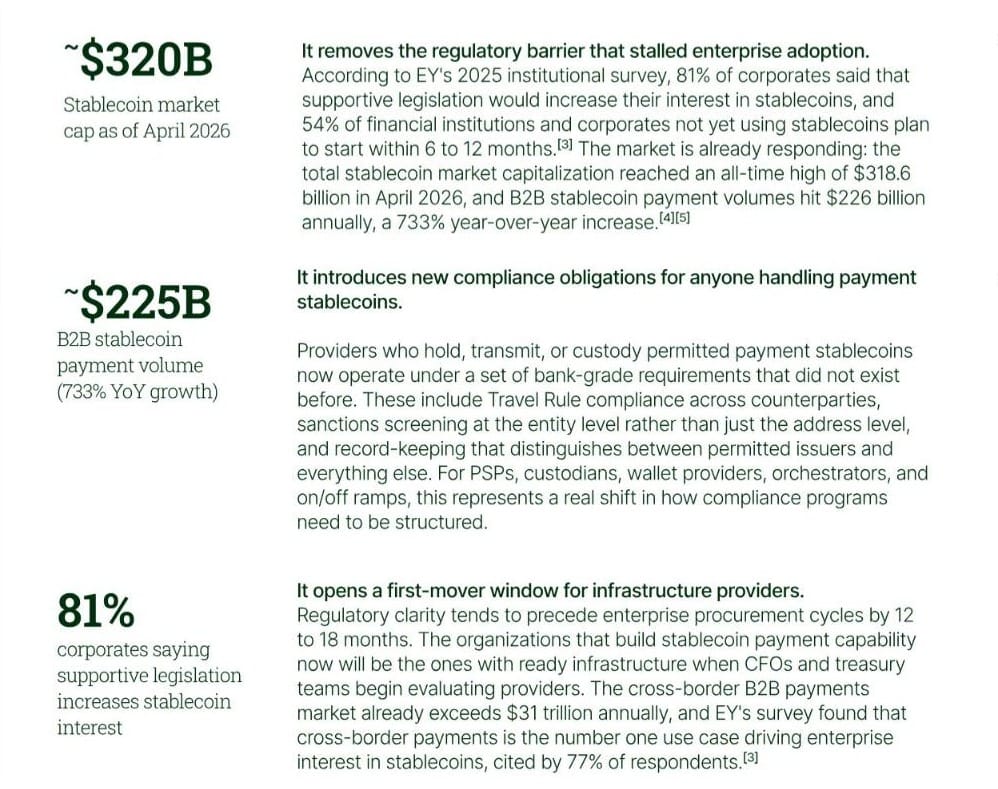
- It removes the regulatory barrier that stalled enterprise adoption: According to EY's 2025 institutional survey, 81% of corporates said supportive legislation would increase their interest in stablecoins, and 54% of financial institutions and corporates not yet using stablecoins plan to start within 6 to 12 months.
- It introduces new compliance obligations for anyone handling payment stablecoins: Providers that hold, transmit, or custody permitted payment stablecoins now operate under bank-grade expectations: Travel Rule compliance across counterparties, entity-level sanctions screening, and record-keeping that distinguishes permitted issuers from everything else.
- It opens a first-mover window for infrastructure providers: Regulatory clarity tends to precede enterprise procurement cycles by 12 to 18 months, so the providers that build capability now will be ready when CFOs and treasury teams start evaluating vendors.
The practical question for payment providers is no longer whether to build stablecoin capability. It is what to build, in what order, and how much of it to own versus adopt.
What GENIUS Act Compliance Requires From PSPs, Custodians, and Orchestrators
The GENIUS Act does not rewrite US financial regulation from scratch. It layers a dedicated federal regime on top of existing rules, and what it means in practice depends on which side of the payment stablecoin ecosystem a company sits on.
For issuers, the April 2026 FinCEN/OFAC joint proposed rule sets AML/CFT and sanctions program requirements that track bank-level standards. For intermediaries, including PSPs, custodians, wallet providers, orchestrators, and on/off ramps, most obligations already apply through pre-existing Bank Secrecy Act (BSA) and sanctions authority. What GENIUS changes is enforcement certainty and the operational bar that counterparties and examiners now expect.
There is one major new restriction that runs directly to intermediaries. After a three-year transition period, digital asset service providers handling payment stablecoins for US persons will generally need to use stablecoins issued by permitted payment stablecoin issuers, or by foreign issuers under a comparable regime. That turns issuer verification into a statutory requirement.
1. Counterparty identification and the Travel Rule
Any provider operating as a money services business under FinCEN's framework, which includes most PSPs, custodians, wallet providers, and orchestrators, has been subject to BSA obligations including the Travel Rule since FinCEN's May 2019 guidance on convertible virtual currencies made its application to stablecoins explicit.
GENIUS does not create this obligation. It removes any remaining ambiguity about whether permitted payment stablecoins fall within the perimeter and raises the enforcement stakes.
The Travel Rule threshold is $3,000 in the US under 31 CFR 1010.410(f), and zero under both the EU Transfer of Funds Regulation and Singapore's PSA framework. At or above the threshold, both institutions must collect, verify, and transmit identifying information about the sender and receiver.
In practice, the playbook says this requires three things:
- A way to identify the counterparty institution for a given transfer.
- A secure channel to exchange required data before or at the time of settlement.
- A system to store and retrieve that data for regulatory examination.
2. Sanctions screening at the entity level
Sanctions compliance for stablecoin payments goes well beyond blockchain address screening. OFAC's October 2021 Sanctions Compliance Guidance for the Virtual Currency Industry already expects US persons, including PSPs, custodians, exchanges, and wallet providers, to maintain risk-based sanctions programs, screen counterparties at the entity and individual level, and demonstrate the technical ability to block, freeze, or reject transactions linked to sanctioned parties. These expectations apply on a strict liability basis.
The April 2026 FinCEN/OFAC proposed rule for permitted payment stablecoin issuers adds real-time screening, program testing, and auditable controls. While those direct obligations run to issuers, the playbook reads them as the standard regulators will increasingly expect across the wider ecosystem.
Address screening alone is not sufficient under the proposed framework.
3. KYC and suspicious activity reporting
Under the GENIUS Act, permitted payment stablecoin issuers are classified as financial institutions under the BSA. That brings a customer identification program, ongoing due diligence, suspicious activity reporting, and the technical ability to block or freeze transactions that violate US law or sanctions.
The FinCEN/OFAC proposal adds a risk assessment, internal controls, independent testing, a US-based qualified compliance officer, ongoing training, and customer due diligence for direct customer relationships. For the issuer-side detail, see our coverage of the FDIC's proposed AML and sanctions standards for stablecoin issuers.
For intermediaries, BSA status still depends on how the entity is classified. Money services businesses remain subject to AML program, customer identification, due diligence, recordkeeping, and SAR obligations under 31 CFR Part 1022. The GENIUS Act does not reclassify them.
4. Issuer verification and token classification
One of the less-discussed requirements is distinguishing permitted payment stablecoins from everything else. The GENIUS Act defines permitted payment stablecoins narrowly: issued by a licensed institution, backed 1:1 by qualifying reserves, and subject to monthly public attestation.
Tokens outside that definition receive different, and potentially less favorable, regulatory treatment, so providers need a reliable way to verify what is moving through their systems.
Our list of GENIUS Act compliant stablecoins tracks which assets qualify.
5. Record-keeping and audit readiness
Record-keeping runs on two tracks. Issuers face bank-grade expectations under the FinCEN/OFAC proposal, including regular internal auditing and testing of compliance controls.
Intermediaries already have BSA record-keeping duties under 31 CFR Part 1010, but enterprise counterparties and examiners will increasingly expect the same depth the issuer rule describes: transaction records, counterparty identification data, sanctions screening logs, and authorization decisions in an examinable format.
6. Cross-border rules: the US is not the only jurisdiction
Payment providers rarely serve one market. The EU's Transfer of Funds Regulation, in full effect since December 2024, requires Travel Rule data on every crypto-asset transfer with no de minimis threshold, and MiCA's grandfathering window for existing providers closed on July 1, 2026.
Singapore, Hong Kong, and other markets run their own Travel Rule regimes at various stages of enforcement. Notabene maintains a jurisdiction-by-jurisdiction Travel Rule tracker.
A compliant US operation is not automatically compliant in the EU or Asia.
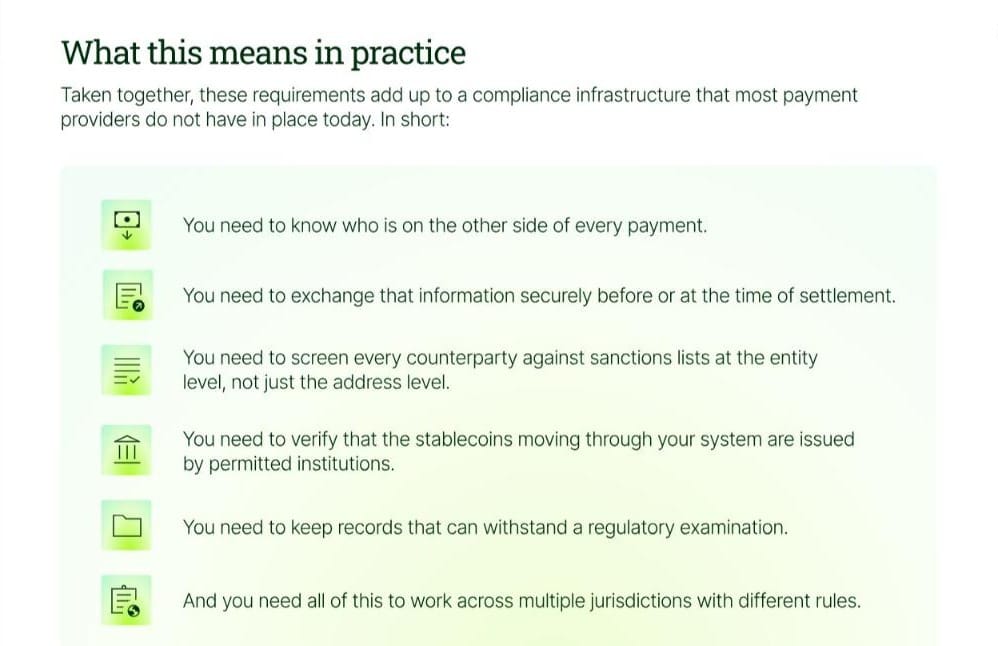
GENIUS Act Compliance Requirements at a Glance
| Requirement | Legal basis | New under GENIUS? | What providers need |
|---|---|---|---|
| Travel Rule | BSA, 31 CFR 1010.410(f); FinCEN 2019 CVC guidance | No, but perimeter and enforcement clarified | Counterparty ID, pre-settlement data exchange, retrievable records |
| Sanctions screening | OFAC 2021 virtual currency guidance; FinCEN/OFAC April 2026 proposal | Higher bar (real-time, tested, auditable) | Entity-level screening on top of address screening |
| KYC, CDD, SAR | BSA; 31 CFR Part 1022 for MSBs | New for issuers; unchanged for MSBs | CIP, ongoing due diligence, block/freeze capability |
| Issuer verification | GENIUS Act permitted issuer definition | Yes, statutory after three-year transition | Verify tokens are from permitted or comparable issuers |
| Record-keeping | BSA, 31 CFR Part 1010; FinCEN/OFAC proposal | Higher counterparty and examiner expectations | Exam-ready logs of transactions, screening, authorizations |
| Cross-border | EU TFR, MiCA, Singapore PSA, others | Already live outside the US | Jurisdiction-aware rules in one auditable system |
Why the B2B Stablecoin Payments Opportunity Is Opening Now
Compliance is the entry ticket, not the reason to invest. The reason, according to Notabene, is that the B2B cross-border payments market is large, structurally inefficient, and beginning to move.
The global cross-border B2B payments market exceeded $31.6 trillion in 2024, according to FXC Intelligence data cited in the playbook. It still runs on correspondent banking, SWIFT messaging, and multi-day settlement.
The all-in cost of a traditional cross-border wire, including bank fees, FX spreads, and intermediary charges, runs between 2% and 7% of transaction value. Settlement takes three to five business days, and reconciliation is often manual.
Stablecoin-based payments settle in seconds, run 24/7, and reduce all-in costs to between 0.1% and 0.5% of transaction value.
| Metric | Traditional cross-border wire | Stablecoin payment |
|---|---|---|
| All-in cost | 2%–7% of value | 0.1%–0.5% of value |
| Cost on a $100,000 invoice | $2,000–$7,000 | $100–$500 |
| Settlement time | 3–5 business days | Seconds |
| Operating hours | Banking hours and holidays | 24/7 |
| Reconciliation | Manual, after the fact | Can travel with the payment (with structured context) |
Demand data supports the shift. EY's 2025 survey found 77% of respondents named cross-border payments as the primary use case driving their stablecoin interest, and 41% of current users reported cost savings above 10% versus traditional methods.
B2B stablecoin payment volume reached $226 billion annually, a 733% increase, according to BCG. In March 2026, the Federal Reserve published a research note on payment stablecoins in cross-border settlement, which the playbook reads as a sign that the central bank views stablecoin rails as durable infrastructure.
$226 billion is still small next to $31.6 trillion. That is the point: it is early enough that infrastructure position still matters, and late enough that the demand signal is real.
For a deeper look at the use case, see our guides to B2B stablecoin payments and stablecoin B2B cross-border payments, or Notabene's overview of compliant cross-border stablecoin payments.
The 9-Layer Stablecoin Infrastructure Stack
Offering compliant B2B stablecoin payments is not a single integration. Notabene's playbook describes it as a stack of nine capabilities, each building on the one below. Some layers can be sourced from established vendors. Others require infrastructure most payment providers do not have today.
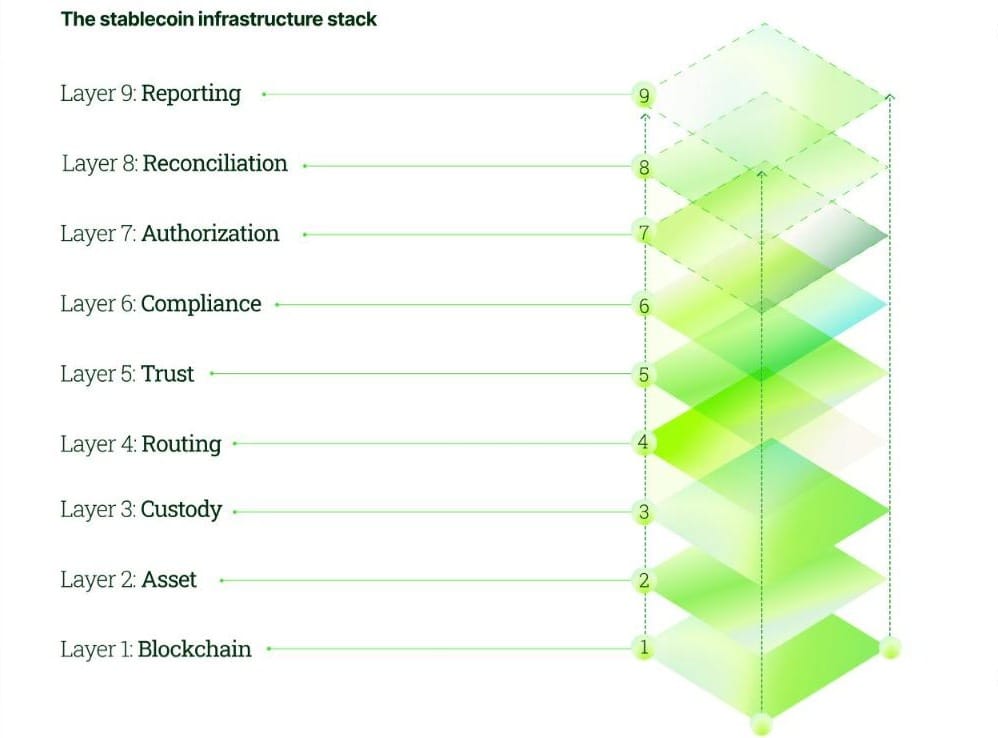
Layer 1: Blockchain
The settlement networks where stablecoin transactions are recorded and finalized. Ethereum and Tron still carry significant volume, but the layer is expanding toward institutional use cases. Canton, a privacy-preserving blockchain, supports over $6 trillion in on-chain assets across 600 institutional participants.
Monad, a high-throughput EVM-compatible chain, has drawn institutional interest for real-world asset tokenization, and Tempo, the payments chain co-founded by Stripe and Paradigm, launched mainnet in March 2026 for stablecoin settlement. Most providers will need to support multiple chains.
Layer 2: Asset
The permitted payment stablecoins themselves. The issuer landscape is no longer just Circle and Tether: PayPal's PYUSDx framework, launched in early 2026, lets developers issue branded, application-specific stablecoins backed by PYUSD reserves, and the number of stablecoins with supply above $10 million grew 89% in 2025. The stack needs to be asset-agnostic and interoperable across issuers.
Layer 3: Custody
Key management, multi-chain address infrastructure, and the accounts that hold and move funds. The basics are well understood: secure key storage, transaction signing, address management, and institutional access controls. What changes under a payments model is that every wallet address represents a counterparty. Custody without counterparty awareness is no longer sufficient.
Layer 4: Routing
The logic that moves value across chains and asset types, including FX and liquidity conversion when sender and receiver use different stablecoins or fiat currencies. Cross-border routing needs liquidity providers that bridge stablecoins and local currencies in real time.
The playbook cites Borderless.xyz, which runs a stablecoin orchestration and liquidity network connecting licensed providers across countries through one API. Few providers will want to build global FX and liquidity themselves.
Layer 5: Trust
Knowing who is on the other side of every payment at the institution level, beyond on-chain address attribution. That means a verified registry of counterparty institutions: legal identity, regulatory status, jurisdictional authorizations, and associated wallet addresses. Without it, a stablecoin payment is just a transfer between anonymous addresses.
The playbook argues that building this registry alone is impractical and that it requires a shared network of verified, discoverable regulated entities, such as the Notabene Network.
Layer 6: Compliance
Travel Rule data exchange, entity-level sanctions screening, and jurisdiction-aware policy enforcement, handled by one infrastructure rather than separate workflows per market. Notabene notes that the gap between "technically compliant" and "operationally ready" on the Travel Rule is wider than most providers expect. Its Travel Rule product has supported regulated institutions since 2020.
Layer 7: Authorization
The step where a payment is reviewed and approved before funds move. Traditional finance does this, which is part of why it is slow. Stablecoin rails solve speed but usually skip authorization: funds move on-chain and context arrives later, if at all.
US, EU, and Asian Travel Rule frameworks are moving toward pre-transaction data exchange, so counterparty information must be verified and sent before funds are released. Missing this layer creates both operational risk and a compliance gap.
Layer 8: Reconciliation
Structured payment context, such as invoice references, amounts, currency, and counterparty identity, that travels with the settlement. SWIFT messages and bank wires carry remittance data that ERP systems ingest automatically.
Stablecoin payments have had no equivalent, so even fast, cheap settlement leaves finance teams matching payments to invoices by hand. The playbook calls this one of the most significant unsolved problems in stablecoin payments infrastructure.
Layer 9: Reporting
Record-keeping, regulatory reporting, and examination-ready logs for everything in Layers 5 to 8. Banks, regulated fintechs, and enterprise finance teams operate under exam regimes where a complete audit trail is a condition of doing business, and the FinCEN/OFAC proposed rule calls explicitly for regular internal auditing and testing of compliance controls.
Where the Biggest Gaps in Today's Stablecoin Stacks Are
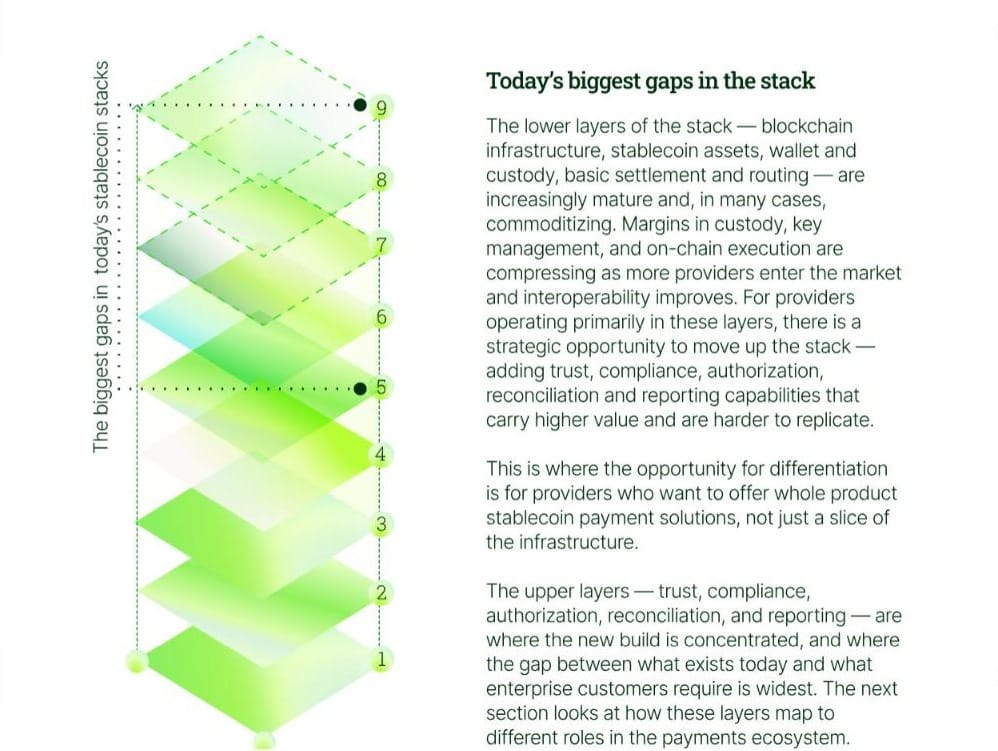
Layers 1 to 4, blockchain, assets, custody, and basic routing, are maturing and in many cases commoditizing. Margins in custody, key management, and on-chain execution are compressing as more providers enter and interoperability improves.
Layers 5 to 9 are where the new build is concentrated.
Trust, compliance, authorization, reconciliation, and reporting are where the distance between what exists today and what enterprise customers require is widest. They carry higher value and are harder to replicate, which is why the playbook frames them as the differentiation opportunity for providers that want to sell whole-product stablecoin payments rather than a slice of the infrastructure.
Where PSPs, On/Off Ramps, Orchestrators, and Custodians Fit in the Stack
No single provider needs to build the full stack. Each provider type already covers some layers, and the strategic question is where to invest next.
| Provider type | Strong layers | Typical gaps | Opportunity |
|---|---|---|---|
| PSPs and payment processors | Merchant relationships, billing, authorization logic, reconciliation | Multi-chain connectivity, wallets, identity, compliance, data exchange | Stablecoin acceptance and B2B billing (invoicing, subscriptions, AR) for existing merchants |
| On/off ramps and remittance platforms | Fiat conversion, corridors, settlement, routing, local licenses | Counterparty identity, Travel Rule, authorization, structured reconciliation | Move upmarket from retail/SMB remittance into institutional B2B cross-border |
| Stablecoin orchestrators | Multi-chain routing, asset selection, settlement logic, fiat corridors | Counterparty trust, compliance, authorization, invoicing and reconciliation | Shift from commoditizing push payouts to pull payments and recurring billing |
| Custodians and wallet infrastructure | Chain connectivity, key management, address infrastructure, secure storage | Payment functionality, counterparty verification | Let clients pay invoices directly from custody accounts and earn new fee streams |
PSPs and payment processors
PSPs are strong in the middle of the stack. The playbook argues that defensible value sits in B2B billing via stablecoins, including recurring invoicing, subscriptions, and accounts receivable, because it needs exactly the structured, compliant payment flows PSPs already manage.
Notabene outlines this use case on its payment providers page.
On/off ramps and remittance platforms
These providers own the edges of the stack, converting fiat to stablecoins and back across dozens of corridors. Most serve retail or SMB use cases today. Enterprise buyers expect compliance, counterparty verification, and audit readiness that retail-grade rails do not provide.
Stablecoin orchestrators
Orchestrators excel at routing, asset selection, and settlement logic, and many have built fiat corridor networks with pre-funded accounts. Their structural problem is that push payments, such as payouts, disbursements, and supplier transfers, are commoditizing fast.
The playbook's way out is moving up the value chain into products that carry context, enforce compliance, and support pull payments and recurring billing, which carry a different margin profile and stickier customers.
Custodians and wallet infrastructure providers
Custodians own the lower layers, where commoditization pressure is highest. Many are already the primary stablecoin account for business clients who pay and receive invoices every week.
Adding payments on top of custody, with counterparty verification and compliance handled at the network level, turns a low-margin service into a revenue-generating product.
See Notabene's approach for custodians.
The common thread across all four: the lower layers are mature and competitive, while identity, compliance, authorization, reconciliation, and reporting are where enterprise expectations are highest and durable advantage can be built.
How Notabene Flow Covers Layers 5 to 9
The final section of the playbook presents Notabene Flow, an open B2B stablecoin payments platform designed to cover the upper stack so providers do not have to build it themselves.
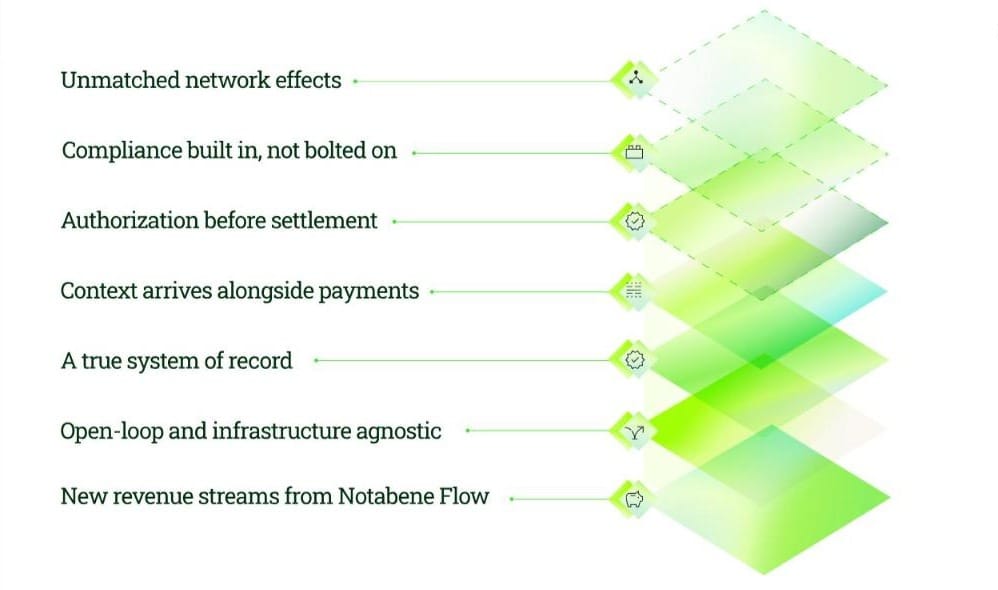
- Network effects: Notabene describes its network as the largest active network of regulated entities connected for counterparty data exchange, with thousands of institutions across more than 100 countries. New participants inherit connectivity to every institution already onboarded.
- Open protocol: The network is built on TAP (Transaction Authorization Protocol), an open-source specification any institution can implement, which keeps integrations portable and avoids protocol-level lock-in. Participants are vetted through a governance framework covering regulated status, security baselines, GLEIF legal entity identifiers, and exclusion of FATF call-to-action jurisdictions.
- Compliance built in: Every Flow payment carries the counterparty data and structured context needed for Travel Rule compliance. Settlement addresses are only shared after complete authorization, so a transaction cannot settle without full Travel Rule data exchange, screening, and explicit approval.
- Authorization before settlement: The receiving institution sees who is sending, what the payment is for, the amount, and the asset, and approves it before funds move. Settlement stays near-instant.
- Context alongside payments: Invoice references, counterparty identity, amounts, and currency travel with settlement, so finance teams can reconcile on receipt.
- System of record: Every verification, compliance decision, authorization, and piece of payment context is logged and retrievable for examiners and auditors.
- Infrastructure agnostic: Flow works across chains, assets, and existing wallet and custody setups, so providers do not have to re-platform.
- New revenue: Supply-side providers such as custodians, exchanges, wallets, and banks earn fees on payments their customers receive. Demand-side providers such as PSPs and billing platforms set their own pricing on a B2B product that Notabene positions as cheaper than credit cards and faster than international wires.
The playbook also makes the closed-loop argument directly: closed stablecoin payment networks face a cold-start problem, needing critical mass on both sides before they are useful, while an open protocol lets the network scale without bilateral negotiation for every counterparty.
Build vs. Buy: What a Provider Would Need to Build Alone
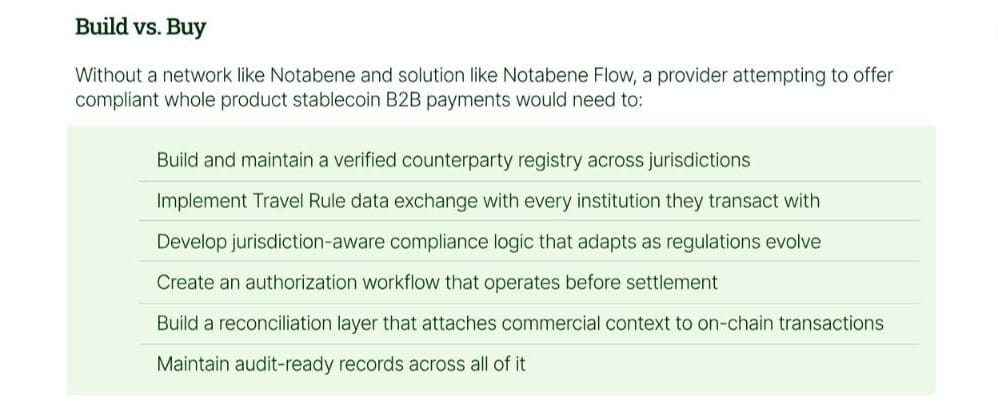
According to the playbook, a provider building compliant whole-product B2B stablecoin payments without a shared network would need to:
- Build and maintain a verified counterparty registry across jurisdictions.
- Implement Travel Rule data exchange with every institution it transacts with.
- Develop jurisdiction-aware compliance logic that adapts as regulations evolve.
- Create an authorization workflow that operates before settlement.
- Build a reconciliation layer that attaches commercial context to on-chain transactions.
- Maintain audit-ready records across all of it.
Each item is a standing engineering and compliance cost, not a one-time project. For a broader view of the vendor landscape, see our guide to stablecoin compliance tools and our analysis of compliance as infrastructure for stablecoins.
What Comes Next for US Stablecoin Payments
The framework is in place. The GENIUS Act takes effect on January 18, 2027, the OCC's final rule is out, and most financial institutions and corporates surveyed by EY plan to adopt stablecoins within 12 months. The stack needed to serve that demand is clear, and so are the gaps.
Notabene's conclusion is that the question for PSPs, custodians, wallet platforms, orchestrators, and on/off ramps is no longer whether B2B stablecoin payments become part of the landscape. It is whether they will be ready when customers start asking.
The playbook expects providers with operational capability in the back half of 2026 to be in the room when enterprise evaluations happen, and those that wait to compete in a more crowded field.
Conclusion
We covers the infrastructure behind regulated stablecoin payments, and Notabene's playbook makes one point clearly: the GENIUS Act did not invent most of the obligations payment providers face, but it removed the ambiguity that let them be handled loosely.
The Travel Rule, entity-level sanctions screening, issuer verification, and exam-ready records are now the baseline for anyone moving permitted payment stablecoins, while the commercial prize, a $31.6 trillion cross-border B2B market where stablecoins cut costs from 2%–7% to 0.1%–0.5%, sits in the upper layers of the stack that most providers have not built yet.
The full compliance breakdown, the nine-layer stack, and the provider-by-provider playbook are in The US Stablecoin Payments Playbook.
Providers mapping their own stack can book a Notabene Flow walkthrough.
Read Next:
- What Is the GENIUS Act? US Stablecoin Law Explained
- OCC GENIUS Act Final Rule: Yield, Reserves and Redemptions
- B2B Stablecoin Payments: Vendor Selection Guide
- Stablecoin Infrastructure Providers
FAQs:
1. What does the GENIUS Act require from stablecoin payment providers?
The GENIUS Act requires stablecoin payment providers to meet bank-grade compliance expectations, including Travel Rule data exchange with counterparties, entity-level sanctions screening, KYC and suspicious activity reporting under the Bank Secrecy Act, verification that tokens come from permitted issuers, and examination-ready record-keeping, according to Notabene's US Stablecoin Payments Playbook.
2. When does the GENIUS Act take effect?
The GENIUS Act takes effect on the earlier of January 18, 2027 or 120 days after federal regulators issue final implementing rules; the OCC issued its final rule on October 21, 2026 with an effective date of January 18, 2027, and digital asset service providers get a three-year transition before they generally must use stablecoins from permitted issuers for US persons.
3. What is the Travel Rule threshold for stablecoin transfers in the US?
The Travel Rule threshold for stablecoin transfers in the US is $3,000 under 31 CFR 1010.410(f), while the EU Transfer of Funds Regulation and Singapore's PSA framework apply a zero threshold, meaning Travel Rule data is required on every crypto-asset transfer in those jurisdictions.
4. What are the nine layers of the stablecoin infrastructure stack?
The nine layers of the stablecoin infrastructure stack, as defined by Notabene, are blockchain, asset, custody, routing, trust, compliance, authorization, reconciliation, and reporting, with the biggest gaps in today's stacks concentrated in Layers 5 to 9.
5. How much cheaper are stablecoin payments than cross-border wires?
Stablecoin payments are significantly cheaper than cross-border wires, with all-in costs of 0.1% to 0.5% of transaction value versus 2% to 7% for traditional wires, which on a $100,000 invoice means $100 to $500 instead of $2,000 to $7,000, with settlement in seconds rather than three to five business days.
Disclaimer:
This content is provided for informational and educational purposes only and does not constitute financial, investment, legal, or tax advice; no material herein should be interpreted as a recommendation, endorsement, or solicitation to buy or sell any financial instrument, and readers should conduct their own independent research or consult a qualified professional.
Join the official Coincamps community:
Telegram: https://t.me/coin_camps
Recommended
Bitcoin at $80,000: A Tug-of-War With No Winners
Oct 27, 19:12Morgan Stanley Raises Global Electricity Demand Growth Forecast: Beyond AI, Who Will Share in the $500 Billion Increment in the Power Market?
Oct 27, 18:35
Why did JPMorgan significantly raise Unitree Robotics' target price to 995 yuan?
Oct 27, 18:04
Bitcoin at $80,000: A Tug-of-War With No Winners
Oct 27, 17:59
Flood of AI Junk Reports: Firedancer Requires Burning 1 SOL Before Vulnerability Submission
Oct 27, 17:54
Brazil election sees epic reversal, prediction markets become insider cash machines
Oct 27, 17:28