Analysis of Morgan Stanley Research Report: Arm Data Center Royalties Nearly Double, 2031 Self-Developed Chip Revenue Target Cut by 30%

Arm's data center royalty revenue is projected to nearly double in fiscal year 2027, but its revenue forecast for fiscal 2031 custom CPUs has been cut to under $10 billion, falling short of management's $15 billion target.
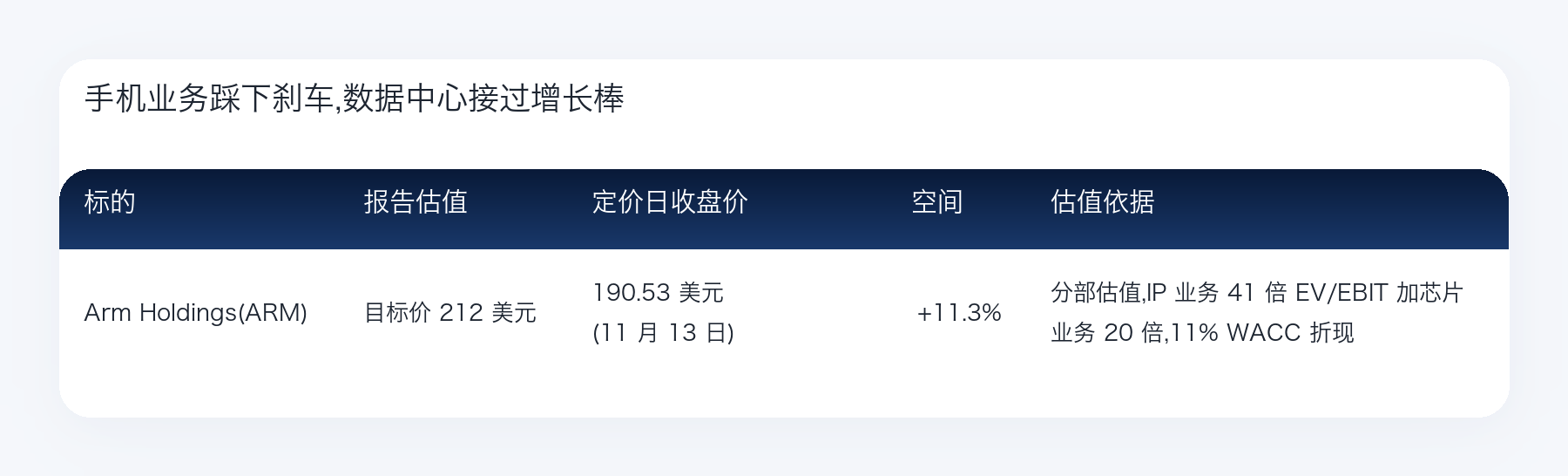
In a November 16 report, a team led by Morgan Stanley analyst Lee Simpson raised its cloud computing royalty forecast while lowering forecasts for mobile royalties and long-term custom chip revenues, maintaining an "Equal-weight" rating and $212 price target for Arm Holdings (ARM).
The bank believes that during this transition period where custom chips drag down gross margins, there is only room for further upside in the stock price if operating leverage and deployment targets for 2030 are validated.
Mobile Business Hits the Brakes, Data Center Takes Over the Growth Baton
Smartphones remain the core foundation of Arm's royalties, but growth is slowing. Impacted by weakening global smartphone shipments, Morgan Stanley expects Arm's mobile royalty revenue to grow by only about 3% in fiscal 2027, well below the roughly 28% growth recorded in fiscal 2026.
By fiscal 2028, stabilizing Apple shipments and increased penetration of the v9 and Compute Subsystem (CSS) architecture are expected to drive mobile royalty growth back up to around 14%. At that point, smartphones' contribution share of total royalties will drop to approximately 37%.
The true growth engine has shifted to cloud data centers.
As hyperscale cloud providers deploy Arm-based CPUs in large numbers alongside AI accelerators, coupled with higher single-chip royalties driven by increasing core counts per chip, Morgan Stanley raised its FY2027 data center royalty forecast by 9% to $686 million, and its FY2028 forecast by 17% to $1.15 billion.
The report projects that total cloud AI royalties will grow 86% year-over-year in FY2027, with the data center sector's share of total royalties jumping from 14% in FY2026 to 31% in FY2028. This upgrade is primarily based on the ramp-up of Amazon Graviton, Google Axion, and NVIDIA Vera chips in both integrated and standalone inference systems.
Power Shortages Stall Data Center Rollouts, Long-Term Custom CPU Targets Cut by 30%
While royalty revenues are strengthening, Morgan Stanley has thrown cold water on expectations for Arm's long-term in-house chip manufacturing ambitions.
The firm maintained its FY2028 revenue forecast for Arm's custom chips largely unchanged at around $1.5 billion, but sharply cut its FY2031 custom CPU revenue forecast by 38.2% to just under $10 billion, significantly below management's internal target of approximately $15 billion.
The power deficit represents the first physical bottleneck for long-term deployments.
Morgan Stanley's U.S. technology strategy team calculated that U.S. data centers face a net power shortfall of 44 gigawatts from 2026 to 2028, accounting for 38% of total power demand during the same period. Delayed data center power connection progress directly constrains the rollout pace of inference orchestration CPUs.
The report's models estimate that the addressable market for global inference orchestration CPUs will expand from approximately 4 gigawatts in FY2027 to about 19 gigawatts in FY2031, with Arm's share expected to rise from roughly 7% to 42%. However, even with smooth market share traction, price wars will still erode some revenue potential.
Due to intensifying competition in the custom chip space, Morgan Stanley assumes Arm's average selling price per core for each generation of custom CPUs will decline by about 5%, a clear divergence from management's hopes of maintaining pricing resilience through network and input/output integration.
Chip Manufacturing Drags Down Gross Margins, Testing Operating Leverage
As Arm shifts from purely licensing intellectual property (IP) to also selling physical chips, its income statement structure is undergoing drastic changes.
In fiscal 2026, Arm's overall gross margin reached an impressive 97.5%. With first-generation custom CPUs beginning shipments, constrained by foundry capacity, testing bottlenecks, and tight memory chip supplies, Morgan Stanley assumes the gross margin for this business segment will be merely around 35%.
The ramp-up of low-margin hardware will directly weigh on the company's overall profitability.
According to the report's projections, Arm's overall gross margin will gradually decline from 97.5% in FY2026 to 95.4% in FY2027, 86.9% in FY2028, and further drop to 85.0% in FY2029. Meanwhile, R&D expenses continue to swell rapidly, expected to increase from $2.776 billion in FY2026 to $4.128 billion in FY2029.
This leads to a notable divergence in earnings pacing. Morgan Stanley slightly adjusted its FY2027 adjusted EPS forecast down by 1% to $2.23, but as subsequent revenue ramps dilute R&D costs, the FY2028 and FY2029 adjusted EPS forecasts were raised by 14% and 9%, respectively, to $3.95 and $5.66.
Valuation Split into Two Segments, $212 Price Target Implies 11% Upside
Facing two businesses with distinctly different business models, Morgan Stanley revalued Arm using a Sum-of-the-Parts (SOTP) methodology.
Impacted by a downward shift in the valuation midpoint across the broader semiconductor IP sector, the firm cut its FY2029 EV/EBIT multiple for Arm's traditional IP business from 49x to 41x, which remains at the upper end of historical valuation ranges. For the emerging custom chip business, it applied a 20x multiple, below the global semiconductor peer average.
Discounting the combined business cash flows at an 11% weighted average cost of capital (WACC) yields a $212 price target, representing 11.3% upside from the November 13 closing price of $190.53.
The report also provided bull and bear case scenarios. Under the bullish scenario, if AI and cloud computing ramp up beyond expectations and the market prices in FY2031 performance ahead of schedule (50x for IP, 20x for chips), the stock could reach $370, implying a probability near 0%. Under the bearish scenario, if custom chips slip into losses, end-user royalty rates weaken, or major litigation setbacks occur, the stock could fall to $65, with options markets implying a roughly 13.1% chance of a break below that level.
Investors will next need to monitor two key validation points: whether software licensing and early partnerships for the next-gen v10 architecture can sustain their 50% year-over-year high growth rate, and whether the overall operating profit margin can rebound above 30% as planned in FY2028 after the custom chip ramp.
Institutional Ledger
This article is a compilation and interpretation by Chaoxiang Research of third-party brokerage research reports. The ratings, price targets, earnings forecasts, and related assessments cited herein reflect the views of that brokerage's analysts alone, represent only their respective institutional stances, do not represent the views of Chaoxiang Research, and do not constitute any investment advice.
Markets carry risks, and decisions require independence. This article should not serve as the basis for trading any securities.
Join the official Coincamps community:
Telegram: https://t.me/coin_camps
Recommended
Cardano Ecosystem Stablecoin DJED Announces Shutdown: After Nearly Four Years of Operation, Holders Must Complete Redemption Before New Year's Day
Nov 18, 14:45
From Crypto Venture Capital to Traditional Venture Capital: The Three Core Competencies That Venture Capital Actually Needs
Nov 18, 14:41
Nvidia Earnings Call: Board Rules Out Huang Return, Guides Q4 to $130B
Nov 18, 14:31
The AI bubble has already burst, yet retail investors are still frantically buying the dip: Hedge fund veteran warns Nvidia risks are far from cleared
Nov 18, 14:31
Research Report Analysis | Space Fund Size Grows to $18 Billion in One Year, but On-Orbit Direct Investment Accounts for Only 3%
Nov 18, 14:18
World Bank Partners with Citi and Circle: Global Aid Funds Expected to Be Settled On-Chain via USDC
Nov 18, 14:15