Research Report Analysis | Space Fund Size Grows to $18 Billion in One Year, but On-Orbit Direct Investment Accounts for Only 3%

Barclays Research Report Analysis: Space Fund Size Increases to $18 Billion in One Year, but Direct In-Orbit Investment Accounts for Only 3%
The global scale of space-themed funds grew from $1.24 billion in Q2 2024 to over $18 billion in Q2 2026, but funds directly allocated to on-orbit operations accounted for only 3%.
In a 61-page in-depth report released on November 16, analysts including Katherine Ogundiya from Barclays' Thematic Investing team introduced the "In-Orbit Economy (in-S.P.A.C.E.)" analytical framework for the first time, filtering 37 in-orbit commercial activities into 15 priority implementation directions and 3 potential disruptive tracks.
The report argues that space commercialization is advancing along an "infrastructure-first" pathway. Investors do not need to wait patiently for space mining or orbital computing centers to mature; the most certain orders today are concentrated in three bottleneck areas: launch and transport, inter-satellite communication, and on-orbit life extension.
Severe Misalignment Between Public and Private Allocations, with Infrastructure Securing Major Contracts First
The space industry is undergoing a round of expansion driven by commercial launches. According to the Space Foundation, global spacecraft deployments reached a record 4,492 in 2025, a year-on-year increase of approximately 60%, of which commercial spacecraft accounted for 4,040.
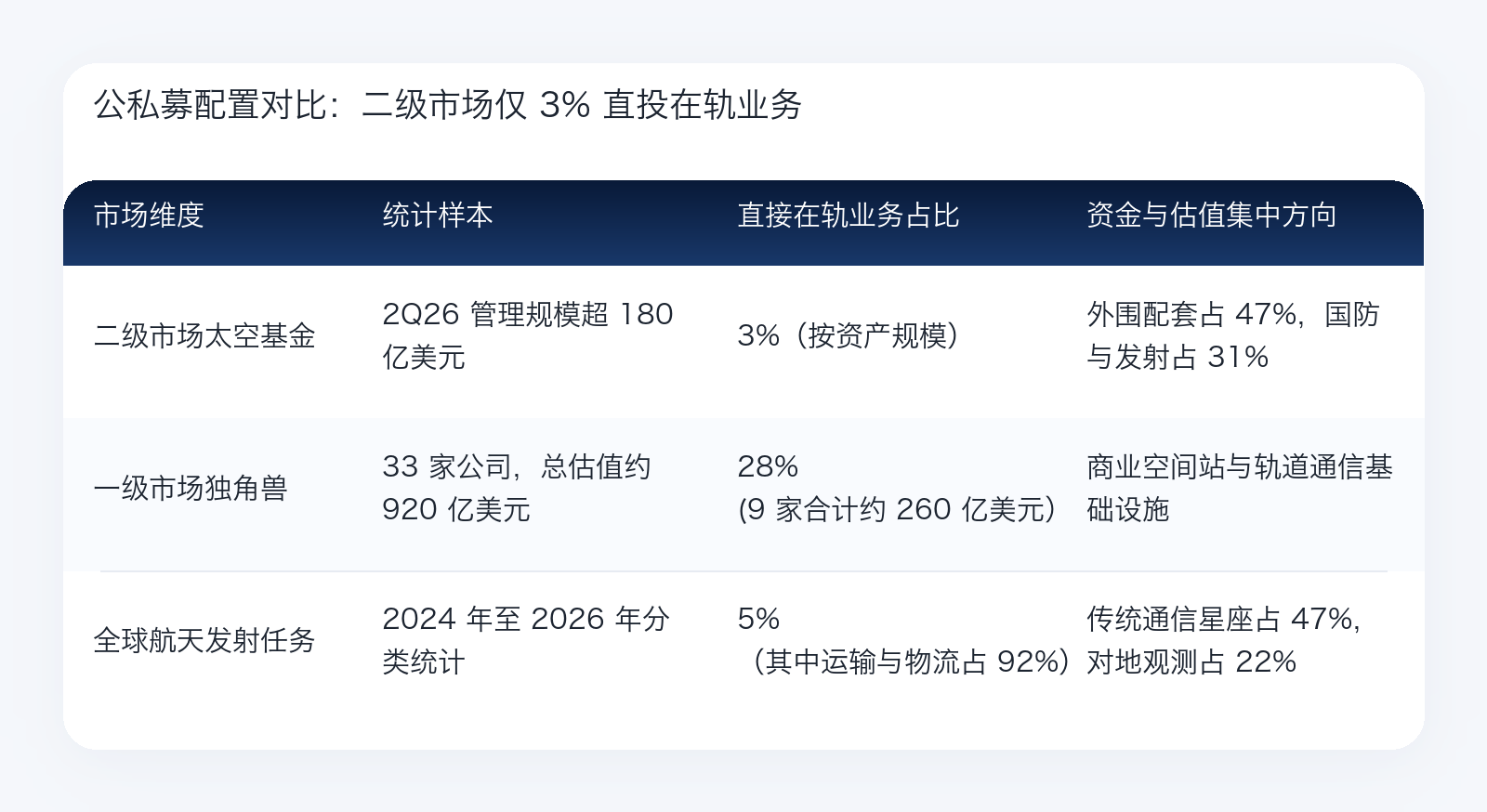
However, capital distribution between secondary and primary markets shows a sharp divergence. Barclays data indicates that within dedicated secondary-market space funds, as much as 47% is allocated to peripheral supporting sectors such as semiconductors, components, and software, 31% goes to defense and launch, while assets directly involved in on-orbit operations account for only 3%.
The primary market, meanwhile, has been betting earlier on pure-play on-orbit businesses. Among the 33 space economy unicorns tracked by Barclays (with a combined valuation of approximately $92 billion), 9 are directly engaged in on-orbit operations, totaling about $26 billion in valuation, or 28% of the total.
Comparison of Public and Private Allocations: Secondary Market Directly Invests Only 3% in On-Orbit Operations
Government budgets are also shifting toward infrastructure. Global government space spending reached $141 billion in 2025, up 7.4% year-on-year. The U.S. budget for NASA's Fiscal Year 2027 includes funding for 30 in-orbit activities, while the UK announced in September 2026 that it will invest £7.8 billion by 2030 for satellite communications and on-orbit services.
Five Physical Bottlenecks Hinder Progress, 15 Priority Tracks Establish Viable Commercial Models
As on-orbit assets surge, the bottlenecks to space commercialization have shifted from pure rocket engineering breakthroughs to five realistic constraints: launch concentration, spectrum and network routing, orbital congestion, on-orbit service standards, and regulatory approval.
Taking launch and orbital congestion as examples, between 2024 and July 2026, China and the United States accounted for over 82% of global orbital launch attempts, with SpaceX and the China Aerospace Science and Technology Corporation (CASC) jointly comprising nearly 71%. Meanwhile, low Earth orbit altitudes between 400 and 600 kilometers have entered peak congestion zones, with Starlink executing collision avoidance maneuvers more than 207,000 times between December 2025 and May 2026.
Barclays scored the 37 in-orbit activities across six dimensions—commercial demand, government synergy, technical feasibility (highest weight), etc.—on a scale of 20 points, screening out 15 priority tracks with scores of no less than 15.
The 8 Most Commercially Mature Tracks Among the 15 Priorities
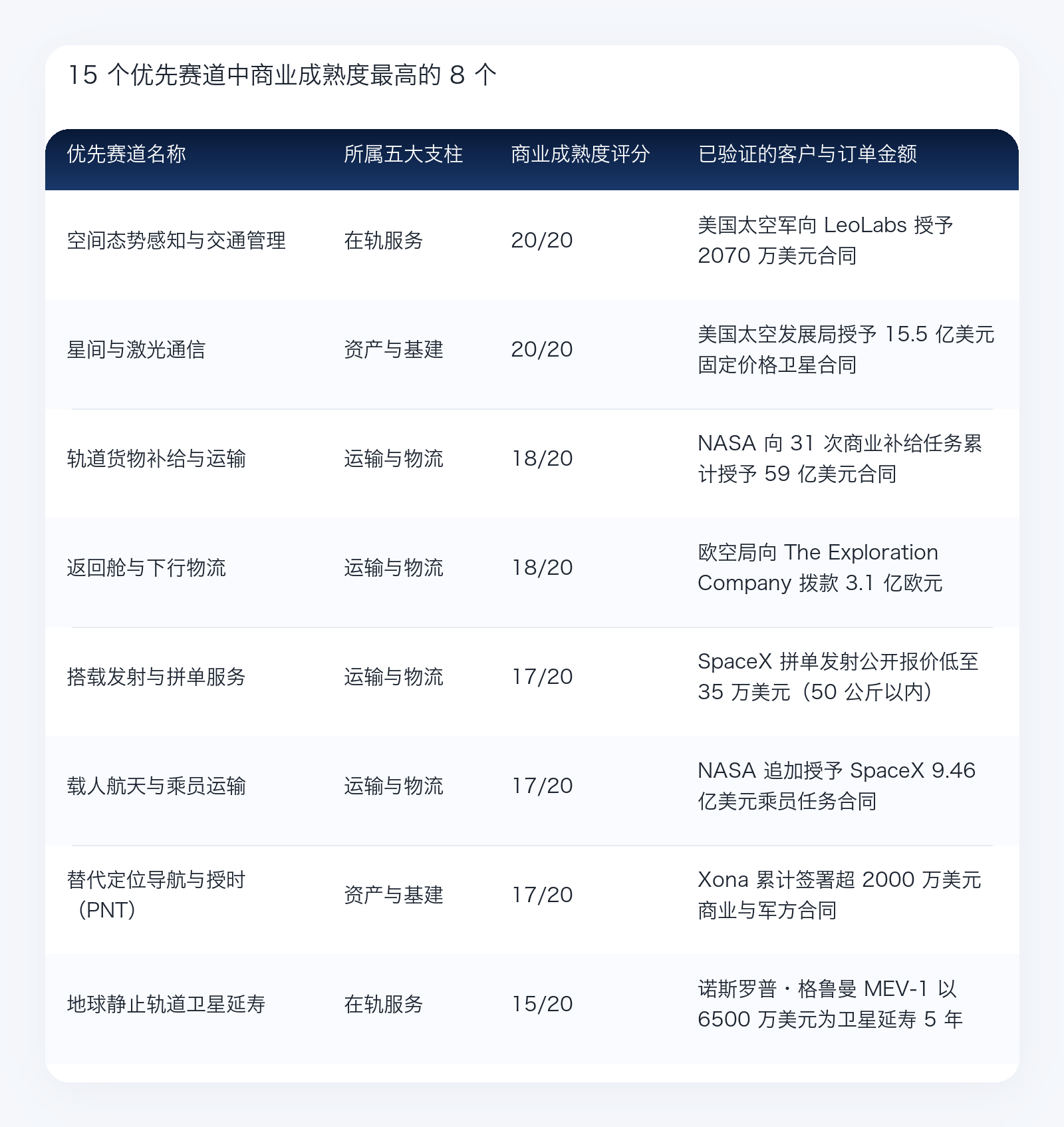
Extending the lifespan of geostationary orbit (GEO) satellites presents a straightforward economic calculation. Approximately 85% of GEO satellites are decommissioned due to fuel depletion rather than hardware failure. Relaunching a replacement satellite costs between $150 million and $300 million, whereas extending its operational life by five years via a servicing spacecraft docking requires only about $65 million.
In contrast, orbital AI computing power and data centers currently score only 8 points overall, ranking as one of the three wildcard potential tracks by Barclays. Although Starcloud deployed Nvidia H100 chips in orbit in 2025, and Google launched a prototype test satellite in October 2026, heat dissipation, power supply, and commercial viability still require large-scale validation.
Four-Tier Investment Map Implemented, Covering Everything from Rocket Platforms to Industrial Gases
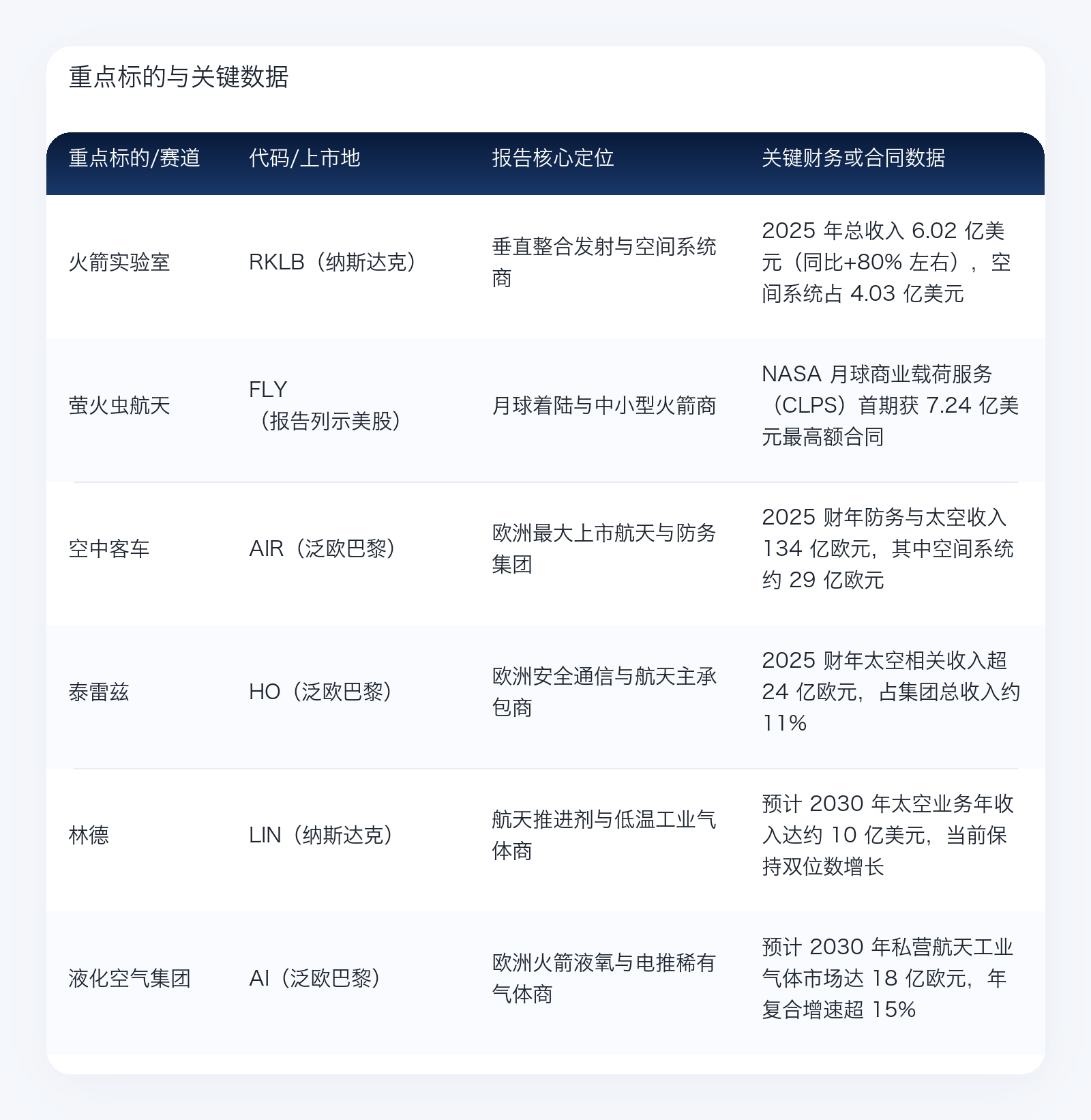
Barclays compiled a list of over 350 listed and unlisted companies, delineating four investment pathways based on their direct relevance to on-orbit operations.
The first pathway directly targets core players in the 15 priority tracks, focusing primarily on vertically integrated launch and aerospace system providers. Rocket Lab (RKLB) has expanded its business beyond the small Electron rocket through continuous M&A into spacecraft platforms and optical communications, generating $403 million in space systems revenue in 2025, accounting for two-thirds of its $602 million total revenue. Firefly Aerospace (FLY), backed by its Blue Ghost lunar lander's successful moon landing in March 2025, secured the highest initial contract of $724 million from NASA's Commercial Lunar Payload Services (CLPS) program.
The second pathway bets on specialized vendors that break through bottlenecks, such as Astroscale and MDA Space in on-orbit servicing and space robotics, laser communication terminal provider Mynaric (acquired by Rocket Lab), and Thales (HO), a partner of ESA's fully optical network initiative.
The third pathway covers the broadest "pick-and-shovel" ecosystem, extending into chemicals, specialty materials, and testing equipment. New heavy-lift rockets consume up to approximately 8,000 tons of liquid oxygen per launch, five times the 1,600 tons used by traditional large rockets. Linde (LIN) expects its space business to generate annual revenue of approximately $1 billion by 2030, while Air Liquide (AI.PA) projects the private aerospace industrial gas market to reach about €1.8 billion in the same year.
The fourth pathway focuses on downstream application monetizers, including Planet Labs (PL) and AST SpaceMobile (ASTS), which rely on satellite imagery and direct-to-device communication services.
Report Insights
This article summarizes and analyzes a third-party brokerage research report by Chaoxiang Research. All cited ratings, target prices, earnings forecasts, and related judgments are the views of the respective brokerage analysts, reflecting only their institutions' positions, not those of Chaoxiang Research, and do not constitute any investment advice.
Investments involve risks, and decisions must be made independently. This article should not serve as the basis for buying or selling any securities.
Join the official Coincamps community:
Telegram: https://t.me/coin_camps
Recommended
Cardano Ecosystem Stablecoin DJED Announces Shutdown: After Nearly Four Years of Operation, Holders Must Complete Redemption Before New Year's Day
Nov 18, 14:45
From Crypto Venture Capital to Traditional Venture Capital: The Three Core Competencies That Venture Capital Actually Needs
Nov 18, 14:41
Nvidia Earnings Call: Board Rules Out Huang Return, Guides Q4 to $130B
Nov 18, 14:31
The AI bubble has already burst, yet retail investors are still frantically buying the dip: Hedge fund veteran warns Nvidia risks are far from cleared
Nov 18, 14:31
World Bank Partners with Citi and Circle: Global Aid Funds Expected to Be Settled On-Chain via USDC
Nov 18, 14:15
AI agents are starting to trade stocks and cryptocurrencies for users, but what's truly valuable isn't the trading bots.
Nov 18, 14:09