AI agents are starting to trade stocks and cryptocurrencies for users, but what's truly valuable isn't the trading bots.
TechFlow Summary: The financial trading paradigm is undergoing a fundamental shift, moving from simple rule-based quant scripts to AI agents capable of autonomous reasoning and decision-making. Traders are no longer just inputting buy/sell orders; instead, they entrust investment intent to agents, which take full responsibility for cross-market data analysis, position risk management, and cross-chain execution.
In this article, Coinbase Ventures systematically breaks down the four-layer architecture of the AI trading ecosystem, clearly stating that open-source models alone lack a moat. Future commercial alpha will flow toward agent frameworks that control the "investment decision loop," accumulate proprietary context data, and underlying trusted execution platforms that earn user asset custody.
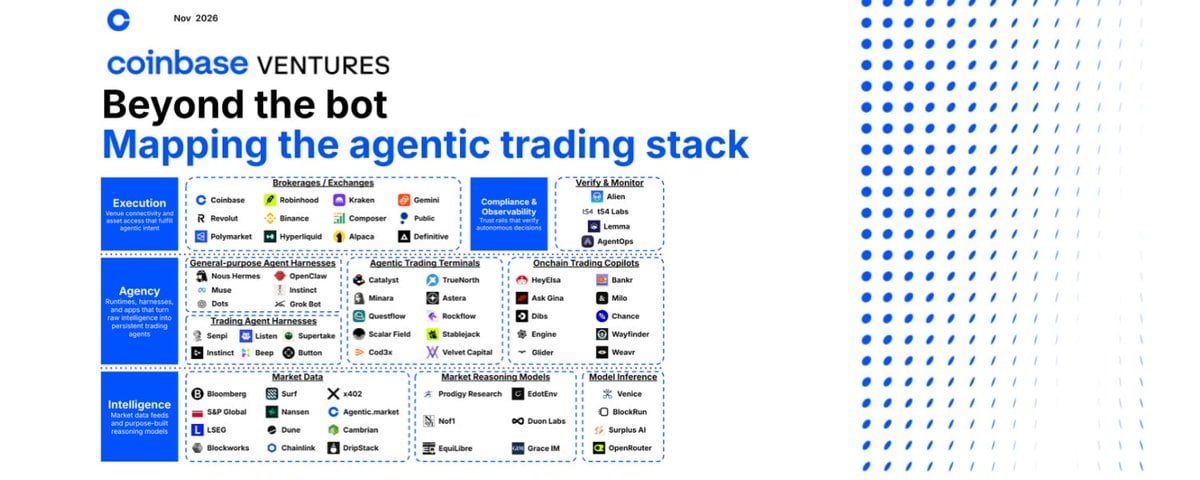
This article was written by Jonathan King, Senior Investment Manager at Coinbase Ventures. Coinbase Ventures portfolio companies mentioned for the first time in the text are marked with an asterisk (*).
AI agents are becoming active participants in economic activities. Their ability to autonomously pursue set goals, make independent decisions, and settle value on behalf of humans is laying the foundation for an entirely new financial system: Agentic Finance (AiFi).
This transformation is advancing along two parallel tracks, profoundly reshaping how humans interact with capital. The first track is payments and commerce, where agents autonomously purchase goods, services, and data; the second is trading and market operations, where agents directly and deeply intervene in financial market transactions. This article focuses on the second core track: Agentic Trading.
In agentic trading, AI agents assume part or all of your trade decision loop on your behalf. You simply set overall goals and risk boundaries, and the agent autonomously researches markets, builds strategies, calculates position sizes, executes orders, and continuously monitors risks within your authorized scope. Although the field is still in its infancy, this paradigm promises to make complex, professional quantitative trading accessible to everyone through minimal natural language prompts.
In our forward-looking discourse on Crypto x AI in 2024, we predicted that natural language interaction would become the primary way people interact on-chain. In our May 2025 article, "The Rise of Onchain AI," we further explored how agents democratize personal portfolio management. Since then, the evolution of this vision has far exceeded native crypto domains. Mainstream exchanges, brokers, and a new wave of startups are now racing to build cross-asset trading infrastructure for agents spanning crypto assets, US equities, derivatives, prediction markets, and more.
As the barrier to building agents continues to drop, we focus more on the core elements backing these businesses to form long-term moats. We believe the value of mere order matching and execution will be rapidly compressed, while greater future value will flow to entities that continuously manage investment strategies and custodians deeply trusted by users and their agents.
This assessment directly guides Coinbase Ventures' three current key investment focus areas: agent trading runtimes and terminals, verticals leveraging deep professional intelligence for true alpha generation, and compliance & observability infrastructure ensuring traceable and accountable onchain agent behavior. Below, we outline this emerging tech stack in full and explain the keys to building enduring businesses in this space.
What is Agentic Trading?
Agentic trading refers to AI agents autonomously running part or all of the trade decision loop within your authorized scope. They consistently anchor to a long-term goal, independently gather market intelligence, formulate and dynamically adjust trading strategies, and execute trades within your predefined risk red lines, all without requiring manual approval for each step.
Despite automated trading having a history of decades in financial markets, every past wave of automation essentially only executed predetermined human decisions faster or at a lower cost:
- Bots based on fixed rules: Execute commands only when preset conditions are met (e.g., "buy when indicator X crosses Y"). They are merely faster execution triggers lacking independent decision-making capabilities.
- Algorithmic execution engines (e.g., TWAP or VWAP): Focus solely on how to most efficiently slice and fill orders you've already decided to trade, never deciding "what to buy."
- Robo-advisors: Rebalance portfolios according to rigid static models, incapable of logically assessing breaking news or forming independent macro views.
- Copy trading: Purely mirrors other traders' positions, inheriting all their risks while completely failing to align with your own risk preferences.
Agentic trading fundamentally disrupts this established model. You simply express an investment goal in plain natural language, and the agent breaks it down into market analysis, strategy generation, position sizing, multi-channel order execution, and round-the-clock monitoring. For the first time in history, machines possess the ability to autonomously form investment logic rather than passively executing externally fed commands. Human roles thus shift from frontline operators to core principals: you no longer need to watch screens and click buy/sell manually, but instead focus on setting overarching guidelines and authorizing risk controls.
Why Now?
Trading with AI is not a new concept emerging today. A wave of AI trading bots already surged in 2023, but most quickly faded after the hype cooled. We believe this time is fundamentally different, driven by four qualitative leaps in the industry's underlying layer over the past 12 months:
- The reliability threshold of foundational LLMs has been crossed: First-gen bots in early 2023 failed because contemporary LLMs could only summarize market data but lacked the ability to close loops and execute in real markets. Today's frontier models boast exceptional multi-step planning, autonomous tool invocation, and self-correction/self-healing capabilities—the essential baseline requirements for fully automated, long-cycle position management.
- Drastic reduction in engineering costs to connect to financial markets: The adoption of open standards like Model Context Protocol (MCP) and Agent2Agent (A2A) has transformed traditionally cumbersome trading APIs, data feeds, and asset custody mechanisms into plug-and-play capabilities. Integrating broker channels for agents used to require custom engineering across several quarters; today, integration takes minutes.
- Open-source agent "Harnesses" make construction effortless: Open-source suites like OpenClaw and Nous Hermes* instantly equip any foundational LLM with persistent memory, scheduled automation, and seamless external market connectivity out of the box. OpenClaw alone garnered nearly 250k GitHub stars in roughly 60 days. The crypto sector absorbed this tech surge first, primarily because permissionless, open APIs completely erased traditional finance barriers, making perpetual futures on Hyperliquid and prediction markets on Polymarket the earliest testbeds for agents.
- Accelerated convergence of cross-market formats and settlement channels: Tokenized US equities, RWA perpetual contracts, 24/7 continuous trading mechanisms, and stablecoin instant settlement systems enable a single agent to execute unified strategies across diverse assets using a single collateral pool. Past automated systems were fragmented into silos precisely because each traditional asset class ran on mutually closed infrastructure.
Why Does It Matter?
Agentic trading is democratizing previously inaccessible quantitative trading capabilities. Professional strategies once achievable only by top-tier quant teams—such as cross-asset signal blending, adaptive position scaling based on market movements, capturing macro cycle inflection points, or tax-aware automatic rebalancing—can now be easily activated by ordinary users with a single sentence.
Consider this use case: "Help me build a momentum-tilted portfolio between crypto assets and semiconductor stocks, strictly cap max drawdown at 15%, and maintain weekly rebalancing." Based solely on this prompt, an agent can simultaneously pull momentum indicators from both markets, construct the underlying portfolio, precisely calculate position weights against the drawdown limit, execute batch orders across liquidity venues, and auto-backtest/refine the strategy each cycle.
This new paradigm also radically reshapes platform user demands. Increasingly, users arrive at platforms not with isolated "order intent" (e.g., "Buy 10 shares of Stock X"), but with broader "portfolio intent" (e.g., "Build me a complete portfolio that captures my bullish thesis on this sector"). This represents a product format entirely distinct from traditional chart-trading interfaces, massively empowering platforms offering broadest asset integration while severely disrupting traditional venues competing solely on single-asset matching efficiency.
Full Stack Overview of Agentic Trading
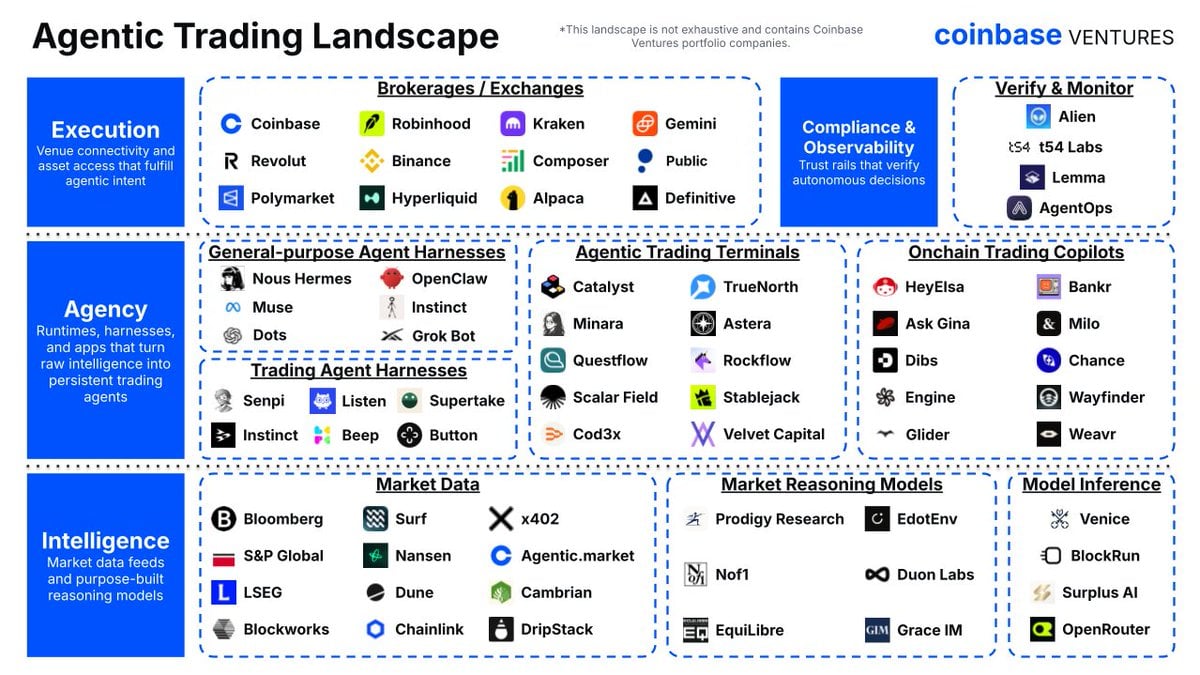
Agentic trading is rapidly shedding its scrappy origins built from experimental tools, accelerating into a clear, rigorous layered tech stack. We systematically deconstruct the ecosystem into four core layers: Intelligence (data & reasoning models powering agent cognition), Agency (foundations & frontend apps transforming static models into resident trading agents), Execution (underlying pipes converting decision logic into filled orders), and Compliance & Observability (trusted foundations fully validating agent motives & audit trails).
The diagram below provides a panoramic view of representative startups and benchmark projects across these layers we closely track, anchored at the base by data & reasoning intelligence, extending upward to execution channels & trust guarantee networks at the top:
Layer 1: Intelligence (Data & Reasoning)
Market Data: Agents require exceptionally clean, standardly structured, machine-readable raw information inputs covering real-time pricing, order book depth, regulatory filings, breaking news analysis, social sentiment indices, and onchain capital flows. Each data point must carry precise timestamps and reliable source attribution. However, today's financial data business models are almost exclusively designed for human analysts, charging hefty fees per terminal seat—utterly incapable of supporting the tens of thousands of automated high-frequency calls agents make daily.
This supply-demand mismatch carves a massive opening for machine-native billing data networks. For example, Coinbase's open-sourced x402 protocol allows agents to precisely pay on-demand with stablecoins the moment they need data. Traditional giants like Bloomberg, S&P Global, onchain analytics platforms Nansen*, Dune*, and oracle networks Pyth* and Chainlink already provide vast foundational info; while next-generation players like Surf* and Cambrian have purpose-built research and data interfaces for AI agents from day one.
Specialized Financial Reasoning Models: While generic reasoning LLMs from frontier labs are powerful, their ubiquitous availability means relying solely on general models offers no differentiated edge. The true massive commercial opportunity lies in building vertically specialized financial market reasoning models: models directionally trained for complex markets, equipped to rigorously test/trade ideas, autonomously allocate real capital, and adaptively control risk across long, unsupervised workflows.
A wave of new financial reasoning model labs is emerging, including teams like Prodigy Research*, EdotEnv*, and Nof1, typically training models on massive proprietary market data or building highly simulated, high-fidelity sandbox environments for iterative reinforcement. Meanwhile, reasoning platforms & smart routers like Venice* allow agents to adaptively select optimal models based on task complexity, often natively supporting per-call reasoning payments in USDC.
Layer 2: Agency (Runtimes, Terminals & Copilots)
General-purpose agent harnesses: Harnesses equip foundational models with persistent memory, scheduled task triggers, external tool-call sandboxes, and automated error recovery/healing, transforming static Q&A models into long-resident agents. Born versatile for complex tasks (coding, research, email handling, etc.), with users flexibly extending capabilities via plugin skills. Open-source frameworks like Nous Hermes* and OpenClaw are highly sought-after here, with trading rapidly becoming a core use case. Yet finance requires more than generic utility boxes; there's a hard demand for professionally hardened trading bases featuring out-of-the-box dynamic position sizing, TP/SL limits, trailing reductions, and rigorous full-path stress backtesting before real capital deployment.
Trading agent harnesses: These frameworks target the aforementioned gap, represented by Senpi* and Supertake*. Dubbing itself an "AI quant engineer," Senpi targets active pro traders, auto-converting natural language strategy descriptions into code, running 24/7 across hundreds of Hyperliquid derivative markets, and automatically applying risk-model-based position sizing with dynamic trailing stops. Supertake targets retail investors: users describe an investment idea ("Take") in plain language, and its agent auto-polishes it into an executable portfolio, offering full simulation modes & public high-yield leaderboards.
Agentic trading terminals: Trading terminals serve as fully functional integrated workspaces where users complete research, strategy customization, historical backtesting, live ordering, and lifecycle risk tracking within a closed-loop interface. Many are born cross-asset, letting a single agent trade US equities, crypto, perpetuals, and prediction markets concurrently; most integrate with existing exchanges/brokers, avoiding direct custody or asset hoarding. Think of them as Bloomberg terminals comprehensively rebuilt for the AI agent era, engineered for pros seeking deep risk control & granular command. For instance, Catalyst* translates market views into composite hedging strategies across stocks, options & prediction markets; TrueNorth equips each user with a bespoke personalized agent scanning equities, commodities, and crypto perpetuals 24/7 to auto-capture trade entries.
Onchain trading copilots: Copilots are lightweight, proactive companion assistants reaching out to users. Typically dialogue-centric, they embed directly into high-frequency social/comms platforms users love (X, Telegram, Web3 wallets). Centered around user self-custody onchain wallets, funds remain under user key control, focusing squarely on native crypto scenarios. They support swapping, bridging, opening perpetuals, yield staking, and prediction market bets via short chats. If pro terminals chase breadth/depth extremes, copilots optimize reach/accessibility thresholds. E.g., HeyElsa* lets users rebalance, bridge chains, and auto-earn yields through casual chat; Bankr* enables token swaps or order placement on X directly via bot @mentions.
In practice, boundaries between these categories are rapidly blurring. General harnesses constantly patch trading capabilities; trading-specific bases integrate terminal-exclusive portfolio management & public leaderboards; trading terminals fully embed conversational UX; copilots aggressively expand 24/7 resident strategy runtime. Long-term, all products clash under one endgame question: who truly masters the trade decision loop. Pro terminals hold moats in functional depth, asset breadth, & user retention; copilots/general harnesses dominate distribution via innate parasitic advantages on mainstream platforms holding peak user attention spans. The ultimate victor will inevitably be the species perfectly fusing genuine alpha-generating intellectual strategy advantages with unreplicable user distribution networks.
Layer 3: Execution (Venue Interconnection & Asset Breadth)
The execution layer's mandate is efficiently translating agent decisions into real-matched positions. This demands precise order routing across fragmented venues/asset types, continuous fill-status monitoring, real-time position reconciliation, and absolute security throughout custody/settlement. The industry is rapidly converging on a "single credential, unified multi-asset" standard, where agents smoothly traverse spot crypto, derivatives, US equities, etc., via one verified unified connection pipe.
Traditional brokers/exchanges are currently opening doors via two divergent paths. Path 1: Bring-your-own-agent (BYOA), allowing third-party agents like ChatGPT, Claude, or Grok to securely access via MCP servers, CLI tools, REST APIs, or dedicated agent accounts. E.g., Coinbase for Agents permits third-party agents to autonomously trade spot crypto, compliant US futures, and equities within user-set risk limits on their Coinbase accounts. Path 2: Built-in native intelligence, where venue-native AI is deeply embedded to directly assist research, planning, & execution—exemplified by Coinbase Advisor. Additionally, native AI financial infra like Alpaca and onchain trading APIs launched by teams like Definitive* (Flash) let agents instantly access institutional-grade clearing/matching rails without reinventing the wheel.
Layer 4: Compliance & Observability (Trust Foundation for Autonomous Decision-Making)
Every current financial regulatory/compliance framework assumes natural humans make final decisions. When invisible AI agents actually allocate capital, regulators/investors demand explicit accountability: What data did the agent see? What judgments were made? What was the core decision logic? Who bears liability for errors? Compliance & observability layers exist to immutably record all agent input data streams, reasoning processes, triggered actions, and final fills, ensuring complete traceability & external audit validity across all behavioral trajectories.
We firmly believe this is the most critically underestimated yet foundational infrastructure gap in the stack. This space breeds historic opportunities to forge new trust foundations tailored for agents: agent identity/verification frameworks ("Know Your Agent"), tamper-proof irrevocable decision logs, fully verifiable historical performance tracking, and distributed reputation scoring. Early pioneers like Alien*, t54 Labs, Lemma, and AgentOps are already digging deep and breaking ground here.
Where Will Commercial Value Flow?
Our core baseline judgment: amid the agentic trading tsunami, the agent code itself isn't a solid moat. Code architectures running on open-source LLMs/harnesses mean any dev can cobble together a fully functional trading agent over a weekend. If agents rapidly commoditize into cheap utilities, core commercial value will inevitably migrate elsewhere.
We identify three fundamental evolutionary drivers redirecting future commercial value:
1. Order execution commissions face extreme compression, but core liquidity remains the absolute winner: Agents deliver dimensionality-reduction blows to pure trading fees, as they millisecond-compare across platforms with zero loyalty to isolated frontends. Yet algorithmically, agents optimize total transaction costs—slippage, spreads, impact costs—not just raw fees. Consequently, automated agent flows naturally cascade into the thickest, tightest-spread core liquidity pools. Pure middleman order-routing intermediaries face infinite margin compression, while true hubs controlling dense underlying liquidity cement unbreakable value.
2. Commercial value flows comprehensively to controllers of the "investment decision loop": We firmly believe future monetization converges on our defined "Intent-as-a-Service": translating vague macro goals into resilient portfolios maintaining long-term risk control. Users will only pay for delivered outcomes/returns, never for useless UI clicks. This rich "intent premium" belongs exclusively to entities mastering the full thought-to-decision loop, not mere pipeline plumbers acting as backend order conduits.
3. Platform-level ultimate win condition hinges on asset trust & coverage breadth: When anyone can spin up an agent instantly, endgame winners will be infra trusted by both users & agents alike for safety, daring to accept custody while providing broadest asset-class trading rails. As users arrive with holistic portfolio intents, traditional platforms limited to single/isolated assets will be ruthlessly replaced by omnichannel platforms enabling one-stop multi-asset penetration.
For startups, these evolutions impose brutally strict strategic filters: We argue truly VC-scale enduring business models inevitably emerge at the intersection of unique proprietary intelligence depth, irreplaceable distribution networks, or ultra-high compliance licensing thresholds. Projects merely slapping thin prompt wrappers on generic foundational models while mounting public trading APIs cannot survive intense red-ocean competition.
Coinbase Ventures Investment Layout
Guided by this perspective, Coinbase Ventures is currently tightly focusing on three core pillars of the agentic trading stack:
- Agent trading runtimes & integrated terminals: We prioritize innovations transcending basic order routing to truly realize advanced portfolio-building intent. They must deliver exceptional UX & rock-solid operational metrics: surging agent-driven volume, growing AUM, & long-term client retention.
- Capturing uncopyable alpha advantages: As generic foundational reasoning commoditizes into undifferentiated utility, the battleground shifts to who injects agents with defensible, exclusive edges. Vertical reasoning labs steadily executing long-cycle, multi-step financial tasks unattended represent highly deterministic tracks; simultaneously, we're deeply interested in proprietary data networks seamlessly callable by agents, specialized quant strategy models, & onchain-verified strategy aggregation markets.
- Compliance & observability infrastructure: Existing regulatory frameworks completely fail to handle non-human automated decisions. We're heavily betting on foundational projects bridging this critical compliance gap: agent identity/credential issuance, tamper-proof full-process decision logging, end-to-end auditing of every tool/data source invoked by agents, performance verification networks, and chain-behavior-based reputation sinking systems.
During team DD & commercial evaluation, we heavily weight long-term defensive moats, refusing to fetishize isolated technical metrics:
- Self-reinforcing "smart-data flywheels": Single static models build zero moats. We prioritize "context loops" forming positive feedback cycles. Here, proprietary trade data & fine-tuned models catalyze mutual evolution; strategy win rates compound snowball-like over time, widening the competitive generational gap against latecomers.
- Native composite team structures: The most explosive core teams invariably fuse three capabilities: deep frontline quant/HFT hands-on experience (ensuring risk-adjusted realistic returns), top-tier frontier AI engineering implementation (guaranteeing logical determinacy & robustness of agent behavior), and razor-sharp regulatory compliance intuition (treating compliance as a core killer feature, not a post-hoc burden).
Looking Ahead
Agentic trading marks a profound paradigm shift in human-financial market interaction. As tech eliminates agent-building barriers, only firms forging uncopyable differentiation will weather cycles & endure. The ultimate future winners will be pioneers firmly controlling core proprietary intelligence depth, earning ultimate user asset custody trust, and erecting compliance corridors connecting autonomous agents to the broadest financial markets.
The entire tech stack remains in its dawn-stage construction phase. From trading-hardened foundational runtimes and decentralized quant strategy markets to agent-issued identities and onchain full-dimensional audit trails, every niche holds massive breakout potential. If you are fully building the future in agentic trading, Coinbase Ventures looks forward to exploring synergies with you.
Join the official Coincamps community:
Telegram: https://t.me/coin_camps
Recommended
Cardano Ecosystem Stablecoin DJED Announces Shutdown: After Nearly Four Years of Operation, Holders Must Complete Redemption Before New Year's Day
Nov 18, 14:45
From Crypto Venture Capital to Traditional Venture Capital: The Three Core Competencies That Venture Capital Actually Needs
Nov 18, 14:41
Nvidia Earnings Call: Board Rules Out Huang Return, Guides Q4 to $130B
Nov 18, 14:31
The AI bubble has already burst, yet retail investors are still frantically buying the dip: Hedge fund veteran warns Nvidia risks are far from cleared
Nov 18, 14:31
Research Report Analysis | Space Fund Size Grows to $18 Billion in One Year, but On-Orbit Direct Investment Accounts for Only 3%
Nov 18, 14:18
World Bank Partners with Citi and Circle: Global Aid Funds Expected to Be Settled On-Chain via USDC
Nov 18, 14:15