Google's Latest Report: Hackers Are Starting to Use AI Agents to Automatically Launch Attacks, Turning Security Patches into Attack Weapons Within Hours
TechFlow Summary: The balance of offensive and defensive cybersecurity is being completely upended by the autonomy of generative AI. According to the latest global tracking report released by the Google Threat Intelligence Group (GTIG), hackers have officially moved past the initial stage of simply prompting AI and have fully upgraded to end-to-end fully automated cyber weapons driven by multi-agent collaboration.
In a newly disclosed real-world intrusion, attackers deployed an automated vulnerability mining pipeline based on an open-source multi-agent framework, directly converting recently released official PHP security patches into weaponized attack code. Within an extremely short timeframe, they launched automated penetration and data theft against French government and commercial websites.
This article provides a comprehensive review of the evolutionary timeline of multi-agent penetration frameworks, the underground ecosystem of hacking for cloud-based large model computing power resale (LLMJacking), and how frontline defenders are reconstructing automated security defenses in the agent era.
Executive Summary: Attackers Officially Enter the Era of Autonomous Multi-Agents
As hacker groups accelerate their shift from basic prompt engineering to deploying fully autonomous Agent workflows, the tactical use of Generative AI (GenAI) in real-world cyberattacks has reached a major inflection point.
Based on Mandiant's frontline incident response operations and global telemetry data, GTIG has summarized five core evolutionary trends in global AI threats over the past quarter:
1. Shift to Autonomous Workflows and Multi-Agent Frameworks: Attackers are not only using Large Language Models (LLMs) as productivity aids but are beginning to integrate fully autonomous execution agents that coordinate multiple models to concurrently perform reconnaissance, code auditing, and exploitation.
2. Automated Vulnerability Mining and Patch Reverse Engineering: Hackers are leveraging large models to systematically analyze newly released security patches, reverse-engineering the vulnerability trigger logic within hours, effectively eliminating the defense patch window.
3. Computing Power Hijacking and AI Credential Monetization (LLMJacking): Driven by profit, cybercriminals are heavily infiltrating enterprise cloud environments, stealing high-value LLM API keys and compute quotas, and setting up "model shuffling mixers" on the dark web to sell and cash out at steep discounts.
4. End-to-End Automation of False Cognitive Warfare (IO): State-sponsored hackers and commercial influence operation contractors have deeply embedded large models into astroturfing matrices, achieving fully automated fake account registration, realistic lifestyle photo generation, and highly targeted information delivery tailored to individual profiles.
5. Targeted Infiltration of Cryptocurrency and High-Tech Companies: North Korean and specifically backed hackers extensively abuse AI resume generation and voice synthesis tools to pose as job applicants, generating real-time answers during technical interviews, and executing deep supply chain poisoning after getting hired.
Multi-Agent Frameworks in Cyber Intrusions
In previous tracking studies, GTIG recorded mostly sporadic attempts by hackers to experiment with LLMs on a small scale. However, the current engineering adoption of autonomous multi-agent frameworks by attackers marks the formal transition of cyber warfare toward large-scale autonomous coordination.
The core paradigm of this attack framework lies in introducing the classic OODA (Observe, Orient, Decide, Act) combat loop. A master agent assigns tasks while specialized sub-agents concurrently execute network topology sniffing, fingerprint identification, script writing, and lateral movement.
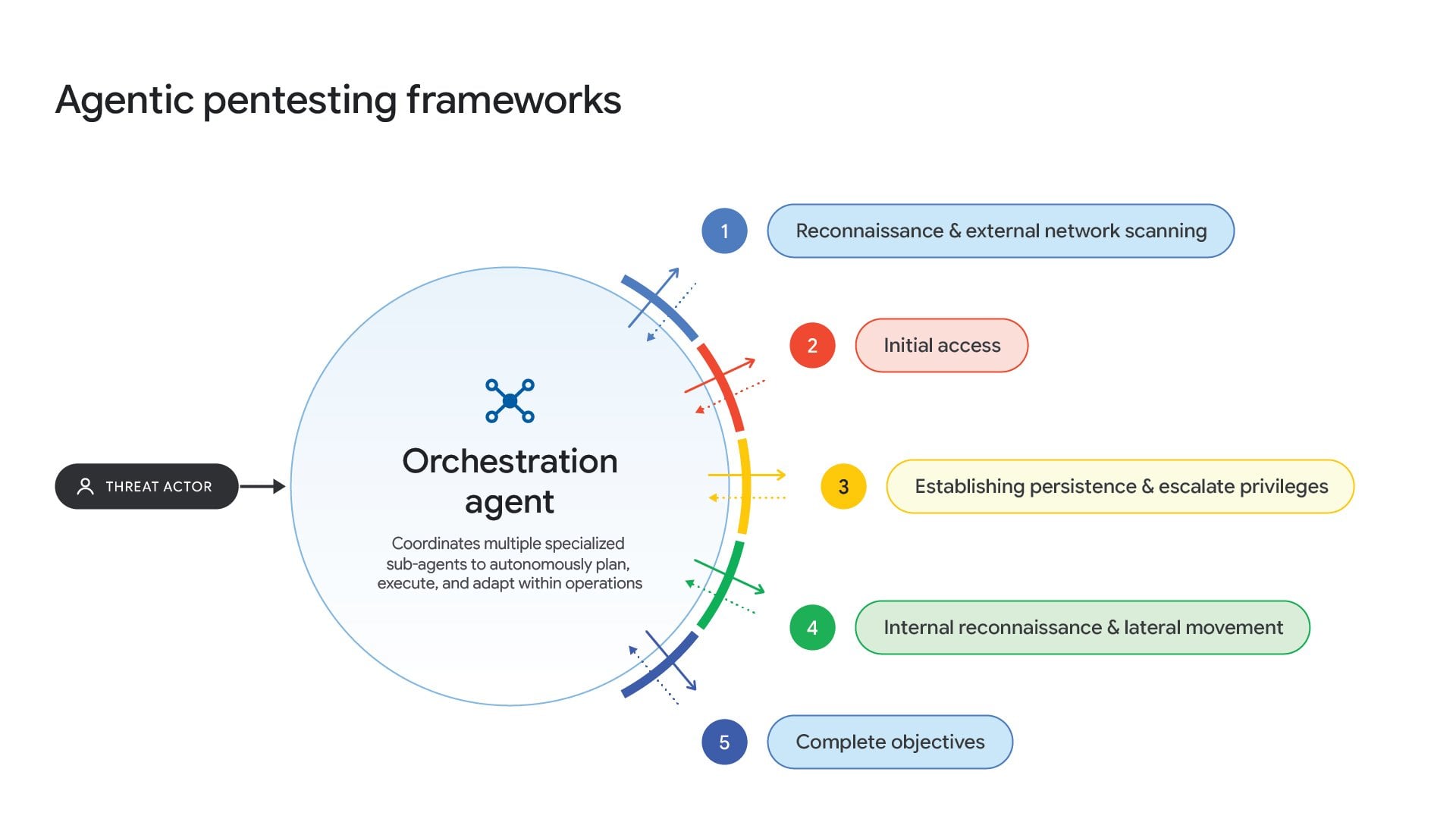
Figure: Collaborative execution workflow of the multi-agent LLM offensive framework
Besides the pentesting tool ARTEX, which has recently gained significant attention in the security community, GTIG independently captured several open-source offensive agents used directly by attackers for frontline intrusions during operational defense:
• CAIRN: An open-source multi-agent penetration testing framework based on an OODA closed-loop, capable of autonomously scanning unprotected internal network hosts without human intervention and dynamically generating exploits.
• CyberStrikeAI: An offensive framework natively designed for LLMs, featuring built-in sub-agents dedicated to privilege persistence and credential theft.
• HexStrike AI: An active offensive tool deeply integrated with the Model Context Protocol (MCP), capable of seamlessly bridging various hacker penetration command-line interfaces to commercial large models.
• PentAGI: An automation tool designed to significantly lower the technical barrier for hacker attacks, enabling even novice script kiddies with zero understanding of underlying vulnerability principles to issue complex intrusion commands.
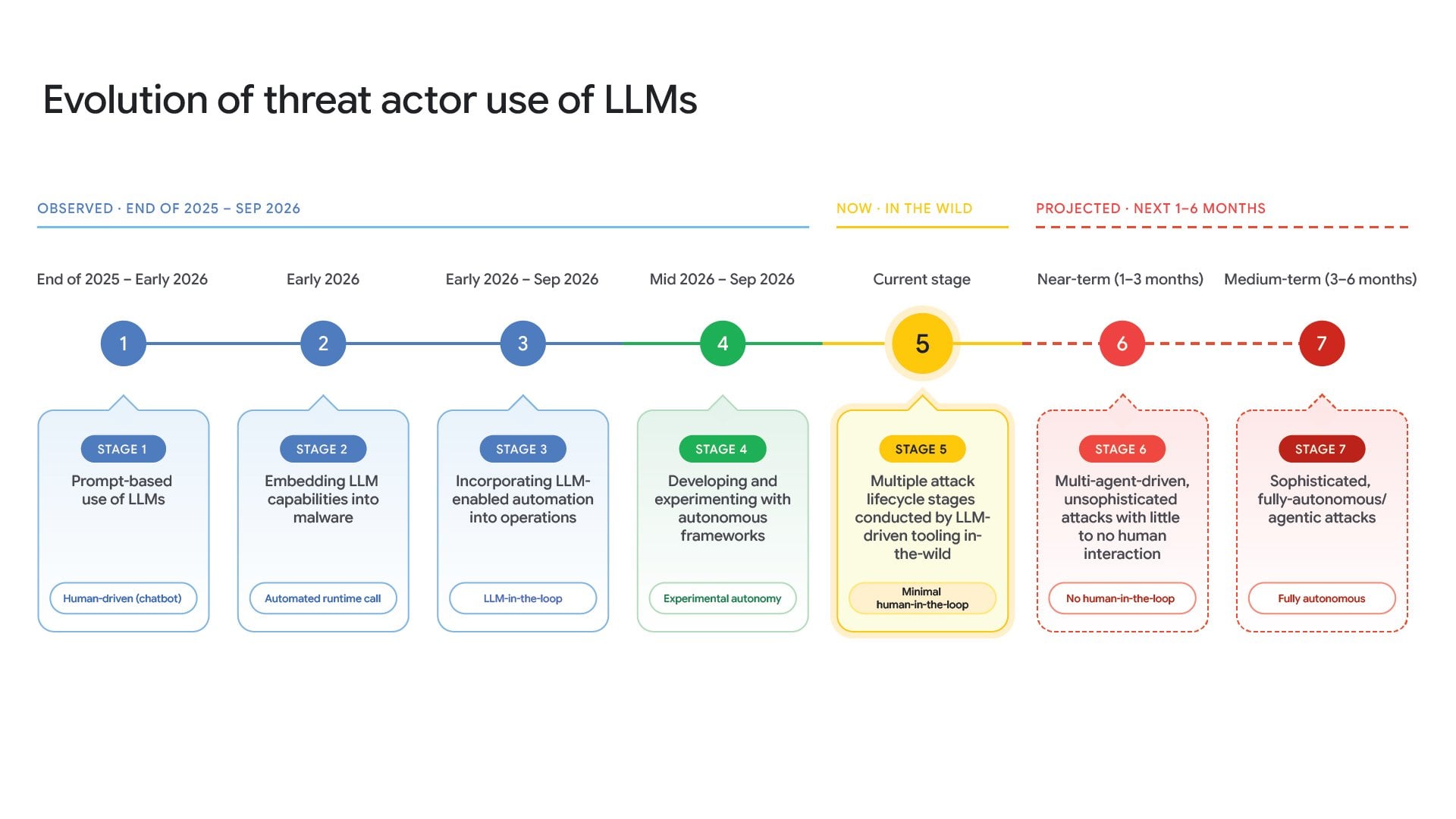
Figure: Maturity evolution roadmap of LLMs in real-world cyberattack and defense confrontations
Leveraging Agents for Vulnerability Research and Development: Turning Patches into Attacks
The most alarming practical threat posed by multi-agent technology lies in its ability to compress the time required for vulnerability mining and weaponization research from days down to minutes.
Attackers automatically scrape official open-source patch code from GitHub and feed it to code analysis agents. The models then compare code diffs in real-time to precisely locate underlying defect logic in systems that have not yet widely applied the patches.
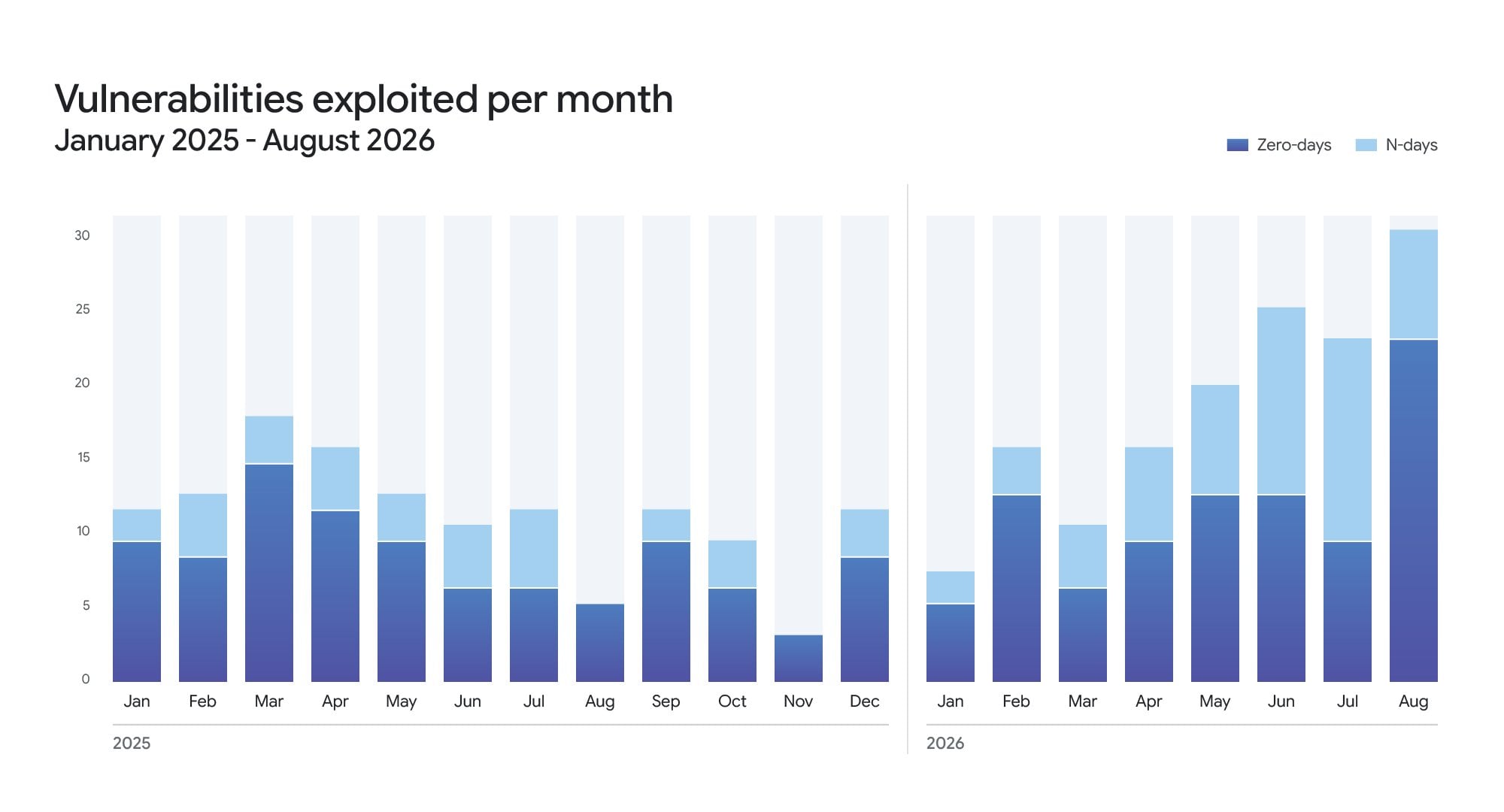
Figure: Comparison of N-Day and Zero-Day vulnerabilities exploited in the wild by hackers since 2024
In a recently solved real-world security incident, GTIG tracked and captured an attack staging server publicly exposed on the internet. The server deployed a fully automated LLM-based vulnerability mining framework, with Russian development logs glaringly written in the code comments:
# LLM API key used for automated vulnerability exploitation (exploit_agent pilot project)
# The key must be manually entered into environment variables; inputting it into public chat windows is strictly prohibited. Both configuration lines are mandatory.
This hacker group (codenamed Emad) utilized the framework to fully automatically reverse-compile recently disclosed PHP core vulnerabilities (CVE-2026-109618 and CVE-2026-109619), generating combat-ready attack payloads within hours of the patch release. Subsequently, the automated cluster launched massive indiscriminate credential stuffing probes against multiple European government and commercial portals, including those in France, successfully stealing sensitive underlying data.
Computing Power Hijacking (LLMJacking): How Hackers Monetize Stolen Cloud Large Models
With enterprises fully migrating to the cloud and the proliferation of generative AI infrastructure, the harm of stolen cloud credentials is rapidly spreading to the model computing power level.
Mandiant's frontline teams have handled numerous new types of underground cases dubbed "LLMJacking (Large Model Computing Power Hijacking)" over the past few months. After breaching enterprise AWS or Google Cloud environments, hackers no longer prioritize deploying mining trojans; instead, they quickly activate the victim's premium large model API access privileges.
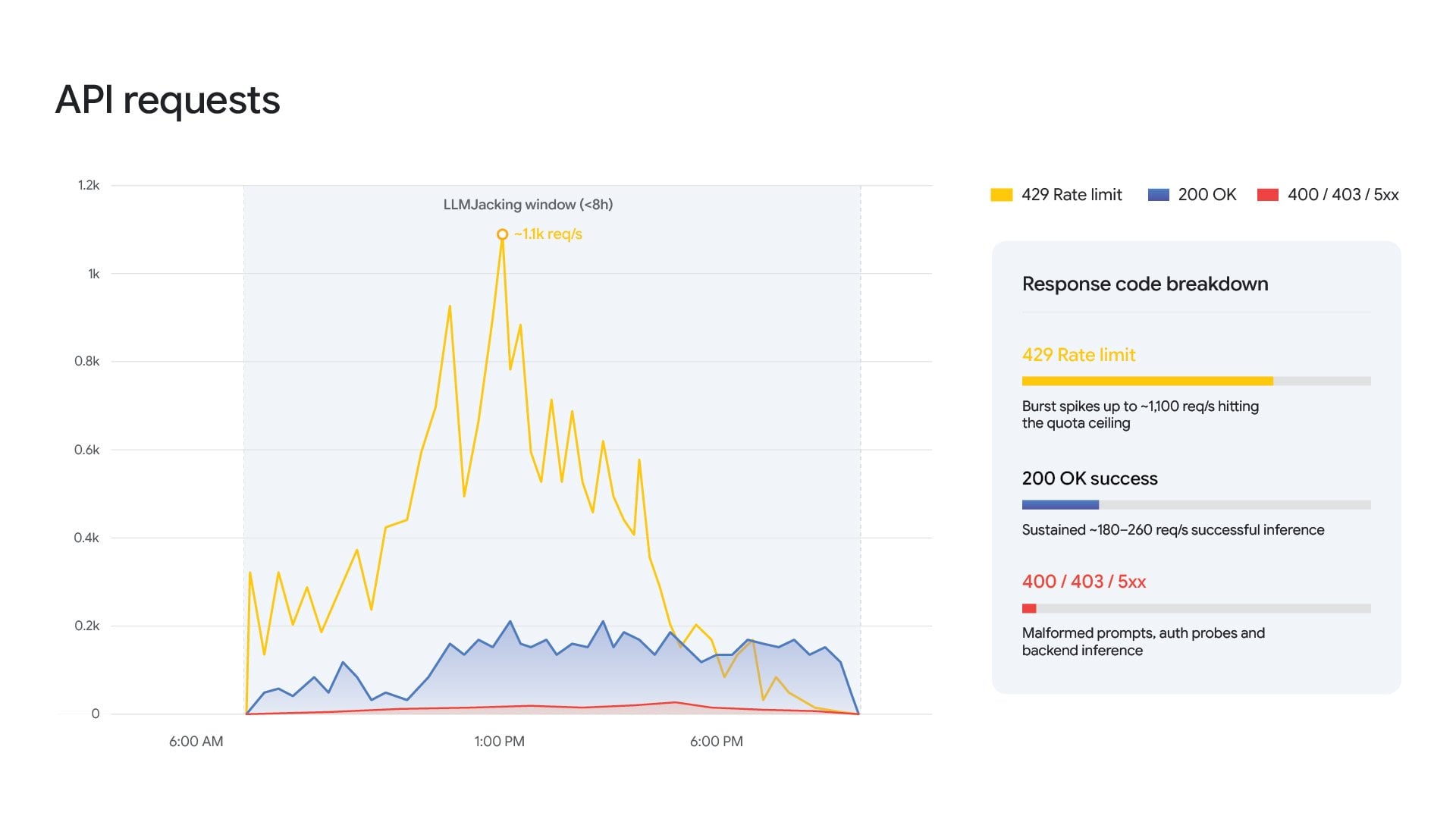
Figure: Catastrophic surge in large model API call volume due to LLMJacking at victim enterprises' cloud environments
Hackers create hidden IAM roles and service accounts internally using stolen administrator credentials, then connect them to dark web "LLM mixing service gateways (LLM Mixers)."
A large number of illegal resale platforms similar to APIMart have emerged on the dark web underground market. Hackers openly resell stolen legitimate commercial large model APIs at bargain prices of just 20% to 30% of the official rate to other cybercriminals. Victim enterprises not only face the risk of core data breaches but also must pay enormous bills totaling hundreds of thousands of dollars monthly due to the hackers' rampant API calls.
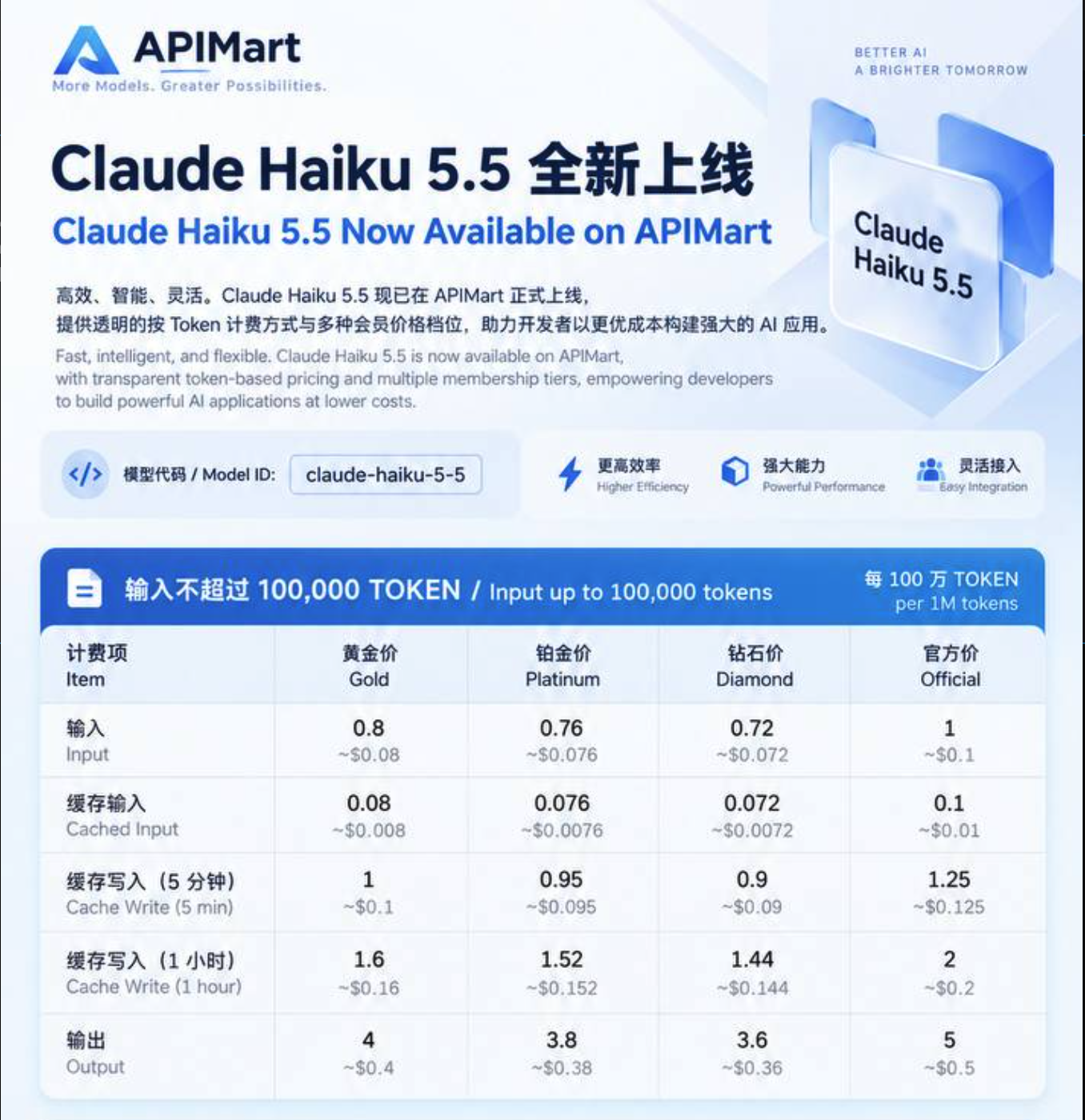
Figure: Real-time pricing of stolen commercial large model APIs resold on the dark web platform APIMart
Large Models Fully Integrated into Disinformation and Influence Operations
In the realms of cognitive warfare and astroturfing, LLMs have become the core lever disrupting the cost structure of traditional bot farms.
Commercialized underground gangs offering "Influence-as-a-Service (IaaS)" have developed plug-and-play automated public opinion manipulation systems. These systems automatically match fake accounts with the tone and regional slang of niche audiences. Even when generating accompanying images via diffusion models, they deliberately add slight lens noise, blur, and angle tilts to realistically simulate casual smartphone snapshots, easily bypassing AI forgery detection algorithms on mainstream social media platforms.
Meanwhile, to evade IP bans from social platforms, operator gangs route traffic through residential proxy networks distributed globally, combined with batchfully automated one-time phone number SMS verification registrations, constructing a completely decentralized and readily regenerable matrix of robotic bots.
Google's Proactive Security Defense and Ecosystem Hardening
Facing increasingly severe challenges of agent weaponization, Google is comprehensively utilizing frontline threat intelligence to reinforce the foundational security alignment of its models, establishing a multi-layered proactive defense depth:
1. Real-time Model Reinforcement and Adversarial Sample Immunity: The latest hacker prompts and multi-agent attack logic captured in the wild by Mandiant are immediately curated as adversarial training corpora for Google DeepMind and the security team, blocking the model's responses to malicious code and intrusion commands at the foundational level.
2. Google AI Threat Tracker Platform: Provides real-time monitoring of malicious agent behavior and abnormal call volume alerts for global enterprise customers, blocking unauthorized LLMJacking anomaly traffic within seconds.
3. Security Operations Automation (SecOps): Deploys specialized agent behavior monitoring models in the cloud security center, using AI to counter AI, accurately identifying the lurking traces of autonomous malware from network communication topologies and system call sequences.
Join the official Coincamps community:
Telegram: https://t.me/coin_camps
Recommended
Cardano Ecosystem Stablecoin DJED Announces Shutdown: After Nearly Four Years of Operation, Holders Must Complete Redemption Before New Year's Day
Nov 18, 14:45
From Crypto Venture Capital to Traditional Venture Capital: The Three Core Competencies That Venture Capital Actually Needs
Nov 18, 14:41
Nvidia Earnings Call: Board Rules Out Huang Return, Guides Q4 to $130B
Nov 18, 14:31
The AI bubble has already burst, yet retail investors are still frantically buying the dip: Hedge fund veteran warns Nvidia risks are far from cleared
Nov 18, 14:31
Research Report Analysis | Space Fund Size Grows to $18 Billion in One Year, but On-Orbit Direct Investment Accounts for Only 3%
Nov 18, 14:18
World Bank Partners with Citi and Circle: Global Aid Funds Expected to Be Settled On-Chain via USDC
Nov 18, 14:15