
HTX Macro Research Report | Economic Repricing Under the New Normal of High Interest Rates: In-Depth Assessment of Global Economic Conditions from 2026 to 2027

Huobi HTX Chief Analyst Cloud recently released an in-depth global macroeconomic research report. Against the backdrop of ongoing Federal Reserve rate hikes and escalating trade frictions, the report assesses the overall trajectory of the global economy from 2026 to 2027, providing investors with a reference for understanding the current macroeconomic environment. The full report follows.
In the past two years, the market has grown accustomed to interpreting macro trends through an "event-driven" lens: each FOMC meeting, inflation print, or geopolitical conflict priced and digested in isolation. However, what truly shapes the economic landscape over the next 12 to 18 months is not any single event, but a defining era-wide characteristic confirmed collectively by these events: the central tendency of global capital costs has structurally risen, while growth, trade, and fiscal dimensions have simultaneously lost their historical buffers. Current discussions regarding further Fed rate hikes, escalating U.S.-Europe trade friction, and the prolonged Russia-Ukraine conflict are less three independent risks than three confirmations of this same era-wide shift. This article does not isolate individual event impacts, but instead offers a systematic assessment of the macroeconomic outlook: where we stand, what the constraints are, where the economy is heading, how major economies are diverging, and how asset prices will be re-priced.
The Current Coordinate of the World Economy: Three "No Longer"s
To assess the overall situation accurately, the first step is to fix the coordinates. The current state of the global economy can be summarized by three "no longer"s. First, cheap money is gone. Policy rates sit at 3.75% to 4.00% and continue to edge higher, the 10-year Treasury yield hovers near 4.9%, and real interest rates have turned positive: a funding environment that has never persisted at length since the 2008 financial crisis. For the past 15 years, every episode of growth stall was met with accommodative rescue, cementing a deep-seated market expectation that "something will be done if markets fall"; this expectation is now the most fragile link in the entire pricing framework. Second, globalization dividends are gone. Tariffs are shifting from bargaining chips to routine tools, supply chain allocation priorities are moving from efficiency-first to security-first, and multinational corporations are paying ever-higher premiums for certainty: the cost is a systematic downward revision of global potential growth, a loss that won't appear in any single quarterly data release but will determine the growth midline for the next decade. Third, fiscal buffers are gone. In a high-rate environment, government interest burdens continue to climb, while fiscal space across major economies tightens simultaneously, significantly weakening countercyclical hedging capacity: meaning that when the next downturn arrives, policy rescues will be markedly weaker than historical precedent.
These three "no longer"s converge on a single conclusion: the global economy is transitioning from an old equilibrium of "cheap money + globalization + fiscal expansion" to a new equilibrium of "high costs + fragmentation + constrained finances." This is an equilibrium switch, not a standard cyclical fluctuation: while cycles have clear troughs and rebounds, an equilibrium shift alters the foundational water level of the entire economy. All subsequent judgments rest on this coordinate. To summarize in one sentence: this is not a passing storm, but a climate change; storms teach us to take shelter, while climate change teaches us to relocate.
The Slope of Constraints: How Three Premises Reshape the Future
Beneath the overarching framework, three emerging premises exist that don't alter the direction, but dictate its slope and speed. First, continued Fed rate hikes: market pricing keeps the probability of a 25bps hike in December above 90%, with divergence only on pace—a one-off 50bps move coexists with gradual tightening, while the path toward a peak rate of 4.75% and a tightening cycle extending into 2027 is now baked into baseline forecasts by multiple institutions. Its significance lies not in the magnitude of a single move, but in confirming the "prolonged normalization of high rates": markets must abandon hopes for rapid easing and re-price all assets against high-cost capital. Second, escalating Europe trade friction: existing tariffs face delays into next year, while new lists target core European exports; EU retaliation tools are filed, and CBAM enters the charging phase. Its significance shifts "trade fragmentation" from a trend forecast to an established reality, pushing supply chain restructuring costs from expectations onto balance sheets. Third, the protracted Russia-Ukraine conflict: mutual strikes on energy infrastructure become routine, ceasefire lacks common prerequisites. Its significance formally places "security costs" on corporate ledgers, turning energy risk premiums, shipping insurance, and supply chain redundancies into structural, long-term expenditures.
All three premises transmit in highly synchronized directions: pushing costs up and suppressing growth. Interest rates set the price of capital, trade sets the price of goods, and conflict sets the price of security: when all three rise simultaneously, the economy faces no low-cost escape. The overarching framework is illustrated in Figure 1: structural changes dictate direction, cyclical constraints dictate magnitude, economic divergence dictates composition, and asset pricing is the ultimate outcome.
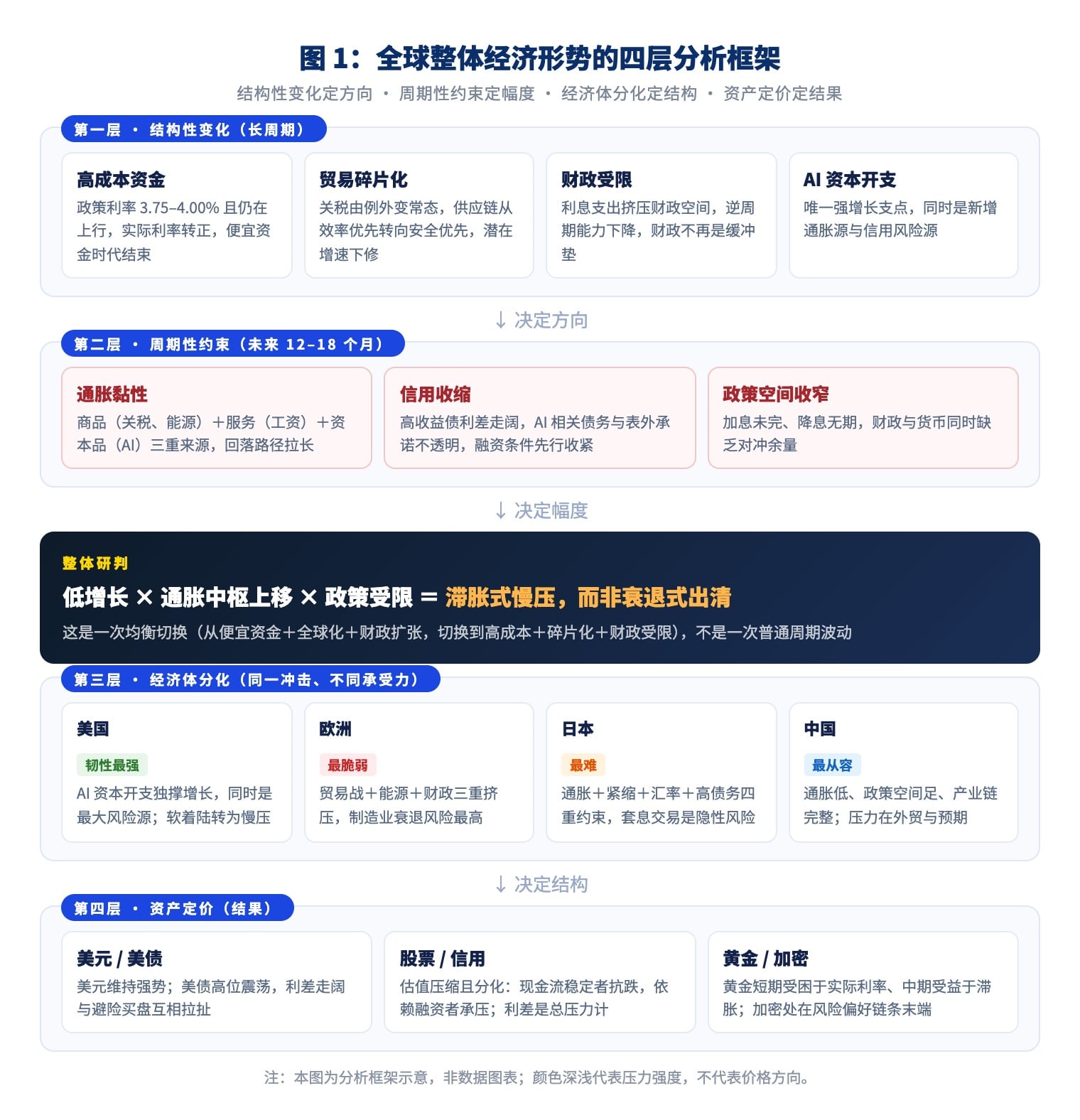
Figure: Four-tier analytical framework for the global macroeconomic landscape (Structural Changes → Cyclical Constraints → Economic Divergence → Asset Pricing)
Comprehensive Assessment: Four Core Themes – Growth, Inflation, Fiscal, Financial
Growth Line: Global growth slows, but avoids a cliff-edge drop.The U.S. economy retains resilience: headline retail sales MoM decelerate to 0.2%, while core retail excluding autos remains at 0.6%, indicating consumption differentiation rather than a stall; corporate investment is weighed down by financing costs, with AI capex serving as the sole strong pillar, though return realization remains uncertain and stages heavily reliant on capital market funding are particularly vulnerable. Europe faces the greatest growth pressure: weak external demand coexists with sluggish domestic consumption, manufacturing recession risk outweighs that of the U.S., while energy and defense spending crowd out fiscal space. Japan presents the most complex scenario: rising inflation, Central Bank tightening expectations, and soaring sovereign debt coincide, with the yen repeatedly testing key support levels; it acts as both a source of global carry trades and a potential volatility trigger. China's pressures center on foreign trade and sentiment, but low inflation, ample policy room, and complete industrial chains provide relatively favorable conditions amid global tightening. Overall verdict: global growth shifts from "U.S.-led strength" to "synchronized deceleration," with the pace dictated by credit conditions rather than demand collapse. Inflation Line: Higher central tendency, extended path to disinflation.The drivers of this inflation wave require a three-layer breakdown: commodity inflation stems from tariffs and energy, a direct product of policy and geopolitics; services inflation originates from wage stickiness, a byproduct of labor market resilience; capital goods inflation emerges from the AI investment boom driving up prices for semiconductors, power, and other inputs, marking a new variable in this cycle: internal Fed members already view AI as the most likely persistent inflation driver going forward. Core PCE remains above 3% with lagged values continuously rising, making a stable return to the 2% policy target unlikely before 2027. The implication for the broader outlook is clear: inflation is no longer a transient cyclical phenomenon that fades on its own, but a structural backdrop that coexists long-term with slowing growth—the very essence of "slow-moving stagflation." Fiscal Line: Degraded from a countercyclical tool into a binding constraint.Elevated interest rates push government interest expenses to historic highs, simultaneously capping fiscal expansion capacity across major economies: the U.S. is bound by debt ceilings and interest servicing, Europe by deficit rules and defense spending, and Japan by the world's highest sovereign debt ratio. Fiscal policy's inability to offset monetary tightening marks the biggest divergence from 2020–2021: when downturns strike, there is no second hand to catch the fall. Financial Line: Credit is the weak link, but not in crisis form.Bank system reserves total roughly $3 trillion with money markets operating smoothly: liquidity is not the issue; willingness to assume risk is. High-yield spreads have widened to 3.52%, AI-linked debt and off-balance-sheet lease obligations are ballooning rapidly, and private credit suffers from insufficient transparency. Risk capital's pricing appetite is declining, financing conditions tighten ahead of the curve, yet bank systems remain well-funded: a classic pattern of "tightening financial conditions without crisis eruption." This dictates a slow, compressional downturn: corporate financing terms tighten first, capex plans delay subsequently, and earnings expectations revise last. Credit spreads thus serve as the premier indicator for assessing the macro backdrop: each basis point of widening forces a repricing of all high-valuation assets.Economic Divergence: Identical Shock, Differential Resilience
Under the new equilibrium, economic performance will diverge sharply, with divergence itself becoming the primary source of future volatility. The U.S. represents a "most resilient yet most vulnerable" combination: AI capex single-handedly props up growth, but if returns disappoint or funding conditions tighten further, this pillar instantly flips into a risk source: equity valuation compression will outpace earnings downside. Europe is the weakest link: trading friction, energy premiums, and fiscal crowding-out create triple exogenous shocks atop existing manufacturing weakness, yielding the highest recession risk among major economies and rendering the ECB's policy stance the most passive. Japan acts as an "implicit powder keg" in the global rate system: inflation meets tightening, debt ratios hit global highs, and yen carry trades scale massively; should BOJ tightening pace misalign with market expectations, forced unwinds could transmit shockwaves to global risk assets—a blind spot in most investor pricing. China appears relatively more composed: low inflation, ample policy room, and complete industrial chains mean pressures concentrate on foreign trade and sentiment repair; within a global landscape of "divergent tightening," CNY assets' relative valuation advantage may actually attract medium-to-long-term allocation flows. In short: as the world moves from "synchronized easing" to "fragmented tightening," investors can no longer trade "global" as a monolith; they must price each economy independently.
Scenario Analysis & Asset Pricing
Base Case (Highest Probability):Rate hikes proceed at a 25bps pace, trade frictions see limited escalation: lists published but enforcement delayed, conflict maintains stalemate. Economy follows a slow-stagflation compression path: growth steps down quarterly, inflation proves sticky, policy holds steady; risk assets drift lower with elevated volatility, though no crisis materializes. Adverse Scenario:Rate hike pace exceeds expectations (a one-off 50bps move or dot plot signaling additional cycles), trade retaliation meets new tariffs head-on, conflict triggers escalation events: their convergence pushes credit spreads to crisis thresholds, risking a second market bottom where neither fiscal nor monetary authorities possess sufficient buffer. Milder Scenario:Inflation unexpectedly falls, trade talks regain track, ceasefire achieves framework milestones: valuation repair windows open, though constrained by high-cost liquidity, the ceiling for recovery remains below historical cycle averages. Asset Pricing Unfolds Accordingly:The USD maintains strength, non-USD currencies and emerging market financing conditions remain under pressure; U.S. Treasury yields oscillate at elevated levels, with spread widening pulling against safe-haven bids; equity valuations broadly compress but at divergent speeds: companies with stable cash flows and manageable capex prove resilient, while AI capex-heavy firms reliant on capital market funding or client advance payments face the heaviest pressure; gold is temporarily trapped by positive real rates and a strong dollar, but mid-term allocation appeal rises as the stagflation narrative returns; among commodities, energy is supported by geopolitics while industrial metals weigh on demand; crypto assets sit at the very end of the risk-preference hierarchy: they bear the first wave of risk-off selling and receive the last tranche of recovery premiums. Portfolio principles adjust accordingly: shorten duration and reduce leverage, enhance asset quality, prioritize cash flow and real assets, hold cash: cash carries a cost, but leverage's penalty is far greater.Conclusion: Five Fundamental Takeaways
First, this is an equilibrium switch, not a cyclical fluctuation: the three pillars of the old equilibrium—cheap money, globalization, fiscal expansion—simultaneously loosen, permanently altering the foundational water level of the economy. Relying on traditional cyclical logic to wait for "oversold rebounds" is dangerous.
Second, the upward shift in inflation central tendency is structural: tariffs, energy, and AI capex form new price drivers, making a stable return to the 2% target unlikely in the visible horizon, while nominal rates will persistently exceed the 15-year average.
Third, fiscal policy is no longer a buffer cushion: the next downturn arrives without a rescue team; market participants must shoulder the cyclical burden themselves.
Fourth, divergence replaces synchronization: the U.S., Europe, Japan, and China traverse distinct paths under identical shocks; pricing economies individually replaces globally unified trading, making volatility the new normal.
Fifth, the core pricing variable shifts from "growth" to "costs": the outperformers of tomorrow will not be assets with the most compelling growth narratives, but those most resistant to high-cost environments: cash flow, low leverage, hard asset characteristics, and policy backing are the four hard currencies of the new equilibrium. Among them, cash stands alone as the only asset free of price risk: it yields nothing, yet purchases optionality; in a phase where direction remains unclear, optionality itself delivers the highest return.
Disclaimer: The content of this article does not constitute investment advice, nor does it amount to an offer, solicitation, or recommendation for any investment products.About Huobi HTX
Established in 2013, Huobi HTX has evolved over more than a decade from a cryptocurrency exchange into a comprehensive blockchain business ecosystem encompassing digital asset trading, derivatives, research, investment, incubation, and other operations.
Committed to lowering barriers to entry in the digital asset sector and serving a broader user base, Huobi HTX continuously refines its products and services in response to user needs and industry shifts, steadily advancing toward its vision of "achieving financial freedom for the world's eight billion people."
For more information about Huobi HTX, please visit https://www.htx.net.in/zh-cn/ or HTX Square, and follow us on X, Telegram, and Discord. For further inquiries, contact glo-media@htx-inc.com.