Despite Bear Market, Still Making Millions a Day, Is pump.fun's Revenue Real?
「What other native cryptocurrency applications can generate revenue?」
When it comes to this question, you might instinctively think of—stablecoins, CEX, Perp DEX, on-chain Pokémon cards...
However, pump.fun, which once shone brightly during the meme frenzy and set one of the largest IPO amounts in cryptocurrency history, is starting to be easily forgotten. In some conversations, I even heard questions like:
「Is pump.fun still alive? Can they still make money?」
pump.fun not only can still make money but remains one of the top "money printers" in native crypto applications. According to DefiLlama's statistics, whether in any time frame of 24 hours, 7 days, 30 days, or 1 year, pump.fun's revenue is only surpassed by Tether, Circle, and Hyperliquid, consistently ranking 4th.
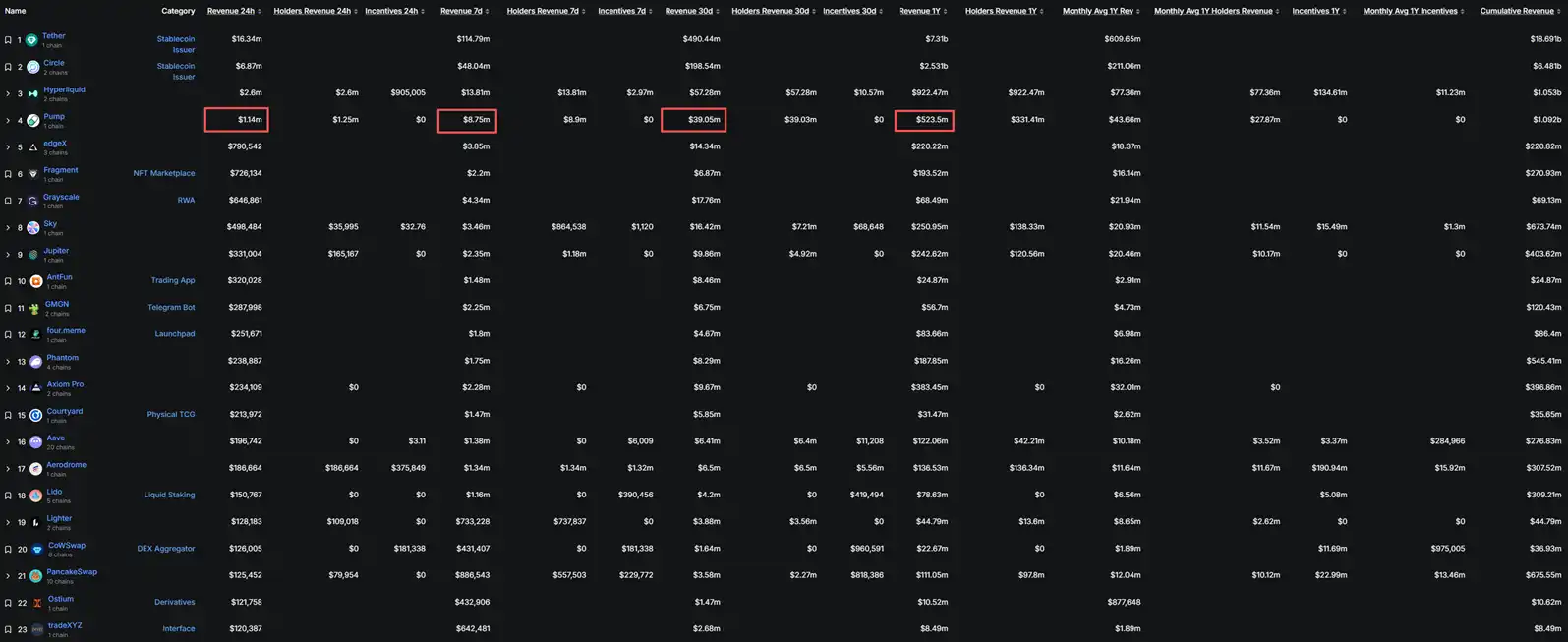
Despite various "shill" chat groups being deserted, with many not even having a single person talking for days, pump.fun's daily average revenue in the past 7 or 30 days still exceeds one million dollars.
Is this real revenue, or is pump.fun fabricating it?
First, according to pump.fun's official revenue dashboard, pump.fun's current revenue consists of 3 parts:
- Bonding Curve Revenue: Transaction fee revenue before the new token graduates, with pump.fun charging a 0.95% protocol fee on this portion
- Pumpswap Revenue: For tokens that have successfully graduated to Pumpswap AMM for trading, a 0.93% protocol fee is charged on tokens with a market cap of 0-420 SOL
- Terminal(Padre) Revenue: pump.fun acquired the Padre trading terminal last October and rebranded it as the multi-chain trading platform Terminal, and the revenue from this trading platform has since been included in pump.fun's revenue
- Revenue deducted for referral commissions and trading cashback
For the protocol revenue during the bonding curve phase, the Solana address officially used by pump.fun to receive this part of the revenue is CebN5WGQ4jvEPvsVU4EoHEpgzq1VV7AbicfhtW4xC9iM. The bonding curve revenue collected to this address is hardcoded in the contract, and if fake revenue were generated by externally transferring funds to this address, there would definitely be external addresses directly calling the System Program's Transfer instruction. After analyzing transactions to this address, we did not find any behavior of falsifying revenue through simple external SOL transfers.
In other words, bonding curve revenue does indeed come entirely from protocol fee extraction from real contract calls.
The revenue data from DefiLlama's pump.fun bonding curve is directly retrieved from the official pump.fun API. This is why we initially conducted on-chain analysis of pump.fun's official bonding curve revenue address. However, DefiLlama's revenue data for Pumpswap and Terminal (Padre) is calculated through Dune SQL queries of Solana on-chain data, completely independent of pump.fun's official API, ensuring a high level of on-chain objectivity and tamper resistance.
At this point, we have ruled out the suspicion of pump.fun falsifying revenue through "external transfers" or "false reporting of data" in a straightforward manner. However, there is still the possibility that they are generating false revenue through "wash trading" via bots or internal wallets. Therefore, we need to inquire — in the current lackluster overall cryptocurrency market sentiment and especially with the considerable decline in meme coin popularity, is pump.fun's revenue genuine and organic?
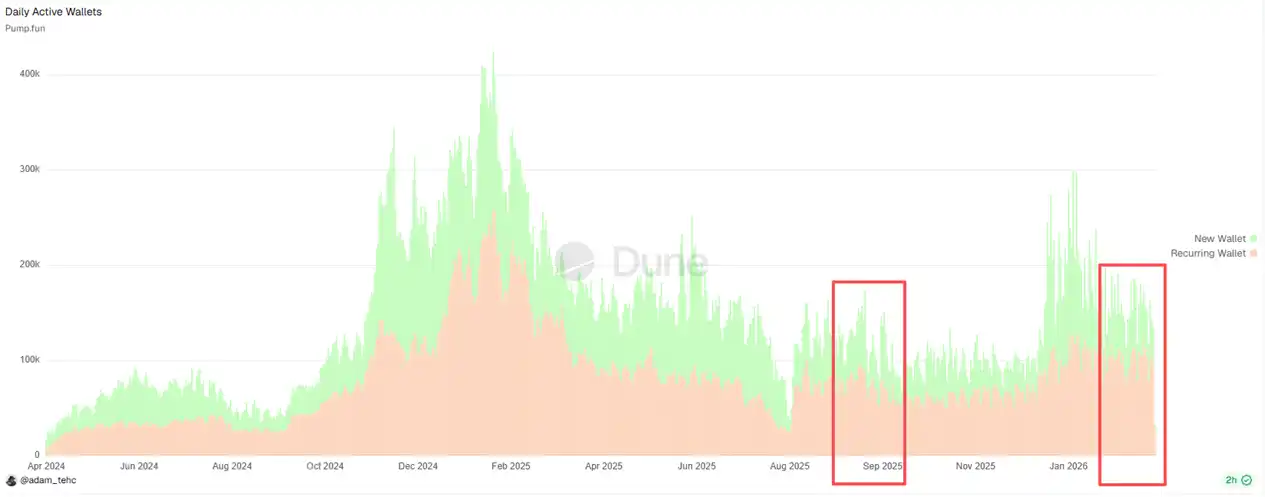
According to Token Terminal data, in the first quarter of this year, Solana's daily active address count has remained between 1.2 million and 2.2 million, while pump.fun has around 150,000.
Additionally, based on Dune's dashboard data related to pump.fun, the approximately 150,000 addresses correspond to a daily average of about 30,000 new token deployments.
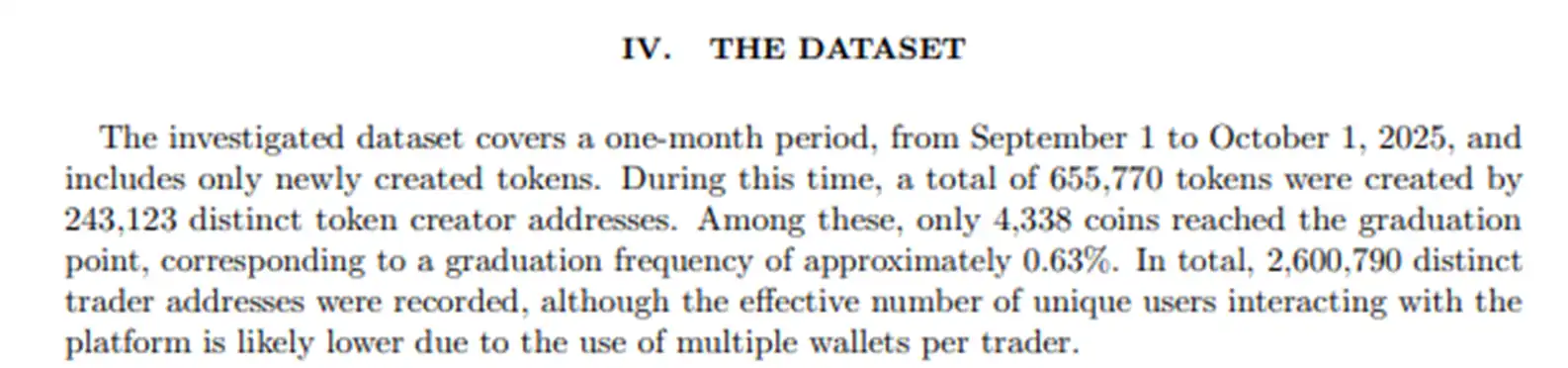
This implies that if every day 30,000 new tokens are fully deployed by different genuine users, then around 20% of active users on pump.fun are minting new coins every day. However, according to a paper published by Giulio Marino et al. last month titled "Predicting the success of new crypto-tokens: the Pump.fun case," from September 1, 2025, to October 1, 2025, a total of 655,770 new tokens were deployed on pump.fun, but the number of addresses deploying tokens was only 243,123.
Meanwhile, the daily average token deployment of the current token is higher than in September last year:
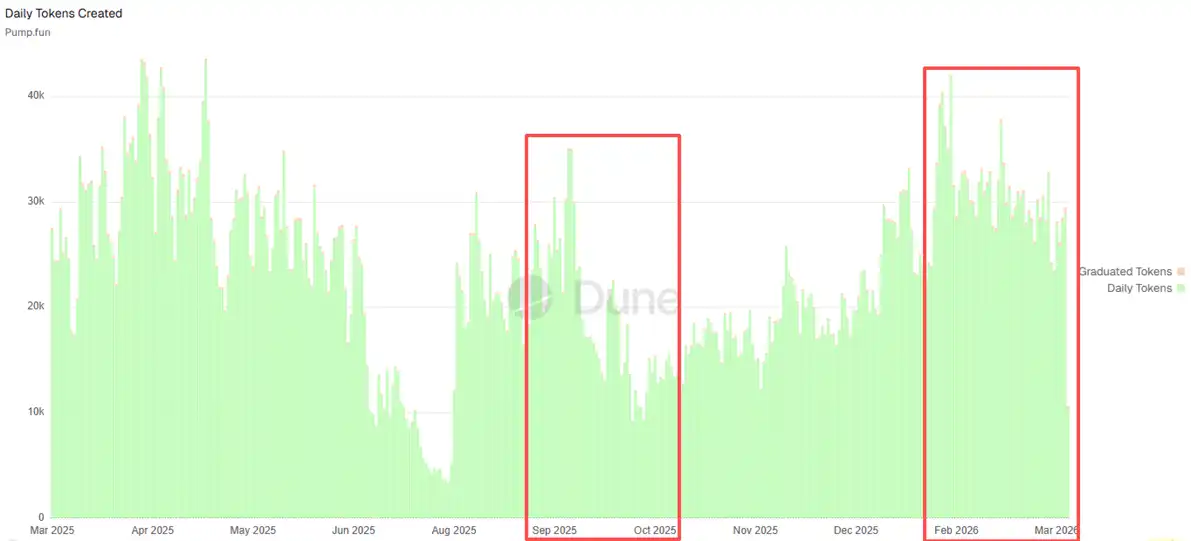
Given the current market environment, this data seems quite counterintuitive — while it feels like cryptocurrency is dying on social media, there are still so many new tokens being deployed on pump.fun every day. Additionally, the number of active addresses in the past month is about 10% higher than in September last year.
Out of the daily million-dollar revenue on pump.fun, Pumpswap and Terminal (Padre) still represent a relatively small portion. For example, based on data from March 18th, the revenue from Pumpswap and Terminal (Padre) on that day was approximately $284,000 and $58,000 respectively, while the revenue from the bonding curve was about $795,000, roughly 2.3 times the sum of the former two.
The new token graduation rate has even exceeded double that of September last year recently:
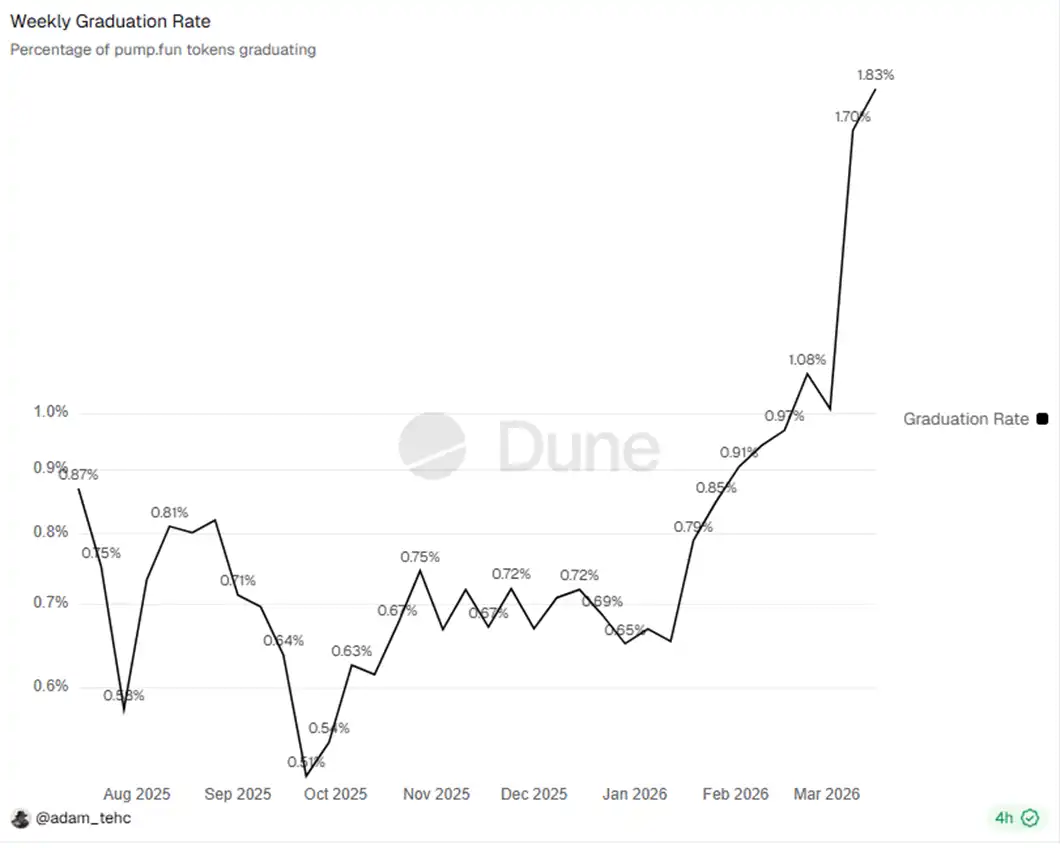
At the same time, around 26,000 new tokens were deployed on pump.fun that day. To achieve $795,000 in bonding curve revenue, a bonding curve volume of approximately $83,684,200 is needed, averaging about $3,218 in volume contribution per new deployed token before successful graduation.
Considering the above data, it doesn't sound so difficult for each new token to contribute over $3,000 in volume, which actually seems quite normal. Even in the data-lagging September last year, pump.fun was still able to achieve this goal. Calculated in SOL terms, the earnings in SOL are even higher now than in September last year, although the USD-based income has decreased.
However, we still have a question here: since August last year, pump.fun has almost entirely used its daily revenue to buy back $PUMP, repurchasing more than 10% of the total supply and over 30% of the current circulation of $PUMP. Why then does the price of $PUMP keep dropping? Although through on-chain data we can see that pump.fun's repurchased $PUMP, worth over $300 million, remains untouched in wallets, is it possible that they are artificially inflating revenue through wash trading, pretending to "buy back" while secretly offloading through dispersed addresses?
Let's take a look at $PUMP's token release plan:
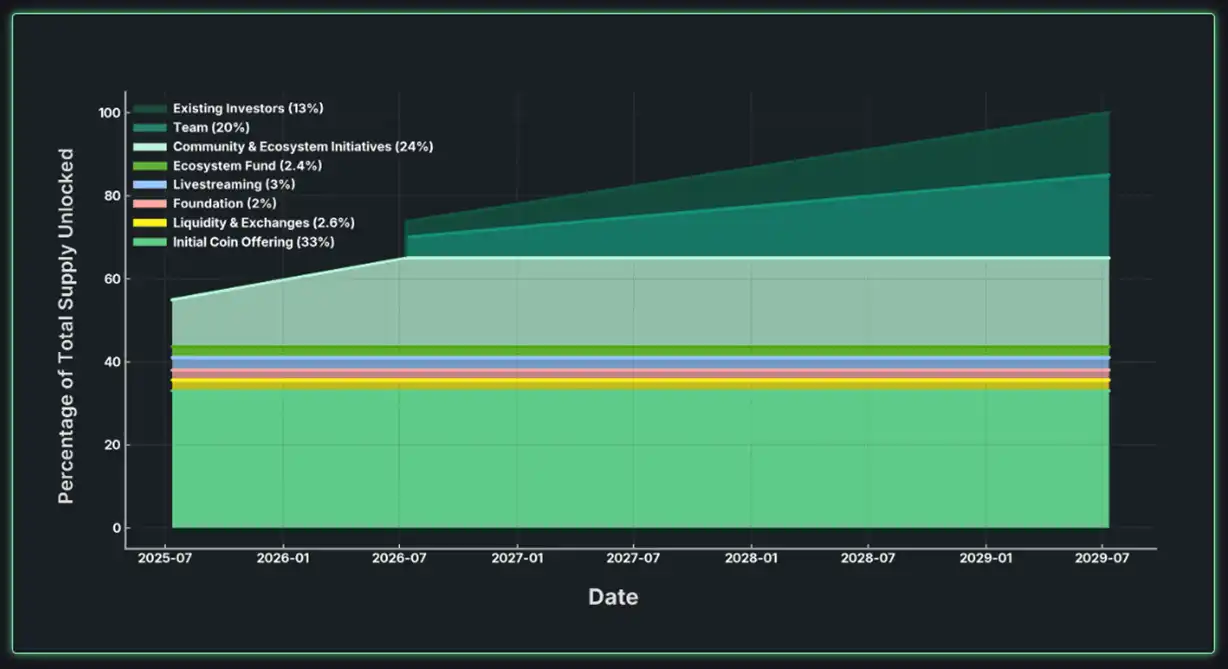
So far, the circulation of $PUMP is as follows:
- ICO: 33%, fully unlocked at TGE
- Team: 20%, still locked
- Investors: 13%, still locked
- LP and Exchange: 2.6%, fully unlocked at TGE
- Ecosystem Fund: 2.4%, fully unlocked at TGE
- Live Support: 3%, fully unlocked at TGE
- Foundation: 2%, fully unlocked at TGE
- Community and Ecosystem Incentives: 24%, approximately 50% unlocked at TGE, with the remaining portion linearly unlocked over 1 year; currently, 65.27% of this portion has been unlocked
In the $PUMP multisig custody wallet with the address Cfq1ts1iFr1eUWWBm8eFxUzm5R3YA3UvMZznwiShbgZt, there are approximately 36.5% of $PUMP's total supply remaining.
This does not align with $PUMP's token release plan. What we can confirm is that post-TGE, all $PUMP was moved to a multisig custody wallet for distribution. Theoretically, the maximum transferable amount is only about 58.67% of the total supply (ICO 33% + LP and Exchange 2.6% + Ecosystem Fund 2.4% + Live Support 3% + Foundation 2% + 15.67% of the Community and Ecosystem Incentives portion already unlocked), with the $PUMP balance in the multisig custody wallet should not be less than approximately 41.33%. There is a difference of about 4.83%.
Where did this 4.83% go? We don't know. In fact, we don't even know where the $PUMP, apart from the ICO sale distribution, which has clear intended uses, is located. Although based on on-chain data comparison, we have indeed discovered that around 24% of $PUMP's total supply has been dormant in various addresses after large transfers and remains silent to this day, approximately corresponding to the portion outside of the ICO sale distribution. However, the pump.fun official team has never disclosed the wallet addresses corresponding to the funds of each part.
Especially for the Community and Ecosystem Incentives portion, currently, the only publicly known community and ecosystem incentive activities include approximately $1.7 million purchased by the Glass Full Foundation in meme coins within the pump.fun ecosystem, $1,000 each to 6 meme coin communities, grants totaling $60,000, funding for 12 projects amounting to $250,000, with $3 million distributed in total but only 6 winning hackathon projects announced so far.
However, this part is already considered the clearest...
But even with this transparency issue, even though 4.83% was stealthily rug pulled, the pump.fun official's buyback of over 10% of the total supply and over 30% of the current circulating supply could offset this sell pressure, why is the $PUMP price still struggling?
A possible reason is that $PUMP indeed does not have enough buying pressure, and large buybacks, in the absence of market recognition, also disappear into thin air.
When it comes to Hyperliquid, we will certainly acknowledge its Perp DEX's leading position and narrative potential, but when it comes to pump.fun's meme coin track, even retail investors, for the most part, consider it a scam and unsustainable.
In the earlier part of the article, we acknowledged the legitimacy of pump.fun's revenue, and now we need to look at some other data. This data can explain that the negative sentiment towards meme coins is not just retail investors' emotional aversion to the extreme volatility of meme coins but will also cause institutional investors to have rational resistance.
As early as April of last year, a study by Medallion Analytics showed that during a 180-day statistical period, about 178,000 deployers of multiple tokens deployed, with 85.3% of these deployers being profitable. In the 180 days, these deployers deployed a total of about 3.59 million tokens, with profitable deployers releasing about 3.07 million of them, a proportion of about 85.5%.
During the statistical period, the top 10 profitable deployers earned about 365,000 SOL, while the 10 deployers with moderate profitability could only earn 47.3 SOL, a difference of about 7720 times. For the top deployers, the average time between new token issuances was only 0.11 hours, while for the average deployers, it was as long as 10.96 hours.
Solidus Labs studied the performance of new token deployments on pump.fun from January 2024 to March 2025. The research analysis indicated that as much as 98.6% of tokens were pump and dump scams.
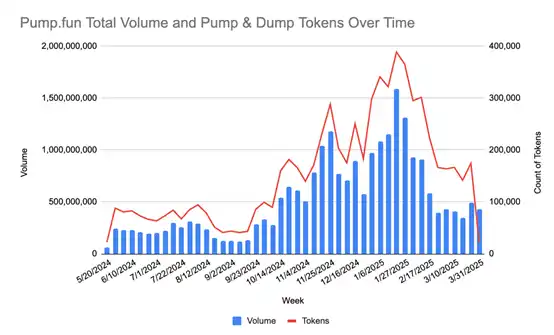
The issuance of meme coins is no longer a competition of creativity but a profit-making machine. Top deployers, after a very short period of rapid profit-taking, can then invest funds in facilities related to automatic token issuance to speed up their harvesting.
pump.fun has driven the cost of launching a new meme coin on Solana down to $2 or even less, which is indeed a technological advancement. However, they did not steer the meme coin race towards a positive direction, leading retail and institutional investors to believe that meme coins are truly a cultural or even ideological asset. They attempted to broaden the race to include livestream coins, ICM coins, and most recently AI Agent coins, but none of these attempts were successful.
The data is clear: they made the most money by providing a "low-cost harvesting tool," much like a casino rake.
For pump.fun, the deployer earns a steady 0.95% risk-free profit for each new coin launched and for every fake volume traded before the token graduates. If you want to give the token more exposure, you need to generate more volume, providing more income to pump.fun. The funds in this ecosystem are real, the revenue is real, but the ecosystem itself is inorganic, and retail investors are the ones hurt. For institutional investors, such an ecosystem lacks a healthy, sustainable long-term foundation, which may be the root cause of pump.fun's coin price slump.
In the end, we have one more question:
Since pump.fun's buyback failed to boost the coin price, would using the daily income as staking rewards be better than the current buyback?
Perhaps, or perhaps they no longer care.
Recommended
Eight-Year Investment U-Turn: Why Did Ethereum Suddenly Abandon Poseidon?
Aug 16, 10:00
The Wall Street Journal: How is AI Trading Stealing the Limelight from Cryptocurrency?
Aug 15, 14:00
Tencent Still Has a Dream
Aug 15, 11:27
To Catch North Korean Hackers, They Set Up a Fake Project
Aug 15, 10:00
From Litigation to Settlement: Positive Signal Released by HTX's Negotiation with FCA
Aug 14, 19:32
11,742 Shipping Addresses Exposed Alongside Trezor Orders
Aug 14, 19:01