All-Time High Stock Price! Corning Sets Sights on CPO Optical Interconnect Market
Summary: Glass Bridge Aims at AI Data Center Chip-Level Optical Interconnect.
TL;DR
· Corning's GlassBridge focuses on fiber-to-photon chip connection, targeting NPO, CPO, and high-density photonics modules.
· Publicly available documentation states that it has demonstrated O-band 1.5dB coupling using glass IOX ion-exchanged waveguides.
· This technology still needs to overcome challenges related to mass production, yield, cost, and customer platform validation, and cannot yet equate to large-scale orders.
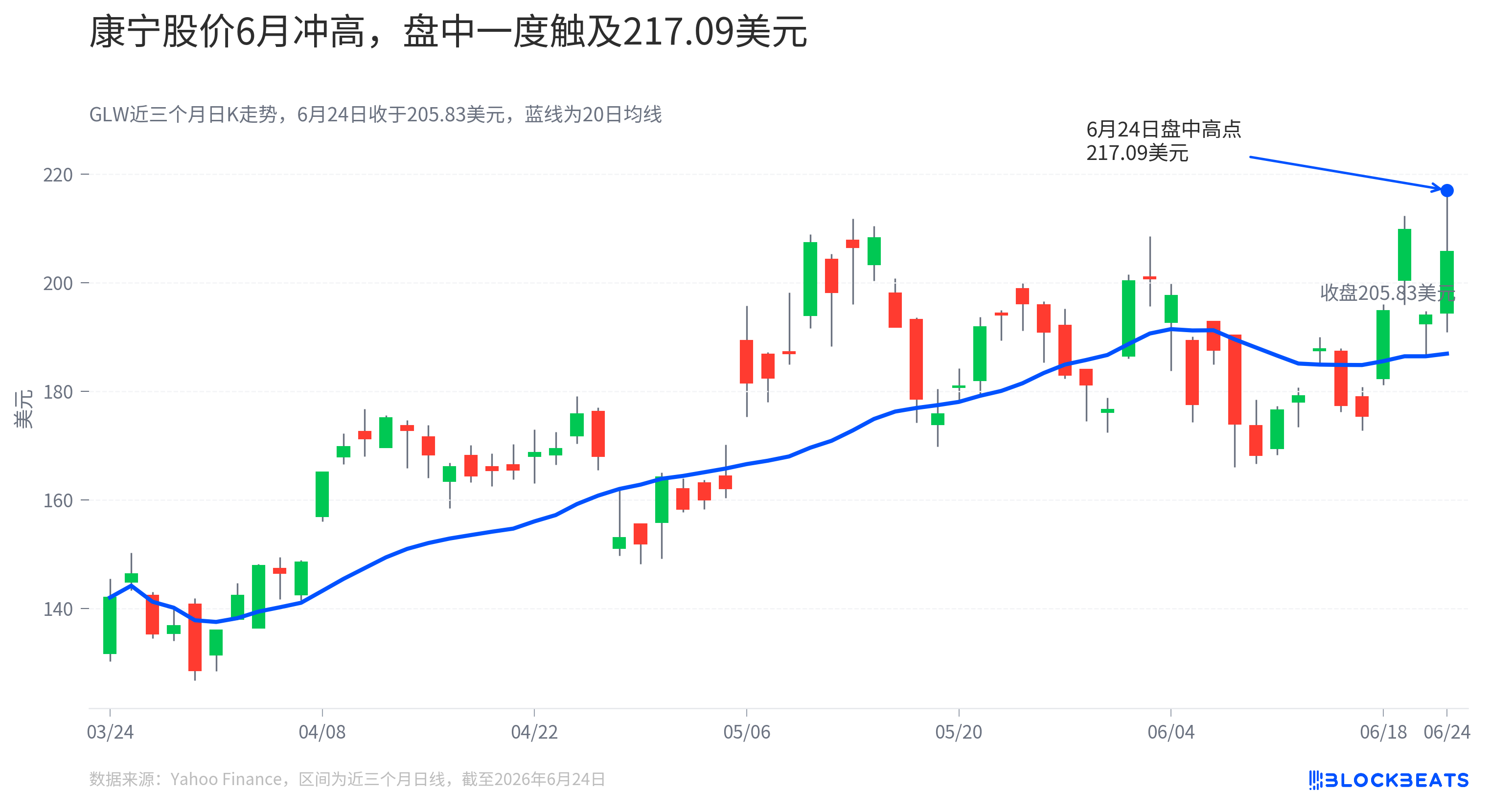
Corning's stock price has reached a high point. As of the U.S. stock market close on June 24, Corning (GLW) closed at $205.83, up approximately 6.1% for the day, reaching a high of $217.09 intraday. The demand for AI data center optical interconnects is one of the key clues reshaping the market's perception of this established glass and fiber company.
According to data from the Seoul AI Data Center Optics Conference on June 24, Corning showcased the GlassBridge glass-based optical connector, attempting to advance fiber connections closer to photonic integrated circuits. Corning's official product page positions it as a "fiber-to-PIC connector platform" for scenarios such as NPO, CPO, and high-density photonics modules.
It is a type of optical interconnection component closer to the chip, deeper than traditional pluggable optical modules. As GPU clusters in AI data centers grow larger, the data transport pressure between chips, servers, and racks increases. Both electrical and traditional optical connections face bottlenecks in density, power consumption, latency, and assembly complexity. CPO, i.e., co-packaged optics, aims to address the challenge of pushing optical connections closer to the chip.
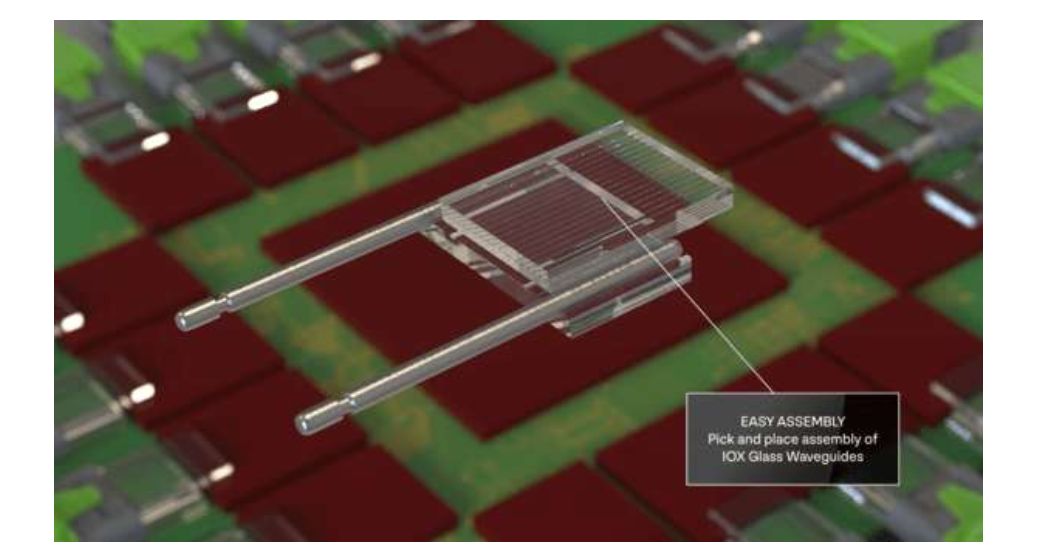
The key highlight of Corning's GlassBridge introduced this time is to leverage the company's long-standing glass and fiber capabilities into the chip-level packaging interconnect stage. The publicly available documentation states that this platform is based on glass and wafer-level IOX ion-exchanged waveguides, has demonstrated O-band fiber-to-photon chip 1.5dB coupling performance, and supports passive alignment, detachability, and high-density connections.
The Glass Bridge Aims to Solve the "Mismatch" Between Fiber and Chip
Optical interconnect sounds like connecting a fiber optic cable to a chip, but the real challenge lies in the scale difference.
The waveguides on a photon chip are usually only a few hundred nanometers wide, while the fiber core diameter is at the micrometer level. When the signal enters the photon chip from the fiber, any deviation in the optical path, angle, or position results in coupling loss. For high-density AI servers, this simultaneously affects link efficiency, assembly, testing, and packaging complexity.
GlassBridge's approach is to preform the optical path in the glass, guiding the fiber optic signal to the photonic chip interface. Customizable PIC pitches listed in the spec sheet include diameters such as 40 microns, 80 microns, 127 microns, and 165 microns. Compared to aligning a fiber array directly to the chip, these glass bridges aim to reduce assembly complexity and eliminate some intermediate connection points.
The 1.5dB is the most notable performance benchmark in this instance, but it should still be understood as a showcase metric from the spec sheet and not indicative of large-scale production validation. Before entering real data centers, this component will undergo testing for packaging yield, long-term reliability, thermal stability, and serviceability.
The Closer the CPO Is to the Chip, the Higher the Packaging Difficulty
The AI data center values CPO because it has the potential to reduce power consumption and latency in high-bandwidth interconnects. In traditional network connections, optical modules are usually inserted into switch or server panels, requiring an electrical signal to travel a distance between the chip and the module. As AI cluster bandwidth demands continue to rise, this electrical connection becomes more costly and power-hungry.
Integrating optical components into packaging or near the chip theoretically can shorten the signal path and increase bandwidth density. However, the closer to the chip, the less it resembles a typical optical module and more like advanced packaging engineering. Tasks such as optoelectronic conversion, fiber coupling, thermal management, packaging materials, assembly precision, and manufacturability are all integrated into a single system.
Corning's next-generation glass-based CPO architecture incorporates a glass substrate, optical waveguides, and through-glass vias (TGVs) into a single concept, supporting photonic devices for flip-chip mounting. The key shift is that Corning is attempting to position glass not just as a transmission material but as a packaging platform.
This also explains why GlassBridge is emerging alongside glass core packaging. Glass material offers advantages in dimensional stability, optical performance, and processability, suitable for carrying high-density optical paths. However, whether advanced packaging can ultimately be implemented depends on production yield, cost curves, supply chain equipment, and customer validation cycles.
Corning Aims to Sell a Comprehensive Optoelectronic Interconnect Solution
GlassBridge is part of Corning's broader AI data center optical communication strategy. Corning has already showcased fiber optics, cables, connectors, and CPO-related solutions for AI data centers in the OFC 2026 press release. The GlassWorks AI platform integrates fiber optics, cables, connectors, fiber array units (FAUs), and alignment components into a comprehensive AI data center optical communication solution, covering intra-rack and inter-campus connections.
This reflects Corning's position in AI infrastructure is evolving from a "fiber optic and cable supplier" to a closer-to-the-chip optical interconnect supplier. The construction of AI data centers has driven demand for optical fiber, connectors, and high-speed interconnects, while CPO and glass-core packaging have further pushed the demand closer to the chip.
Customer relationships and manufacturing capacity underpin Corning's progress along this path. Corning is collaborating with GlobalFoundries on the GF Fotonix platform to develop a detachable optical fiber interconnect solution for high-bandwidth, low-power optical connections in AI data centers. The company has also signed a multi-year agreement with Meta worth up to $6 billion and announced a long-term commercial and technology collaboration with NVIDIA, involving the expansion of AI infrastructure manufacturing capabilities in the United States.
However, this background does not directly translate to GlassBridge having secured large-scale deployment orders. The information provided does not disclose the production timeline, final yield, customer list, or revenue contribution of this component, nor does it specify a clear milestone for entering which generation of switch chips, AI servers, or packaging platforms.
Advancing Along the Glass Path, Pending Customer Platform Validation
This time, Corning has positioned the intersection of glass materials, optical fiber connections, and advanced packaging in front of AI data centers. If GlassBridge can achieve low loss, ease of assembly, and scalability in high-density interconnects, it may become a key component in CPO packaging.
The limitations are also clear. Current public information focuses more on product platforms and technology demonstrations, with no disclosure regarding production timelines, yield rates, cost competitiveness, and large-scale customer deployment pace. The competitive landscape continues, with various approaches such as silicon photonics, glass-based packaging, and hybrid interconnect architectures progressing side by side in AI data center optical interconnects.
Ultimately, cloud providers and chipmakers will need to consider individual metrics such as coupling loss, system design, power budgets, supply chain stability, and maintainability. GlassBridge appears to be Corning's step towards chip-level optical interconnects in AI, but glass-based CPO technology still requires further customer validation to prevail.
Recommended
Desk: Brent Crude Tops $110, Musk's Net Worth Drops 528.6 Billion in Four Days After Tesla Roadster Launch
Oct 17, 21:49
JST Fifth Buyback and Burn Successfully Concludes: Over 170 Million Tokens Worth Approximately $23.53 Million Burned, Buyback Mechanism Set for Comprehensive Upgrade
Oct 17, 20:10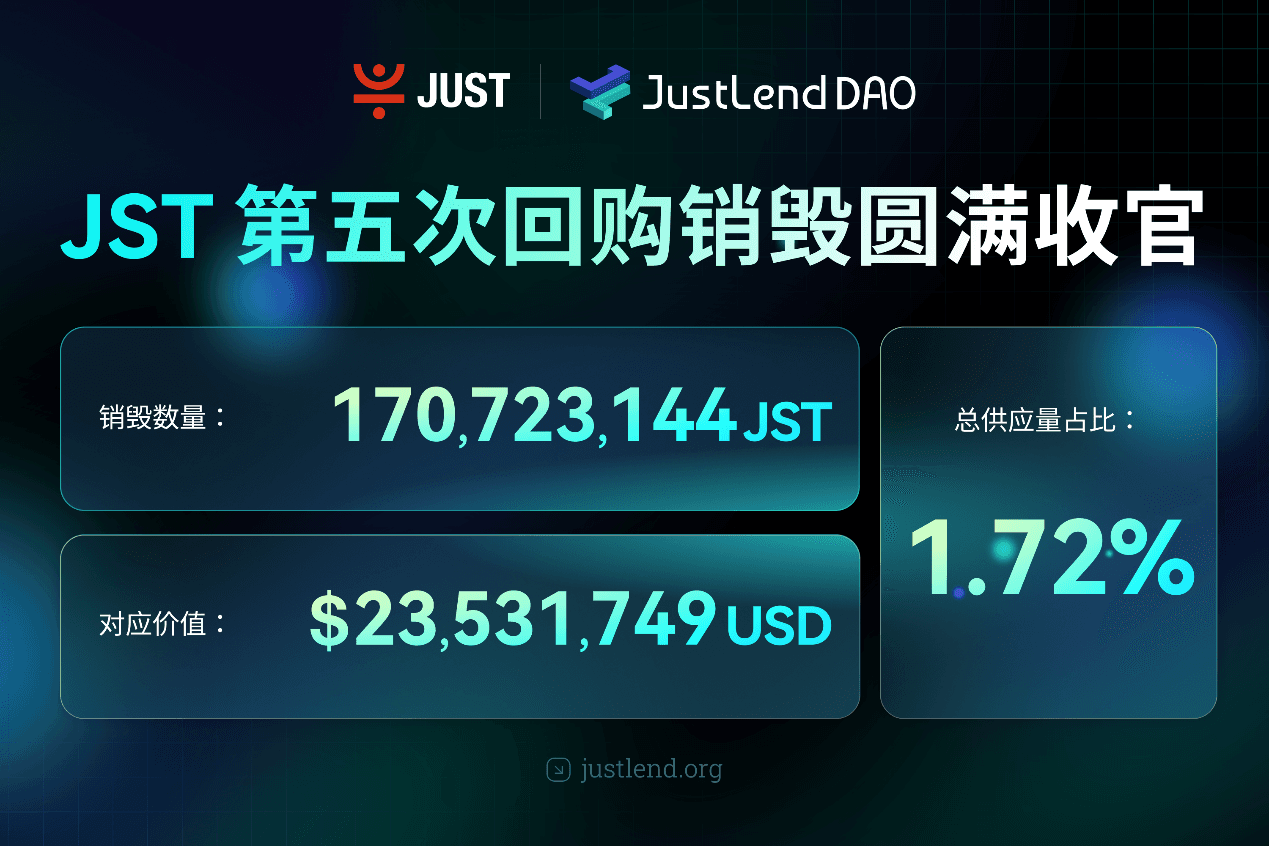
BitTorrent Brand Upgrade and Initial BTT Buyback & Burn Launch Simultaneously, Dual Engines Usher in New Era of Web3 Infrastructure
Oct 17, 20:00
Asia Market Daily: Japan's BOJ signals more rate hikes while Korea targets offshore perpetual platforms (2026/10/17)
Oct 17, 17:01Why did Papertrade backfire on you?
Oct 17, 17:01
The 'Strict Father' of Northern Myanmar: This Company Deploys 200,000 "AI Best Actors" to Strike Back Against Scammers
Oct 17, 15:34