Citi Insights: Bullish on the AI Optical Interconnect Market, Three Key Targets Behind the $92 Billion Opportunity
TL;DR
· Citi expects the global optical interconnect market to reach $92 billion in 2028 and has raised the price targets for Neophotonics, InnoLight, and II-VI Incorporated.
· The migration from 800G to 1.6T, 3.2T, and CPO/NPO is driving demand for high-speed optical modules, silicon photonics, and laser chips.
· The Chinese optical communication supply chain sees the most direct benefits, but challenges in laser chip supply, yield rate, and high valuations will still constrain the pace of realization.
In a June 24 report, Citi raised its AI optical interconnect market forecast, projecting the global optical interconnect market to reach $92 billion by 2028, with a compound annual growth rate of about 65% from 2025 to 2028. In the same adjustment, the price targets for Chinese optical communication companies such as Neophotonics, InnoLight, and II-VI Incorporated were significantly increased.
The rationale behind this assessment is not complicated. As AI data centers grow larger, the data that needs to be transported between GPUs and ASICs increases, leading to a rise in connectivity demands between cabinets, switches, and servers. High-speed optical modules, silicon photonics, and laser chips are no longer just supplementary equipment for data center expansion but a critical link in ensuring efficient computing power connectivity.
According to Citi's model, the average selling price of optical interconnects from 2025 to 2028 is expected to maintain a compound annual growth rate of about 18%, mainly driven by the increasing proportion of high-speed products such as 800G, 1.6T, and 3.2T.
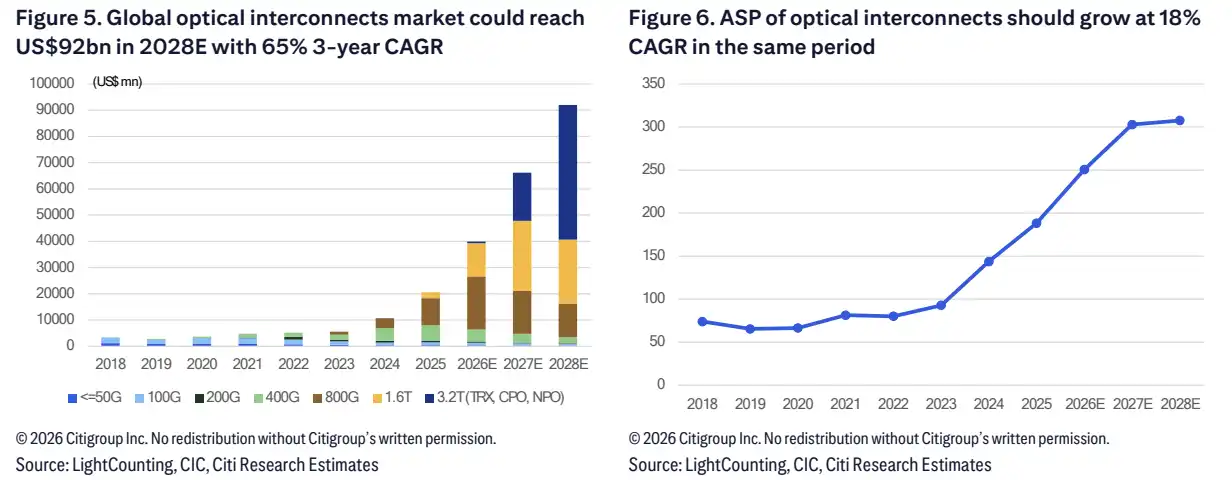
Global optical interconnect market size for 2028E raised to $92 billion, with ASP maintaining an 18% CAGR from 2025 to 2028.
Ordinary investors need to understand a key shift: this round of target price increases is mainly driven by data center interconnection, not traditional telecom networks or enterprise networks.
In Citi's model, global optical interconnect shipments are expected to increase from 110 million units in 2025 to 300 million units in 2028, with a three-year compound annual growth rate of about 40%. The proportion of data center business in total shipments is projected to rise from 71% in 2025 to 89% in 2028.
Product specifications are also moving up. The share of high-speed products above 800G in data center optical interconnects is expected to increase from 37% in 2025 to 89% in 2028. This signifies not just buying more optical modules but the accelerated replacement of lower-speed products with higher-spec products.
800G remains one of the main drivers in recent years, but 1.6T, 3.2T, and updated packaging solutions are seeing higher growth rates. Under the base scenario, the 1.6T transceiver is projected to achieve a compound annual growth rate of 215% from 2025 to 2028. The 3.2T is set to take off in 2027, with shipments reaching 4 million units in 2027 and escalating to 35 million units in 2028.
CPO and NPO are part of a more advanced technology transition. In the base scenario, shipments of CPO/NPO are expected to reach 18 million and 56 million units, respectively, by 2028. Under the optimistic scenario, these figures could increase to 33 million and 116 million units in 2028. The significant difference between the two scenarios depends mainly on cloud provider demand, yield improvements, and the deployment pace of platform architectures by companies like NVIDIA and Google.
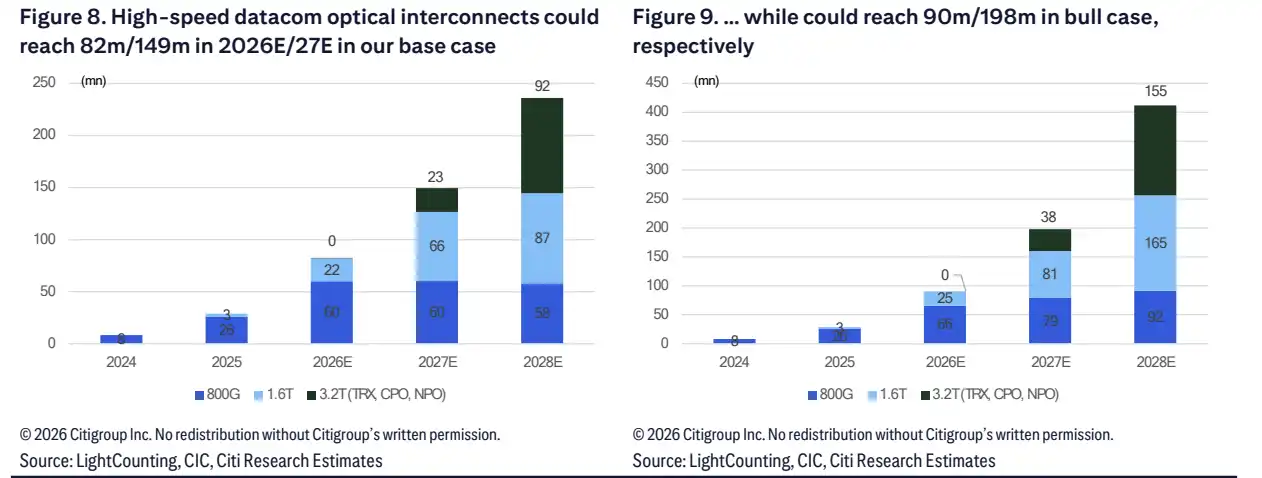
The high-speed optical interconnect demand significantly diverges after 2027, with 1.6T and 3.2T/CPO/NPO being the main sources of elasticity between the base and optimistic scenarios.
If $920 billion represents the market space, then "Silicon Photonics" and "Laser Chips" determine the allocation of this growth in the supply chain.
Citi Research expects the penetration rate of silicon photonics solutions in high-speed optical modules to increase from 29% in 2025 to 60% in 2028. Under this assumption, the total demand for optical chips in 2028 is estimated to be around 1.714 billion units, with a compound annual growth rate of approximately 62% from 2025 to 2028.
Among them, EML chip demand is projected to reach 718 million units, with a three-year compound annual growth rate of about 34%. CW laser chip growth is even faster, with expected demand reaching 987 million units in 2028 and a three-year compound annual growth rate of approximately 114%.
This is also the reason why supply constraints are repeatedly mentioned. After the high-speed optical module production ramps up, the bottleneck may not necessarily be in the module assembly stage but could also arise in laser chip production, packaging yield, and upstream capacity constraints. Pure-play module manufacturers are securing upstream supply through long-term agreements and strategic investments, essentially positioning themselves early for the subsequent ramp-up of 1.6T, 3.2T, and CPO/NPO.
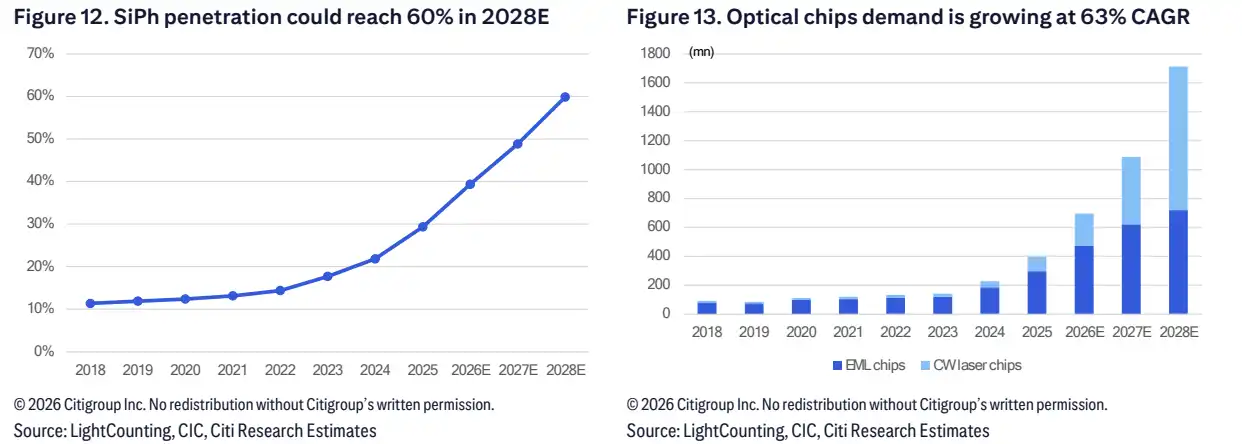
The silicon photonics penetration rate is projected to reach 60% by 2028E, with an estimated demand of around 1.714 billion optical chips in 2028E, and CW laser chip CAGR reaching 114%.
At the individual stock level, the most direct changes are seen in New Ease, Eastern Precision, and TF Communications.
Eastern Precision is one of the most conspicuous companies in this round of upgrades. Citigroup raised its target price from 225 yuan to 350 yuan and increased its net profit forecast for 2026 to 2028. The research report indicates that the AI optics business is seen as the main driver of growth, with profits expected to significantly increase in the coming years.
In terms of valuation, Eastern Precision is segmented into traditional business, optical modules, optical chips, and AI PCB. This segmentation indicates that when the market looks at Eastern Precision, it is no longer just looking at traditional PCB or electronics manufacturing businesses, but rather at whether it can monetize its AI optics business into profits.
New Ease's target price was raised from 353.57 yuan to 701 yuan, with the main drivers coming from the 3.2T transceiver and NPO. TF Communications' target price was raised from 318.57 yuan to 419 yuan, with the focus on increased CPO volume and the 3.2T optical engine.
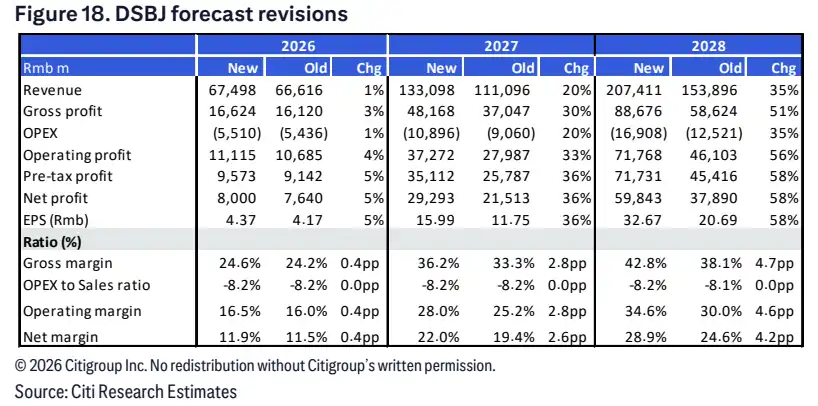
Eastern Precision's Profit Forecast Raised
Differentiation is also occurring. TooSun Light (300570.SZ) was downgraded from Buy to Sell, with the target price lowered from 156 yuan to 152 yuan. Citigroup lowered its 2026 and 2027 EPS forecasts, primarily considering the risks of decoupling from Corning, intensifying Asian supply chain competition, and high valuation. According to the report, TooSun Light is currently trading at around 59 times the 2027 P/E ratio, while the target price corresponds to a 31.8 times P/E ratio for 2027.
These rating changes indicate that an upward revision in demand for AI optical interconnects does not mean that all companies in the industry chain will benefit simultaneously. The market places more emphasis on high-speed product capabilities, silicon photonics and laser chip layout, customer structure, supply chain stability, and whether the current stock price has already reflected future growth.
It is worth noting that these target prices are still based on broker model assumptions, not company commitments. For investors, the upward revision of target prices reflects institutions raising their expectations for AI optical interconnect demand, product upgrades, and Chinese supply chain share, but it remains to be seen whether orders, deliveries, and profit margins can keep up.
This round of upgrades does not mean that AI optical interconnect has entered risk-free growth.
The first constraint is supply. EML and CW laser chips may face tight supply, especially in the scenario of rapidly increasing silicon photonics penetration, and the accelerated volume of 1.6T and 3.2T. Upstream capacity and yield rates will directly impact final shipments. If key chip supplies cannot keep up, orders and expectations may rise first, but revenue recognition may have to wait for delivery schedules.
The second constraint is technological implementation. CPO/NPO is seen as a significant increment after 2027, but whether the new architecture can scale up in an optimistic scenario depends on cloud vendor capital expenditure, network architecture choices, equipment yield, and the progress of platform solutions such as NVIDIA and Google. There is a significant gap between the base case and the optimistic scenario, indicating that shipments in the next two years are not yet set in stone.
The third constraint is valuation. Tai Sun Light was downgraded from buy to sell by Citi, citing risks of decoupling from Corning and overvaluation. Light Speed Technology was also maintained a sell rating, with the primary pressure also coming from valuation concerns.
A $920 billion market forecast has pushed AI optical interconnect into the spotlight, but stock prices have already priced in many optimistic expectations. What will truly set companies apart is not just how many AI orders they receive, but who can penetrate higher-end product generations, secure upstream laser chip supply, and translate the scaling of 1.6T, 3.2T, and CPO/NPO into sustainable profits.
Recommended
Desk: Brent Crude Tops $110, Musk's Net Worth Drops 528.6 Billion in Four Days After Tesla Roadster Launch
Oct 17, 21:49
JST Fifth Buyback and Burn Successfully Concludes: Over 170 Million Tokens Worth Approximately $23.53 Million Burned, Buyback Mechanism Set for Comprehensive Upgrade
Oct 17, 20:10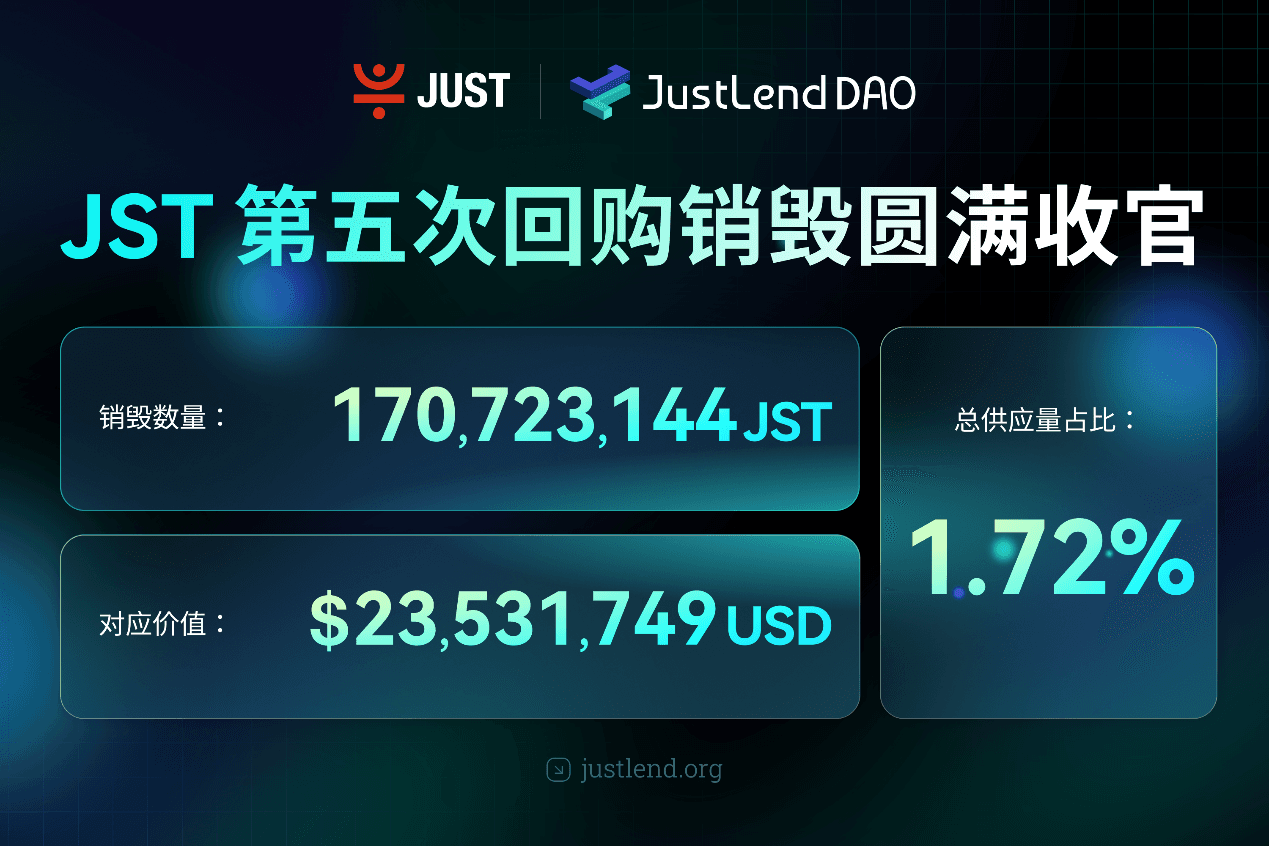
BitTorrent Brand Upgrade and Initial BTT Buyback & Burn Launch Simultaneously, Dual Engines Usher in New Era of Web3 Infrastructure
Oct 17, 20:00
Asia Market Daily: Japan's BOJ signals more rate hikes while Korea targets offshore perpetual platforms (2026/10/17)
Oct 17, 17:01Why did Papertrade backfire on you?
Oct 17, 17:01
The 'Strict Father' of Northern Myanmar: This Company Deploys 200,000 "AI Best Actors" to Strike Back Against Scammers
Oct 17, 15:34