Hyperliquid officially announces its entry into the United States, a milestone for the Perpdex sector.

Hyperliquid's approach to entering the U.S. market is now essentially clear.
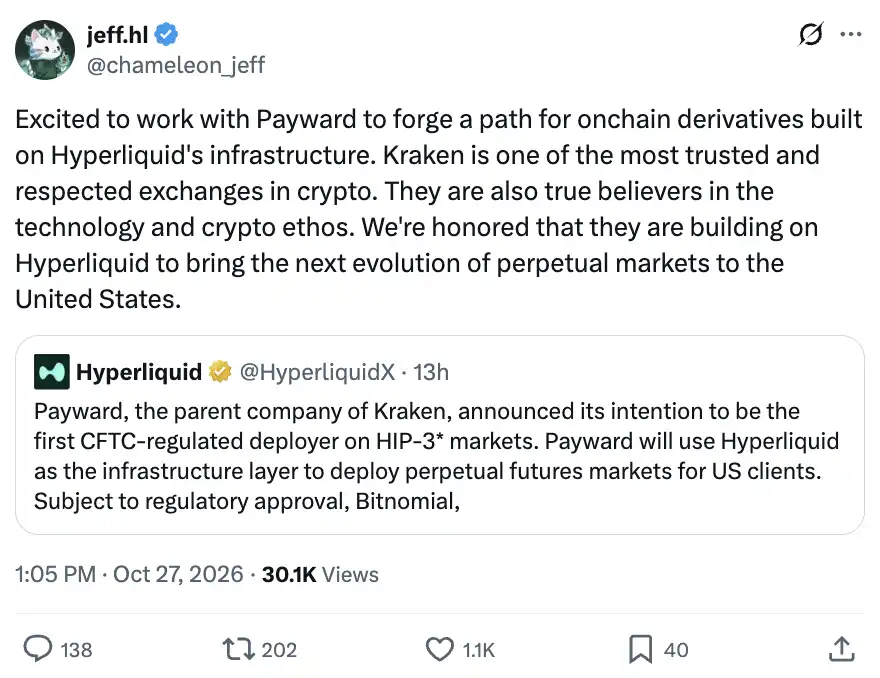
Kraken's parent company Payward plans to become the first CFTC-regulated HIP-3* deployer, using Hyperliquid's infrastructure to offer perpetual contract trading to U.S. customers. Hyperliquid's latest announcement disclosed the specific arrangements: Bitnomial will be responsible for deploying and managing markets, clearing and settling contracts, while NinjaTrader Clearing will be responsible for hosting customer accounts.
Jeff subsequently publicly expressed support for the partnership, calling Kraken a trustworthy exchange that embraces crypto technology philosophy, and expressing anticipation for both parties to bring Hyperliquid-based on-chain derivatives to the United States.
Readers familiar with Hyperliquid should be no strangers to HIP-3. External teams can use this framework to deploy their own perpetual contract markets on Hyperliquid. HyperCore provides the underlying trading capabilities, while deployers decide which contracts to list, which oracles to use, and how high to set leverage.
Markets can be operated by different teams, all using the same underlying on-chain infrastructure.
But to serve U.S. customers, operators also need to solve another set of problems: who is eligible to enter the market, who verifies customer identity, and who handles accounts when risks arise.
Licensed institutions must be able to manage their own customers, rather than simply connecting a wallet as on the main site.
HIP-3* adds an optional set of features on top of the original HIP-3, enabling deployers to operate markets with access requirements. Its core is an on-chain whitelist, managed by the deployer or its sub-deployers. Institutions can add eligible wallets to the list after completing customer identity verification, granting trading permissions.
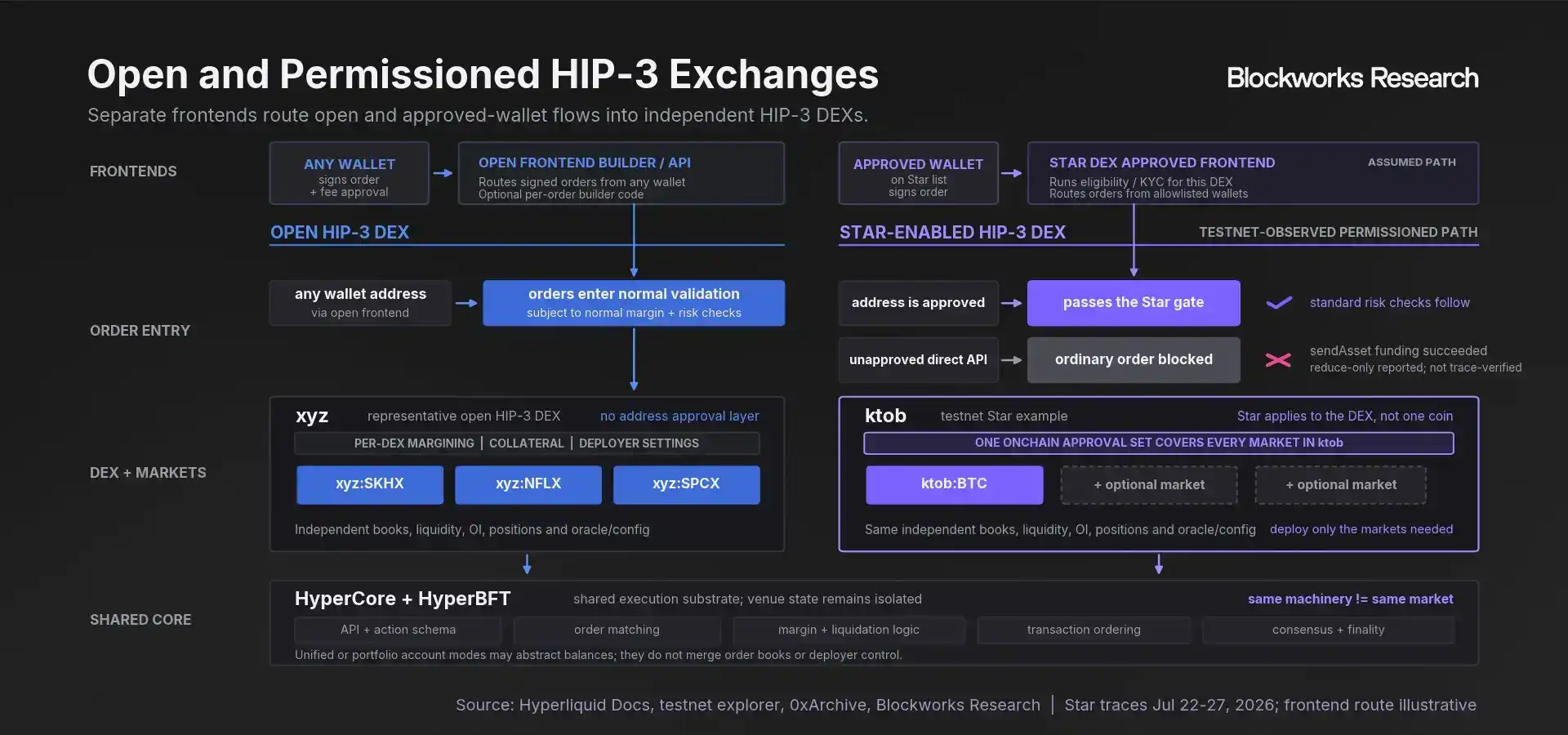
Whether HIP-3* features are enabled is decided by the deployer. Hyperliquid officially emphasizes that it is an incremental extension to HIP-3, with existing markets remaining unchanged. U.S. licensed institutions can use permissioned markets, while other deployers continue to operate in their own ways.
This route had already left clues earlier. In August, a deployment named "Kraken HIP-3 test DEX" appeared on the Hyperliquid testnet, with testing covering whitelisting, order cancellation, reduce-only orders, and collateral transfers. These features correspond precisely to institutional needs for client access and account risk control.
Hyperliquid can thus preserve the openness of its infrastructure while providing tools for institutions that need to manage client identities and trading permissions.
Besides Kraken, several less familiar names appeared in the announcement: Payward, Bitnomial, and NinjaTrader.
Payward is Kraken's parent company and the group entity behind this business arrangement. The entities specifically responsible for U.S. market duties are its subsidiaries Bitnomial and NinjaTrader Clearing.
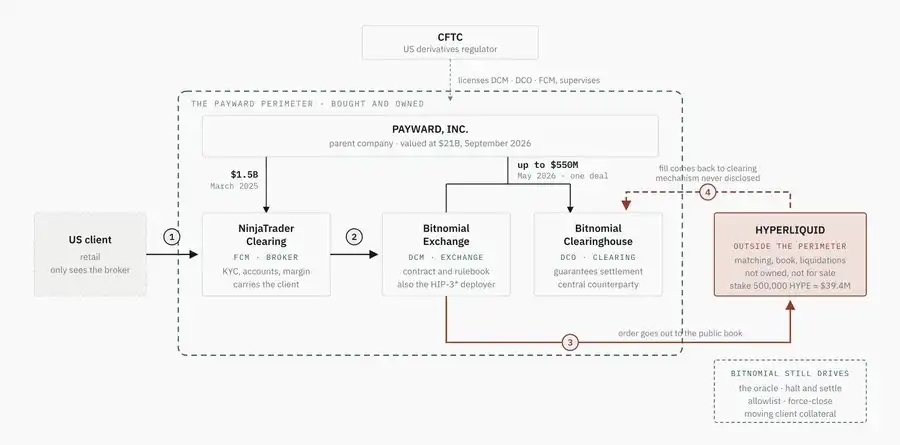
Bitnomial holds two types of operating licenses, DCM and DCO. The former is a designated contract market, responsible for contract listing, market operations, and trade surveillance; the latter is a derivatives clearing organization, responsible for clearing, margin, and settlement arrangements. According to the latest announcement, if approved, Bitnomial will become a HIP-3* deployer, creating, owning, and managing the relevant markets, and clearing and settling contracts.
NinjaTrader Clearing's role is as an FCM, i.e., a futures commission merchant. It handles the client account side, providing clients with access to the market. It is the operating entity corresponding to accounts, client funds, and related risk control businesses.
This is the value of the Kraken-Hyperliquid partnership. Payward already has client access and regulated entities, and Hyperliquid already has trading infrastructure available for use. The two sides are connecting their respective existing capabilities to jointly organize a perpetual contract business serving U.S. clients.
Lighter, which is also targeting the U.S. market, has chosen a different organizational approach.
According to the plan disclosed at its third-quarter investor meeting, Lighter plans to submit an application to the CFTC in November 2026, seeking both DCM and DCO qualifications, to advance a U.S. business covering perpetual contracts and options.
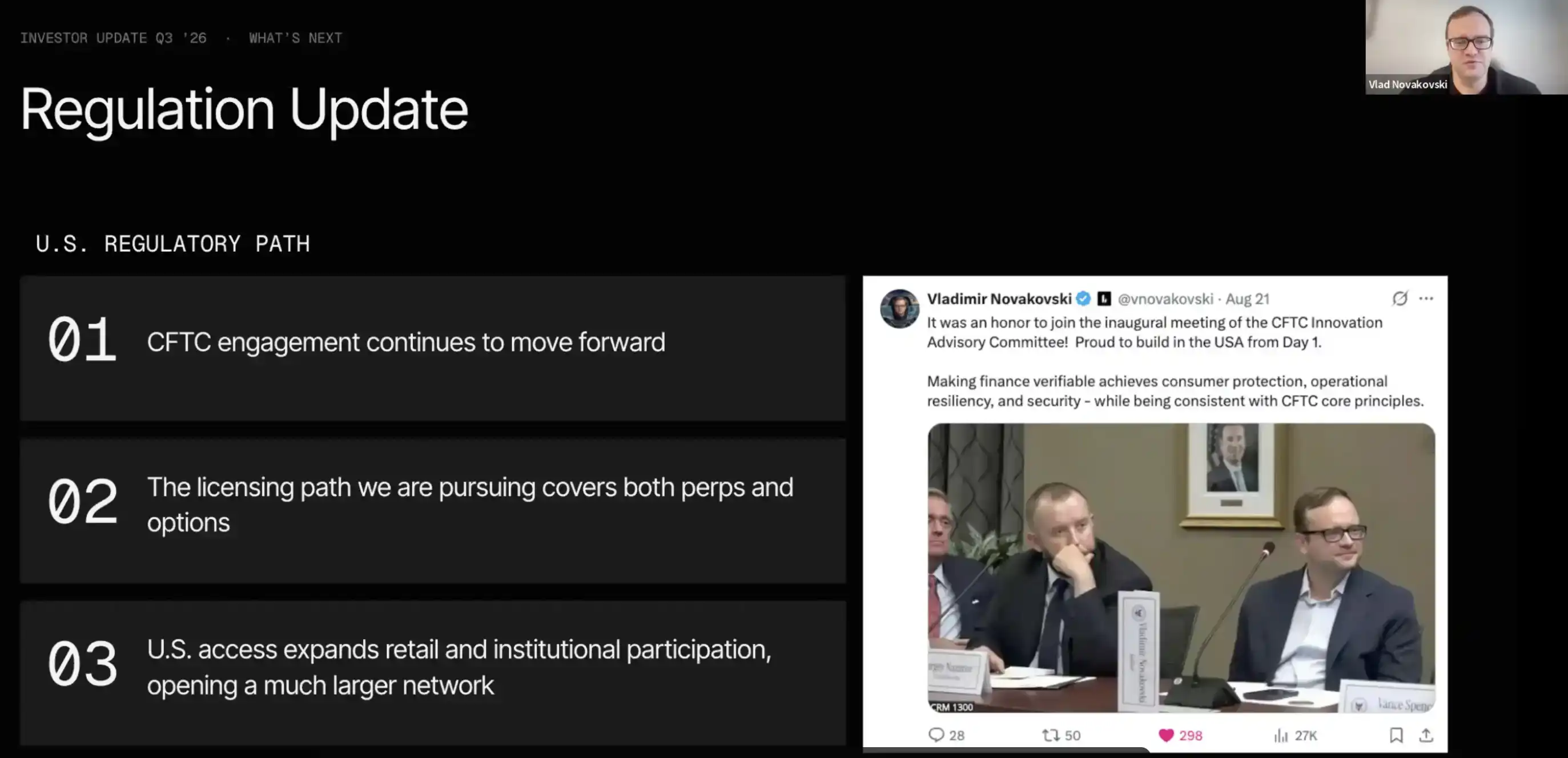
In other words, this time Hyperliquid has the market deployed and operated by a licensed entity under Payward, while Lighter plans to establish market operations and clearing qualifications on its own side. Both are pushing on-chain trading into the U.S., but the licenses and operational responsibilities fall on different entities.
Lighter's choice is related to the partnership business it has already launched.
The Robinhood wallet is a ready example. Users operate within the wallet, while the perpetual contract service behind it is provided by Lighter. In the third quarter, this partnership contributed about 13% of Lighter's total network trading volume. Customers can stay in the app they are familiar with, while the trading service is provided by another company.
Lighter hopes to continue expanding this partnership model. The partnership directions it listed at the conference include crypto wallets, centralized exchanges, and financial applications that can be connected after obtaining U.S. licenses in the future. After obtaining market and clearing qualifications, the customers it pursues can further extend to U.S. retail investors, institutions, and partners that need licensed trading services.
For Lighter, applying for licenses and expanding distribution are a mutually reinforcing plan: the former expands the scope of business it can conduct, while the latter allows more customers to use its trading services through different entry points.
Partnerships such as Kraken and Hyperliquid may be a landmark event. With HIP-3* formally approved for operation, later entrants now have a practical case they can evaluate. In the future, traditional financial/technology institutions will also consider building markets in their familiar fields through HIP-3* and serving different customers, thereby expanding their business footprint.
Join the official Coincamps community:
Telegram: https://t.me/coin_camps
Recommended
Morgan Stanley Raises Global Electricity Demand Growth Forecast: Beyond AI, Who Will Share in the $500 Billion Increment in the Power Market?
Oct 27, 18:35
Why did JPMorgan significantly raise Unitree Robotics' target price to 995 yuan?
Oct 27, 18:04
Bitcoin at $80,000: A Tug-of-War With No Winners
Oct 27, 17:59
Flood of AI Junk Reports: Firedancer Requires Burning 1 SOL Before Vulnerability Submission
Oct 27, 17:54
Brazil election sees epic reversal, prediction markets become insider cash machines
Oct 27, 17:28
Banned on X After Reviewing Kimi K3.1? Multiple Overseas Bloggers Forced to Label Content as "Paid Collaboration," Even Negative Reviews Aren't Spared
Oct 27, 17:25