When will Rocket Lab's $3.57 billion backlog turn into revenue?

On the early morning of November 10 Beijing time, commercial space company Rocket Lab (Nasdaq: RKLB) released its third-quarter report, with both revenue and backlog hitting records.
In the same announcement, the company also provided the first flight timeline for its medium-lift rocket Neutron, which is still under development, with the earliest being 2027.
This rocket, which has not yet flown, already has customers booking slots years in advance. European radar satellite operator ICEYE signed three dedicated launches in one go, to be executed starting in late 2028. Putting this contract together with the financial report reveals two different business lines. One is already delivering satellites and components, while the other is selling future launch slots.
Who contributed to quarterly revenue, and who expanded the backlog?
Rocket Lab's third-quarter revenue reached $268 million, up 73% year-over-year. Subtracting each segment's revenue from the same period last year, the incremental revenue almost entirely came from space systems. This segment covers whole-satellite manufacturing, satellite components, and mission operations. Its revenue can come from a single device installed in someone else's satellite, or from an entire satellite delivered by Rocket Lab.
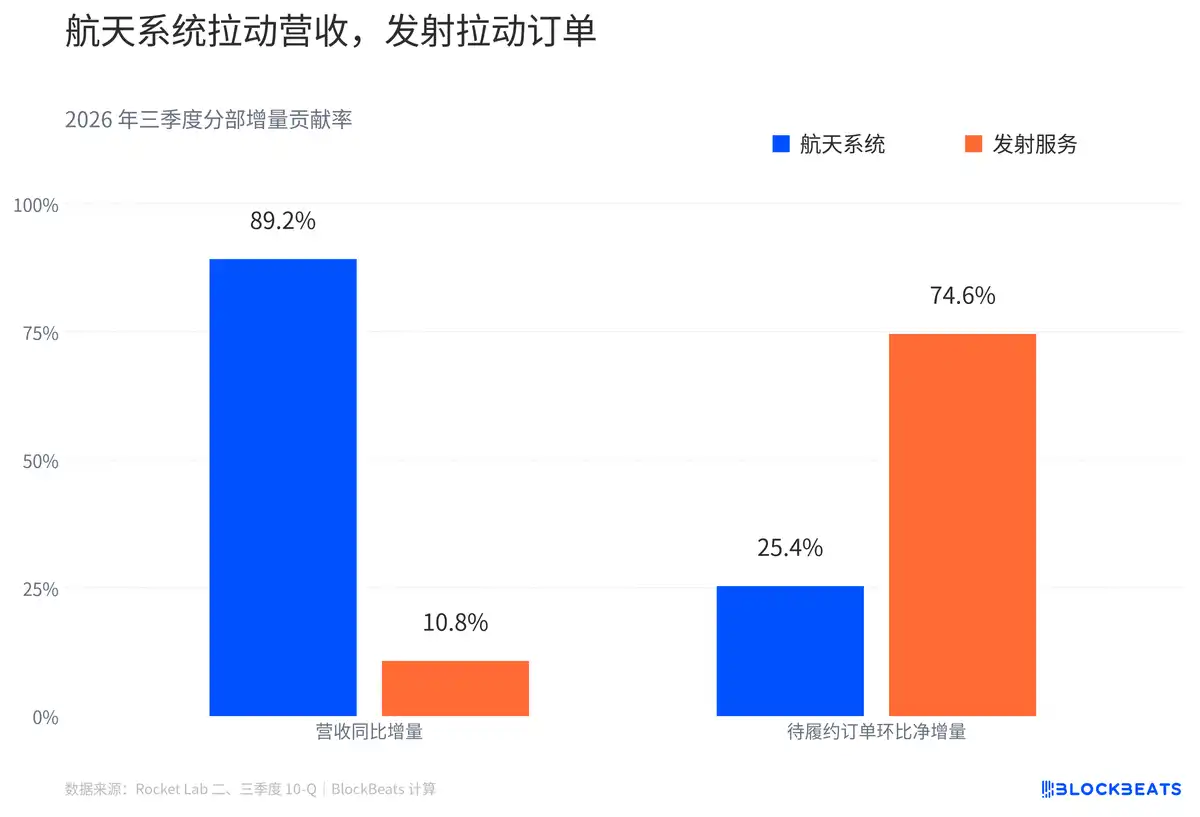
Space systems contributed 89.2% of the year-over-year revenue increase, while launch services contributed 74.6% of the net sequential increase in backlog
The company mainly attributed the growth in space systems to spacecraft manufacturing and acquisitions. The laser communications equipment provider Mynaric, acquired in the first half of the year, alone contributed about $26.04 million in revenue this quarter, equivalent to about a quarter of the year-over-year increase in space systems. Part of the group's revenue jump was because sales from acquired companies entered the financial statements.
The margin on this growth is also changing. The group's gross margin fell from about 37% in the same period last year to about 34%. The space systems segment earned more gross profit, but launch services saw revenue rise while gross profit fell. In the same period last year, revenue from a hypersonic test launch contract was concentrated in a catch-up recognition, raising the comparison base. This quarter had more launch missions, but the average contract revenue per launch was also lower, which the company attributed to changes in customer mix and mission complexity.
Turning to the backlog, the main player becomes launch services. From the end of the second quarter to the end of the third quarter, the launch services backlog balance increased by about $908 million, accounting for about three-quarters of the net increase in the company's backlog balance. During the same period, this segment contributed only about one-fifth of the group's revenue. Revenue records work performed in the current period, while the backlog balance still carries missions to be delivered in the future. The increments of the two are measured on different bases.
The large order also comes from a rocket already in operation. On the last day of the quarter, Rocket Lab announced that Japanese Earth observation company Synspective placed a new order for 20 small rocket Electron launches, with the contract covering multiple years. This is an example of one contract corresponding to multiple missions; the two parties disclosed the number of launches, but the contract amount was not made public.
The backlog grew by $1.2 billion, how much can be recognized in the recent year?
At the end of the third quarter, the remaining performance obligation balance reached $3.57 billion, up about 52% quarter over quarter.
The financial statement notes divide the remaining performance obligations into two time periods. Multiplying the percentages disclosed in the two periods by their respective quarter-end order balances, the amount expected to be recognized within one year increased by only about $120 million. The forward tranche increased by about $1.1 billion. These two tranches are calculated on a rolling basis from their respective quarter-ends, and the difference reflects changes between the two order snapshots.
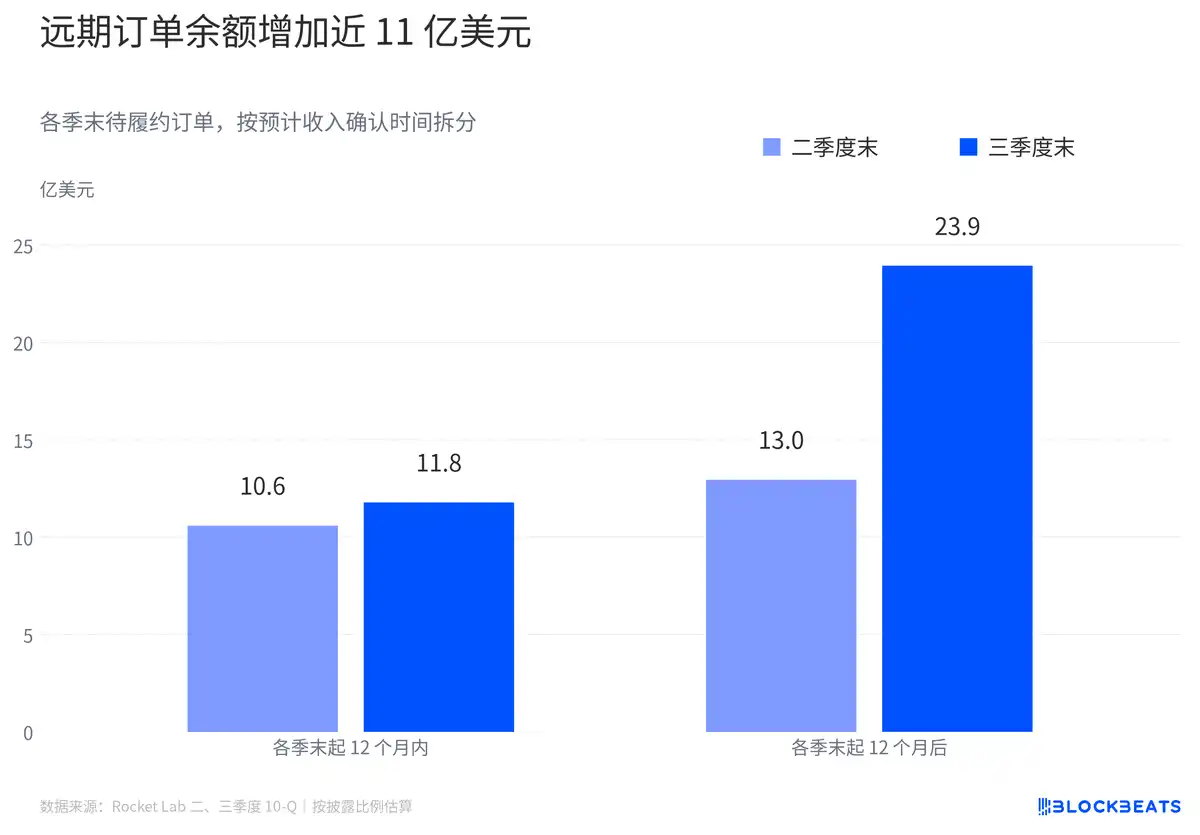
The increase in the order balance expected to be recognized within one year is limited, while the forward order balance increased by nearly $1.1 billion
Neutron makes this time gap concrete. The company disclosed that in the third quarter, 5 constellation operators signed 8 launches for it. Take ICEYE as an example: customers can lock in dedicated slots now, but the rocket must first fly before launches can be executed under the contract. Some of Rocket Lab's long-term contracts recognize revenue upon delivery, while others recognize revenue as performance progresses. Exactly when to book it depends on the delivery and performance milestones agreed in each contract.
The Neutron contracts signed in the third quarter amounted to more than $515 million, already exceeding the group's revenue for the quarter. This signing amount corresponds to a set of missions executed over multiple years. The first flight is only one threshold for performance; after that, there are each customer's own satellite and launch arrangements.
The first flight still has to wait for a tank. While manufacturing the first-stage propellant tank, Rocket Lab found porosity in the composite dome. The company disclosed that it still needs to manufacture and inspect replacement parts, then complete tank assembly and cryogenic and other tests. The backlog discloses balances by launch services and space systems, while recognition timing is aggregated at the company level. To break down the forward order balance to a specific rocket, a table cross-tabulating by model and time is still missing. Third-quarter 10-Q
Operating cash flow turned positive, how many equipment bills can be paid?
Another highlight of the third-quarter report is that operating cash flow turned positive. Subtracting the six-month cumulative figure from the nine-month cumulative figure, quarterly operating cash flow was about $7.15 million, consistent with the rounded figure in the company's announcement. Calculated the same way, capital expenditures for equipment, facilities, and software in the quarter exceeded $31 million.
For every dollar spent on these assets, operating cash flow for the quarter covers only about 23 cents.
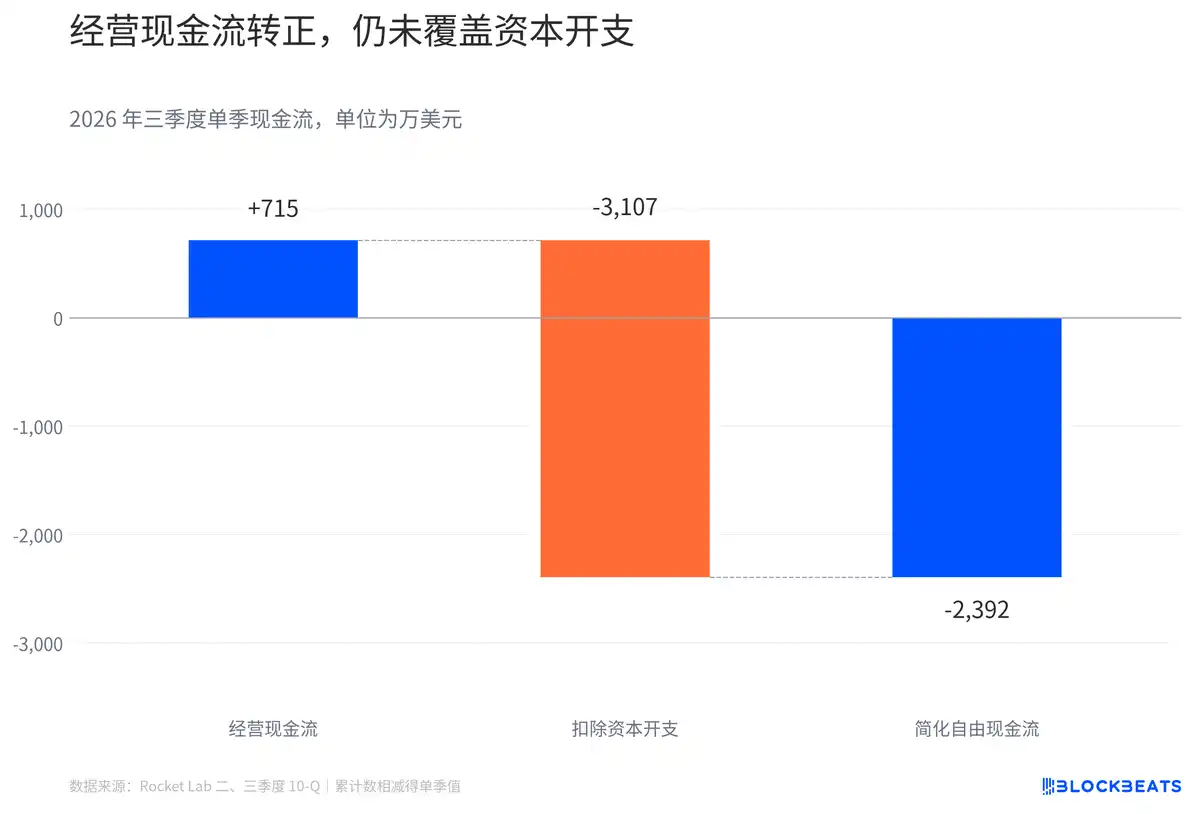
Operating cash flow for the third quarter was approximately $7.15 million, and simplified free cash flow after capital expenditures was approximately negative $23.92 million
Breaking out the cash flow details using the same method, changes in contract liabilities brought a positive adjustment of approximately $65.65 million. Customers paying before delivery, or the company invoicing based on progress, can both create contract liabilities first. As products are delivered or services are completed, the relevant amounts transfer from contract liabilities to revenue. The third-quarter report discloses received and invoiced advance payments on a combined basis. On the income statement for the same period, Rocket Lab still recorded an operating loss of approximately $79.19 million.
R&D is also a line item. The company disclosed that quarterly R&D expenses grew approximately 39% year over year. Driving factors include Neutron development, R&D spending from acquired companies, and prototype development needed to expand the satellite and components product lines. After selling future launch slots, the company still has to pay for current development and testing.
Cash, cash equivalents, and marketable securities totaled approximately $4.7 billion at quarter-end. In the first nine months of the year, net proceeds from stock issuance through the market were approximately $3.88 billion.
Rocket Lab estimates that the proposed acquisition of satellite communications operator Iridium will involve cash payments exceeding $3 billion, including shareholder cash consideration, repayment of some debt, and transaction fees. Closing still requires regulatory approval.
In this earnings report, a satellite may already have been delivered, a launch may only occupy a spot on the calendar, and cash may arrive before revenue.
Join the official Coincamps community:
Telegram: https://t.me/coin_camps
Recommended
Crypto Morning Briefing: Coinbase Receives Official Trust Bank License from US OCC, Hyperliquid Ecosystem's Elysium Mainnet Officially Launches
Nov 10, 10:20
Bitget UEX Daily | US Stocks Broadly Rally, Nvidia is Sole Decliner; Oil Plunge Eases Inflation Concerns; Tonight’s CPI to Set the Tone
Nov 10, 10:20
Nvidia Faces Independent Investigation, Bernstein Maintains $400 Price Target
Nov 10, 10:15
Starting from Jensen Huang's extramarital affair, let's talk about narcissism, desire, and spy narratives in the Bay Area.
Nov 10, 10:11
The Ethereum Foundation and Vitalik Face Lawsuit: The Termination of a Cancer Patient and a "Harakiri Pledge"
Nov 10, 09:59
Hedge funds are selling off at a record pace, so why is Morgan Stanley calling it a buying opportunity?
Nov 10, 09:55