From Chasing Project Catalysts to Building Your Own Market Model
I think I've had a misconception for a while now: I wasn't in the habit of using first principles to think about this market from a long-term perspective. Instead, I always started from a more micro perspective, trying to find opportunities in the details of each project — things like "What good news did the project team just release?" "What does the project team need?" "What events are shaping price formation?" "What ticker is the SM shilling now?" and so on. While these methods do work within shorter time frames, they also make it easy to let your perspective be led around by local information, ignoring the connection between a project team's specific actions and the market's overall operating mechanism. In the end, these detail-based judgments always fall short of forming a clear enough overall judgment of the market, which makes it hard to find opportunities truly worth concentrating your position on.
For example, my trade on $BP.
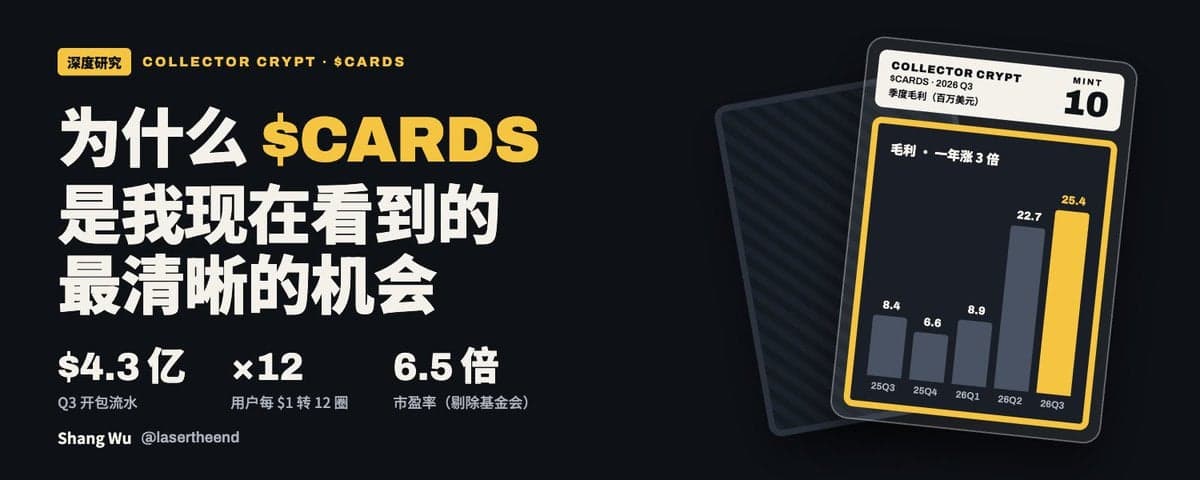
I bought $BP at 0.19 and sold it all at 0.5. My perspective at the time was confined to a short-term view — I vaguely "bought the news" and then completed the trade. But I never actually thought about the long-term value brought by $BP's scarcity as RWA infrastructure in the Solana ecosystem. This same problem also showed up with $VVV, $PONS, $CARDS, and $PENDLE.
I used to really enjoy predicting the short-term movement of a ticker through the project team's needs and narrative, while often overlooking a deeper question: "Under various different time frames, what real demand actually exists in the market, and how do market participants understand, imagine, or even misjudge this demand?" In reality, at different points in time, the problem a project genuinely wants to solve is not always the same as the problem the market currently believes it is solving. What the market trades is not just demand itself, but also the market's perception of demand, the formation of consensus, and the price revaluation that occurs when these perceptions change.
So, how should we change?
I think the first thing is to stop chasing more information and start building a world model of your own — one that can be repeatedly tested against reality. In AI terms, "I need to keep advancing along one main thread: understanding through what mechanisms real-world demand, profit, and power are converted into the value and price of assets." An article I wrote earlier about how prices form expresses the same viewpoint, except that at the time I hadn't articulated these things concretely — I could only express a somewhat vague viewpoint through examples.
Back to the point. Breaking it down, we need to: 1) build a unified causal framework; 2) force ourselves to look for counter-evidence rather than constantly refining our own explanations; 3) build a system for recording our own judgments.
The second and third points are mainly manual labor, while the first point tests your understanding of the current world and the current market — and this understanding can be narrowed through AI to close the gap between you and top traders.
The approach AI gave me is:
"Whenever you study something new, don't first ask whether it's good or has potential. Instead, ask in order:
-
What has changed in reality? Is it a technological breakthrough, falling costs, growing demand, or institutional change?
-
Why did this change happen? What are the interests, constraints, and incentives behind it?
-
Who benefits from it? Where do profit, users, data, liquidity, and power ultimately flow?
-
How does value transmit to the asset? Why does the beneficiary making money necessarily or possibly cause a certain stock or token to rise?
-
When will the market reprice? How much expectation is already priced in, and what factors have not yet been accounted for?
These five questions can serve as a common starting point for your research into any industry, project, or even macro event."
I think AI summarized it quite well, so I'll share it here.
Building on this, we can also make some extensions: when we try to understand an expectation, our thinking needs to be more layered. Besides thinking about the expectation under the narrative, the formation of the expectation, and the realization of the expectation, we also need to think about these two aspects: 1) how participants in different markets view expectations and asset price behavior; 2) how to convert our understanding of market expectations into trades truly worth participating in. Essentially, this is about finding the misalignment between fundamental changes, market perception, and price, and trading the convergence of that misalignment.
When I mention "understanding the operating mechanism of the world or the market," I don't mean immediately building a theory that explains everything — physics hasn't even produced a grand unified theory yet. What I hope to achieve in the future is to gradually build a methodology that tells me when I understand, when I don't yet understand, and when I must admit I'm wrong. This step can start with a single question: study it repeatedly, make predictions, accept testing, and then gradually connect the verified patterns together.
For example, Kinetiq's Layer2 Elysium, which I've been looking at recently. If we only look at it from a micro perspective, the trade was already over once Kinetiq announced that Elysium would launch on November 9. This is a typical case of expectation realization — although Kinetiq also offered the expectation of sequencer revenue buying back $KNTQ, because most previous Layer2s performed mediocrely and HyperEVM itself is weak, the market's expectation for Elysium wouldn't be very high either.
But let's think about it from another angle: what is HyperEVM's current problem? Why has the main site's perpetual contract trading platform been so successful, yet HyperEVM hasn't taken off? Personally, I think it's largely a performance issue. The performance issue has limited the entry of professional market makers onto Hyperliquid, thereby suppressing the issuance of assets and trading demand. Because a high-performance environment is more favorable for market making, arbitrage, and hedging, and is also more conducive to asset issuance (here I mean RWA assets, not memecoins). This layer is also the market gap that high-performance blockchains like Monad and MegaETH wanted to fill when they were first established. Putting these together, it seems $KNTQ has some opportunity again.
So if we use the framework above to go through these perspective questions, it would be:
-
Is HyperEVM really failing to take off because of performance limitations? Has it really restricted professional market makers from entering on-chain?
-
Does Elysium truly solve these performance problems, and does it have the ability to attract users, assets, and professional market makers?
-
Can the new trading environment create synergy with the core needs of HyperEVM and Hyperliquid Core's own users?
-
If Elysium succeeds, how much incremental value can it bring to the entire Hyperliquid ecosystem, and how much mechanical sell pressure can it bring to $KNTQ?
-
How does the market view Elysium as a Layer2, and is there a misalignment in the market's perception on this front?
After answering these questions one by one, in the KNTQ trade we can know where the market's perception is misaligned, where the reasons and opportunities for the trade lie, what data we should monitor, and the timing and other information.
I think the Elysium example is very interesting because it can string together questions at several different levels: starting from the potential problem, understanding why Kinetiq wants to build a Layer2, then deducing the value it might create, the token's value transmission mechanism, and how the market might reprice in the future.
All in all, what I hope is to let this framework help me find tickers worth trading with a reasonable position size, without greedily demanding that it cover all assets in the posture of a grand unified theoretical framework.
Finally, I think this kind of casual essay is quite good — first, it lets me share some of my thinking, and second, it lets me sort out my own logic. For my future update plans, I want to continue with two more casual essays from the angles of asymmetric trades and consensus & reflexivity. Also, the projects and tokens mentioned in this type of article are never advertisements.
Thanks for reading.
Join the official Coincamps community:
Telegram: https://t.me/coin_camps