Why is CARDS the clearest opportunity I see right now?

Bottom Line
$CARDS, the token of @Collector_Crypt, is the clearest and most promising opportunity I see right now. Not because of a good narrative, but because it took a century-old business and used Crypto to make it a better one, with every transaction on-chain for anyone to audit.
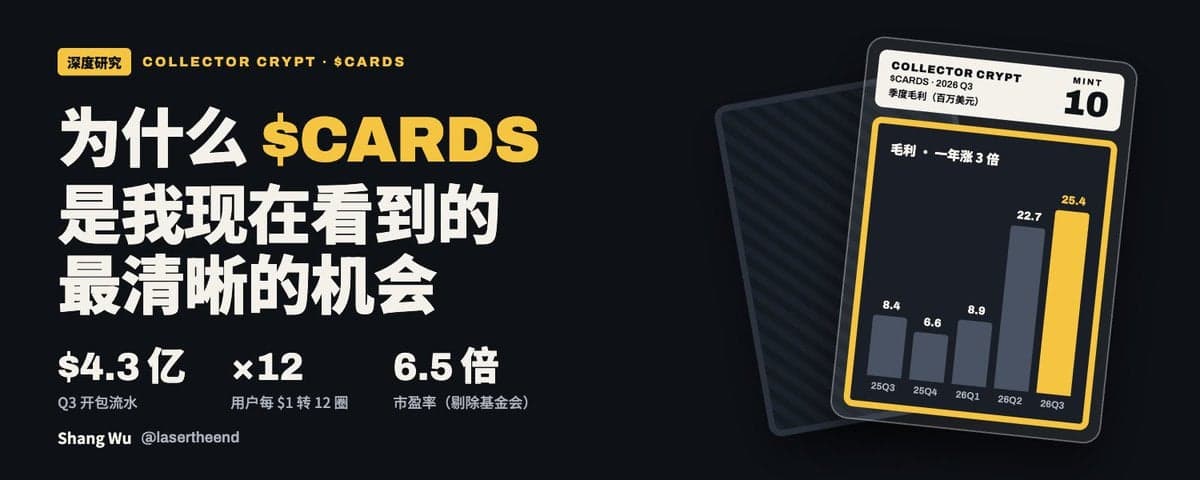
- Earnings are not dependent on the crypto cycle and are sustainable: In Q3 2026, users opened $433.5 million worth of packs on its gacha machines, generating $25.4 million in platform gross profit—both all-time highs. Cumulative volume exceeded $1 billion in August alone.
- The core comes down to two words: high velocity. Users only actually put up about $35 million, yet generated $430 million in platform volume, cycling every $1 twelve times. No offline card shops, eBay, or Whatnot can match this.
- It is also cheap: Excluding foundation holdings, based on my neutral estimates and the Oct 19 price of $0.274, it trades at roughly a 6.5x P/E ratio.
- Three more cards to play: Coinbase (partnership almost confirmed by the community), RipMart (pack opening + instant resale), Marketplace (2% fee vs. eBay's 10%+).
- My price target: $0.44–0.55 (~2x current price).
In the first half of this article, I’ll share my understanding of the card collecting business; the second half covers a rational breakdown and valuation. All data includes sources—you’re welcome to fact-check me.
I. Card Collecting is a Century-Old Business

Card collecting isn’t some niche Crypto club thing; it’s an extremely broad, highly predictable category, and it’s accelerating even faster these days.
- History: As early as 1886, tobacco company Goodwin & Co started inserting collectible cards into cigarette boxes (GoCollect). A PSA 1 graded copy of the T206 Honus Wagner issued between 1909–1911 sold for $5.12 million in February this year (Boston.com).
- Scale: Over 85 billion Pokémon cards have been produced cumulatively, with roughly 10 billion printed in just the 2025/26 fiscal year, sold across 90+ countries and regions (PokeGuardian).
- Momentum: Global major grading companies graded 26.6 million cards in 2025, with PSA alone handling 19.26 million, a YoY increase of 26%. Pokémon single-category submissions exceeded 16.1 million, marking the first time TCGs surpassed sports cards (Cllct).
Why has this business survived for over a century? My take is that it simultaneously satisfies several types of demand:
- It’s the most lottery-like, and most accessible, form of gambling. A pack costs tens of dollars, but you might pull a card worth thousands or tens of thousands. The dopamine hit from opening that pack is identical to scratching a lottery ticket.
- But its expected value is better than pure gambling. If you lose at a casino, it’s gone. Cards you pull are real physical assets you can resell. Pulling a card you love isn’t just about money; it’s a form of attachment, and it could appreciate later.
- It’s social currency. Pokémon is globally recognized, cute, playable, and great for conversations. A rare card is the easiest bragging right an ordinary person can flaunt.
- It taps into the zeitgeist. Financial nihilism is increasingly discussed. With falling birth rates, unaffordable housing, and AI taking jobs, people no longer treat money as money. Instead, they’re willing to spend on “joy” and the chance at a life-changing win.
Put simply, card collecting is like derivatives trading for the average person: thrilling, capped, and grounded. In my foreseeable future, this demand will only grow, never shrink.
II. Where Buying, Opening, and Selling Cards Hurts Today
It’s a great industry, but the current user experience is poor, with plenty of room for optimization. To sum it up in one word: slow.
- Offline card shops carry rent and labor costs, and their customer base is limited to locals. So their buy prices and sell prices will never be competitive.
- Whatnot brought pack opening to livestreams, solving for “convenience” and “accessibility,” but not for “speed.” If you pull a gem in a stream, you still have to wait for mail delivery, and if you want to sell, you have to list it yourself again. Want to keep playing? You have to bring out fresh cash.
Thus, traditional gacha velocity is extremely low: no matter how much someone loves it, they can’t reuse the same capital repeatedly. This is where Crypto can intervene. Every time money and cards cycle between buyers, shops, and platforms, each step extracts a toll.


III. Collector Crypt Got One Thing Right: Maximizing Velocity
If I had to summarize Collector Crypt in one word, it would be velocity. Using USDC and on-chain assets, it compresses the “open pack, sell card, re-open pack” loop into seconds.

If you pull an unwanted card, you can sell it back to the platform within 72 hours for 85%–93% of its estimated value (85% for small packs, 93% for $1,000+, Four Pillars). Funds return instantly to your balance, ready for another pack. On Pokémon machines, roughly 96% of pulled cards get resold (Blockworks).
This is what sets it apart from every traditional platform:
- Repeated use of the same capital. In Q3, users’ net spend (pack opening minus resales) was ~$35.3 million, yet supported $433.5 million in pack opening volume (Blockworks).
- Every user is highly valuable. In Q3, 21,876 wallets purchased packs, averaging ~$4,640 in gross margin contribution per paid wallet annually.
- The platform captures more. On Whatnot, for every $1 spent, the platform takes ~$0.06–0.11. At Collector Crypt, ~$0.72 of every $1 net invested becomes platform gross margin.
Many bear calls cite “low user count, reliant on whales”: 548 wallets spent over $100k each in Q3, accounting for 83% of revenue (Pine Analytics). I see it exactly the opposite way: the user base is still small, yet each is this valuable. Any growth in total users means exponential fundamental improvement.

Another crucial point: this differs from launchpad wars. Whether a token launches on Pump.fun or another launchpad, it’s fundamentally the same asset. But on-chain gacha versus off-chain gacha are two entirely different quality businesses. People often ask why Crypto exists—the data from Collector Crypt answers that.
IV. Collector Crypt Has High Business Stickiness
It’s rare to see a project at this stage growing independently, without relying on Bitcoin trends or card price cycles:
- BTC drops, it rises. From early April to late June this year, BTC fell 10% from $66.9k to $60.2k; in the same quarter, Collector Crypt’s gross margin grew 2.5x from $8.93 million to $22.66 million.
- BTC pumps, it doesn’t FOMO. In Q3, BTC surged 39%, while gross margin only grew 12%. Flat correlation in both directions proves demand is native to the protocol.
- Card prices drop, it keeps climbing. Over the past 4 weeks, the modern Pokémon card index was 9% below its 90-day average, yet gross margin rose 58% vs. the prior 4 weeks.
Fears that Pokémon cards are in a bubble suggest the business dies if prices fall. The data suggests the exact opposite.

First, it profits from velocity, not card prices.
A Pokémon card averages 21.6 resales before being kept, while a $50 pack breaks even after just ~6.2 resales (Blockworks). At that rate, even a permanent 70% crash in card prices would still allow average cost recovery. Pokémon inventory sells out in just 2.7 days; cards don’t sit on shelves.
Second, users are genuinely addicted.
Wallets opening packs >21 days/month totaled only 6 last September, but reached 281 this September. This near-daily cohort spent $42.5 million that month, ~⅓ of total monthly volume (Blockworks). Gacha isn’t a one-off purchase; once hooked, they stay hooked.

Over a year ago (July 2025), only 14 wallets met the >21 days/month threshold; by September this year, it was 281—a 20x increase. Lowering the bar to “>6 days/month” grew from 130 to 1,006. The real inflection came in May/June: >21 day wallets jumped from 24 in April to 152 in June, stayed above 130 since, and doubled again in September.
Third, volume stays here even if other EVs are higher.

RipIndex tracks live EV across machines: over the last 7 days, Collector Crypt leads the $25–99 tier, but Phygitals tops <$25 and $100–249. Yet Q3 gross margin for Collector Crypt was $25.4M, while runner-up Courtyard sat at $7.6M (down 57% QoQ) (Pine Analytics). Same dynamics as USDT, Binance, or Hyperliquid: the first mover locks in liquidity and inventory, making them nearly irreplaceable.
Per DefiLlama, Q3 revenue for Collector Crypt hit $34.75M, capturing 74% of the on-chain gacha segment. Second-place Courtyard pulled in $7.63M (down 57% QoQ, just ⅕ of CC). Phygitals, despite higher EV in some tiers, only reported $900k in Q3 (<3% of CC). October-to-date share has already climbed to 85%.
To clarify, CC isn’t the pioneer. Courtyard generated Polygon-based revenue as early as 2023 and slightly edged CC in Q1. But from Q2 onward, the gap widened dramatically. More akin to Binance vs. Hyperliquid: neither invented exchanges or perpetuals, but once UX and liquidity compound, users stick. Gacha works the same: more players = thicker inventory + richer pools = stronger network effects. Slightly higher EV elsewhere won’t steal them away.
Fourth, it’s already capturing off-chain users.

Critics claim CC only milks on-chain degens and lacks real-world usage. But credit card pack purchases grew from $930k in Q1 to $5.22M in Q2, then $6.88M in Q3 (Blockworks). The team has also publicly shared Meta ad ROI. Off-chain spend may be smaller initially, but this channel is validated and actively scaling.
V. Wide Moat, Grounded Team, No Monopoly Tactics
Seeing gacha profitability, many want to replicate it. Operationally, the hardest part isn’t building a site—it’s managing inventory. CC currently holds $26M in machine stock, with $55.1M in total on-chain assets across the platform (Pine Analytics).
Lacking inventory creates two fatal flaws:
- Inventory gets drained. Even with 96% resales, top-tier pulls get kept forever. Higher traffic demands constant replenishment efforts.
- Sourcing is expensive and complex. Buying $30M in cards isn’t like trading stocks; it’s granular procurement. CC buys via cons, eBay auctions, and bulk channels at ~85% market price, jumping to 90%–93% for premium grabs (Four Pillars). An individual wallet or exchange trying solo would need dedicated staff, anti-scam measures, and massive upfront capital tied up in stock.
So CC made a disciplined, strategic choice: no desire to monopolize. Recognizing marketing isn’t their core competency, they refuse to force all traffic to their own site. Instead, they open APIs and inventory to existing platforms for rev-share.

This distribution strategy is already executing:
- Jupiter: Launched July 13, driving 11% of Q3 volume; 92% of Jupiter pack buyers were new wallets who hadn’t purchased in Q2 (Pine Analytics).
- Expanded chains & entry points: Base (Aug 30), Jupiter Mobile (Sep 7), and the Robinhood chain (Sep 25, accepting USDG). The Robinhood integration contributed ~14% of gross margin in its first two weeks (Blockworks).
- Wallets & third parties: Pack openings via Solflare, Magic Eden, and others integrated via API are fully counted in Blockworks’ Gacha volume metrics.
CC’s worst fear would be stagnant inventory and margins swinging solely with card prices. Partner integrations eliminate this risk: more channels mean deeper stock and greater operational resilience.
Coinbase is next. On Sep 28, Coinbase tweeted: “Your binder is about to get a major upgrade. Rip packs on your phone. Every pull backed by a real, physical card. Vault it or ship it.” (Coinbase on X). Community tracking of Coinbase’s underlying contract interactions strongly indicates CC inventory powers it. I align with this assessment. Official confirmation from both sides is pending as of today. If true, this validates the foundational moat: even Coinbase chooses integration over building from scratch. https://x.com/lasertheend/status/2104880379106894285
VI. RipMart: Applying the Playbook to Pack Breaking

The second major vertical is direct pack breaking—the format retail users engage with most. Packs retail for tens of dollars but contain prizes ranging from hundreds to tens of thousands. Lower EV, but bigger jackpots, functioning closer to lottery tickets.
Currently dominating this space is Whatnot, a livestream commerce and pack-breaking platform. Its metrics are staggering:
- $20B valuation: Raised $545M in its Series G round in Aug 2026. In 18 months, valuation scaled from $4.97B to $11.5B, then to $20B (AuctionCompass).
- Doubling GMV yearly: $3B in 2024, $8B in 2025, surpassing $8B again in H1 2026. 2026 revenue is projected to exceed $1B, with ~8% take rate (ecommerce-nation).
- Cards are core: In the US, sports cards are Whatnot’s #1 category, TCGs #2 (Sports Collectors Daily). While Whatnot hasn’t disclosed exact split, even a 20% card share translates to $3B+ annualized volume at 2026 pace.
RipMart, CC’s upcoming project, targets this exact market. Launching soon, it mirrors Whatnot’s livestream pack-breaking model using CC’s sealed inventory. Streamers break live, and pulled cards can be instantly resold to the platform (Blockworks 0xResearch). Like gacha, it leverages partnerships rather than going solo for influencers, inventory, and retail traffic—a pragmatic approach.

VII. Marketplace: The Final Loop
This section excites me the most.
Most view CC purely as a gacha machine. I see the machine as a Trojan horse: users think they’re just pulling cards, but cards, capital, buyers, and sellers all progressively migrate on-chain.

Step 1: Gacha converts physical cards into on-chain assets. Every card entering a machine is already graded, vaulted, and minted. Pulled cards born on-chain can be listed for sale in under a second. Current on-chain inventory sits at $55.1M (Pine Analytics).
Step 2: RipMart scales this flywheel. Pack breaking is the sector’s largest entry point. Winning a gem on Whatnot requires mailing home, submitting for grading, listing on eBay—weeks of friction. Cards broken on RipMart are on-chain from birth, graded or raw. Once live, native on-chain supply compounds organically. No need to convince users to ship home collections; breakers naturally onboard them card by card.
Step 3: Abundant inventory attracts organic buyer demand. Buyers only care about three things: selection, pricing, and security. CC’s Marketplace charges 2% royalties vs. 7%–16% via PSA vaults, eBay, or auction houses. On-chain transfers guarantee authenticity and instant settlement. In September, a vintage PSA 10 Charizard sold for $825k; seller netted $808.5k, CC took $16.5k. An auction house/eBay route would’ve cost >$80k in fees alone (Pine Analytics).
Step 4: Buyer volume fuels gacha expansion. Sellers favor the platform for fast turnover and low fees. Retained cards thicken machine/RipMart inventory and diversify pools, attracting more breakers. Network effect complete.
Today, Q3 Marketplace GMV sits at $8.6M (2% of pack volume), dismissed as a side feature. I view this as an advantage—it signals the loop hasn’t fully compounded yet.
To clarify, I’m not expecting users to mail home collections to vaults and tokenize them—that’s too cumbersome and adoption-proof. I mean native inventory: cards born from machines and RipMart are inherently on-chain.
My endgame thesis: eventually, when an ordinary buyer wants a premium card, their first stop won’t be eBay—it’ll be Collector Crypt.
VIII. Unlocks, Buybacks & Team
Despite the positives, one critical factor demands transparency: heavy CARDS unlocks. This is the token’s primary structural headwind today, but in my view, also a catalyst.

Unlocks are substantial. Team, advisors, and seed pool total 445M tokens, releasing monthly on the 29th until July 29, 2027. Next unlock hits Oct 29 with ~59.5M tokens. At $0.274 today, that’s ~$16M new supply monthly. Over the next year, circulating supply expands from 500M to 900M–1.1B, roughly doubling. Valued at $0.274, that’s $110M–160M in new issuance, matching its annualized gross margin run-rate ($101.5M based on Q3). This represents CARDS’ primary structural risk.

The upside: post-year-end peak sell pressure dissipates. All major unlock schedules concentrate within this 12-month window. By July 2027, the full 445M team/advisor/seed tranche releases. Remaining allocations tie to community incentives, making future dilution and pacing fully manageable.
Current buyback activity trails unlocks. The auto-buyback bot has sourced CARDS on Raydium since April for immediate burning. Q3 deployed only $567k, retiring 3.3M tokens (~2.2% of quarterly margin) (Pine Analytics). On the Aug 29 anniversary, the team burned 22.5M tokens in one shot; cumulative burns now stand at 25.8M, merely 1.3% of total supply. Holders currently receive zero dividends; buybacks represent the sole yield mechanism.
So why do I maintain exposure?
First, full on-chain transparency. Distribution and sales are publicly verifiable. Blockworks tracks Y2 unlock wallets: the top four allocations (90M, 70M, 70M, 70M) show zero sales from two addresses, while two others routed directly to burn contracts. Monitoring my tracked top-7 core team addresses reveals zero sell activity to date. Alert triggers will fire immediately upon execution. Conversely, initial investors selling 83.4% of Y1 allocations confirms selective distribution behavior. Pressure sourcing must be contextualized.
Second, transparent team identity. Founders operate publicly and engage daily on Discord. Managing long-term relationships with cons, eBay sellers, graders, Jupiter, and Robinhood makes reputation the highest-value corporate asset.
Third, constrained buybacks reflect strategic capital allocation. Margins currently fund inventory replenishment, Web2 acquisition, and RipMart infrastructure development—yielding superior long-term buyback capacity vs. immediate retirement. I’d rather see $26M deployed in machine stock (Pine Analytics) than an artificially inflated buyback metric.
Why this functions as a catalyst. Unlock schedules are public and deterministic; markets price them forward monthly. Excluding foundation reserves leaves ~740M tokens unissued, nearly 1.5x current float. Therefore, my valuation methodology uses ex-foundation FDV, assuming full circulation today. Trading cheap under such conservative assumptions signals genuine undervaluation. Post-July 2027 unlock completion removes structural overhead; business compounding at current velocity projects materially larger enterprise value.
IX. Valuation: How Cheap Is $CARDS?
This section models CARDS as a public company: earnings multiples, forward optionality, and terminal value. All calculations apply ex-foundation FDV: ~1.239B tokens × $0.274 = $339M (CoinGecko price Oct 19), fully assuming unvested supply circulates today.
Comparison: Pump, Raydium, Hyperliquid

Three takeaways from this comparison table:
- Trades 40% cheaper than Pump. Identical methodology yields 2.5x for CARDS vs. 4.2x for Pump.
- Raydium and Hyperliquid operate in a different bracket. 19x and 26x multiples represent 8–10x premiums over CARDS.
- Concession stems primarily from buyback yield. Pump retires ~60% of revenue, Hyperliquid 100%, while CARDS commits <2%. Scaling buyback ratios unlocks significant multiple re-rating potential.
*Rationale for excluding foundation holdings: The 735M treasury allocation follows no vesting schedule, distributes to no wallets, and aligns with Blockworks’ float calculations. Functionally equivalent to treasury stock: internal corporate holdings excluded from diluted float and EPS denominator since they generate no yield, votes, or dilution unless liquidated. Applied identically here.
Why $CARDS Holds >=2x Upside
For the entire model, I apply a single multiple: 4.2x annualized gross margin, mirroring Pump’s current pricing. All subsequent projections calculate margin × 4.2.
The remaining variable defines 12-month gross margin run-rate. I segment projections into three drivers:
- Gacha baseline: $129M, anchored to trailing 4-week velocity. Represents verified run-rate; Oct 1–11 momentum exceeds this (annualized $141M). Modeled as floor with zero forward growth assumptions.
- Coinbase integration: adds $25.4M (highly conservative), representing 25% of Q3 margin. Benchmarked against prior channel deployment: Jupiter captured 11% of opening volume in Q1, Robinhood chain contributed ~14% margin in fortnight post-launch. Given Coinbase’s US market dominance, combined channel equivalence serves as prudent input.
- RipMart Y1: adds $8.8M. Projects $150M annualized GMV (<2% of Whatnot H1 figure, highly conservative); applies 5.9% gacha-derived margin profile (Q3 margin ÷ volume).
Segment valuation mapping and scenario sensitivities below:

Conservatism Assessment
The derived $0.55 price target incorporates heavy conservatism across inputs. Reversing assumptions quantifies incremental value per unrealized driver:
- Gacha growth: Margin assumes flat TTM velocity. Considers ongoing channel integrations beyond Coinbase, rendering this assumption structurally conservative.
- Multiple application: Capped at Pump’s 4.2x, deliberately avoiding Raydium (19x) or Hyperliquid (26x) peer comps.
- Float modeling: Calculates using FDV inclusive of unvested supply. Switching to realized float (Pump-style) lifts target to $0.76.
- RipMart upside: Assumes gacha-equivalent 5.9% margin. Y1 $150M GMV yields $8.8M margin (+$0.03/share). Bull case capturing 10% of Whatnot H1 GMV ($800M) generates $47M margin (+$0.13/share).
- Treasury assets: +$0.02. ~$30M in cash/card inventory excluded from base case.
- Marketplace: +$0.07. Fully excluded from base model. $1B annual GMV at 2% royalty yields $0.07 incremental value. Core utility lies in capital retention mechanisms accelerating gacha/RipMart velocity.
One area defying conservatism: Physical logistics and labor expenses omitted. While Pump multiples similarly ignore opex, tangible inventory businesses bear heavier overhead, warranting discounting. Neutralized structurally via flat-gacha assumptions and FDV modeling.
Conclusion: Grounded in executed metrics alone, CARDS prices at 1.6x current levels; integrating Coinbase/RipMart drives 2x over 12 months; shifting to bull-case triad assumptions yields 3x. This defines “clarity”—mathematical probability over narrative speculation.
X. Near-Term Catalysts: Confirmed Events Driving Price Discovery
- Coinbase official announcement. Sep 28 preview focused solely on product UX, omitting launch timing and partner disclosures (edgeX News). Verified integration constitutes definitive validation of inventory moats. Y IX valuation priced this corridor at flat $25.4M annual margin.
- Buyback escalation. Automated procurement trending upward (Q2: $218k, Q3: $567k) (Pine Analytics), remains asymmetric vs. throughput. Scaling to 20% margin capture yields ~$20M annual retirement, representing 6% ex-foundation FDV yield. As documented, structural concessions stem entirely from low buyback yields; policy shifts offer highest-convexity catalyst.
- Utility expansion. Current tokenomics restrict roles to gachas, marketplace routing, and automated buybacks (CoinMarketCap). Implementing staking-linked multipliers or fee discounts would transition holder composition from speculative traders to operational participants.
- Centralized exchange listings. Dominant volume currently routes off-chain. Primary CEX presence limited to OKX, plus KuCoin/Gate/MEXC secondary traction; Tier-1 venues (Binance/Coinbase/Bybit) remain unlisted. Proven Coinbase backend integration structurally necessitates spot pair approval.
- Q4 earnings print. Oct 1–11 margin registered $4.25M; linear annualization projects Q4 run-rate at $35.5M (+40% QoQ vs. Q3) (Blockworks).
XI. Risk Parameters: Scenario Testing
While structurally bullish, materialization of any listed factors triggers immediate model revision:
- Regulatory scrutiny. Gacha mechanics border adjacent to gambling jurisdictions. March 2026 class actions led by attorney Paul Lesko alleged Whatnot operations constituted illegal casino activity (denied by platform) (Value Added Resource). Legal classification of instant-resale mechanics remains contested between sweepstakes and commercial transactions.
- Whale concentration risk. Q3 top-548 wallets generated 83% of flow. Optimistically viewed as high-LTV cohorts; pessimistically modeled as liquidity vacuums upon coordinated exit.
- Asymmetric value capture. Zero dividend rights, governance exclusion, and sub-2% revenue recycling. Profitability attribution does not automatically map to token repricing; acknowledged structural disconnect.
- Vesting overhang. Multi-million monthly emissions persist through July 2027. Quarterly stagnation scenarios magnify unlock-induced liquidity slippage.
- Counterparty dependency inversion. Pending official MOU. Alternative supplier routing or vertical integration by Coinbase transforms partnership into existential traffic competition.
- Competitive margin compression. RipIndex benchmarks reveal Phygitals offering superior redemption tiers in select brackets. Defensive resale ratio adjustments threaten structural profitability preservation.
- Asset class depreciation & IP vulnerability. Stress tests confirm breakeven viability following ~70% permanent asset write-downs. However, franchise sentiment contraction precipitates immediate volume deceleration. Third-party IP licensing exposes operations to external moderation policies governing secondary markets.
XII. Closing Thesis
Card collecting operates within a century-old behavioral framework destined for longevity. Collector Crypt executes a straightforward intervention: applying cryptographic architecture to accelerate and reduce friction in legacy workflow steps. Execution output demonstrates a sub-25k active wallet ecosystem generating $25.4M quarterly gross margins.
Investment conviction derives not from narrative alignment, but from cryptographic verification: transparent telemetry across volume, margin, vault inventory, buyback execution, and treasury address movements. Source citations validate all figures; independent audit required.
Probability-weighted outcome centers on $0.55 re-rating as high-certainty trajectory. Asymmetry favors risk-reward parameters despite residual uncertainty. Structurally clearest opportunity available within current market landscape.
Join the official Coincamps community:
Telegram: https://t.me/coin_camps
Recommended
Teaming Up with PreStocks to Enter Pre-IPO, Pump.fun Finds a New Revenue Stream
Oct 21, 20:35Full Analysis of Three Possible Outcomes for the US Midterm Elections: What Will Trump Face? The 2027 Fiscal Battle Is Hard to Avoid
Oct 21, 20:28
Has the hype around Robinhood Chain cooled down?
Oct 21, 20:26
BitGo vs Fireblocks for Stablecoin Custody and Treasury
Oct 21, 20:26
Global Crypto "Zero-Tax" Illusion: No Capital Gains Tax Does Not Mean Profits Are Tax-Exempt
Oct 21, 19:59
Five DeFi Projects on Watchlist: From Tranched Vaults to On-Chain Perpetual Orderbooks
Oct 21, 19:56