Global Crypto "Zero-Tax" Illusion: No Capital Gains Tax Does Not Mean Profits Are Tax-Exempt
Translated by AididiaoJP, Foresight News
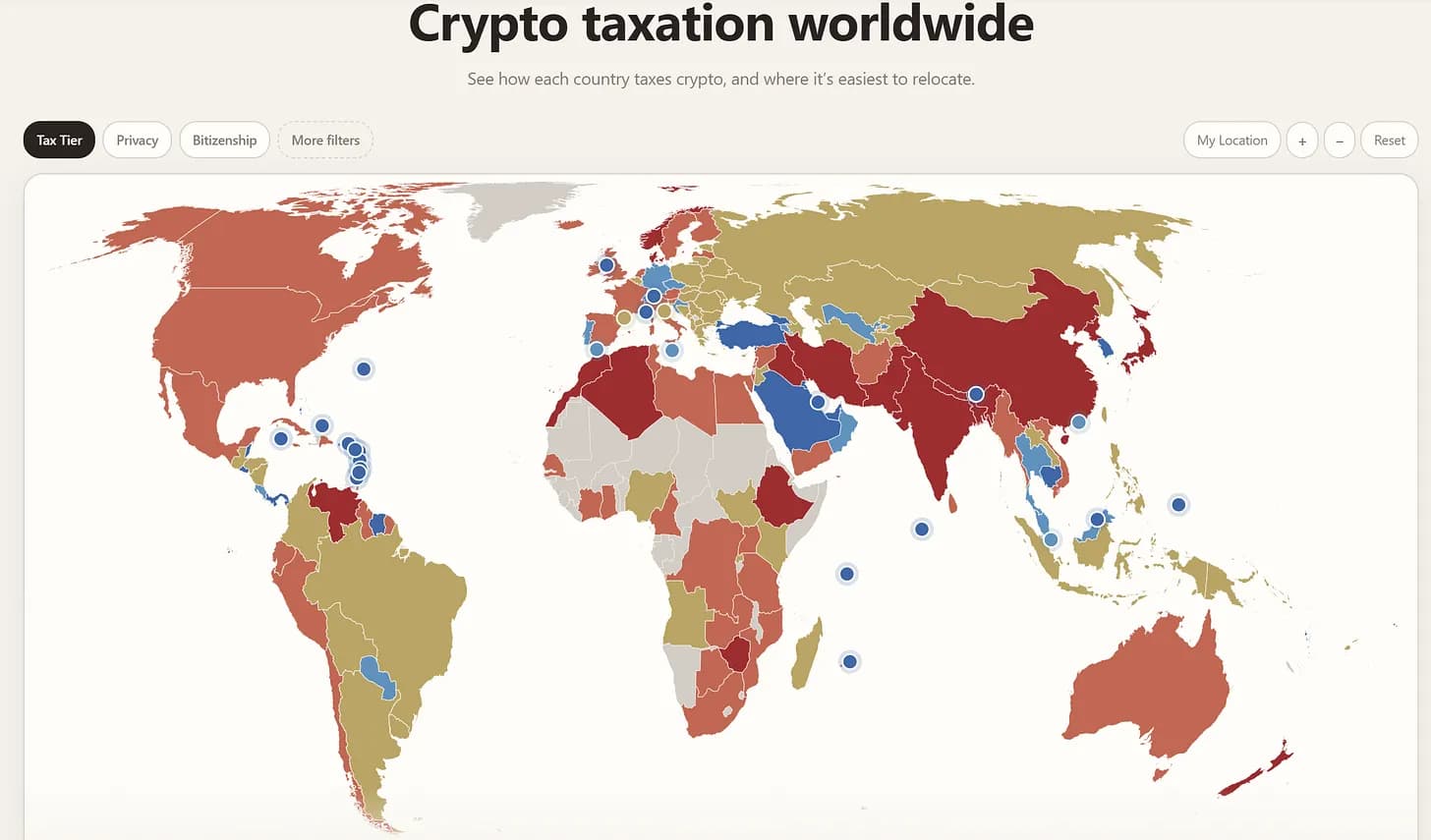
There is a claim that crypto taxes are 0% in over 30 countries. This isn't entirely wrong, but it can easily be misleading.

Whether a country does not levy capital gains tax, and your crypto profits being tax-exempt, are two different things. What really determines the tax burden is often not the nominal rate, but how your earnings are classified: as investment, professional trading, income, or business operations.
Singapore and Hong Kong do not levy substantive capital gains taxes, but may tax profits that constitute business income. Switzerland generally exempts private investment gains, but still imposes a wealth tax. Germany, Portugal, and Luxembourg offer exemptions based on holding periods. Cyprus also appears on many older "zero-tax crypto" lists, but starting in 2026, qualifying crypto disposal gains are taxed at 8%.
The key word is "classification." Below, we examine what major destinations actually exempt and do not exempt, and where the claim of "0% crypto tax" starts to fall apart.
Switzerland: Capital Gains Exempted, Wealth Tax Not Exempt
Switzerland's appeal is straightforward: assets held as private wealth are generally exempt from income tax on capital gains, including privately held crypto assets. It lacks Germany's uniform one-year holding period requirement.
But there are two prerequisites.
First, your activities must remain within private investing. If deemed professional trading or self-employment, gains become taxable.
Second, crypto holdings must be counted toward taxable wealth. How much is paid depends on cantonal and local tax brackets.
This operates differently from countries that "only tax realized profits." Swiss investors might not sell anything for a year and still owe wealth tax. So a more accurate statement is "private capital gains are generally exempt," not "crypto is tax-free."
Cyprus: Old Lists Need Updating
Cyprus deserves separate mention because the rules have changed.
Starting January 1, 2026, profits from qualifying crypto disposals are subject to a flat 8% income tax. Selling coins, coin-to-coin swaps, spending with crypto, and income-generating gifts are all covered; neither capital gains nor trading gains escape.
Loss treatment is also limited. Crypto losses generally can only offset crypto gains for the same person in the same tax year and cannot be carried forward under this special regime. Crypto acquired through mining does not qualify for this special treatment.
Therefore, treating Cyprus as a zero-tax destination for standard crypto disposals in 2026 is outdated advice. Its non-domicile regime doesn't change this conclusion: favorable treatment for one category of income does not mean all resident income is exempt. Cyprus now belongs in low-tax discussions, not the zero-tax column.
Portugal: Long-Term Holders Still Get an Edge
Portugal's rules are more specific than its past reputation as a "crypto haven."
For qualifying crypto assets that do not constitute securities, disposing of them after holding for at least 365 days results in tax-free gains. Gains that don't meet the exemption are generally taxed at 28%; however, netting rules and other exceptions may alter the outcome.
This structure favors patient investors over short-term traders.
But "holding for a year" isn't the complete answer to all crypto tax questions. The exemption applies to a defined category of disposal gains, meaning not every token, business activity, or type of crypto income receives the same treatment. Buying selected assets and holding long-term may make the exemption highly valuable; those with complex on-chain portfolios and frequent operations will need to look into the details.
Monaco: Zero Personal Income Tax, But Status Must Withstand Scrutiny
Monaco does not levy personal income tax on most residents. French nationals are the primary exception due to the Franco-Monegasque tax treaty.
For eligible individuals, Monaco is one of Europe's clearest jurisdictions for tax-exempt personal investment gains.
The crucial prerequisite is that you genuinely reside in the principality. Moreover, Monaco's rules do not override how other countries determine your status. An address in Monaco alone does not prove that your previous country of residence no longer considers you a tax resident.
The tax advantage is simple: most eligible residents pay no personal income tax. The difficulty lies in proving you truly qualify and that the evidence holds up.
Luxembourg: The Six-Month Rule Is Often Overlooked
Luxembourg isn't highly vocal in crypto relocation discussions, but its private investor rules are worth examining.
Individual crypto gains are generally taxed as speculative gains if disposed of within six months of acquisition, provided total speculative profits that year reach at least €500. Beyond this window, genuine private investment gains are generally untaxed.
Its holding period threshold is shorter than both Germany and Portugal.
But this is an investor rule, not a blanket exemption for crypto businesses. When short-term gains are taxable, they are subject to ordinary personal income tax rates, not some special low crypto rate. Luxembourg's appeal is specific: it may be more beneficial for private investors holding beyond six months.
Malta: Check What Token You Have First, Then How Long You Hold
Malta is often simplified as "long-term crypto gains are tax-exempt." The actual framework is more nuanced.
Tax guidance distinguishes between coins, financial tokens, utility tokens, and hybrid assets. Coins held as capital assets are outside the scope of capital gains tax; however, profits from corporations exchanging coins or selling tokens held as inventory constitute ordinary income.
Financial tokens may yield different outcomes. If a token qualifies as a security under relevant rules, disposal may fall under capital gains tax.
Nor is there a universal rule stating all crypto assets become tax-exempt after six months or a year. Purpose and context matter, not just duration. Malta may be friendly to genuine long-term holdings, but "Malta = 0% crypto tax" omits too much to serve as a conclusion.
Germany: Strong One-Year Exemption, But Don't Just Look at One Year
Under Germany's current framework, privately held crypto assets sold after holding for over a year are generally exempt. The amount of gain does not affect this exemption.
However, if sold, swapped, or spent within the one-year window, gains may be taxable under private disposal rules. There is also an annual €1,000 allowance for related private disposal gains. Note that this is a threshold, not a deduction: reaching the threshold could bring all related gains into the taxable scope.
Two distinctions are crucial.
First, coin-to-coin swaps can also constitute a disposal. You don't need to convert to euros to trigger a taxable event.
Second, crypto assets held by enterprises are subject to different rules than private holdings.
As of this writing, the one-year exemption remains current law. Reform proposals have been reported, so future relocation or disposal plans must distinguish between existing law and proposed changes. For patient private investors, Germany may be far friendlier than its "high-tax country" reputation suggests; for frequent traders, the outcome could be completely different. Nevertheless, the risk of adjustments to Germany's 0% treatment is not insignificant.
UAE: Personal Investing and Business Operations Are Separate Tracks
For those seeking zero tax on qualifying individual crypto investment gains, the UAE is one of the clearest non-European options.
Qualifying individual investment income is excluded from business activities that "bring individuals into the corporate tax regime." However, the UAE does not automatically apply a zero rate to all crypto-related activities.
Individuals running a business in the UAE with annual revenue exceeding 1 million Dirham may be brought under corporate tax; qualifying individual investment income does not count toward this threshold. Under the standard corporate tax regime, taxable income below 375,000 Dirham is taxed at 0%, and above at 9%.
These are profit thresholds, distinct from the individual's 1 million Dirham revenue test. The core distinction is whether you are "managing your own investments" versus "conducting a taxable business," not simply separating crypto from other things.
Singapore & Hong Kong: Capital Gains and Trading Profits Separated
Singapore does not levy substantive capital gains taxes. Individuals buying and selling financial instruments, including digital tokens, generally see profits treated as personal investment returns; however, companies trading tokens in their ordinary course of business must tax trading profits.
When authorities distinguish between capital gains and taxable trading income, they consider factors like investment intent, trade frequency, and holding periods. There is no simple rule stating that as long as profits are generated in Singapore, all crypto gains are tax-exempt. Singapore may appear on "no capital gains tax" lists, but should not be on lists claiming "all crypto income is tax-free."
Hong Kong similarly separates investment gains from business profits. Capital gains fall outside the profits tax scope, potentially applying to crypto assets held as long-term investments; however, Hong Kong-sourced crypto business profits may be taxable. Sourcing is determined by looking at the operational activities generating the profit and where they occur.
"Hong Kong has no capital gains tax" is a useful starting point; "all crypto trading strategies are tax-exempt" is not a reliable conclusion. Hong Kong is a separate tax jurisdiction, not a sovereign state.
Where Exactly Is 0%? Three Categories of Answers
Category one does not broadly levy personal capital gains taxes. Qualifying individual investment income in the UAE generally falls outside the tax net; Singapore does not tax substantive capital gains; Hong Kong excludes capital gains from profits tax; most eligible residents who genuinely settle in Monaco pay no personal income tax, with French nationals requiring separate consideration. As Hong Kong is a separate tax jurisdiction, this list only covers the destinations mentioned in this article, not a comprehensive global roster.
Category two offers exemptions for qualifying private investments. Swiss private investment gains are generally exempt, but wealth tax still applies; in Malta, qualifying coins fall outside capital gains tax, while trading income and certain tokens are treated separately.
Category three provides 0% after a holding period. Luxembourg private investments held over 6 months are generally exempt; under current German rules, private crypto holdings over 1 year are generally exempt; in Portugal, qualifying crypto assets must be held for at least 365 days and meet applicable conditions.
Cyprus does not belong in these zero-tax categories. Disposals covered under its 2026 regime are taxed at 8%.
DeFi Compares Differently: Four Questions to Unpack First
Once a portfolio involves more than just buy, hold, and sell, cross-country comparisons become less straightforward.
Capital gains exemptions won't automatically answer how to treat mining, token rewards, investment yields, or business trades. Conducting a tax review for active crypto users requires unpacking at least four questions:
How are tokens treated upon disposal? How are tokens treated when received as income or rewards? Do your activities constitute a business? Do the assets you actually hold fall within the exemption scope you rely on?
A favorable answer to the first question does not mean the other three are resolved. Someone holding BTC for two years and someone earning tokens, rotating positions, and trading derivatives may live in the same country yet require entirely different tax analyses.
Questions That Country Rankings Cannot Answer
No matter how low the nominal rate is, it only matters if the rules apply to you. You need to confirm which jurisdiction has taxing rights, rather than assuming a change of address solves the problem.
Low taxes do not mean low transparency. Crypto reporting rules under the EU's DAC8 apply to reportable activities starting in 2026, with initial reporting taking place in 2027 based on national implementation rules. Tax exemption status and reporting obligations are two different things.
The truly useful question isn't "where is crypto tax 0%?", but rather: given my actual portfolio, trading activity, and income, where can I qualify for this treatment? Can I clearly document the basis and prove it?
Join the official Coincamps community:
Telegram: https://t.me/coin_camps
Recommended
Teaming Up with PreStocks to Enter Pre-IPO, Pump.fun Finds a New Revenue Stream
Oct 21, 20:35Full Analysis of Three Possible Outcomes for the US Midterm Elections: What Will Trump Face? The 2027 Fiscal Battle Is Hard to Avoid
Oct 21, 20:28
Has the hype around Robinhood Chain cooled down?
Oct 21, 20:26
BitGo vs Fireblocks for Stablecoin Custody and Treasury
Oct 21, 20:26
Five DeFi Projects on Watchlist: From Tranched Vaults to On-Chain Perpetual Orderbooks
Oct 21, 19:56
Solana launches Alpenglow, its largest consensus upgrade since 2020, with transaction finality expected to drop from 6 seconds to 150 milliseconds.
Oct 21, 19:53