Jensen Huang Quit Nvidia Before the Opening Bell and Tokenized Nvidia Priced It First

Nvidia announced on Thursday, 12 November 2026, that Jensen Huang had resigned as chief executive, effective immediately, ending a 33-year run. CFO Colette Kress became interim CEO.
The news landed before the Nasdaq regular session opened. By the time the opening bell rang, tokenized Nvidia shares, onchain perpetual futures and prediction markets had already repriced the stock, and almost all of that trading was settled in stablecoins.
This is the clearest test yet of what 24/7 equity markets do when a major stock gets major news. Here is what the data shows, and what it does not.
The first market to price Jensen Huang's exit was not the Nasdaq. It was a set of onchain venues trading Nvidia exposure against USDC, and they moved minutes after the news broke.
Key Takeaways
- Huang resigned on 12 November 2026, and Colette Kress became interim CEO.
- Polymarket odds jumped from 37.5 to 99.5 percent in ten minutes.
- Hyperliquid's Nvidia perpetual fell 3.2 percent before the regular session opened.
- Tokenized Nvidia tokens fell about 10 percent within 24 hours.
- Stablecoins were the cash leg for nearly all of it.
What Happened at Nvidia
The chain of events started on Sunday, when Huang apologised to staff for being unfaithful to his wife. Nvidia's board opened an independent investigation into reports that he had been targeted by Chinese intelligence, while saying it had no reason to believe national security was compromised.
On Wednesday, Reuters and the New York Times reported a further relationship, with an executive who reported directly to Huang. On Thursday, Nvidia filed an 8-K announcing his resignation from the CEO role and the board.
Nvidia shares fell more than 14 percent at one point on Thursday and closed down more than 4 percent, according to Al Jazeera and the Boston Globe. The move came as Wall Street institutions are themselves testing tokenized stock trades.
What to note: the FBI, lawmakers from both parties and Malaysian authorities are all looking at parts of the story, so more headlines are likely outside market hours.
The Ten Minutes Before the Bell
The sharpest move came on prediction markets. Polymarket odds that Nvidia would announce Huang's departure by 12 November rose from 37.5 percent at 13:40 UTC to 99.5 percent ten minutes later, according to 99Bitcoins.
Hyperliquid's Nvidia perpetual, the xyz:NVDA contract, fell from 159.38 to 154.27 dollars over the same window, a 3.2 percent drop. From 13:45 UTC, 128.2 million dollars changed hands in 15 minutes, and the busiest five-minute candle carried about 13 times the earlier pace.
The Nasdaq regular session did not open until 14:30 UTC. Pre-market trading was available to some brokerage clients, but the deepest round-the-clock price discovery in those first minutes was happening onchain.
What to note: NVDAb, one tokenized version, traded 212 million dollars in 24 hours against a market value of about 150 million dollars.
Where Nvidia Traded While Wall Street Waited
Three kinds of venue carried most of the onchain Nvidia trading, and they are not the same product.
Hyperliquid NVDA-USDC perpetual
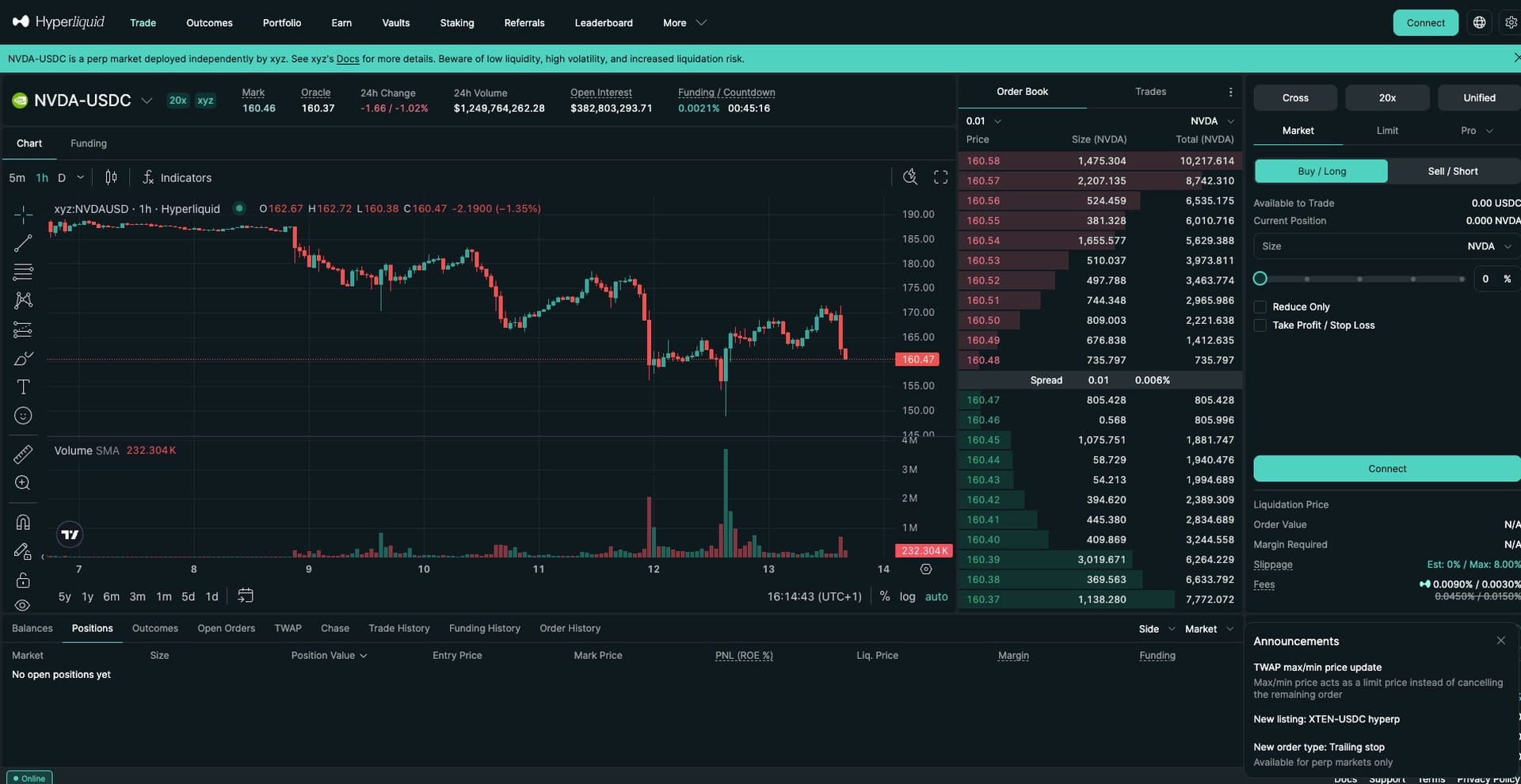
This is a perpetual futures contract deployed independently by a team called xyz, margined in USDC and offering up to 20x leverage. On 13 November it showed about 1.25 billion dollars of 24-hour volume and about 383 million dollars of open interest.
It gives price exposure, not ownership of Nvidia shares. The market's own banner warns of low liquidity, high volatility and increased liquidation risk.
Ondo NVDAon
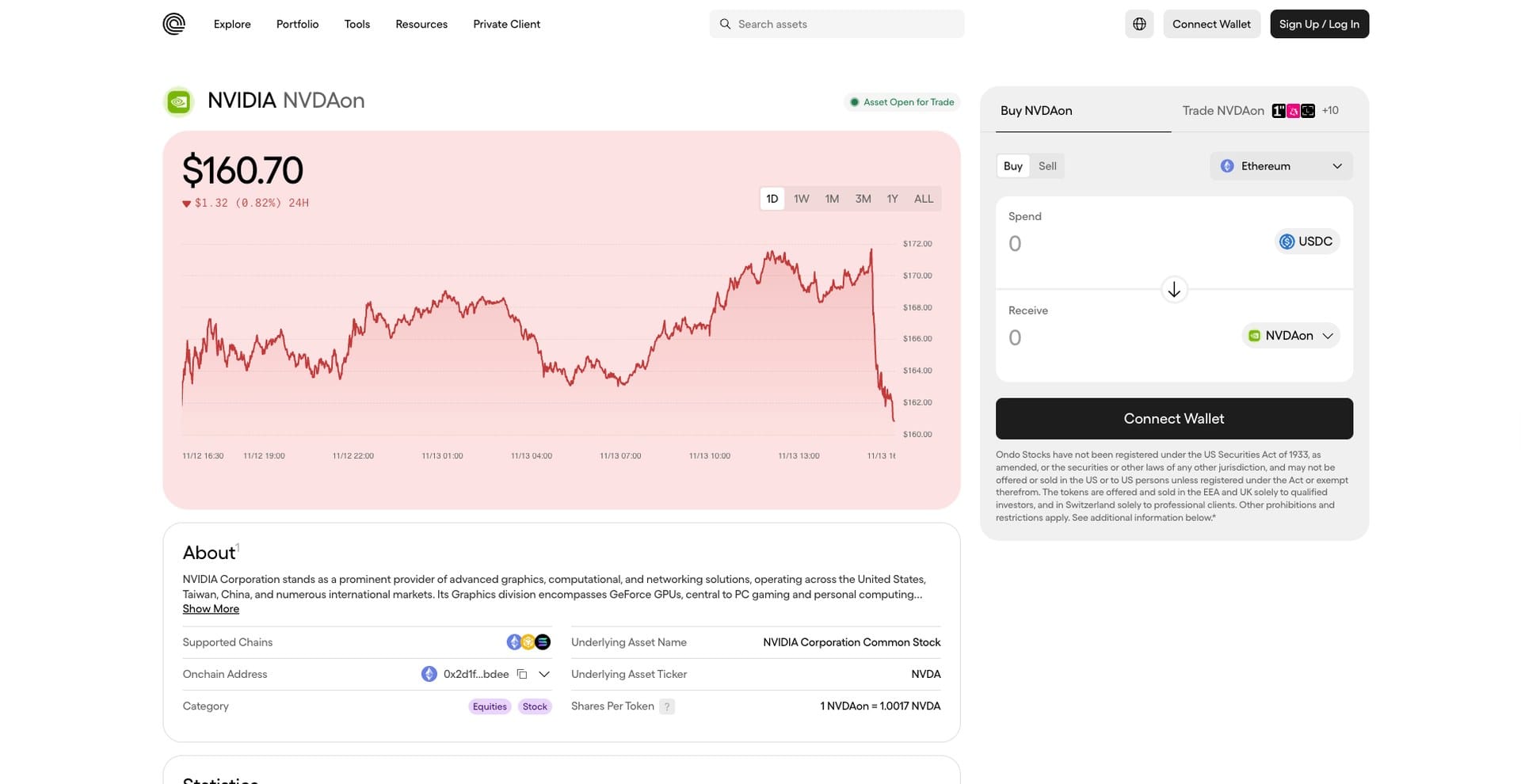
NVDAon is a tokenized stock bought with USDC, where one token represents 1.0017 Nvidia shares. Ondo describes it as bankruptcy remote with a security interest in collateral and daily attestation reports, as our Ondo Finance review covers in more detail.
Its page caps a single regular-session trade at 3 million dollars and limits the maximum net position to 1 million dollars on weekends and holidays. Ondo Stocks are not offered to US persons.
xStocks NVDAx
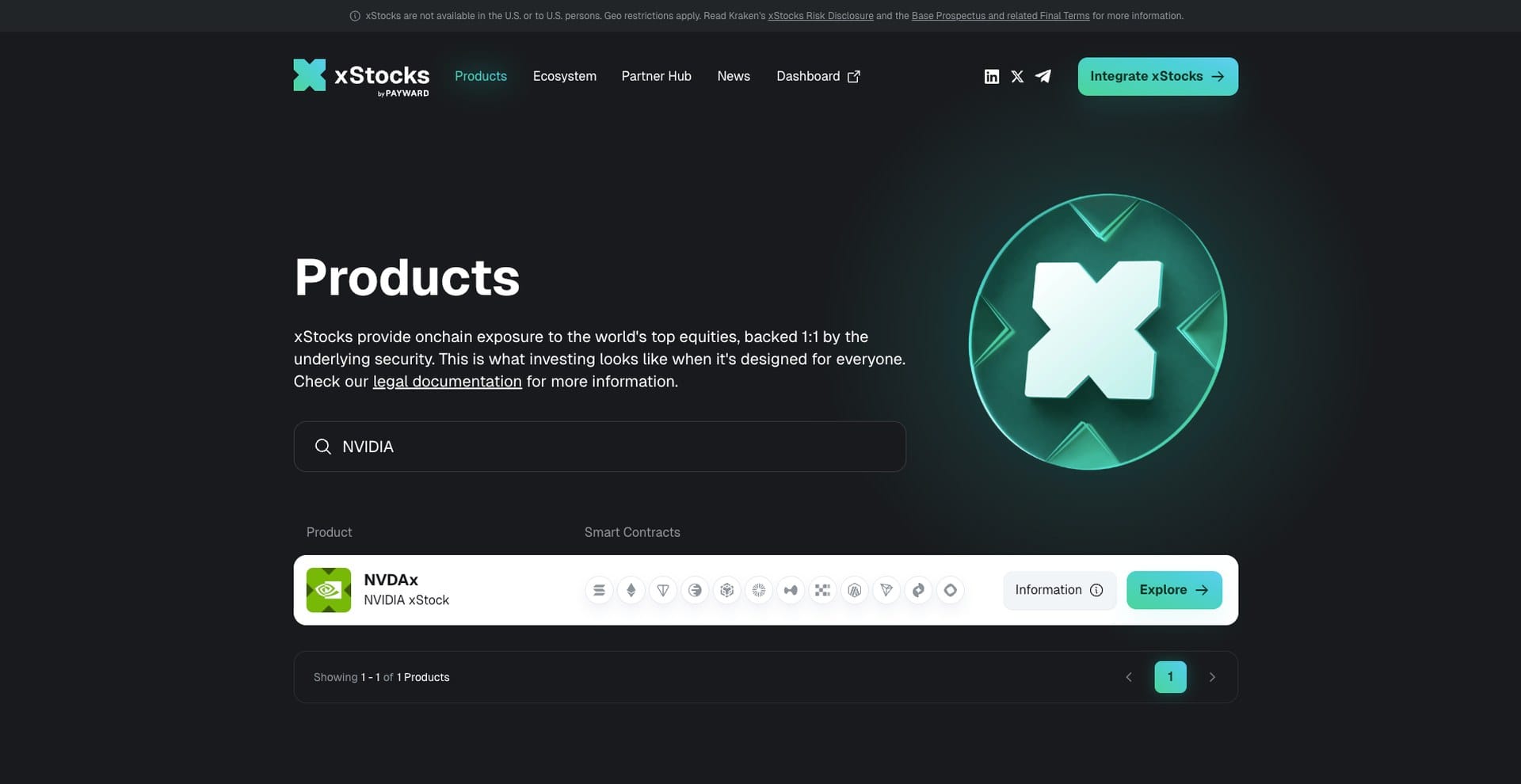
NVDAx is the xStocks version, now branded as a Payward product, the parent of Kraken. xStocks says each token is backed 1:1 by the underlying share and lists NVDAx across several blockchains.
Like Ondo's tokens, xStocks are not available in the US or to US persons. The issuer is Backed Assets (JE) Limited, a Jersey company.
The Fine Print of a 24/7 Price
A tokenized price that moves before the Nasdaq opens is useful information. It is not the same as a deep market that can absorb any size.
Ondo's own limits show the gap. Its off-hours cap of 1 million dollars in net position is small next to the hundreds of millions of dollars of Nvidia stock that change hands on an ordinary trading day.
Perpetuals add a different risk. With up to 20x leverage, a 3 percent drop in ten minutes is enough to liquidate many positions, which can push prices further than the news alone would.
What to note: treat the first onchain move as a signal of direction, not a reliable estimate of where the regular session will settle.
Why Stablecoins Are the Real Story
Every venue in this story used a stablecoin as cash. Ondo's NVDAon is bought with USDC, Hyperliquid's contract is margined in USDC, and Polymarket settles in USDC too.
That is what made round-the-clock trading possible. A bank wire cannot move at 13:45 UTC on a Thursday for a crypto venue, but a stablecoin transfer can, which is why issuers have worked to deepen USDC on Hyperliquid.
Nvidia's worst week in years therefore doubled as a stress test for stablecoin settlement. The tokens repriced, the perpetuals liquidated and the prediction market resolved, all without waiting for the bell.
What to note: watch whether stablecoin balances on these venues grew during the move, which would show new money arriving rather than existing balances rotating.
What to Watch Next
Several things could move Nvidia outside market hours in the coming days. The board's CEO search, findings from its independent investigation and any congressional action are the obvious ones.
Each of those is a test of the same question. If the next headline also breaks before the bell or on a weekend, onchain Nvidia markets will again be the first to price it.
The other test is depth. If off-hours volumes keep exceeding the market value of the tokens themselves, issuers will face pressure to raise their weekend limits, and regulators will face pressure to decide who can trade them.
Risks and Limitations
- Tokenized stocks and perpetuals are not available to US persons on the venues named here.
- Perpetual contracts give price exposure only, not ownership of shares.
- Off-hours liquidity is limited, so onchain prices can overshoot.
- Leverage of up to 20x can trigger cascading liquidations.
- Trading data here comes from news reports and venue pages and is not independently audited.
Conclusion
Jensen Huang's resignation was announced before the Nasdaq regular session opened. Polymarket, Hyperliquid and tokenized Nvidia tokens had repriced it within minutes.
Those venues are smaller and thinner than the Nasdaq, and their limits and leverage matter. They still delivered a price while the main market waited, and they did it on stablecoin rails.
For anyone watching stablecoins, that is the story. The largest company news of the week was traded first in USDC.
Read Next:
- DTCC Runs First Live Tokenized Stock and Treasury Trades
- Ondo Finance Review 2026
- Coinbase Becomes USDC Treasury Deployer on Hyperliquid
FAQs:
1. Why did Jensen Huang resign as Nvidia CEO?
Nvidia did not give a reason in its announcement. The resignation followed reports of extramarital relationships, including one with a woman alleged to have links to Chinese intelligence, which Nvidia's board is investigating.
2. Who is Nvidia's interim CEO?
Colette Kress, Nvidia's chief financial officer since 2013, is interim CEO and remains CFO while the board searches for a permanent successor.
3. What is tokenized Nvidia stock?
It is a blockchain token designed to track Nvidia shares, such as Ondo's NVDAon or xStocks' NVDAx, usually bought with stablecoins and tradable outside normal market hours.
4. Can US investors buy tokenized Nvidia?
Not on the venues covered here. Ondo and xStocks both state that their tokens are not available to US persons.
5. Why do stablecoins matter for 24/7 stock trading?
Stablecoins move at any hour, so venues can settle trades when banks are closed. Every venue in this story used USDC as its cash leg.
Disclaimer:
This content is provided for informational and educational purposes only and does not constitute financial, investment, or legal advice; no material herein should be interpreted as a recommendation, endorsement, or solicitation to buy or sell any security, token or derivative, and readers should conduct their own independent research or consult a qualified professional. Details about Nvidia and Jensen Huang are drawn from company filings and news reports at the time of writing and may change as investigations continue. Trading data is drawn from news reports and venue pages and is not independently verified. Tokenized stocks and perpetual futures carry significant risks, including leverage, liquidity and regulatory risk, and are not available in all jurisdictions.
Join the official Coincamps community:
Telegram: https://t.me/coin_camps
Recommended
Cheapest Way to Send USDT on TRON in 2026: Energy Rental, Staking and GasFree Compared
Nov 14, 00:14
Binance Hack Seizure: DOJ Gets Court Orders for $1.2B of Stolen Crypto
Nov 13, 21:18
Nik Storonsky: Revolut Founder, Net Worth and Stablecoins
Nov 13, 21:12
In Anthropic's doomsday narrative, there is no room for a Jensen Huang.
Nov 13, 20:41
Intelligence Bureau: Jensen Huang Resigns as NVIDIA CEO Amid Multiple Extramarital Affair Scandals; Microsoft Global Outage Lasts 12 Hours and Remains Unresolved
Nov 13, 20:21