Cheapest Way to Send USDT on TRON in 2026: Energy Rental, Staking and GasFree Compared
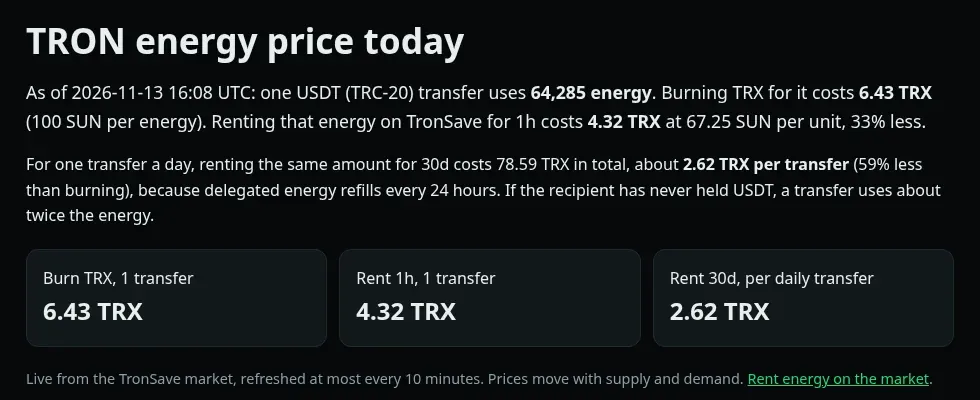
The cheapest way to send USDT on TRON, if you send at least once a day, is to rent energy for 30 days. On 13 November 2026, TronSave quoted 78.59 TRX for a month of energy covering one transfer a day, about 2.62 TRX per transfer, against 6.43 TRX burned per transfer with no energy (TronSave). GasFree suits wallets that hold no TRX at all, staking TRX suits teams that already hold enough TRX, and Feee.io and JustLend DAO are the alternatives for short or on-chain rentals.
The fee comes from energy. TRON's Proposal 104 set the burn price at 100 sun (0.0001 TRX) per unit of energy from 29 August 2025 (TRON TIPs), and the live chain parameters still showed 100 sun on 13 November 2026 (TronGrid).
Last updated: 13 November 2026. Fees and rental prices re-checked against provider pages and TRON chain data on this date.
Key Takeaways
- A USDT transfer to a wallet that already holds USDT used 64,285 energy in our simulation on 13 November 2026; a transfer to a wallet that has never held USDT used 130,285 (USDT contract on TRON).
- With no energy, those transfers burn 6.43 TRX and 13.03 TRX, about $2.01 and $4.08 at $0.3129 per TRX (CoinGecko).
- A one-hour TronSave rental cost 4.32 TRX per transfer; a 10-minute Feee.io rental cost 4.746 TRX including a 0.56 TRX service fee (TronSave; Feee.io).
- In the latest 1,000 USDT payments to GasFree's provider address, 965 were 1.5 USDT and 35 were 3 USDT, which fits a 1.5 USDT transfer fee plus a 1.5 USDT first-time activation fee (Tronscan; imKey).
- Staking replaces rental costs with locked capital: one daily transfer needed about 6,666 TRX staked, roughly $2,086, and unstaked TRX takes 14 days to withdraw (TronGrid).
What are the cheapest ways to send USDT on TRON?
The cheapest ways to send USDT on TRON are the five options below, compared with burning TRX. Prices are for one transfer to a wallet that already holds USDT. Every row links to the page or chain data we read.
| Option | Best for | One transfer (read 13 Nov 2026) | 30 daily transfers |
|---|---|---|---|
| Our pick: TronSave | Businesses and traders sending USDT every day | 4.32 TRX (1-hour rental) | 78.59 TRX (30-day rental) |
| GasFree | Wallets that hold USDT but no TRX | 1.5 USDT; 3 USDT on the first send | 45 USDT |
| Stake TRX | Teams that already hold TRX | 0 TRX once about 6,666 TRX is staked | 0 TRX; 14-day unstaking wait |
| Feee.io | One-off transfers and bots via API | 4.746 TRX (10-minute rental) | 126.14 TRX (30-day rental) |
| JustLend DAO | Users who want an on-chain rental contract | About 3.15 TRX plus gas for the rent and return transactions | About 119.5 TRX plus deposit rules |
| Burn TRX (no energy) | Rare senders who keep TRX in the wallet | 6.43 TRX | 192.86 TRX |
Two patterns stand out. A one-off rental saves about a third against burning, but a monthly rental saves far more because delegated energy refills every 24 hours, so the same 64,285 energy covers one transfer every day (TRON Stake 2.0). And only GasFree removes the need to hold TRX: every other option is paid in TRX.
🔎How we compared: on 13 November 2026 we read TRON chain parameters through TronGrid, simulated USDT transfers against the USDT contract, read JustLend DAO's rental rates from its contract and API, read prices on the TronSave price index and the Feee.io order form, and sampled the latest 1,000 USDT payments to GasFree's provider address. We did not rent energy, stake TRX or send transfers ourselves, and we gave no scores. Listings are editorial and unpaid; any paid inclusion would be labelled and never buys a position. See our methodology.
How much does a USDT transfer on TRON cost with each option?
A USDT transfer on TRON costs between $0 and $2.01 to a wallet that already holds USDT, and up to $4.08 to an empty one, depending on how the sender pays for energy. We assumed 30 transfers a month, one a day, TRX at $0.3129 and USDT at $0.9993 (CoinGecko, 17:02 CET), an activated GasFree wallet, and no negotiated discounts.
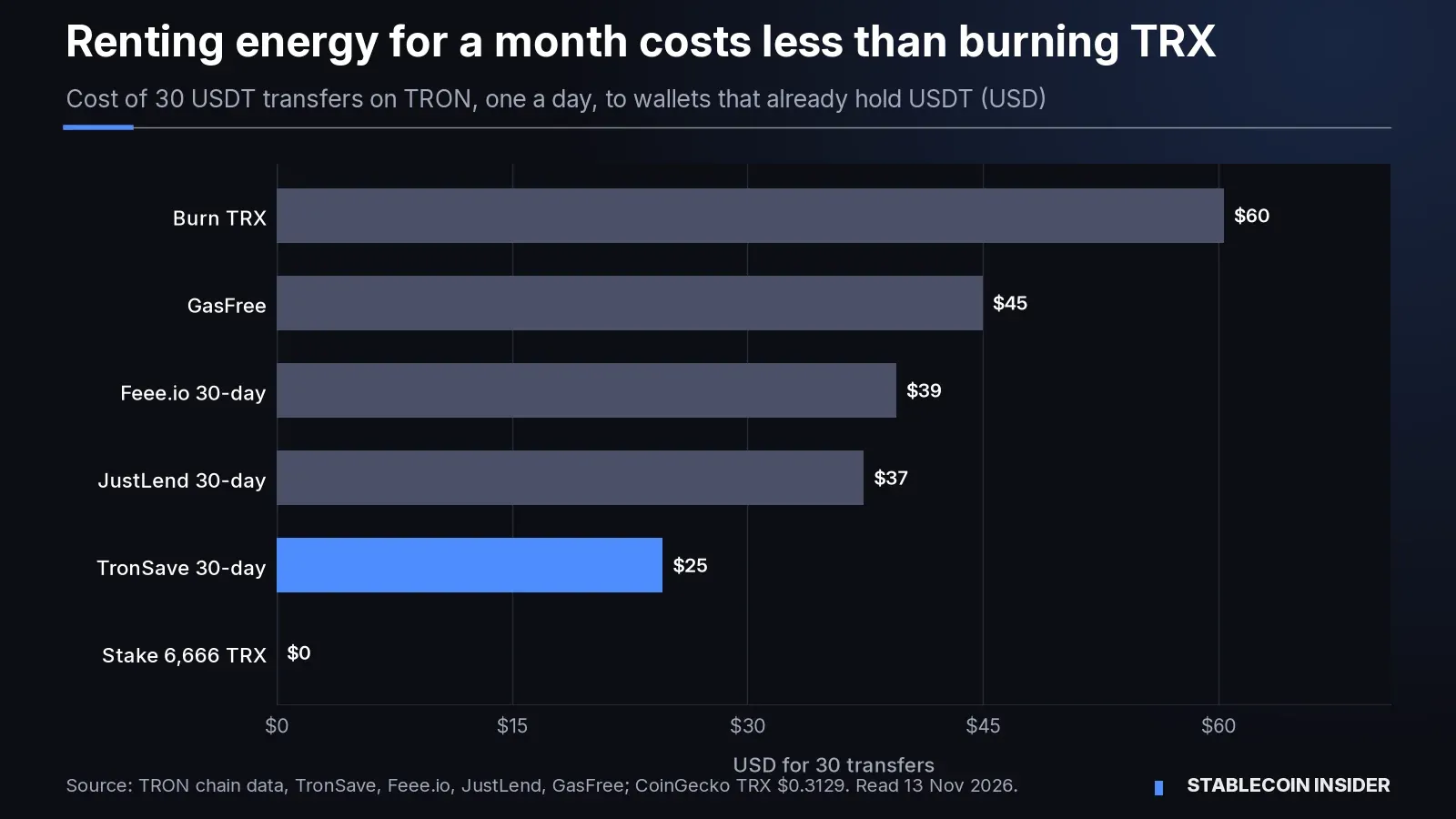
| Option | To a USDT holder | To an empty wallet | 30 daily sends (USD) |
|---|---|---|---|
| Burn TRX | 6.43 TRX ($2.01) | 13.03 TRX ($4.08) | $60.34 |
| TronSave | 4.32 TRX, 1 hour ($1.35) | About twice the energy to rent | $24.59 |
| Feee.io | 4.746 TRX, 10 minutes ($1.49) | Rent 130,400 energy | $39.47 |
| JustLend DAO | About 3.15 TRX + gas | About 6.39 TRX + gas | $37.40 + gas |
| GasFree | 1.5 USDT ($1.50) | 1.5 USDT | $44.97 |
| Stake TRX | $0 (about 6,666 TRX staked) | $0 (about 13,511 TRX staked) | $0 |
How we got the numbers: burn costs are energy × 100 sun. TronSave's 30-day figure is its own quote for 64,285 energy at 40.75 sun per day (TronSave). Feee.io quoted 126.14 TRX for 64,400 energy for 30 days at 65 sun, with its 0.56 TRX fee included (Feee.io). JustLend's figures apply its documented rules to its live rate of 0.6198 TRX per 10,000 energy per day: a one-hour rental plus the 0.75-day deposit deduction charged when rented energy is used up (JustLend docs; JustLend API). Its 30-day figure is 30 days at that daily rate.
Bandwidth is left out. In a sample of 40 recent USDT transfers, 36 used 345 bandwidth, and every activated account gets 600 free bandwidth a day (TRON docs), so one daily transfer stays inside the free allowance. A second transfer the same day burns about 0.345 TRX extra unless you also hold bandwidth.
The practical lesson: a business paying suppliers in USDT every day can cut its TRON fees by about 59% with a monthly rental instead of burning TRX, without staking capital.
TronSave: best for regular USDT senders
Best for: businesses, OTC desks and traders that send USDT on TRON daily and want the lowest per-transfer cost without locking up TRX.
TronSave runs a market for renting TRON energy. On 13 November 2026 its price index listed 65 sun for 15 minutes, 67.25 sun for one hour and 40.75 sun per day for 30 days at the 64,000-energy tier, falling to 36 sun per day for 50 million energy or more (TronSave). Under one day, the price covers the whole rental; from one day up, it is charged per day.
- Pros: lowest monthly cost of the rentals we checked; published price grid by amount and duration; per-day pricing rewards longer rentals.
- Cons: paid in TRX, so you still need a TRX balance; prices move with supply and demand; a transfer to a wallet that has never held USDT needs about twice the energy.
GasFree: best when the wallet holds no TRX
Best for: individuals and small merchants who receive USDT and want to send it on without buying TRX first.
GasFree lets a service provider pay the network cost while the user signs a transfer authorization and pays a fee in the token sent (GasFree specification). The specification sets an activation fee and a transfer fee per token, both adjustable by the provider. In the latest 1,000 USDT payments to the GasFree provider address, received between 16:41 and 17:05 CET on 13 November 2026, 965 were exactly 1.5 USDT and 35 were exactly 3 USDT (Tronscan). That matches the 1.5 USDT transfer fee and 1.5 USDT activation fee listed by imKey, a wallet that integrates it (imKey).
GasFree runs in TronLink as a separate GasFree wallet with its own address (TronLink). Moving USDT into it from a regular TRON address is an ordinary USDT transfer that needs energy, so the saving is largest when USDT arrives at the GasFree address directly.
- Pros: no TRX needed; one fee per token in the specification, so it does not rise for wallets that have never held USDT; supported in TronLink and other wallets.
- Cons: 1.5 USDT is dearer than a rental for wallets that already hold TRX; the fee is a provider setting that can change; TronLink warns that a GasFree wallet created from a multisig wallet needs only one signature (TronLink).
Staking TRX: best for teams that already hold TRX
Best for: treasuries and exchanges with idle TRX that send USDT on a steady schedule.
Staking TRX through Stake 2.0 gives an account energy in proportion to its share of all TRX staked for energy, and used energy refills over 24 hours (TRON docs). On 13 November 2026 the network's 180 billion daily energy was shared across about 18.67 billion TRX staked for energy, roughly 9.64 energy per TRX (TronGrid). One daily transfer to a USDT holder therefore needed about 6,666 TRX, around $2,086. Staked TRX also carries voting power, which earns rewards only if you vote (TRON docs).
- Pros: no rental fee per transfer; energy can be delegated to another account; voting rewards are available.
- Cons: capital is exposed to the TRX price; the energy per TRX falls when more TRX is staked; unstaked TRX is locked for 14 days.
Feee.io: best for one-off rentals and API buyers
Best for: occasional senders who want energy for a single transfer and developers who automate energy purchases through an API.
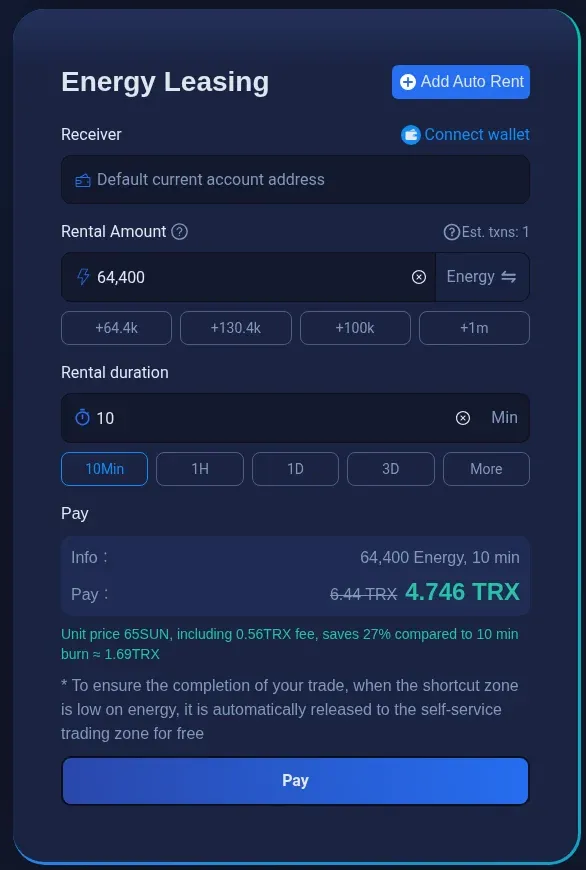
Feee.io sells energy from 10 minutes to 30 days, from 32,000 energy per order (Feee.io). Its order form quoted 4.746 TRX for 64,400 energy for 10 minutes, 5.2612 TRX for one hour, 7.644 TRX for one day and 126.14 TRX for 30 days, each including a 0.56 TRX fee. Its API returns the same quote with the service amount shown separately (Feee.io API docs).
- Pros: short 10-minute rentals; API and Telegram bot; bulk ordering.
- Cons: the 0.56 TRX fee per order makes short rentals dearer than TronSave; the one-day price of 7.644 TRX is more than burning TRX for a single transfer.
JustLend DAO: best for an on-chain rental contract
Best for: DeFi users who prefer renting energy from a smart contract and can manage deposits and returns.
JustLend DAO rents energy from TRX staked in its sTRX pool through a contract, for up to 30 days, to your own or another regular address (JustLend docs). On 13 November 2026 its API priced rental at 0.6198 TRX per 10,000 energy per day (JustLend API). The prepayment adds a one-day security deposit and a liquidation reserve of at least 20 TRX. Both come back if you return the energy on time, but 0.75 days of rent is deducted when the rented energy has been used (JustLend docs; contract reference).
- Pros: transparent contract rules; rent for other addresses; refunds unused rent on early return.
- Cons: renting and returning are on-chain transactions that cost gas; about 24 TRX must be prepaid for a one-hour rental of 64,285 energy; rentals under three hours should be returned straight after use to avoid liquidation.
How we chose
We chose these options with four tests applied on 13 November 2026: the option must cut the TRX burned on a USDT transfer; its price must be readable from a public page, API or the chain; it must not take custody of the user's USDT; and its costs must be comparable with the same transfer. We did not survey every energy rental seller. Prices are a snapshot and move during the day.
💡Our take: for anyone who sends USDT on TRON more than a few times a month, burning TRX is the expensive default. Rent energy for a month if you pay in TRX, stake if you already hold a large TRX balance, and use GasFree only when the wallet has no TRX to begin with.
Paying gas in stablecoins on EVM chains instead? See the best paymaster providers for paying gas in USDC. For USDT's share of TRON supply, see top stablecoins on TRON, and for costs beyond the network fee, the hidden costs of stablecoin payments.
For the full picture, see our Stablecoin payments and cards hub.
FAQ
Why does sending USDT to a new wallet cost more on TRON?
Sending USDT to a new wallet costs more on TRON because the transfer creates a new balance entry in the USDT contract. In our simulation on 13 November 2026 it used 130,285 energy instead of 64,285, so it burns 13.03 TRX rather than 6.43 TRX when the sender has no energy (USDT contract; TronGrid).How much energy should I rent for one USDT transfer?
You should rent about 64,285 energy for one USDT transfer to a wallet that already holds USDT, and about 130,285 for a wallet that has never held it. JustLend's documentation gives the same rule of thumb of roughly 64,000 and 130,000 (JustLend docs). Renting too little means the rest is paid by burning TRX.Can I send USDT on TRON without any TRX?
You can send USDT on TRON without any TRX through GasFree, which charges its fee in USDT instead (GasFree). Energy rentals and staking are paid in TRX, but the TRX can come from another wallet: Feee.io and JustLend DAO both deliver energy to a receiving address you enter (Feee.io; JustLend docs).Is renting TRON energy safe?
Renting TRON energy is safe for your USDT in the sense that you never hand it over: the energy is delegated to your address and you still sign your own transfers (TRON docs). The risks are paying a seller who fails to deliver, renting the wrong amount, and, on JustLend, losing part of the deposit if a rental expires without being returned (JustLend docs).Our verdict
TronSave is our pick for regular USDT senders on TRON: its 30-day rental cost about 2.62 TRX per daily transfer on 13 November 2026, the lowest of the paid options we checked. Choose GasFree if the wallet holds no TRX and the 1.5 USDT fee is acceptable. Stake TRX if you already hold several thousand TRX and accept the price risk and 14-day lock. Use Feee.io for quick one-off rentals or API buying, and JustLend DAO if you want an on-chain contract and are comfortable managing deposits.
Sources: TRON TIPs proposal list (Proposal 104); TronGrid chain parameters; TRON resource model; TRON Stake 2.0 overview; USDT contract on TRON; TronSave price index; Feee.io Fast Trading; Feee.io order price API; JustLend DAO Energy Rental; JustLend Energy Rental contract reference; JustLend sTRX API; GasFree; GasFree specification; GasFree provider address on Tronscan; TronLink GasFree user guide; imKey GasFree guide; CoinGecko TRX price. All read on 13 November 2026.
This content is provided for informational and educational purposes only and doesn't constitute financial, investment, legal or tax advice. Prices, fees and network parameters were read on 13 November 2026 between 17:00 and 17:10 CET and change during the day; the worked example uses stated assumptions and excludes bandwidth beyond the free daily allowance. Companies and assets mentioned: TRON, Tether (USDT), TronSave, Feee.io, JustLend DAO, GasFree, TronLink, imKey and TRX. None of the listings in this article is a paid placement.
Join the official Coincamps community:
Telegram: https://t.me/coin_camps
Recommended
Jensen Huang Quit Nvidia Before the Opening Bell and Tokenized Nvidia Priced It First
Nov 13, 23:23
Binance Hack Seizure: DOJ Gets Court Orders for $1.2B of Stolen Crypto
Nov 13, 21:18
Nik Storonsky: Revolut Founder, Net Worth and Stablecoins
Nov 13, 21:12
In Anthropic's doomsday narrative, there is no room for a Jensen Huang.
Nov 13, 20:41
Intelligence Bureau: Jensen Huang Resigns as NVIDIA CEO Amid Multiple Extramarital Affair Scandals; Microsoft Global Outage Lasts 12 Hours and Remains Unresolved
Nov 13, 20:21