
Backpack Makes a Comeback to the US, Unveils First Compliant Perpetual Contracts
Summary: On November 16, the U.S. Commodity Futures Trading Commission (CFTC) officially granted Designated Contract Market (DCM) status to operations under the crypto financial institution Backpack. Coupled with its previously approved Derivatives Clearing Organization (DCO) registration, Backpack has officially become the first blockchain derivatives platform in the United States to secure a full suite of trading and clearing licenses. The platform is authorized to offer leveraged perpetual contracts to U.S. residents, featuring bidirectional collateralization with fiat and crypto assets, 24/7 trading, and integration into a global unified order book. Following the announcement, its native token BP skyrocketed by more than 42% in a single day. This signifies that crypto perpetual contracts, which have long resided in the offshore gray zone, have officially entered the U.S. market under a compliant framework, marking the end of the era when crypto derivatives liquidity operated entirely offshore without oversight.
The most profitable perpetual contract business in the offshore market has officially been brought out from the shadows by U.S. top financial regulators into the light of onshore compliance.
According to official announcements from the U.S. CFTC and Reuters, regulators officially approved TLD Markets (operating under the name Backpack Exchange) to obtain Designated Contract Market (DCM) status on November 16. Three days prior, its affiliated clearing entity, TLD Clearing, had already been the first to pass the CFTC’s Derivatives Clearing Organization (DCO) registration. With both premier financial licenses secured, Backpack has completed all the necessary legal pillars required to operate its derivatives business in the United States.
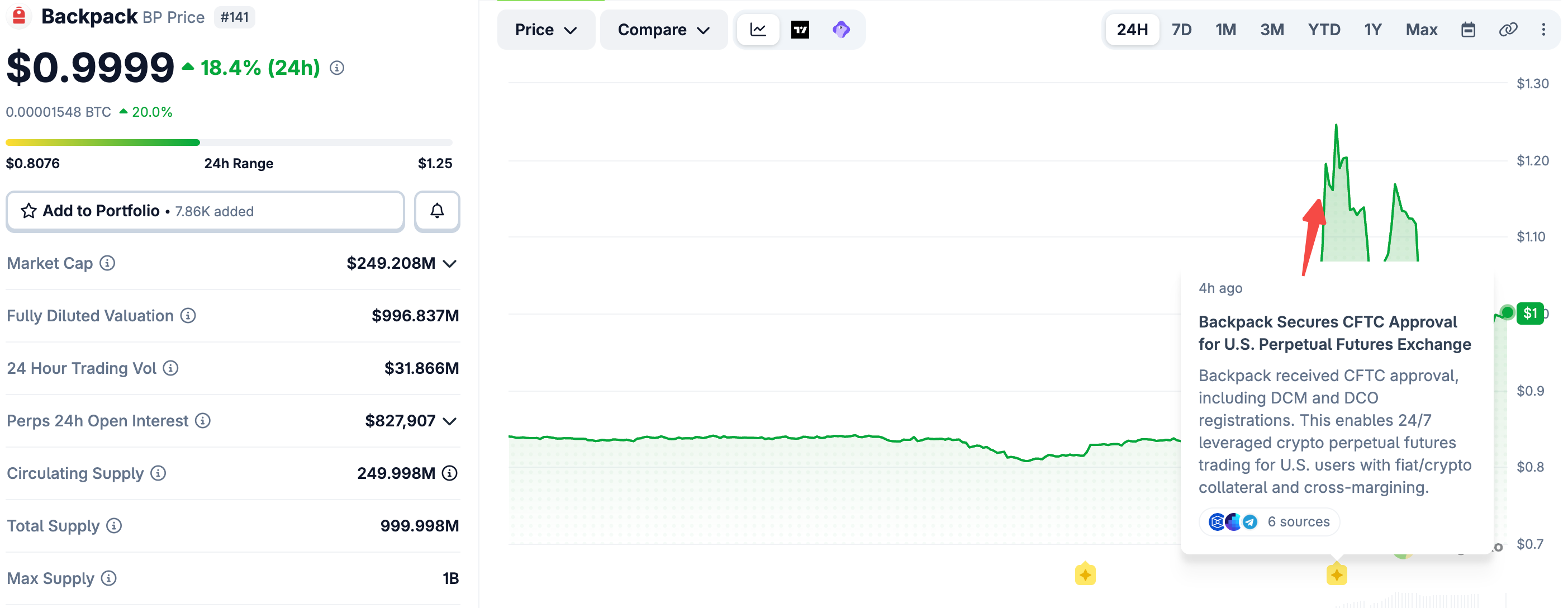
Boosted by the news, the crypto asset market priced in the development rapidly. According to CoinGecko data, Backpack’s native token BP climbed directly from $0.83 to $1.19 within 24 hours, posting a daily gain of 42.48%, while its 24-hour trading volume surged more than ninefold.
Leveraging Dual Licenses: Comprehensive Onshoring of Clearing and Trading Architecture
Unlike many past platforms that only secured single intermediary channels, Backpack has now acquired the core foundation of the entire financial trading backend.
According to the approval documents released by the CFTC, the DCM license grants the platform the right to establish and operate a derivatives matching market within regulatory boundaries, while the DCO qualification allows it to act as a central counterparty, independently managing trading collateral, settlement, and default liquidation obligations. In traditional financial markets, these two licenses are typically monopolized by industry giants such as the Chicago Mercantile Exchange (CME) and Intercontinental Exchange (ICE).
CFTC Chairman Michael S. Selig set the tone in a statement released on the same day, declaring this approval a significant milestone in the evolution of the U.S. financial market. Selig emphasized that the Commodity Exchange Act establishes universal core principles for trading and clearing institutions without restricting specific technological architectures; however, introducing a blockchain underlying layer does not mean exempting them from regulation. Infrastructure utilizing new technologies must adhere to the same compliance standards as traditional financial institutions, including strict segregation of client assets, anti-money laundering protocols, adequate financial resources, and round-the-clock risk monitoring.
This breakthrough was largely attributed to the deep regulatory background of its management team. According to public records, Mark Wetjen serves as Backpack’s President of the Americas. He previously served as a CFTC Commissioner and Acting Chairman, and long headed the Global Policy Department at the Depository Trust & Clearing Corporation (DTCC). Before entering the U.S. market, Backpack had already accumulated over $450 billion in transaction volume across more than 150 countries globally and holds a license from Dubai’s Virtual Assets Regulatory Authority (VARA).
Connecting the Global Unified Order Book: Perpetual Contracts Shed “Offshore Exclusivity”
For the entire crypto trading ecosystem, the most impactful provision of this approval lies in the cross-border integration of liquidity.
According to an official statement from Backpack, the core product authorized for launch in the U.S. is leveraged crypto perpetual futures (Perpetual Futures). U.S. users will not only enjoy 7x24 uninterrupted trading and support for full-position collateralization using both fiat and crypto assets, but most crucially, they will gain direct access to Backpack’s Global Unified Order Book.
This permission breaks the multi-year stalemate of fragmented offshore liquidity.
Since BitMEX invented perpetual futures in 2016, this super-derivative, which accounts for over 70% of total network trading volume, has long been blocked by U.S. regulators. Previously, even compliant platforms like Coinbase could only offer traditional delivery contracts to U.S. retail investors. Its perpetual futures business was forced to relocate to Bermuda to establish an offshore branch, resulting in extreme liquidity deprivation in the onshore compliant market.
Mark Wetjen, President of Backpack Americas, stated that from a macro-policy perspective, bringing blockchain financial infrastructure fully under U.S. federal regulation strategically aims to relocate the "price discovery" function, which had previously operated in non-compliant overseas venues, back to U.S. soil.
Token Surges Over 40% in a Single Day: Compliant Derivatives Reshape the Onshore Ecosystem
The strong reaction from capital markets reflects not only certainty regarding the trading license but also a forward-looking bet on the reshuffling of onshore liquidity.
In traditional market cycles, U.S. domestic investors wishing to participate in leveraged speculation often had to route through offshore VPNs or bear significant counterparty risks from OTC contracts. After the collapse of FTX, global demand for exchange fund security rose to historic highs. Backpack Founder and CEO Armani Ferrante noted that the company strategically chose to secure all necessary compliance qualifications before their launch day in the Asia-Pacific, European Union, UAE, and now the United States.
Data from CoinGecko shows that within hours of the announcement, spot trading volume for the BP token across exchanges quickly surpassed $30 million, pushing its Fully Diluted Valuation (FDV) above the near $1 billion mark.
With the CFTC’s clearance, the most core derivative trading in the crypto world has officially crossed the threshold of federal law.
For U.S. domestic traders, this is the first time they can participate in global perpetual contract trading without bearing the risk of offshore platforms abruptly ceasing operations. For the global exchange sector, the full suite of licenses secured by Backpack signals that the liquidity moat built by offshore exchanges through regulatory arbitrage has begun to face dissolution on the main battlefield.
Join the official Coincamps community:
Telegram: https://t.me/coin_camps
Recommended
Podcast Notes | Sam Altman: Jensen Huang is my hero, AI chip demand is overhyped, and OpenAI will eventually go public.
Nov 17, 11:16
As restrictions on Nvidia's computing power rentals tighten, the U.S. plans to regulate remote computing power in overseas data centers.
Nov 17, 11:14
Bitget UEX Daily | Nasdaq Drops 2.49%, AI Growth Expectations Tested Again; Bitcoin Hovers Below $65,000; Tonight's Focus on Retail and NVIDIA (November 17, 2026)
Nov 17, 11:11
The Money-Making Business Behind GTA VI: How One Game Has Kept a Company Profitable for Ten Years?
Nov 17, 10:57
The Trap of Revenue and Narratives: Why Minimalist Assets Navigate Crypto Cycles More Effectively?
Nov 17, 10:37
Backpack Founder's Latest Speech: Solana Will Become the API for US Finance, Ushering in the Era of Neobrokerage
Nov 17, 10:18