Shouting "Buy": Why Goldman Sachs Still Bullish on Samsung and Hynix

TL;DR
· Samsung Electronics and SK Hynix have fallen by 23% and 35% in the past month, respectively. Despite this, Goldman Sachs maintains a Buy rating, believing that the market has underestimated the sustainability of earnings.
· Goldman Sachs expects both companies' 2027 HBM hybrid ASP to be close to $2.9 per Gb, with a price increase of around 60% for similar products, and the remaining increase coming from product mix improvements.
· 3- to 5-year LTAs, floor pricing, and prepayments enhance demand visibility, but AI server demand, production expansion pace, LTA final terms, and CXMT catching up remain key risks.
Samsung Electronics and SK Hynix's stock prices have fallen by 23% and 35%, respectively, in the past month, but Goldman Sachs has reiterated its Buy rating for both companies. The report suggests that the 2027 HBM re-pricing, expansion of long-term supply agreements, and low supplier inventory levels are expected to dampen the earnings volatility of this storage cycle, improving visibility into future revenue and profits.
The market has not fully embraced this logic yet. Investors are concerned about weakening storage price expectations, lack of transparency in long-term agreement terms, rising module factory inventory, increased supply from China, and the potential for overcapacity with another round of expansion. Hynix's second-quarter operating profit falling short of expectations has also heightened market doubts about earnings sustainability.
Goldman Sachs' response can be summarized in three points: HBM is set to regain a price premium relative to traditional DRAM by 2027; customers are locking in capacity ahead through multi-year agreements; and low inventory and enterprise SSD demand are reducing the short-term industry risk of oversupply.
HBM is a key storage component for AI accelerators, and its price directly impacts the profit elasticity of Samsung Electronics and SK Hynix in the next two years.
Goldman Sachs expects that by 2027, the average selling price of Samsung and Hynix's HBM hybrids will be close to $2.9 per Gb, corresponding to a year-on-year growth of 87% and 100%, respectively. The price increase for the main products is estimated to be around 60% on a like-for-like basis, with the rest of the growth mainly coming from product mix improvements, including the adoption of next-generation and higher-layer HBM.
The basis for the 2027 price increase comes first from supply and demand. AI server demand may still outpace HBM supply, while the manufacturing complexity of the latest HBM is increasing. Core dies and base dies are beginning to use more advanced processes, and higher-layer stacking will increase process complexity and reduce yield. The new generation of HBM consumes more wafer capacity, further constraining effective supply.
Another reason is the changing price relationship between HBM and traditional DRAM. HBM is usually negotiated annually, with prices relatively fixed over the course of a year, while traditional DRAM adjusts prices monthly or quarterly to react more quickly to market changes. As of the second quarter of 2026, traditional DRAM prices have exceeded those of HBM. Goldman Sachs anticipates that the average selling price of traditional DRAM will rise to around $2 per Gb by the end of 2026, far higher than the $0.5 to $0.6 per Gb at the end of 2025.
If HBM is to maintain the profit margin and price premium expected for high-end products, repricing in 2027 appears necessary. Visible Alpha's market consensus for Hynix's 2027 HBM average selling price is around $2.3 per Gb, with Goldman Sachs' $2.9 price forecast representing approximately a 24% increase.
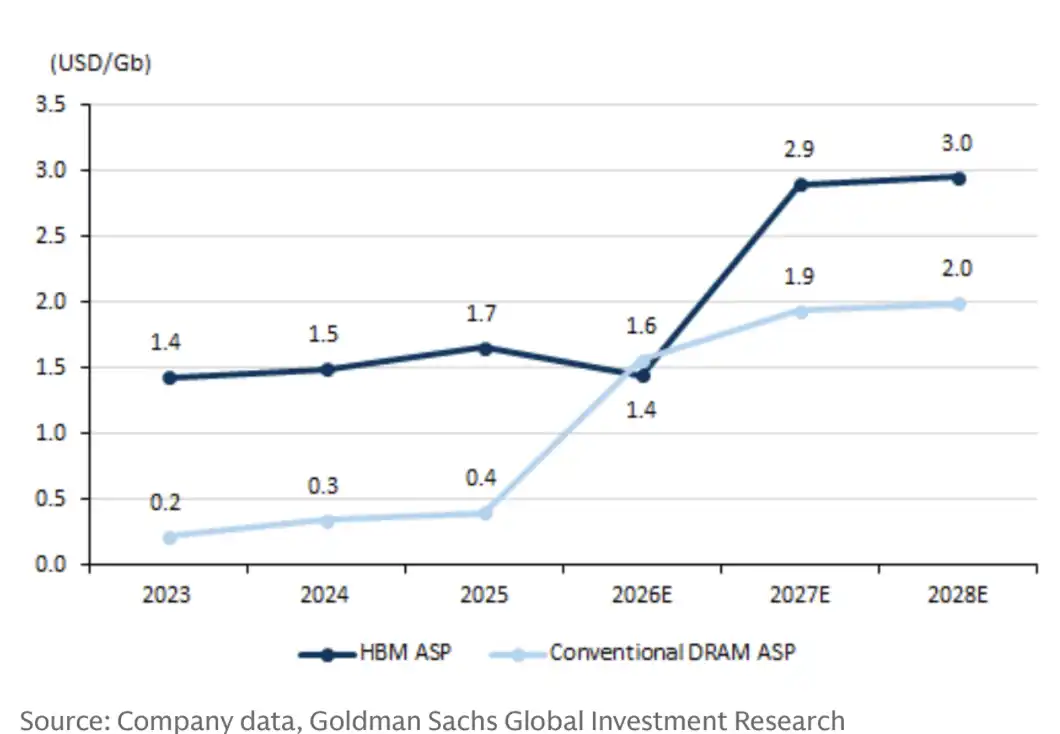
Hynix's HBM blended ASP is expected to increase to $2.9 per Gb in 2027, further widening the price gap with traditional DRAM.
HBM revenue share is also expected to rise. Goldman Sachs predicts that the proportion of HBM in Samsung's and Hynix's DRAM revenue will increase from 8% and 14% in 2026 to 16% and 22% in 2027, further reaching 18% and 25% in 2028. If prices and shipments materialize, AI-related storage will become a more significant and visible part of the two companies' profit structures.
The annual pricing of HBM explains the room for price increases in 2027, while multi-year LTAs address why this storage cycle may be more stable.
In traditional storage cycles, customers tend to concentrate orders during supply tightness and quickly reduce purchases after demand weakens. After suppliers expand production based on high expectations of prosperity, they are susceptible to bearing the risk of price declines and inventory increases alone. The new round of long-term agreements is beginning to allocate some risk to customers in advance through longer contract terms, higher coverage rates, price protection, and prepayments.
Goldman Sachs states that current LTA terms are typically 3 to 5 years, with most agreements based on 5 years and some customers opting for 3 years. Samsung employs a rolling contract structure, extending the contract period by one year annually through negotiation, so the actual collaboration time could exceed 5 years.
Coverage ratios are also expanding. Samsung has already signed contracts with the world's top five data center customers and is in final negotiations with an additional five large customers related to AI demand. After these contracts are finalized, multi-year agreements are expected to cover 60% to 70% of their planned capacity.
Micron stated that it has concluded LTA negotiations with around 10 customers, including key customers. Meanwhile, Intel revealed that it has signed 16 strategic customer agreements, covering about 20% of DRAM shipments and around one-third of NAND shipments during the contract period, with such agreements expected to ultimately cover over 50% of the company's revenue.
Long-term agreements are becoming more binding. The current pricing structures being discussed mainly include fixed prices, price ranges with upper and lower limits, and floor prices. Price ranges can mitigate drastic fluctuations, while floor prices limit downside risk for suppliers while retaining the benefits of price increases in the market.
Some agreements also include take-or-pay, prepayment, and default penalty clauses. Intel expects to receive $22 billion in cash deposits and related financial commitments; Western Digital disclosed financial guarantees and prepayments exceeding $11 billion. Samsung also stated that it has received approximately one-fourth of the total contract prepayment.
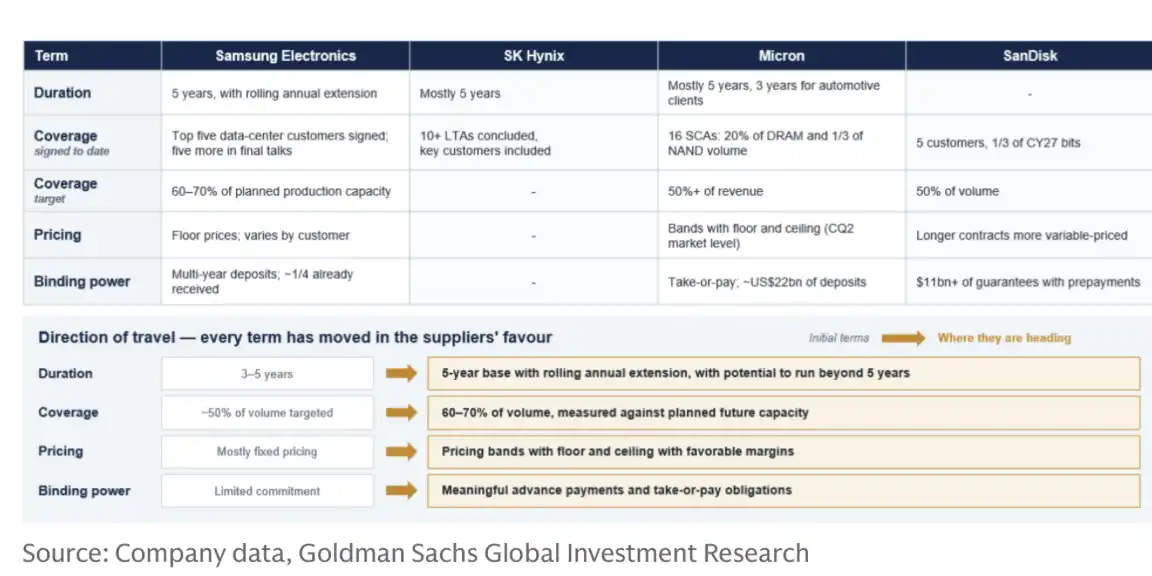
Summary table of Long-Term Agreement (LTA) terms. Highlighting 3- to 5-year durations, 60% to 70% coverage targets, price ranges, floor prices, prepayments, and financial guarantees.
For storage manufacturers, securing more customer commitments before expanding production capacity can reduce the passivity to future demand changes. An increase in capital expenditure may still bring supply pressures, but if a substantial portion of future capacity is already covered by contracts, there will be a thicker buffer against price declines.
The recent market concerns about the rise in module factory inventories are not unfounded. Soft demand for smartphones and PCs has indeed led some module factories to increase their stockpiles.
Goldman Sachs believes that this shift is more impactful on market sentiment than on industry fundamentals. The markets where module factories operate represent only a single-digit percentage of the overall storage market, with more significant suppliers and major customer inventories at healthy levels.
As of the end of the second quarter of 2026, Goldman Sachs estimates that supplier DRAM and NAND inventories are between 2 to 4 weeks, below the usual 4 to 5 weeks, and significantly lower than the previously common levels of over 10 weeks before a downturn in storage. Considering that future 12 to 18 months of capacity expansion and supply growth rates may still lag behind demand growth, the low inventory status is expected to continue.
Client-side inventory is also considered to be near normal levels. Although there has been significant procurement in the past few quarters, server storage supplies are mainly used for immediate production and have not led to significant hoarding. Low inventory levels combined with increased LTA coverage reduce the likelihood of sudden price reversals in the storage market in the short term.
Strong HBM does not mean the entire storage industry is without risk. NAND and traditional DRAM will still be affected by weak demand from consumer electronics such as smartphones and PCs.
Goldman Sachs predicts that the main incremental demand for NAND is shifting towards AI servers and enterprise SSDs. The report projects that from 2026 to 2028, enterprise SSD demand will reach 474EB, 619EB, and 755EB, corresponding to year-on-year growth of 66%, 31%, and 22%, respectively. Even with weak consumer demand, server demand still has the opportunity to offset some of the pressure.
The supply side expansion is also relatively restrained. Major manufacturers' capital expenditures are more focused on DRAM, with NAND investments leaning towards technology migration rather than significantly increasing wafer capacity. Therefore, Goldman Sachs expects that the mid-term NAND supply growth rate may still be lower than the demand growth rate.
Recent NAND spot prices have weakened, mainly focusing on specific products like TLC 512Gb, while other products like TLC 1Tb have seen relatively stable trends. The price of TLC 512Gb has surged nearly 600% over the past year, and the recent pullback occurred after a significant outperformance compared to other products. It cannot be directly seen as a sign of the entire NAND market moving towards oversupply.
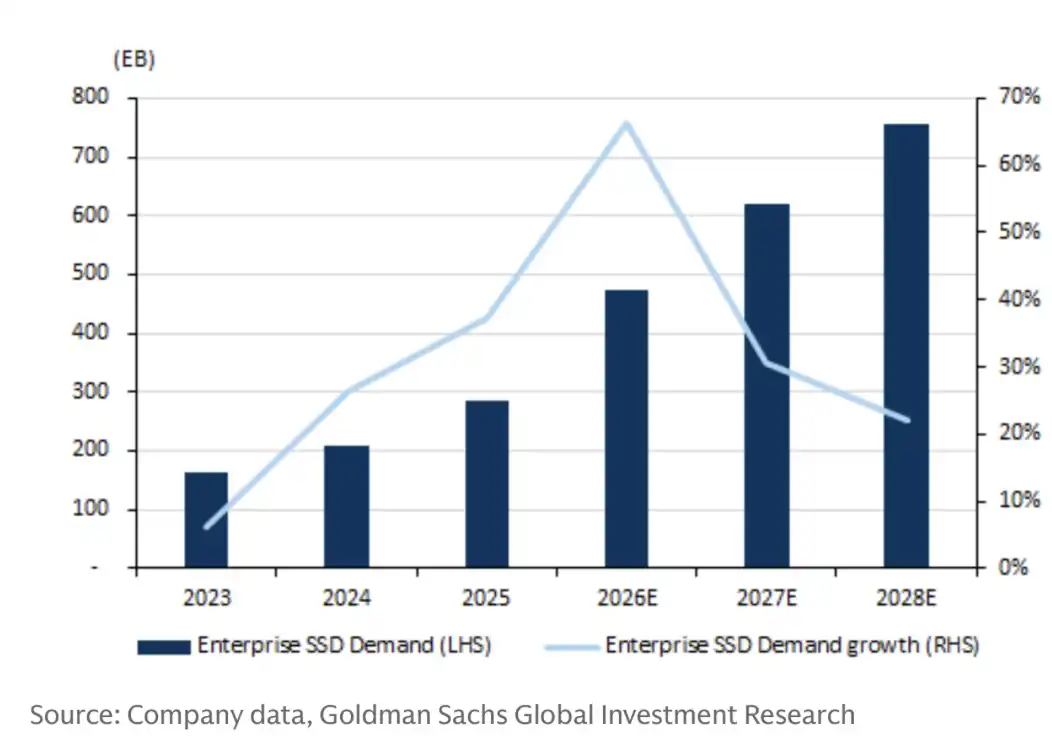
Enterprise SSD demand and year-on-year growth rate. Estimated demand for 2026E, 2027E, and 2028E is 474EB, 619EB, and 755EB, with year-on-year growth rates of 66%, 31%, and 22%.
Goldman Sachs' supply and demand model is also tight. The supply-demand gaps for DRAM, NAND, and HBM in 2027 are estimated to be around 5.9%, 4.6%, and 6.0%, respectively, with HBM being the most tense. Supply-demand gaps do not necessarily mean prices will continue to rise, but they show that due to low inventory and AI server demand, NAND has not yet entered oversupply directly due to weak consumer demand.
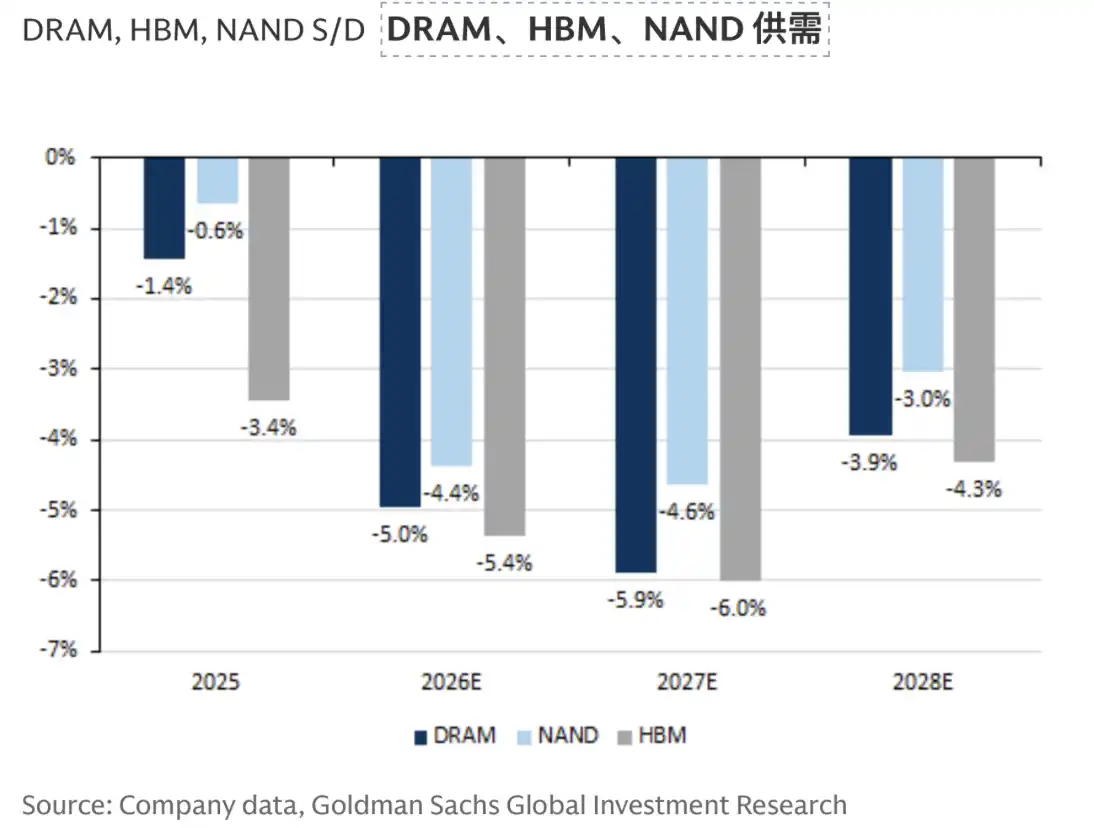
In 2027, there are supply gaps for DRAM, NAND, and HBM, with HBM facing the most intense supply-demand imbalance.CXMT Faces Short-Term Tight Supply, Long-Term Remains a Supply Variable
The market is still watching how YMTC's expansion will affect global DRAM supply and demand. Goldman Sachs expects that YMTC will mainly rely on domestic Chinese demand to expand market share, while overseas sales will be simultaneously affected by commercial terms and geopolitical factors. Considering the technological gap, YMTC is not yet able to substantially alter the global storage supply-demand tension in the short to medium term.
The growth of CXMT in the mobile DRAM sector is currently mainly driven by purchases from Chinese smartphone manufacturers. According to TrendForce data cited in the report, approximately 70% of CXMT's mobile DRAM shipments this year are still LPDDR4(X); Samsung and SK Hynix, on the other hand, have already shifted to LPDDR5(X) as their main products, with the related products expected to account for 75% to 85% of mobile DRAM shipments.
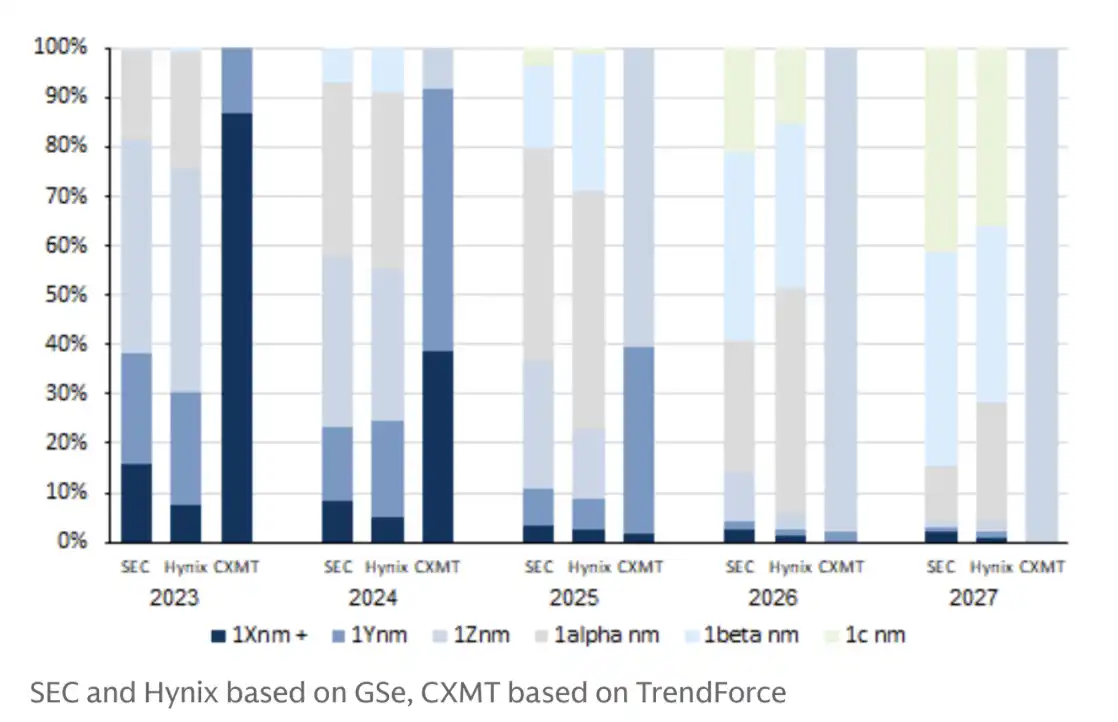
CXMT still lags behind Korean manufacturers in terms of process technology. CXMT's current main process technology is still about 2 to 3 generations behind the world's leading manufacturers, making it difficult for short-term capacity expansions to directly affect the high-end DRAM supply and demand.
There is also a technology node gap. CXMT's current main process technology is roughly equivalent to the 1z node, while the world's leading manufacturers are transitioning from the 1a, 1b to the 1c node, representing a gap of about 2 to 3 generations. Historically, each generation of process migration typically takes several years, and catching up will not be immediately completed with capacity expansion.
Equipment limitations will also affect the pace of its upgrades. More advanced DRAM processes require EUV and other wafer manufacturing equipment, and Chinese manufacturers are still restricted in obtaining such equipment. It will take a long research and development cycle for domestically-produced lithography equipment to achieve EUV performance.
The challenge of catching up in HBM is even greater. In addition to traditional DRAM processes, HBM also involves advanced packaging, data transfer speeds, power consumption, yield, and wafer foundry capabilities. For CXMT to establish competitiveness in the HBM field, it will also need China's local advanced process and packaging supply chain to upgrade synchronously.
Therefore, the risks have not disappeared. If AI server demand is lower than expected, the room for HBM price increases will shrink; if the price protection, prepayment, or procurement obligations in the final LTA terms are weaker than currently assumed, profit visibility will also be discounted; and if mature process supply continues to expand, prices of traditional DRAM and consumer products may still be under pressure.
The undervaluation after the pullback of Samsung Electronics and SK Hynix reflects investors' lingering doubts about whether this storage cycle can escape past severe fluctuations. Goldman Sachs' bullish view is based on HBM price increases, long-term agreement locking volumes, and low inventory levels occurring simultaneously. What truly needs to be validated next is whether AI server orders can continue to grow, whether LTA terms can be implemented, and whether additional capacity can be restrained before demand expansion.
Recommended
Desk: Brent Crude Tops $110, Musk's Net Worth Drops 528.6 Billion in Four Days After Tesla Roadster Launch
Oct 17, 21:49
JST Fifth Buyback and Burn Successfully Concludes: Over 170 Million Tokens Worth Approximately $23.53 Million Burned, Buyback Mechanism Set for Comprehensive Upgrade
Oct 17, 20:10
BitTorrent Brand Upgrade and Initial BTT Buyback & Burn Launch Simultaneously, Dual Engines Usher in New Era of Web3 Infrastructure
Oct 17, 20:00
Asia Market Daily: Japan's BOJ signals more rate hikes while Korea targets offshore perpetual platforms (2026/10/17)
Oct 17, 17:01Why did Papertrade backfire on you?
Oct 17, 17:01
The 'Strict Father' of Northern Myanmar: This Company Deploys 200,000 "AI Best Actors" to Strike Back Against Scammers
Oct 17, 15:34