CoreWeave Delivers Record-Breaking Financial Report, Why is Bernstein Still Bearish?

TL;DR
· CoreWeave's Q2 revenue was $2.575 billion, a year-over-year increase of 112%. Adjusted operating profit significantly exceeded expectations, with Bernstein calling it the company's best quarter to date.
· The company's order backlog has reached $104.2 billion, which increased to around $129.2 billion after signing over $25 billion in new contracts at the beginning of Q3, with active power capacity increasing by nearly 500MW in a single quarter.
· However, the expansion costs are also rising rapidly: Q2 capital expenditure reached $9.4 billion, and the full-year CapEx guidance has been further increased to $35 billion to $39 billion.
· Initiatives such as custody reasoning, enterprise clients, and price increases are improving the business model. Still, Bernstein believes these new businesses are not enough to prove that CoreWeave can withstand the competition from mega-scale cloud providers such as Microsoft and Meta.
· Bernstein has raised the target price from $67 to $74 but maintains an "Underperform" rating that is expected to underperform the market. Relative to the closing price of $90.32 on August 11, it still represents a downside of approximately 18%.
CoreWeave delivered a nearly flawless financial report, but Bernstein is still not changing its view.
In the commentary on CoreWeave's Q2 earnings released on August 11, Bernstein raised its target price from $67 to $74 while continuing to maintain an underperform rating. The research report even acknowledged that this is CoreWeave's "strongest financial performance to date": revenue, profit, orders, power capacity, and annual guidance are all showing improvement.
However, the report's real focus is not on whether the AI computational power demand is strong enough.
On the contrary, the demand is strong. The question is how much CoreWeave needs to spend to translate this demand into revenue and how long the current high growth, high prices, and long contracts can be sustained when data center supply is no longer as tight.
Looking at the fundamentals, CoreWeave's Q2 revenue reached $2.575 billion, a year-over-year increase of 112% and a 24% increase from the previous quarter, slightly above the market's consensus of $2.563 billion.
More significant improvement came from the profit side.
Adjusted EBITDA reached $1.51 billion, a year-over-year increase of approximately 101%, with a profit margin rising from 56% in the first quarter to about 59%; meanwhile, adjusted operating profit surged from $210 million in the first quarter to $1.28 billion, corresponding to a 5% margin, significantly higher than the company's previous guidance range of $30 million to $90 million.
The management attributed the improvement to three factors: the scaling of deployed mining power, increased utilization, and the improved economics of new client contracts. The company stated that the recent contracts added have a profit margin contribution 5 to 10 percentage points higher than contracts signed in the previous few quarters.
At the same time, in July, CoreWeave implemented approximately a 25% price increase on different SKUs, indicating that the second-quarter profit margin improvement has not yet fully reflected this round of price hikes.
In other words, at least in the short term, CoreWeave is experiencing the "operating leverage" that the market has been eagerly awaiting: as data centers and GPU clusters come online, revenue is starting to grow faster, while upfront costs are gradually being diluted.
Demand remains robust.
By the end of the second quarter, CoreWeave's revenue backlog stood at around $104.2 billion, a 46% year-over-year increase; with the additional commitments from customers exceeding $25 billion at the beginning of the third quarter, the total backlog has now reached around $129.2 billion. The company stated that currently, over half of the orders have moved into the actual delivery phase, and by the end of the year, this proportion is expected to exceed two-thirds.
This means that CoreWeave's most pressing issue is increasingly not "finding customers" but whether they can rapidly build out and commission the contracted mining power and put it into operation.
In the second quarter, the company added nearly 500MW of active power capacity, reaching 1.5GW; the year-end target has also been raised from over 1.7GW to over 1.85GW.
The signed power capacity has further increased from 3.7GW at the end of the second quarter to approximately 4.2GW at the time of the earnings call. Additionally, the company holds over 1.5GW of potential power resources associated with land, site expansion options, and intention agreements.
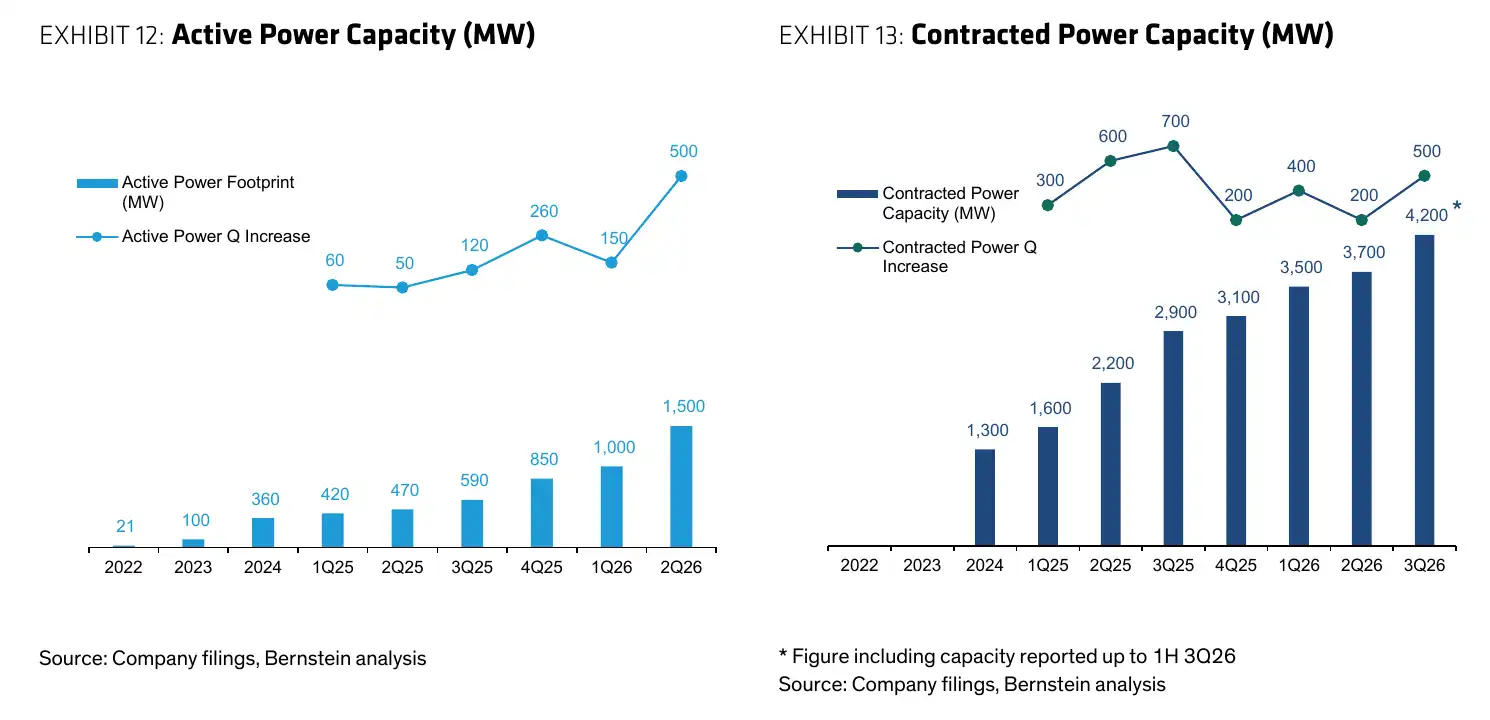
This chart illustrates the trend more vividly: CoreWeave's active power capacity has risen from 360MW in 2024 to around 1,500MW in the second quarter of 2026, while the signed power capacity has already reached near 4,200MW.
This is also the CoreWeave story that has captured the market's attention: it has already secured a significant amount of supply in the most scarce AI data center resources, including power, GPUs, and data center space.
But for Bernstein, this set of numbers holds another layer of meaning—over the next few years, the company still needs to invest a massive amount of capital to truly transform this "contracted electricity" into revenue-generating AI compute clusters.
This is precisely why Bernstein remains cautious.
CoreWeave's second-quarter capital expenditure reached around $9.4 billion, exceeding the previous guidance ceiling; the in-progress projects increased from $9.6 billion in the first quarter to $11.9 billion.
The company also raised its full-year 2026 capital expenditure guidance from $31 billion to $35 billion to $35 billion to $39 billion, with an expected investment of $11.5 billion to $13.5 billion in the third quarter alone.
In contrast, the company's latest 2026 revenue guidance is only $12.4 billion to $13.2 billion.
In other words, CoreWeave is still in a very typical heavy capital expansion phase: to fulfill future compute contracts, it needs to pre-purchase GPUs, build data centers, secure power, deploy networks, and cooling facilities.
The second-quarter GAAP net loss still reached $626 million, with net interest expense rising to $640 million. During the same period, the company raised approximately $18 billion through debt, convertible bonds, and equity financing, having raised over $32 billion in debt and equity capital to date.
The cost of financing has indeed improved, with the company stating that the weighted average cost of debt has dropped by nearly 300 basis points over the past year.
However, Bernstein is concerned about the absolute scale: the more the business expands, the more capital is required, and the more debt and interest increase.
This sets CoreWeave apart from traditional cloud providers like Microsoft, Amazon, and Google. The latter can subsidize AI infrastructure development with the massive cash flow generated from their mature businesses, while CoreWeave itself must rely on financing to drive expansion.
Therefore, for a neocloud—a new type of cloud provider mainly focused on GPU and AI compute power—strong AI demand does not automatically translate into equally excellent shareholder returns.
CoreWeave is also attempting to reshape this structure.
One of the most notable new businesses is managed inference, a managed inference service.
The traditional CoreWeave model largely relied on multi-year take-or-pay compute contracts: customers would pre-commit to GPU capacity and pay regardless of actual usage.
Managed inference, on the other hand, is closer to token or pay-as-you-go pricing, catering to shorter-term, more elastic AI inference demands.
The company has disclosed that the booked ARR for this business has grown from around $1 million at launch to over $100 million, with plans to reach at least $250 million by the end of 2026.
This business also holds another strategic value.
As early long-term contracts expire, CoreWeave faces a crucial question: what to do with the older generation GPUs?
If it can reallocate the post-contract GPUs to more enterprise clients through the inference service, it can increase asset lifecycle utilization, mitigating the impact of GPU depreciation on the economic model.
Bernstein acknowledges this direction but believes that the scale is currently insufficient to change the assessment. Managed inference is still in its early stages, and profitability, customer retention, usage rate stability, and the need for additional capital investment have yet to be validated.
This is also a key point to understand Bernstein's bearish thesis.
It doesn't think CoreWeave will run into an immediate issue.
In fact, Bernstein specifically states that it has become more optimistic about CoreWeave hitting the 2026 targets post-Q2 and expects the company to potentially add around $45 billion in contracts from now until the end of 2027. Its 2026 revenue forecast is also broadly in line with the market consensus.
The real divergence starts from 2027 and significantly widens after 2028.
Bernstein believes that CoreWeave is currently enjoying a unique window of opportunity: a surge in AI computational demand, coupled with a severe shortage of GPU data centers, power, and construction capacity.
This scarcity of supply allows CoreWeave, with its control over GPU and power resources, to command higher prices and secure large-scale long-term contracts.
However, if data center supply gradually increases after 2028, this scarcity premium may diminish.
By then, CoreWeave will not only face more competition from neoclouds, but also from hyperscale cloud providers with lower capital costs, stronger software ecosystems, and larger customer bases.
Bernstein particularly questions whether CoreWeave's software barrier can withstand direct competition from hyperscalers. The report suggests that the continued growth in AI demand will not eliminate this structural issue but may only delay its impact.
According to Bernstein's current model, by 2028, its CoreWeave revenue forecast is already about 15% lower than market expectations, and this gap is expected to widen further.
In other words, while the current market trades on the premise of "insufficient AI computational power," Bernstein is concerned about what CoreWeave will have to offer if computational power is no longer as scarce.
Therefore, the research report presents what appears to be a contradictory but actually a very clear conclusion.
As the second-quarter performance exceeded expectations, Bernstein has raised its short-term profit outlook and increased CoreWeave's price target from $67 to $74.
However, the long-term business model assessment remains unchanged, hence the continued Underperform rating.
Bernstein uses a 25.5x forward EV/Adjusted EBIT valuation, corresponding to a $74 price target. Based on the closing price of $90.32 on August 11, this still implies approximately an 18% downside.
The report also outlines three key upside risks that could invalidate this assessment: slower-than-expected data center construction by hyperscale cloud providers, CoreWeave's software platform achieving genuine differentiation, and ongoing data center power shortages enabling the company to maintain stronger pricing power.
So, the report doesn't really provide a simple answer to whether CoreWeave is doing well or not.
The second quarter has shown that CoreWeave can sign deals, can build, and most importantly, can monetize its hashpower.
What really needs to be proven next is whether this growth can ultimately generate a high enough and sustained capital return to cover GPU depreciation, data center buildout, and the massive financing costs.
This is the threshold that CoreWeave must cross to evolve from a rapidly growing AI hashpower company into a truly sustainable business.
Recommended
Will Tonight's U.S. CPI Data Crush Expectations for a September Rate Hike?
Aug 12, 17:49
Manus and Lin Junyang, Collective Return
Aug 12, 14:38
StonkBroker is undoubtedly the Robinhood of the Metaverse, bro.
Aug 12, 12:18
Arthur Hayes New Article: Betting on Yen Appreciation, ENA Could Surge 5 to 10 Times in the Coming Months
Aug 12, 11:29
Lumentum Revenue Surpasses $1 Billion, $7.1 Billion Losses Explained
Aug 12, 11:28
After CoreWeave's Revenue Doubles, AI Cloud's 'Scale Up Bill' Comes Into Focus
Aug 12, 10:03