After CoreWeave's Revenue Doubles, AI Cloud's 'Scale Up Bill' Comes Into Focus
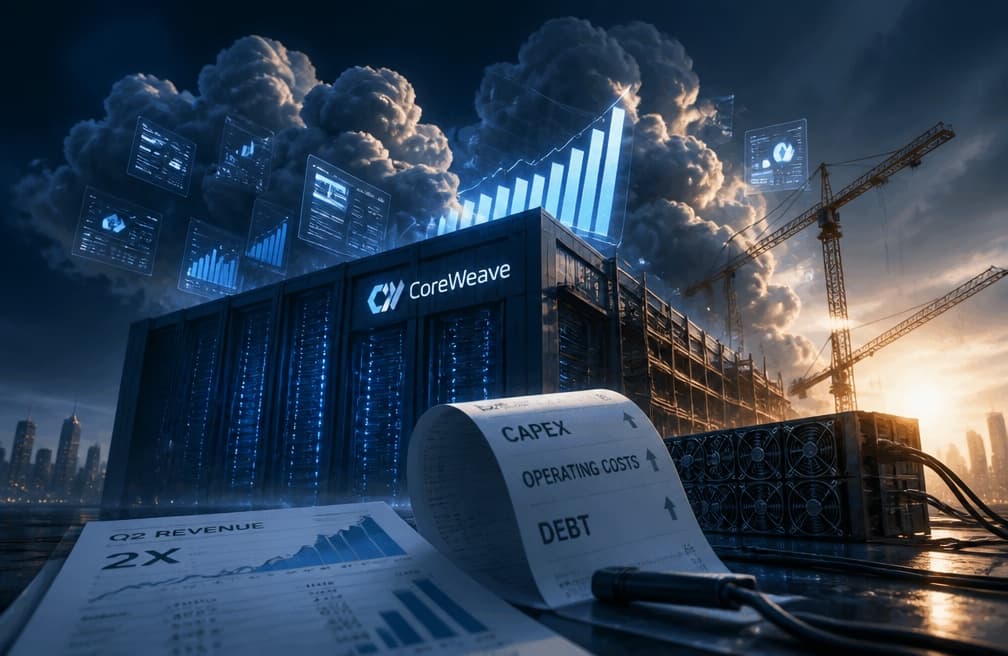
On August 11, AI cloud services provider CoreWeave released its second-quarter performance as of June 30. According to the unaudited performance press release provided by the company via an 8-K, quarterly revenue rose to $2.575 billion, a 112.5% year-over-year increase.
This could easily be condensed into a "strong demand for computing power" financial report. The company disclosed on the same day that its backlog of revenue orders was approximately $104 billion, with an active power capacity of 1.5 gigawatts. If you put the income statement, cash flow statement, and power resources together, the picture becomes much more complex. Revenue has been recognized, construction funds have been expended, and contracted power capacity exceeds active power capacity, with the two in different states of readiness.
These three things do not happen simultaneously. The time lag between them is the real unfolding expansion account in this financial report.
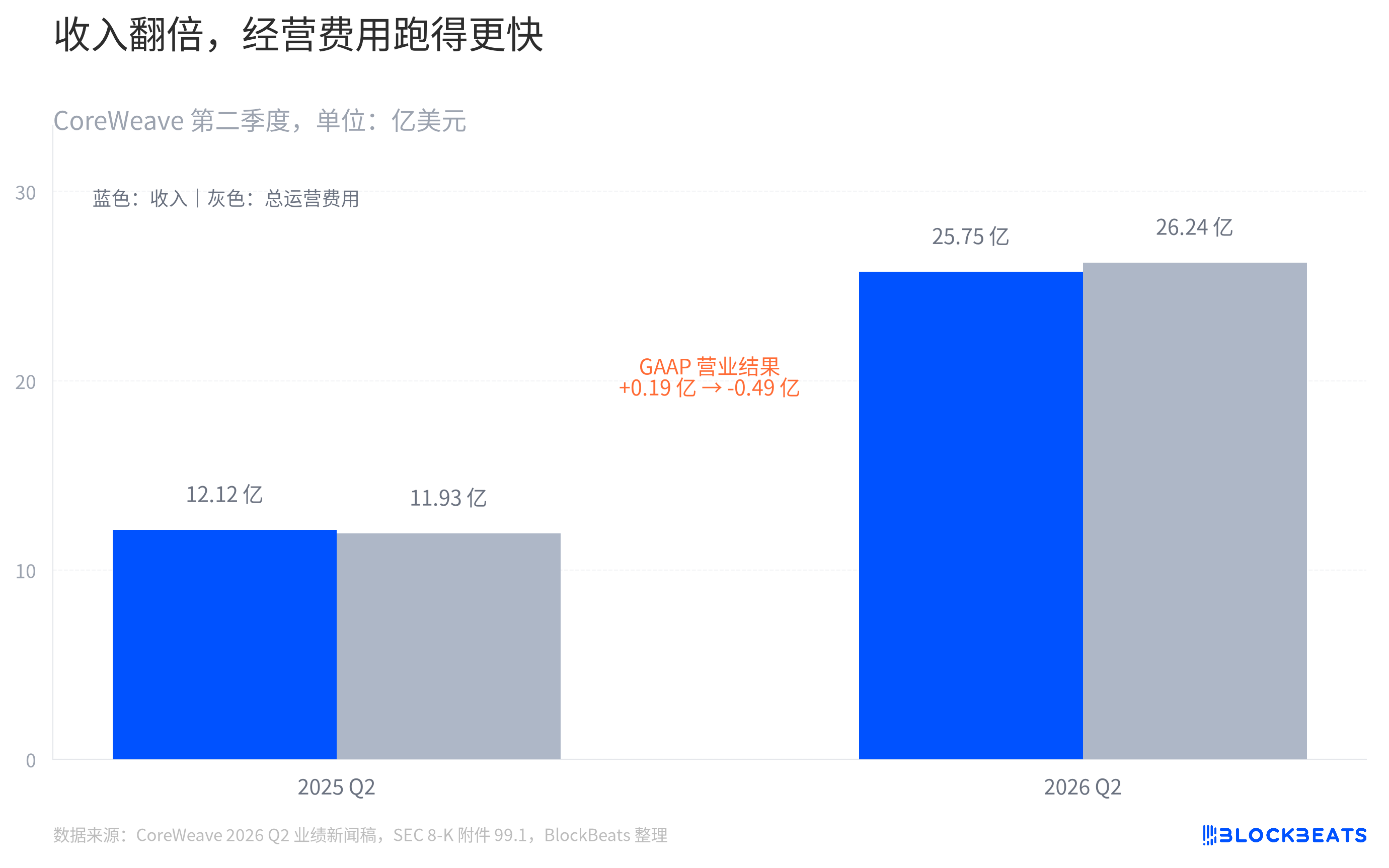
Let's start with the first chart. CoreWeave's revenue column did see a steep rise, but the total operating expenses column rose even higher. According to the company's performance press release, the quarterly GAAP operating income, which was a profit of $19 million in the same period last year, turned into a loss of $49 million.
In terms of net profit, CoreWeave has been operating at a loss for two quarters. The chart refers to the GAAP operating income that is closer to the core business, where revenue growth has not yet solidified into operating profit.
On the other end of the income statement, interest expenses have also increased significantly. According to the company's performance press release, the second-quarter net interest expense was $640 million, a $373 million year-over-year increase. This is not the sole reason for the widening net loss. Capital investments, financing costs, and revenue recognition from new capacity also do not strictly align at the same point in time.
The company disclosed an adjusted EBITDA of $1.51 billion, with a profit margin of 59%. This is a non-GAAP metric defined by the company to observe its adjusted operational performance, but it cannot replace the GAAP operating income in the chart. Only by comparing these two metrics side by side can we avoid misinterpreting "revenue growth" as profits keeping pace with construction speed.
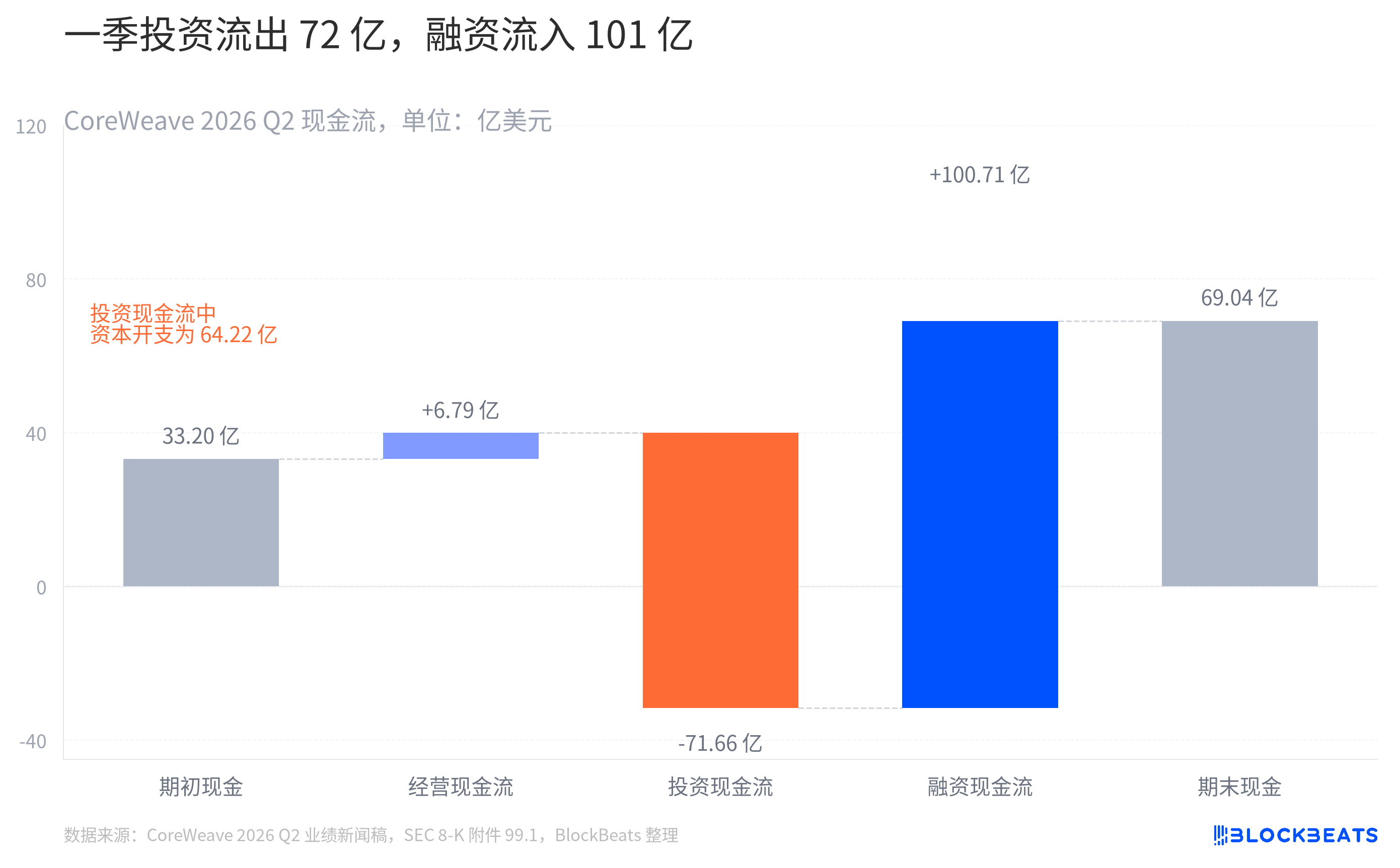
The second chart ties this account together. CoreWeave recorded a $679 million net cash inflow from operating activities in the second quarter. However, cash outflows for the purchase of property, equipment, and capitalized internal software totaled $6.422 billion, nearly 9.5 times the quarterly operating cash flow.
If we consider AI Cloud as a marketplace that sells computing power, revenue corresponds to services that have already been settled. Capital expenditure is more like first building the marketplace, then fitting the electricity, cooling, and servers all at once. The former comes back as customers use the services, while the latter often requires a concentrated outlay of funds at an earlier point in time.
Therefore, the thickest blue bar in the chart represents not operating cash flow but rather net cash inflow from financing activities. This amount is $10.71 billion, higher than the $7.166 billion net outflow from investing activities for the quarter. According to the same cash flow statement, financing activities include debt issuances, debt repayments, private placements of common stock, and purchases of capped call options hedging convertible bonds. It cannot be simply translated as "new borrowing," but it sufficiently indicates that external capital still accounts for a larger portion of the quarterly cash flow structure.
CoreWeave's outlook material also indicates that management expects capital expenditures for the third quarter to be between $11.5 billion and $13.5 billion. This is a forward-looking guidance, not cash flow that has already occurred. Its purpose is to alert readers that the expenditure in the second quarter shown in the chart is not a one-off expense, and the company still plans to allocate significant construction spending in the next quarter.
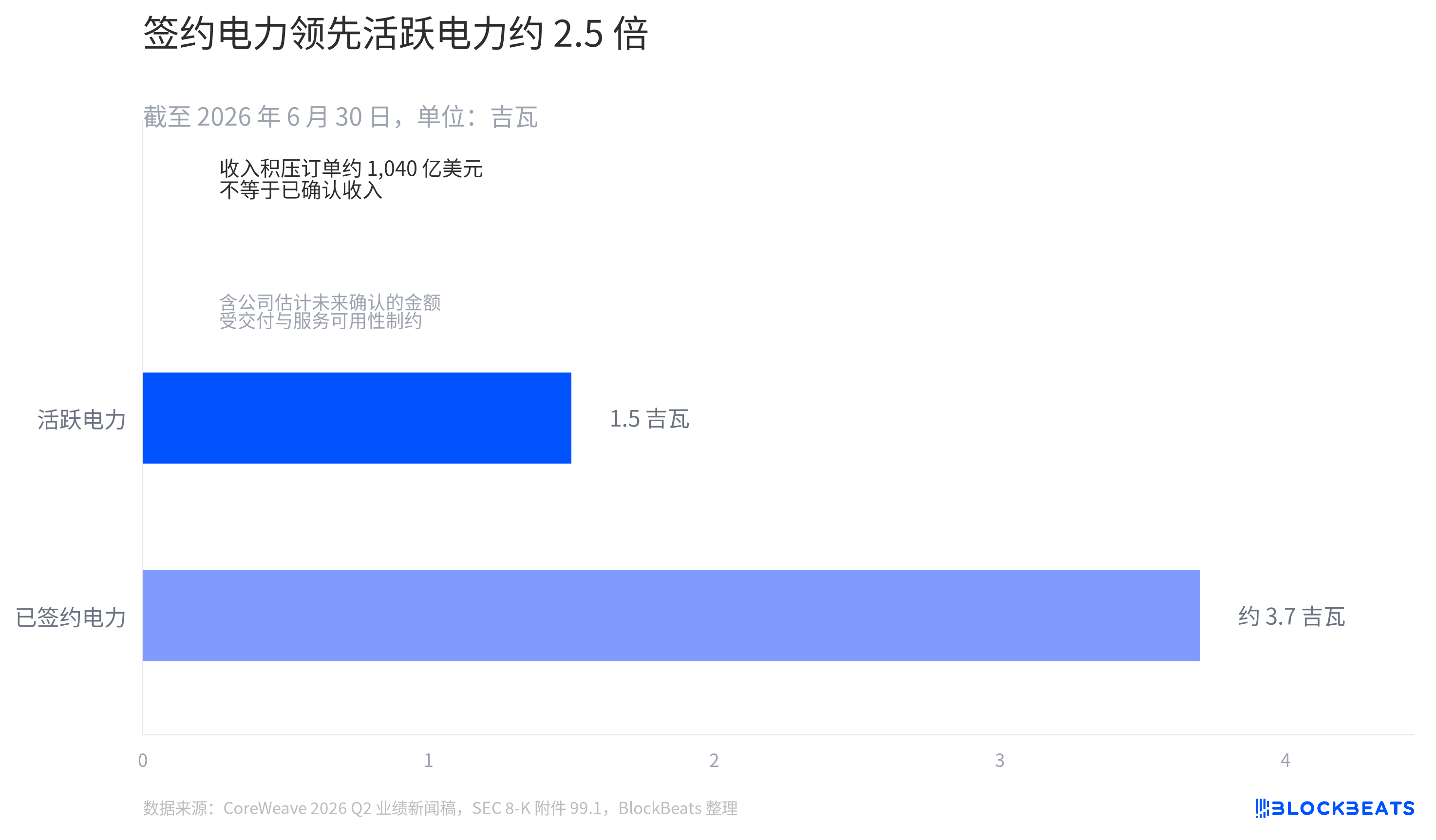
By the end of the second quarter, CoreWeave's active power was 1.5 gigawatts, and contracted power was around 3.7 gigawatts. The latter is about 2.5 times the former.
There are at least three different states here. Revenue is the amount of confirmed services. CoreWeave's so-called revenue backlog includes remaining performance obligations and other amounts the company estimates will be recognized in the future. Contracted power is the committed resources, while active power is the state of resources already in operation. Calling them all "demand" would blur the most challenging part in between.
This $104 billion amount is still subject to delivery and service availability constraints. According to the company's performance press release, this figure does not include over $25 billion in net customer commitments added early in the third quarter. This cannot be taken as quarterly revenue already locked in, nor can it be simply converted to fixed revenue over a certain period.
The same logic applies to power capacity. A 3.7-gigawatt contracted capacity does not mean that all these resources are ready to be delivered to customers, nor can specific launch dates or GPU quantities be deduced from it. The difference between contracted and active capacities at least hints that resource commitments are not the same as the current operational state.
For CoreWeave in the second quarter, revenue has been recognized, construction expenses have been paid, and there is still a gap between contracted power and active power.
Recommended
Arthur Hayes New Article: Betting on Yen Appreciation, ENA Could Surge 5 to 10 Times in the Coming Months
Aug 12, 11:29
Lumentum Revenue Surpasses $1 Billion, $7.1 Billion Losses Explained
Aug 12, 11:28
NVIDIA Releases Trillion-Parameter Model Open-Source, AI Race Heats Up at the Forefront | Rewire News Daily
Aug 12, 09:35
Twenty Years of the Chinese Internet and the Summer of Office Agent
Aug 12, 09:13
Hardcore Research Report: After a Stunning Start, Frame-by-Frame Breakdown of RobinhoodChain's Revenue Potential
Aug 11, 19:53