Hardcore Research Report: After a Stunning Start, Frame-by-Frame Breakdown of RobinhoodChain's Revenue Potential

Original Article Title: Robinhood Chain: Can It Move Robinhood's Bottom Line?
Original Article Author: ACJ, Blockworks
Original Article Translation: Azuma, Odaily Planet Daily
Key Takeaways
· Despite Robinhood's overall business reaching new heights, its crypto business is in decline. In the second quarter of 2026, Robinhood's crypto business revenue saw a 38% year-on-year decline to $100 million, accounting for only 8% of the company's total revenue; retail crypto trading volume dropped by 36% year-on-year, and the share of crypto assets in customer assets under custody (AUC) hit a historic low of only 7%.
· Robinhood Chain is one of the most robust recent examples of a Layer 2 (L2) network launch. The chain created $3.6 million in real economic value (REV) in July, representing 38% of all L2 network revenue tracked by growthepie, surpassing established networks including Polygon and Base.
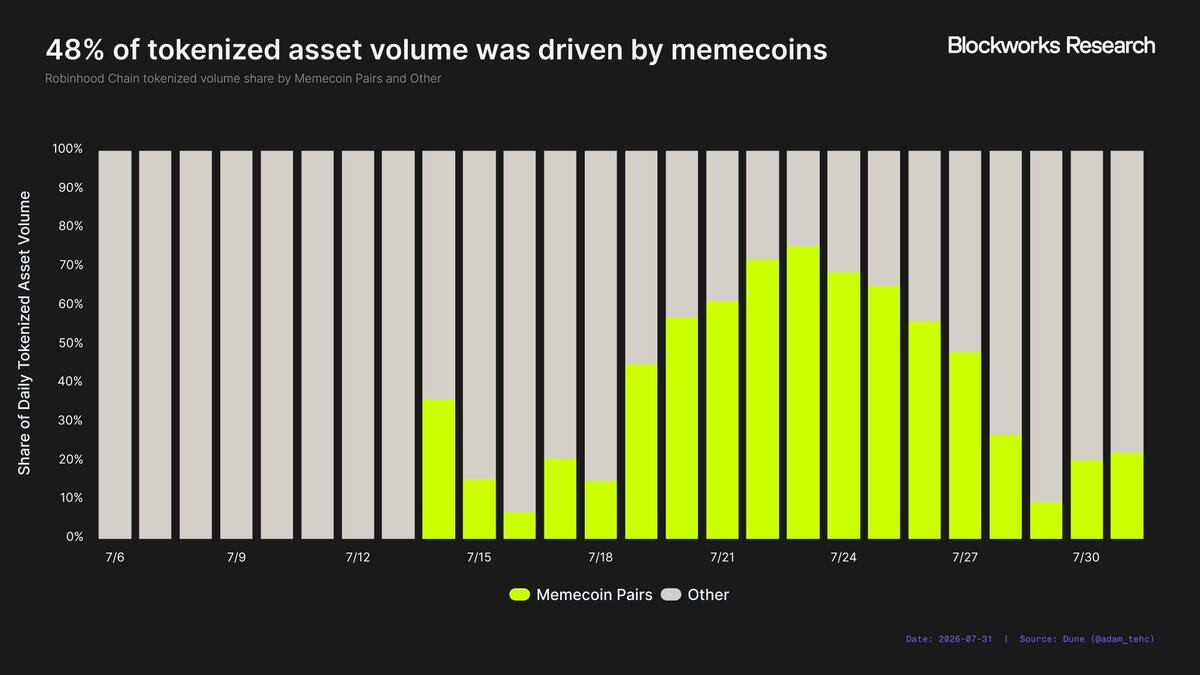
· What drove early activity on Robinhood Chain was not Real World Assets (RWA), but Meme coins. In July, Meme coins accounted for 51% of Robinhood Chain's spot trading volume, while RWAs only made up 5%. Additionally, 48% of the RWA trading volume came from liquidity pools composed of RWA and Meme coins.
· Robinhood's most clear monetization opportunity lies not at the infrastructure layer, but at the application layer. Currently, the USDG stablecoin has been able to generate approximately $10.5 million in annualized interest income; Morpho's case also demonstrates the value of Robinhood's main application distribution capability. In contrast, Lighter's trading volume obtained solely through integration with the Robinhood Wallet accounts for only 0.2% of its perpetual contract total trading volume.
· At present, Robinhood Chain has yet to significantly impact Robinhood's profits. The total known annualized scale of Robinhood Chain revenue sources is only about $54.8 million, equivalent to 14% of Robinhood's crypto business's annualized revenue. If Robinhood Chain wants to become a significant business line, the company needs to expand the USDG scale, commercialize main application traffic, or leverage the chain as an entry point for users to access higher-value products.
Quote: Robinhood Crypto Business at a Crossroads
Perhaps no company represents the rise of retail investors more than Robinhood, which has become synonymous with retail investing and has seen rapid growth in its underlying business as a result.
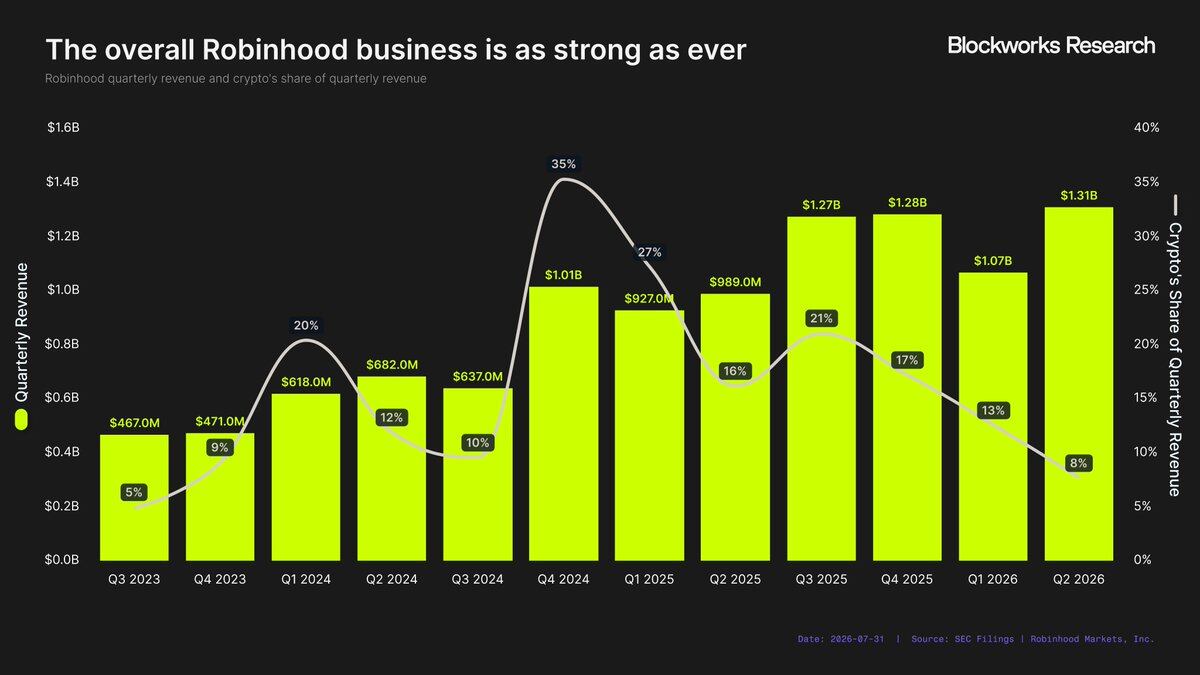
In the second quarter of 2026, Robinhood's quarterly revenue reached $13.1 billion, hitting a record high and growing 32% year-over-year, compared to a 92% increase from the second quarter of 2024. This growth has stemmed not only from its core stock and options trading business but also from its expanding product suite. Today, Robinhood has 13 business lines with annualized revenue exceeding $1 billion each. In fact, in the second quarter of 2026, all of Robinhood's transaction-based revenue business lines achieved double-digit year-over-year growth...
Except for one—the crypto business.
Once contributing over a third of Robinhood's revenue, the crypto business has now shrunk to an almost negligible portion. In the second quarter of 2026, only 8% of Robinhood's total revenue came from the crypto business, marking the lowest level since the third quarter of 2023.
The importance of the crypto business in Robinhood's revenue mix has plummeted significantly—even the event contracts introduced just last year generated more revenue in the second quarter than the crypto business:
· Event Contracts Revenue: $156 million;
· Crypto Business Revenue: $100 million;
This weakness is not only reflected in the declining revenue share but also in Robinhood's core users losing interest in crypto assets. While this trend is not unique to Robinhood, the magnitude of its decline is still astounding.
The most noticeable impact is seen in trading activity. In the second quarter of 2026, retail cryptocurrency trading volume on the Robinhood App was only $18.2 billion, a 36% year-over-year decline and the lowest quarterly level since the third quarter of 2024.
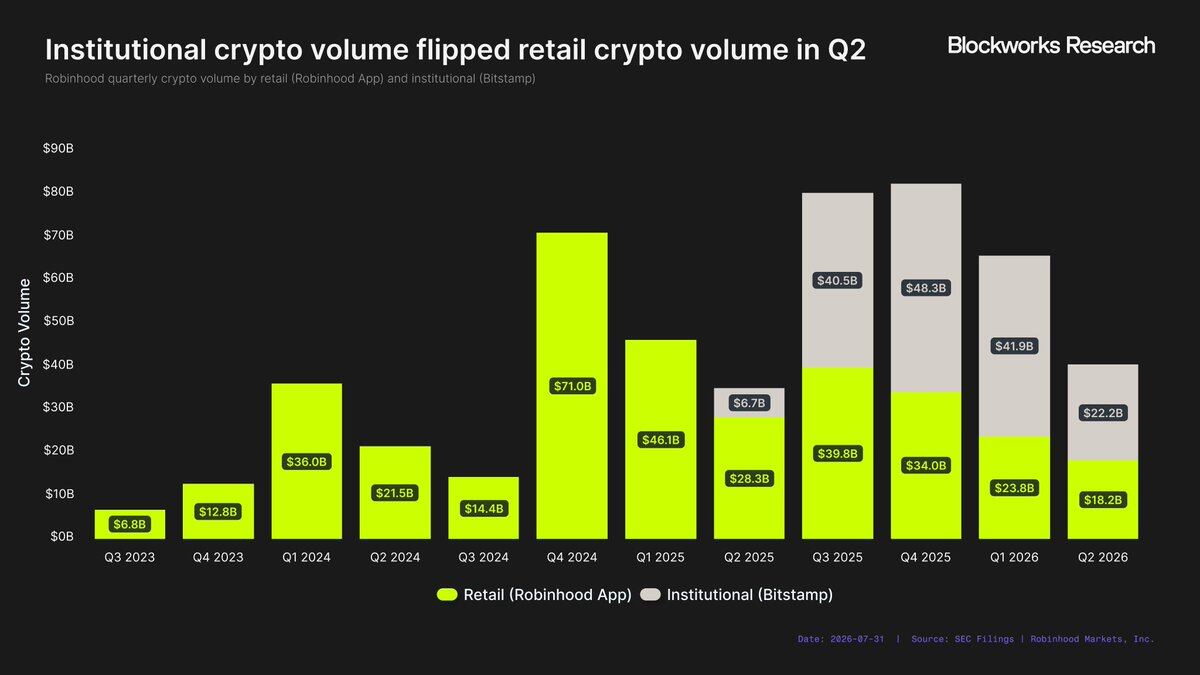
The decline is so significant that institutional trading volume on Bitstamp has surpassed retail trading volume on Robinhood for the first time, and even the institutional trading activity during this period was not particularly robust—Bitstamp's second-quarter volume was $22.2 billion, marking its second-lowest quarterly performance in history.
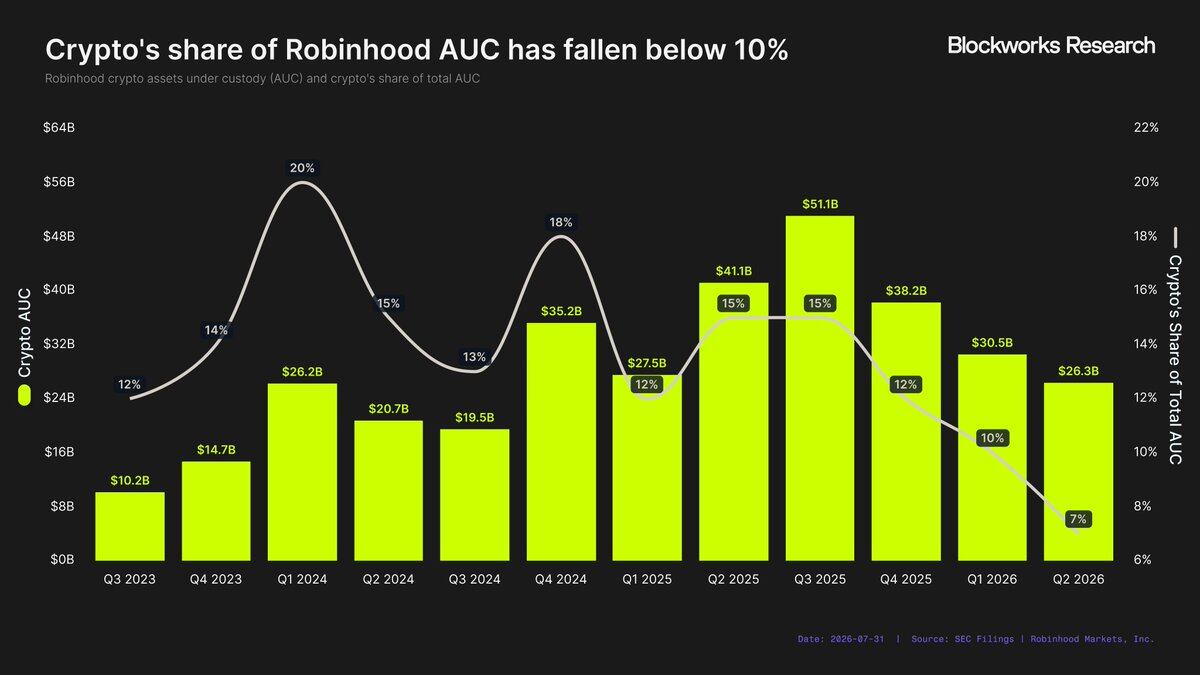
Transaction volume is not the only indicator that can reflect the shrinking of the crypto business. In the first quarter of 2024, Crypto Assets Under Custody (AUC) were $26.2 billion, accounting for 20% of Robinhood's total AUC. Over two years later, crypto AUC remained relatively stable at $26.3 billion, but the proportion of total AUC was only 7%, marking the lowest quarterly percentage in history.
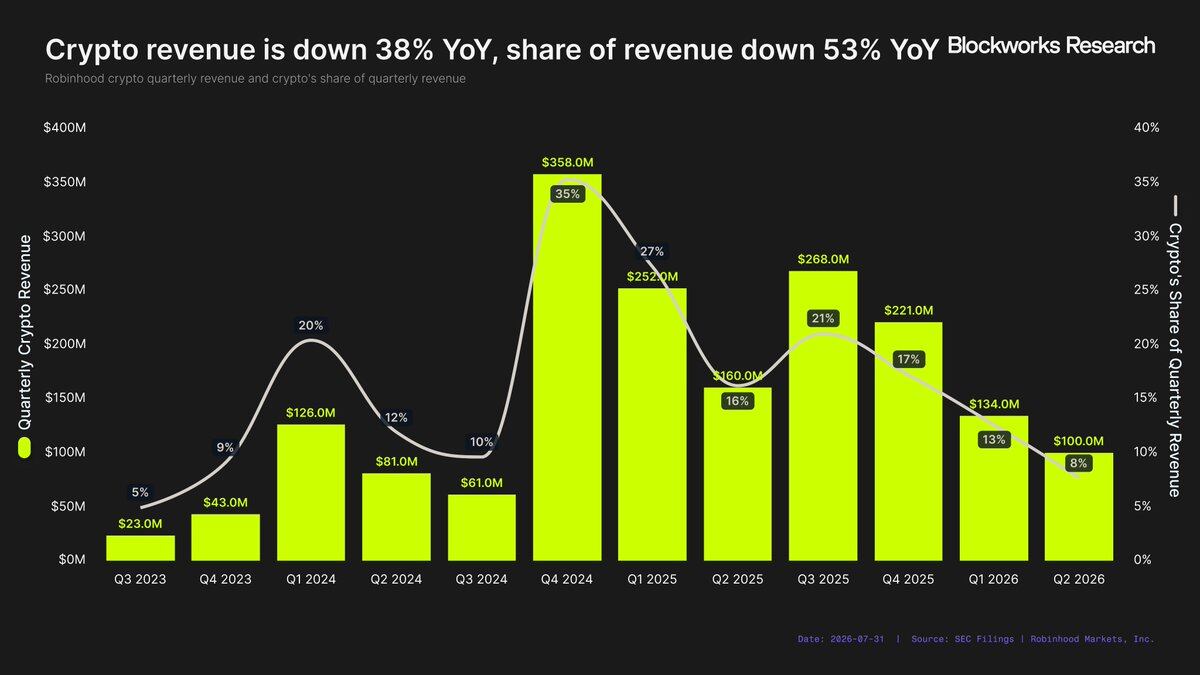
Against this backdrop, Robinhood's crypto revenue has been hit hard. Crypto revenue in the second quarter decreased by 38% year-on-year, with its share of total revenue falling by 53%. In short, Robinhood is growing overall, but not its crypto business.
However, Robinhood has not retreated from the crypto space. On the contrary, it has launched Robinhood Chain, its largest crypto bet to date. Robinhood is no longer relying almost entirely on trading revenue but is attempting to build a broader and more enduring crypto business. The key question is, can Robinhood Chain make crypto a meaningful driver of Robinhood's growth again?
What Is the Monetization Potential of Robinhood Chain?
On July 1, 2026, Robinhood officially announced the launch of the Robinhood Chain mainnet at The World Is Flat event. This is Robinhood's self-developed Layer-2 (L2) blockchain designed to power the company's growing on-chain ecosystem. Since its launch, Robinhood Chain has become one of the fastest blockchain networks to launch in recent times.
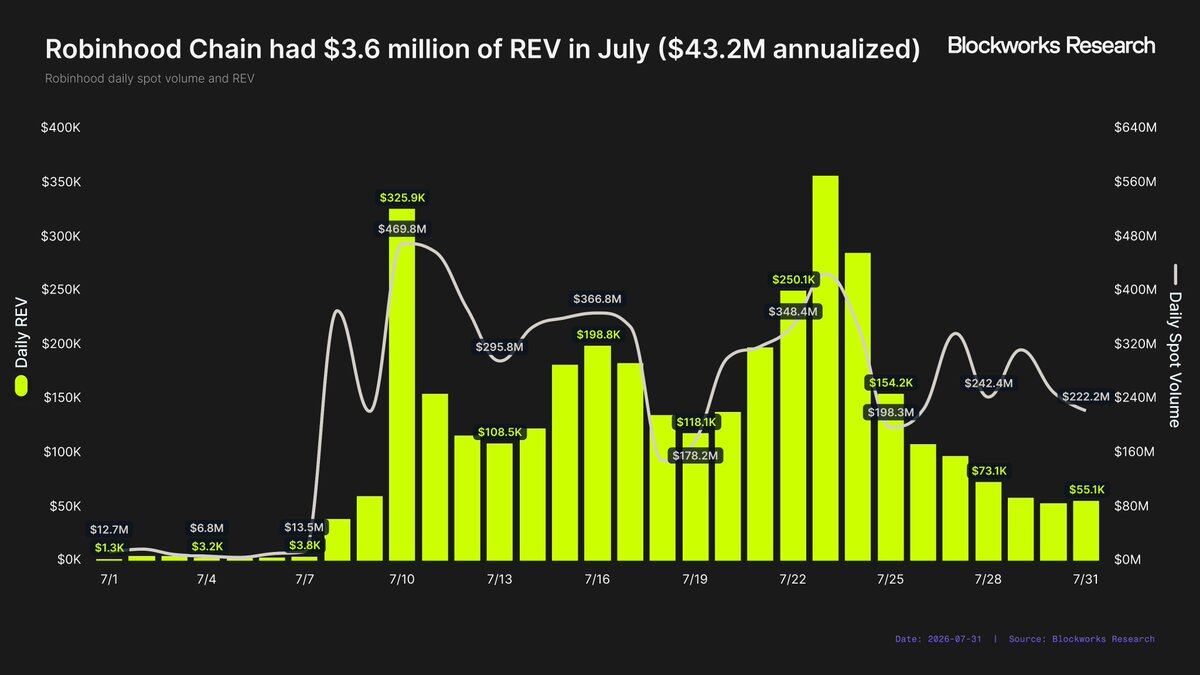
In the first month after launch, Robinhood Chain created $3.6 million in Real Economic Value (REV). Although it is still too early to determine if this level of activity is sustainable, if we simply annualize the data from the first month, Robinhood Chain's annualized REV is approximately $43.2 million.
This is a good starting point, but solely relying on this scale is still far from enough to reverse the declining trend in Robinhood's crypto business revenue.
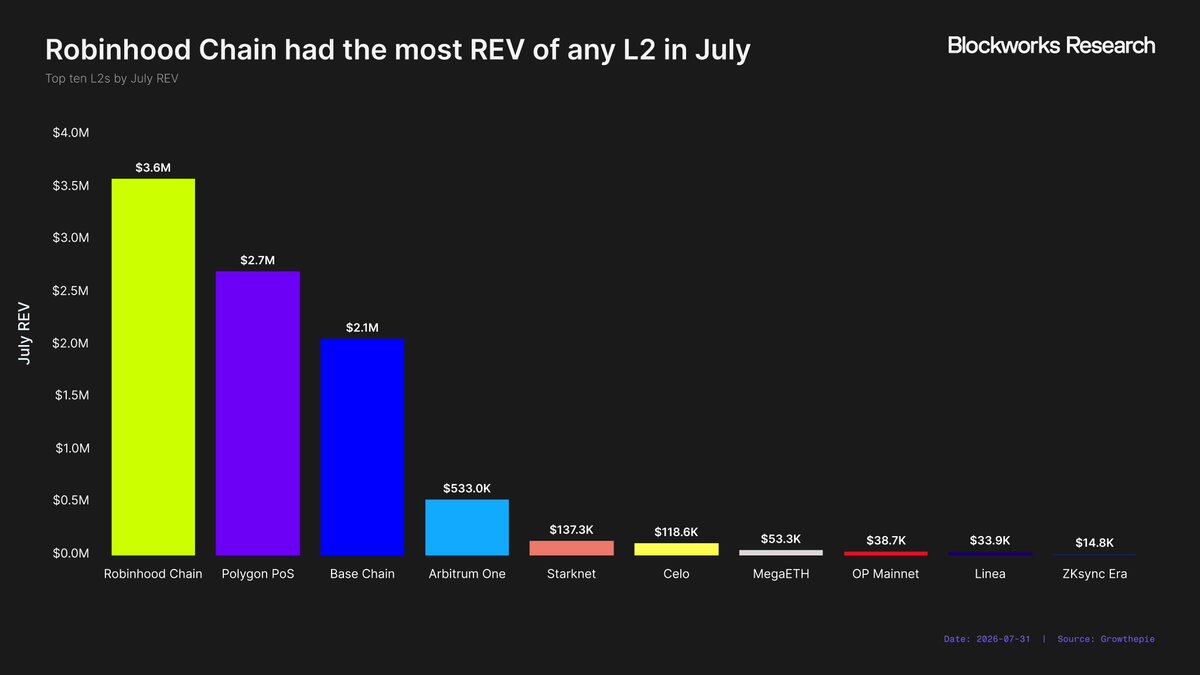
Nevertheless, the launch performance of Robinhood Chain remains impressive. In July, Robinhood Chain ranked first in revenue among all Layer 2 networks, surpassing many well-established networks that have been running for years, such as Polygon ($2.7 million) and Base ($2.1 million).
According to data tracked by growthepie, Robinhood Chain currently holds 38% of all Layer 2 network chain revenue. In other words, Robinhood Chain is now the largest L2 in terms of chain revenue, but still has 62% of market share attributed to other networks. Even if the total L2 chain revenue remains stagnant, Robinhood Chain can achieve significant growth by capturing a larger market share.
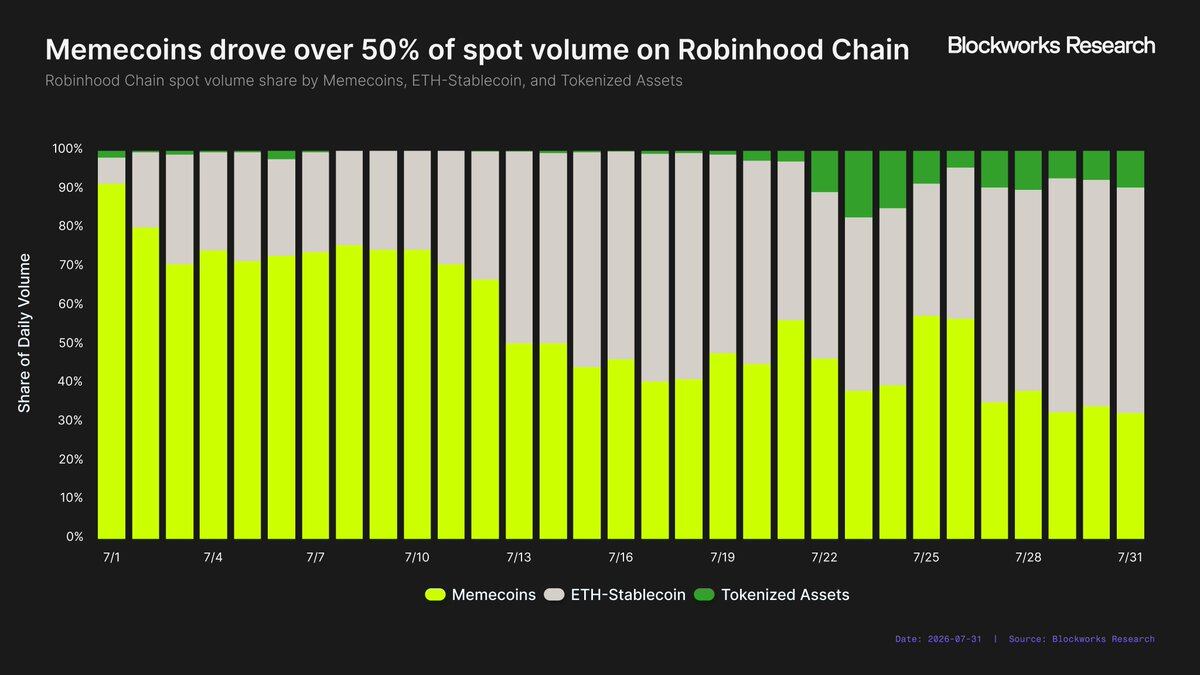
However, an important premise of Robinhood Chain's early success is that most of the current activity is attributed to Meme coins, which have always been one of the main drivers of the REV blockchain. Robinhood seems to accept this fact openly, with founder Vlad Tenev expressing support for Memes on multiple occasions.
Even so, the extent to which Meme coins drive activity on Robinhood Chain is still quite astonishing. The chain facilitated $69.3 billion in spot trading volume in July, with $35.5 billion (51%) coming from Meme coins. In contrast, RWA — the core use case claimed by Robinhood Chain — accounted for only $3.132 billion, or 5% of the total trading volume.
Furthermore, the direct percentage of Meme coins in Robinhood Chain's trading volume may still underestimate their true impact on network activity. Take RWA, for example. One strategy promoted by the Meme coin launchpad L()ng is to pair Meme coins with tokenized stocks or ETFs in a liquidity pool, aligning the price movement of Meme coins with the underlying RWA. If the underlying RWA increases by, say, 5%, the price of the Meme coin will also rise by 5% (assuming no trading activity). Therefore, a significant portion of the apparent RWA trading volume is actually driven by Meme coins. From July 6 to July 31, 48% of the RWA trading volume occurred in liquidity pools pairing Meme coins with RWA.
While Meme coins have been effective in driving chain revenue growth, historically they have rarely been able to become a sustainable long-term revenue source. Meme coins are known for their high volatility, with Ethereum, Avalanche, TRON, and Base each experiencing their own speculative frenzy before funds and users moved on to other networks. Whether Robinhood Chain can retain this activity in the future remains uncertain. One month of data is not enough to prove whether Meme coins will become a sustainable source of REV for Robinhood Chain or if they are just another brief stopover in a cycle of funds eventually returning to Solana.
From a more macro perspective, relying solely on Robinhood Chain's REV is unlikely to revive Robinhood's crypto business. Across the industry, network revenue is in a state of structural decline. First-generation smart contract platforms once relied on blockchain space scarcity to generate significant fee revenue, but as block space has become increasingly commoditized, new chains find it more challenging to generate substantial revenue directly from infrastructure.
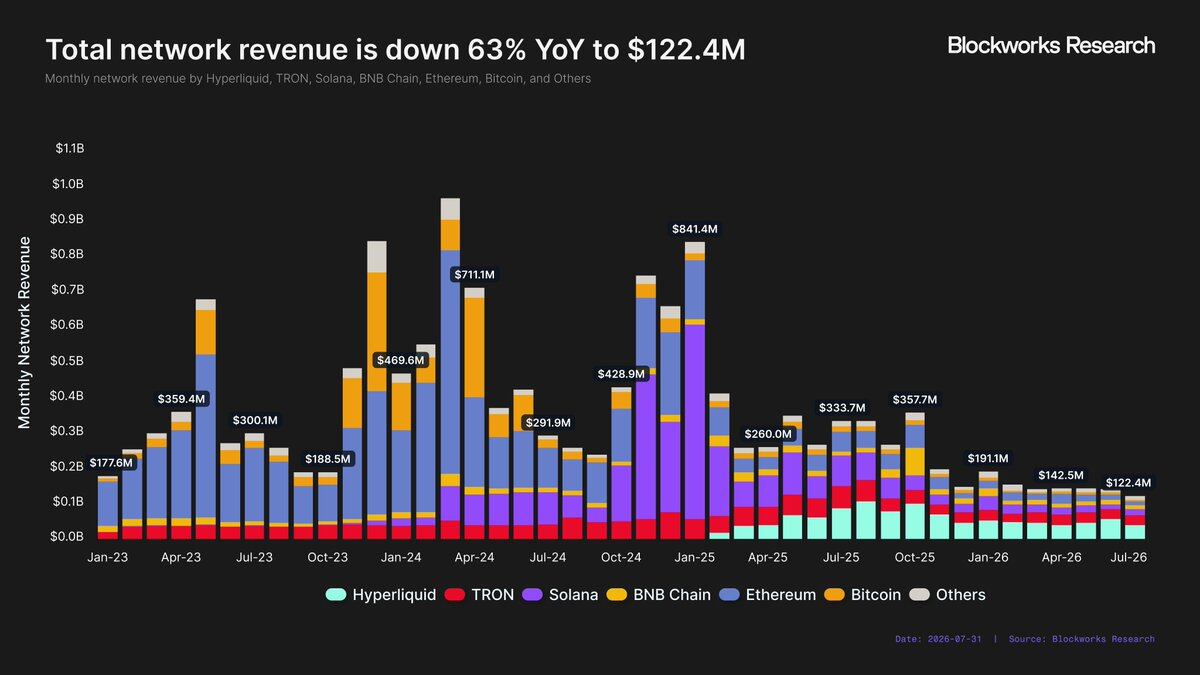
In July, the Blockworks-tracked chains collectively generated $122.4 million in network revenue, the lowest monthly total in three and a half years. In comparison, network revenue in July 2025 was $333.7 million, representing a 63% year-over-year decrease. This deterioration cannot be simply attributed to market cycles. In July 2023, during the previous bear market, chains still generated $300.1 million in network revenue.
As mentioned earlier, Robinhood already has 13 business lines that have achieved at least $1 billion in annualized revenue. Relying solely on network revenue, it is challenging to envision Robinhood Chain joining this rank. Even if Robinhood Chain continues to capture a larger share of the L2 activity, its chain revenue will eventually hit a market ceiling of around $100 million in annualized revenue.
To break through this ceiling, Robinhood needs to onboard its existing user base onto the chain. However, as Robinhood's user base is predominantly in the U.S., in the current regulatory environment, they mostly cannot access Robinhood Chain through the Robinhood app, which may take time.
If Robinhood aims for Robinhood Chain to become the next $1 billion-value business line in the near term, the company needs to transcend a mere network revenue model.
Commercialization at the Application Layer
The value capture in the crypto industry is gradually shifting from the infrastructure layer to the application layer. Solana is a prime example.
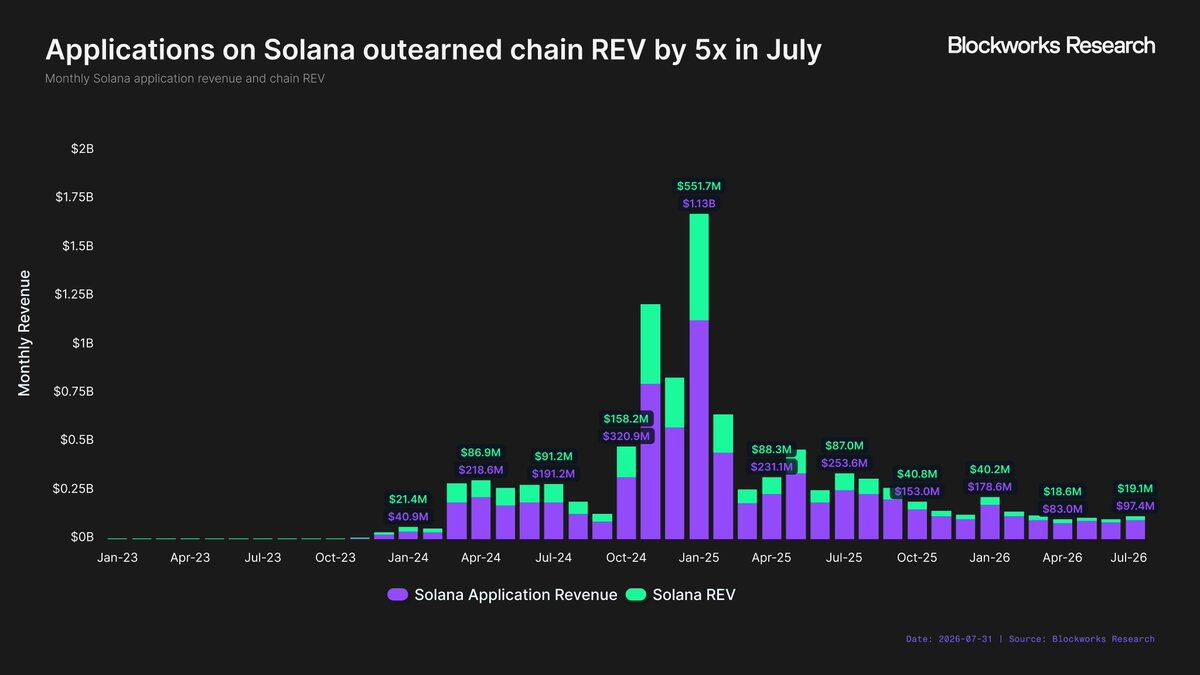
In January 2024, at the beginning of Solana's recovery, Solana applications collectively generated $40.9 million in revenue, while the Solana network could generate $21.4 million in REV, with application revenue about 1.9 times that of network revenue; in January 2025, at the peak of Solana's bull market, its application revenue reached $1.13 billion, while Solana REV was $551.7 million, maintaining a ratio of around 2 times; however, this gap has since widened. In July 2026, for every $1 of revenue generated by Solana's ecosystem applications, the network itself could only capture about $0.2.
In other words, the application layer is capturing an increasing amount of value, while the proportion of value captured by the underlying blockchain is decreasing. If Robinhood wishes for Robinhood Chain to become the next $100 million business line, then it must directly participate in the commercialization of on-chain applications. Although Robinhood has not officially announced this strategy, its early moves have signaled this direction.
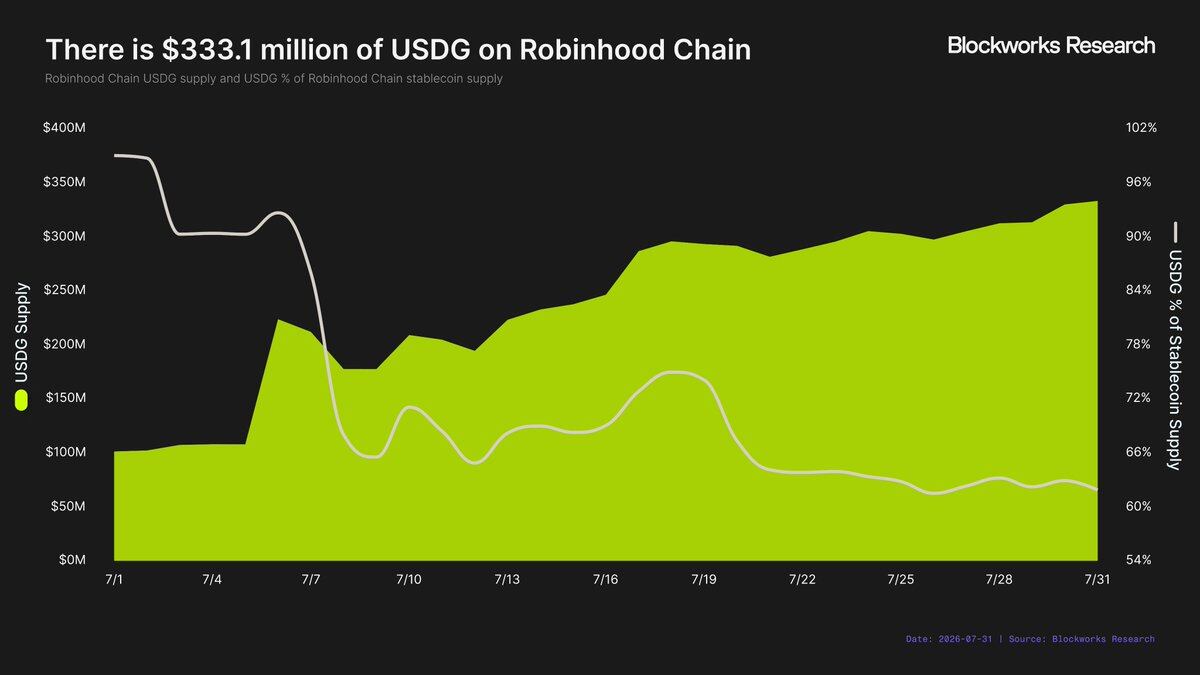
The most prominent example to date is Robinhood's stablecoin strategy. Unlike most blockchains that primarily rely on Circle's USDC or Tether's USDT, Robinhood has designated USDG as the native stablecoin of the Robinhood Chain. This has created an additional revenue stream for Robinhood—interest income generated from the underlying reserves of USDG. As of the end of July, the market cap of USDG on the Robinhood Chain was $333.1 million. Assuming an underlying reserve yield of 3.5%, with 90% of the related interest income going to Robinhood, USDG would generate approximately $10.5 million in additional annualized revenue.
Robinhood should have no trouble further expanding the supply of USDG to create a sustainable revenue stream. If the supply of USDG reaches $1 billion (a reasonable goal as stablecoins on 11 blockchains already have a supply of at least $1 billion), it would generate $31.5 million in annualized revenue, nearly matching the current chain revenue of Robinhood Chain.
Robinhood Chain appears to be expanding its use cases beyond stablecoins. Lighter has launched a custom deployment of its Perp DEX on Robinhood Chain and will share a 50/50 split of trading fees with Robinhood. As part of the collaboration, the Robinhood Wallet—a self-custodial wallet separate from the main Robinhood app—will directly feature Lighter perpetual contracts within the app.
Furthermore, reportedly, Morpho also paid a fee to Robinhood for integration within the Robinhood app. If true, this would signify a business model that is notably different from the traditional blockchain ecosystem. Previously, it was typically the blockchain paying incentives to apps to encourage deployment, whereas Robinhood is attempting the reverse—apps paying fees to access Robinhood's user distribution channel.
How Much is Robinhood's Distribution Worth?
The viability of the entire app layer strategy ultimately hinges on the value of Robinhood's distribution channel. If protocols are willing to pay to reach Robinhood users, then Robinhood can monetize this traffic asset.
From the current cases, protocols on Robinhood Chain can mainly acquire users through two channels:
· The Robinhood main app, such as Morpho;
· Independent Robinhood Wallets, such as Lighter.
While the distribution power of the Robinhood main app is well-known in the market, the value of distribution through the Robinhood Wallet is far less clear.
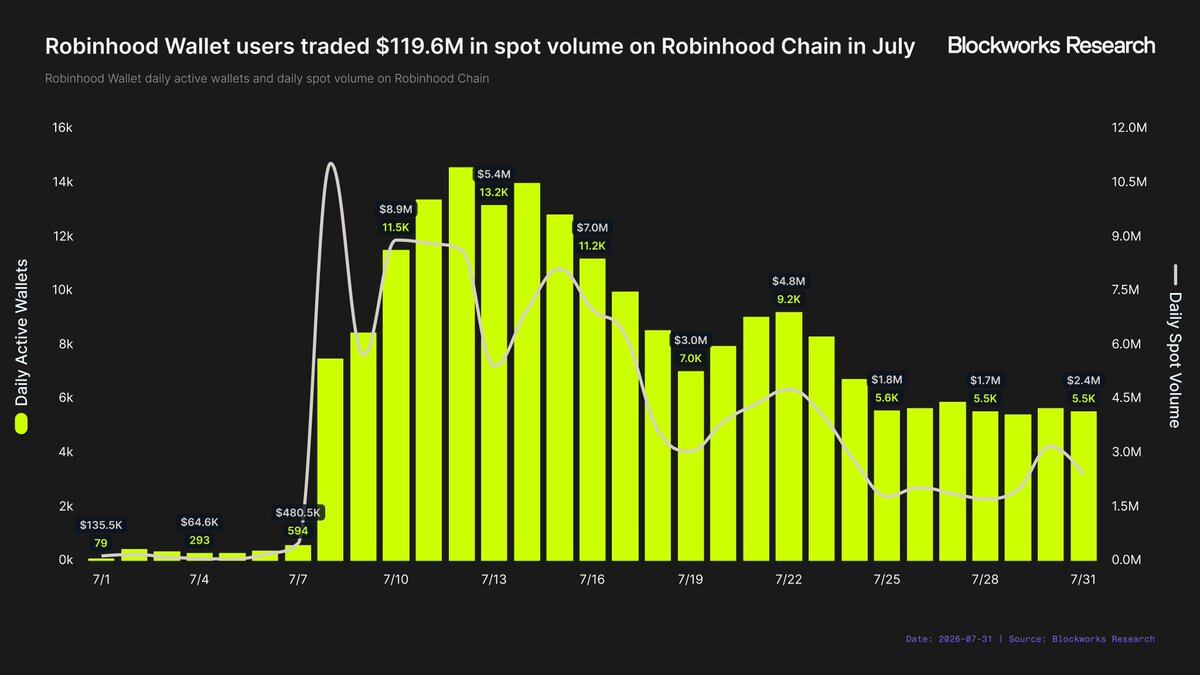
Looking solely at the activity on Robinhood Chain, Robinhood Wallet users generated $119.6 million in trading volume in July. Daily volumes peaked at $11 million on July 8th, dropping to a daily average of $2.1 million in the final week of the month. The daily average active wallet count for Robinhood Wallet in July was just below 7,000. This analysis did not apply a wash trading filter, so the actual number of unique users may be lower.
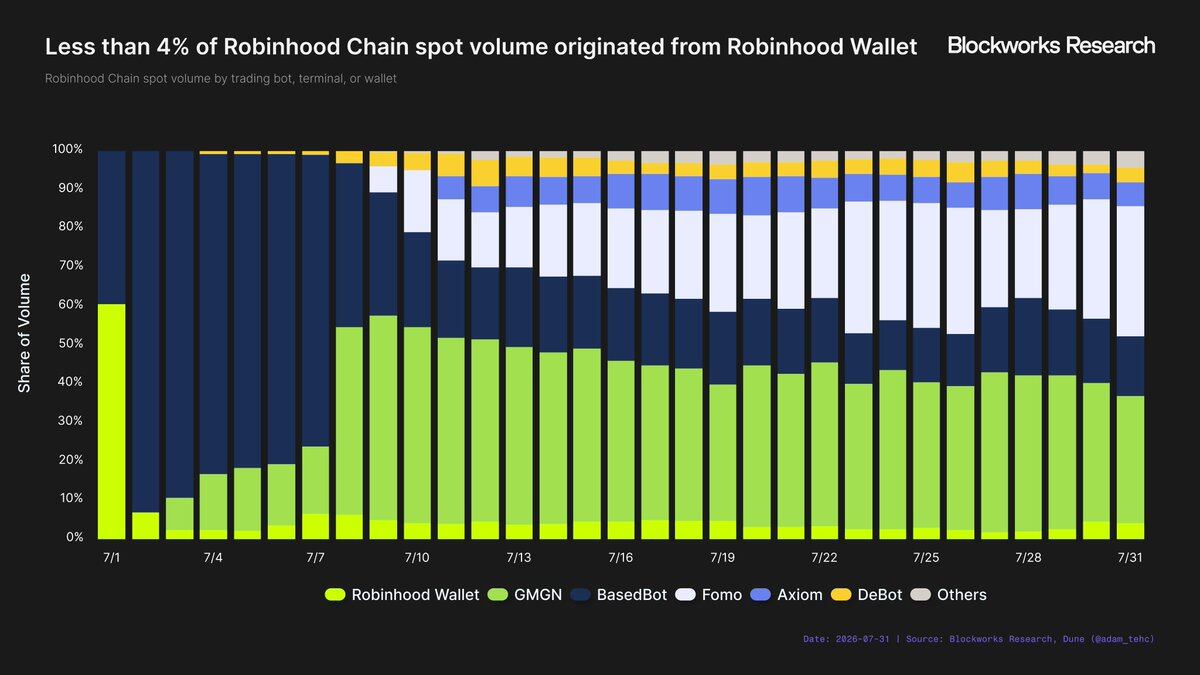
Compared to the broader wallet and trading app ecosystem on the Robinhood Chain, Robinhood Wallet remains a relatively small player. Tracked wallets and trading apps generated a total transaction volume of $30.8 billion in July, with Robinhood Wallet accounting for $1.196 billion, holding less than a 4% market share. However, the transaction volume of these apps is mainly driven by power users. Robinhood Wallet ranks fourth in daily active wallet count but sixth in transaction volume.
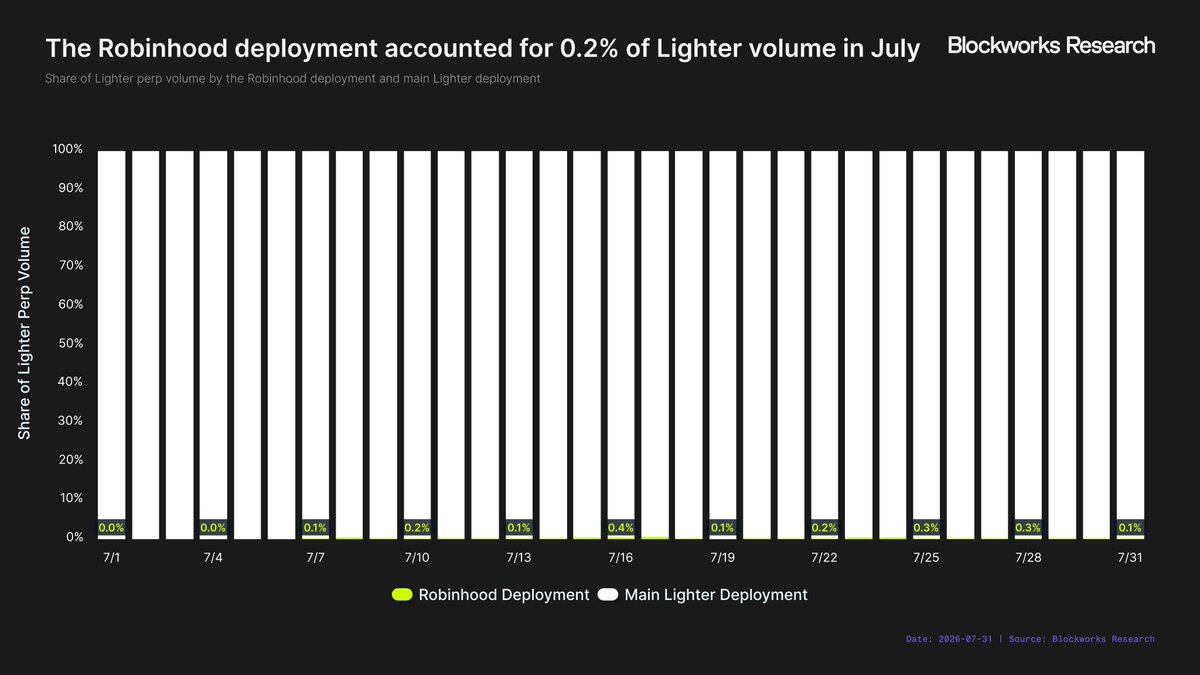
Lighter's integration further underscores the limited value distribution of Robinhood Wallet. Since integration with Robinhood Wallet, Lighter's Robinhood deployment only represents 0.2% of its perpetual contract total trading volume. In July, this figure was $86.8 million, lower than the spot trading volume generated through Robinhood Wallet that month.
Perhaps more concerning, Lighter is directly incentivizing perpetual contract trading through Robinhood Wallet, allocating 11 million LIT tokens, currently valued at approximately $25 million, for this purpose. Even the current limited trading volume is incentive-driven, and without these rewards, it might be even lower. At present, it is difficult to draw a conclusion on how much revenue can be solely generated through Robinhood Wallet distribution.
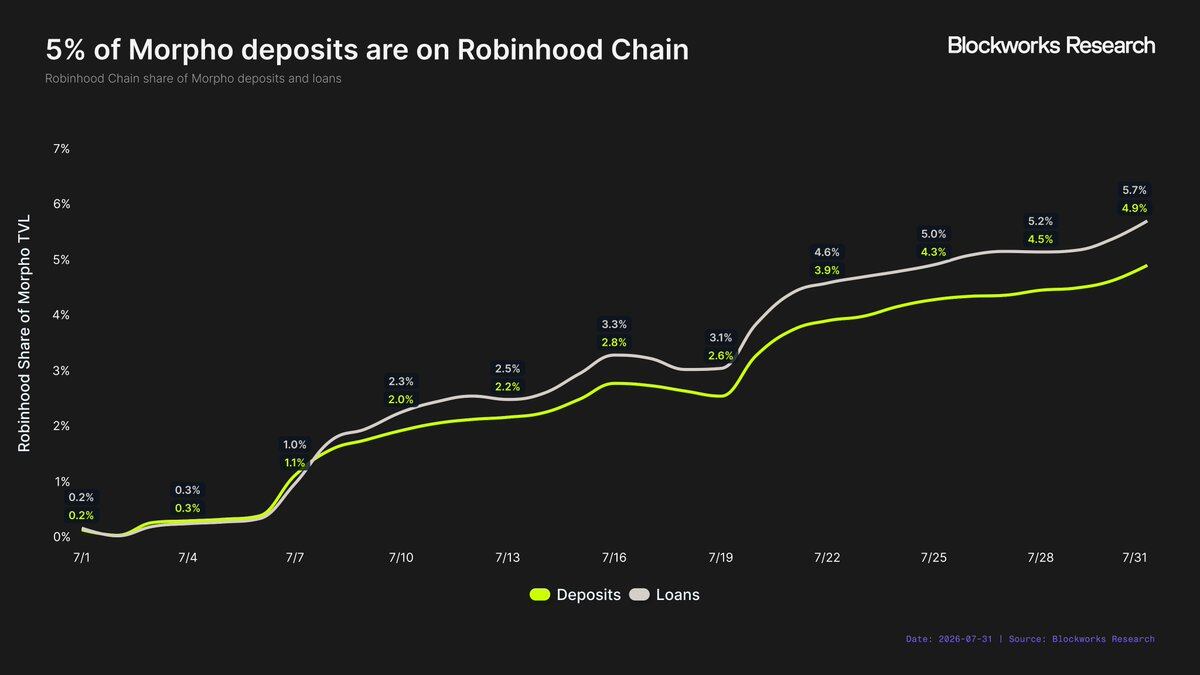
While the distribution value offered by Robinhood Wallet may be limited, the main Robinhood application tells a different story. Morpho provides the clearest example, where Robinhood users can directly deposit stablecoins into Morpho through the main app and receive a 7% APY incentive. By the end of July, the market deployed by Morpho on the Robinhood Chain accounted for 5% of Morpho's total deposits, representing almost 6% of all loans. Just one month after launch, Robinhood Chain has become Morpho's third-largest TVL market.
It must be acknowledged that this TVL is also incentive-driven. Nonetheless, the difference between the value distribution through the main Robinhood app and Robinhood Wallet is still significant. While not a perfect apples-to-apples comparison, the share of the Robinhood Chain market in Morpho's total deposits is 25 times the share of the Robinhood-deployed market in Lighter's perpetual contract total trading volume.
Therefore, early conclusions regarding the distribution value on Robinhood are mixed. For protocols able to secure direct integration into the Robinhood core app, the distribution value seems substantial; however, distribution solely through the Robinhood Wallet appears far less appealing. Unless Wallet integration can serve as a stepping stone to ultimately reaching the core app, it is difficult to understand why a protocol would sacrifice meaningful economic upside for this.
Indeed, this conclusion is based on just two early cases. Robinhood has not formally signaled that app-layer distribution transactions are part of a broader strategy, and it is unclear how aggressively the company intends to pursue such partnerships. But the observed differences to date are stark. The true value of Robinhood distribution comes not from being "associated with the Robinhood brand" or "deployed on the Robinhood Chain," but from the ability to directly reach users within the Robinhood core app.
Can Robinhood Chain Revitalize Crypto Business?
This report began with a central question—can Robinhood Chain make crypto a meaningful driver of Robinhood's growth?
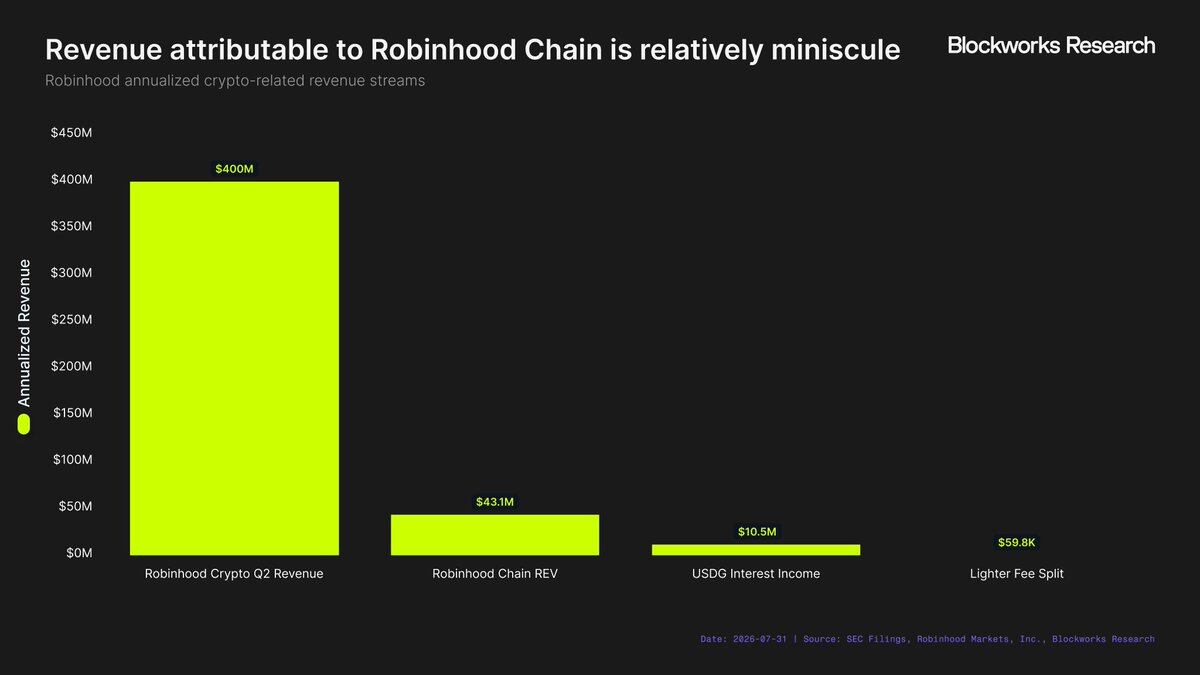
Early data paints a rather clear picture. Robinhood Chain has seen remarkable success as a blockchain but has not yet become a meaningful contributor to Robinhood's business. Robinhood's Q2 crypto revenue was $1 billion, annualizing around $4 billion. In comparison, the total known and quantifiable revenue streams related to the Robinhood Chain (chain REV, USDG interest revenue, Robinhood's shared Lighter fees) amount to an annualized total of only $54.8 million, representing about 14% of Robinhood's crypto business annual revenue. Indeed, this comparison only annualizes the first month of Robinhood Chain's data and should not be mistaken for its long-term revenue potential.
Frankly, Robinhood Chain will never materially impact Robinhood based solely on network revenue. The block space is too commoditized, and the entire L2 revenue market is too small. If Robinhood Chain is to make crypto a meaningful driver of Robinhood's growth, the company needs to monetize economic activity above the infrastructure layer.
The stablecoin provides the clearest path. Tether and Circle have already demonstrated how lucrative interest income from stablecoin reserves can be. At a 3.5% yield, every $1 billion USDG in supply would generate $35 million in annualized revenue for Robinhood (assuming it retains all relevant interest income). With a supply of $10 billion, this figure would increase to $350 million per year, nearly matching Robinhood's current annualized crypto revenue. While this won't happen overnight, considering the scale and volume of Robinhood's business, achieving this goal is not inconceivable.
App distribution is another compelling opportunity. Robinhood possesses something that almost all other blockchains lack—an immediate reach to a large group of retail investors. If on-chain protocols are willing to pay for access to these users or share revenue with Robinhood, Robinhood can monetize its distribution capability rather than relying solely on fees generated by the chain itself. Early indications suggest that when protocols integrate into the Robinhood main app, this strategy indeed works, even though the value of the Robinhood Wallet distribution itself is marginal.
There is also a possibility that Robinhood does not view Robinhood Chain as a standalone revenue-generating business. Instead, it may see this chain as a user onboarding and conversion channel. Robinhood Chain could serve as a user acquisition tool, exposing users to tokenized assets before they trade stocks, options, crypto, and other products within the broader Robinhood ecosystem. In this model, the chain's value may not necessarily be reflected in network revenue but rather in higher engagement and revenue in other areas of the Robinhood business.
Currently, the question posed at the beginning of this report still receives a "no" as the answer. Robinhood Chain has not yet become a meaningful driver of Robinhood's growth, and it will never achieve this solely through network revenue; for the answer to eventually become "yes," Robinhood needs to expand the USDG scale or commercialize the user distribution capability of the Robinhood main app. Otherwise, Robinhood Chain is likely to only have indirect financial value, serving as a user acquisition tool for high-value products that have already propelled the Robinhood business.
Original Post Link
Recommended
Wang Xing's Nine-Year Thousandfold Yushu: From Unable to Enter the Venue to Front Row Seat
Aug 11, 17:45
Gold Price Returns to $4350, Has the Precious Metal Pullback Ended?
Aug 11, 17:31
Kalshi Founder Interview: Sports Trading Accounts for 95%; Misaligned with Polymarket’s Vision
Aug 11, 15:24Hyperliquid Trading Volume Skyrockets, Why Is Profit Decreasing?
Aug 11, 15:23
Morgan Stanley Insights: AI Chip Frenzy, Can Power Keep Up? Implied Demand of Around 38GW by 2027
Aug 11, 14:20
Bitcoin Community in Turmoil, Understanding the Bitcoin Scaling Debate Caused by BIP-110
Aug 11, 13:52