
NVIDIA Releases Trillion-Parameter Model Open-Source, AI Race Heats Up at the Forefront | Rewire News Daily
On the same day regulators forced Meta to unwind the Manus acquisition, Anthropic secured a $91 billion power contract in the U.S. AI decoupling and AI arms race are accelerating simultaneously.
1|NVIDIA Open-Sources Trillion-Parameter Model, SpaceXAI Starts Selling Agent
According to The Information, NVIDIA is building an open-source model family, Nemotron 4, with over 1 trillion parameters, expected to be ready this fall. NVIDIA's AI VP, Kari Briski, stated, "Every company and every country needs accessible cutting-edge open-source models." Recently, Jensen Huang introduced a $500 billion AI financing framework, and NVIDIA will directly compete with Meta, DeepSeek, and other open-source approaches.
On the other end, SpaceXAI's xAI has launched Agent Grok Bot, a cross-app runnable agent, with a monthly subscription of $120 in beta. This follows SpaceXAI's product move after acquiring Anysphere/Cursor in June. While NVIDIA is advancing open source at the foundational level, SpaceXAI is selling agents at the application layer. Model weights, computational capital, and ultimate access are currently being battled over by different companies.
(Source: The Information / CNBC / Reuters / Bloomberg)
2|Anthropic Simultaneously Secures Power, Watermark, and Mathematical Research
As reported by Fortune, Anthropic signed a 20-year, $91 billion total value power lease with Bitcoin mining firm Riot Platforms, gaining access to a 191-megawatt power capacity in Lockdale, Texas. The agreement includes extension clauses, and the total value could rise to $161 billion. Riot's stock price rose by 17% on the day of the announcement.
On the same day, Anthropic announced embedding machine-readable invisible watermarks in Claude's generated text. Additionally, an unreleased Claude model, as reported by TechCrunch, used 31 million tokens in two dialogues to advance the human baseline on a Riemann hypothesis-related issue from 41.6% to 67.2%. The three advancements involve infrastructure, product security, and research. Anthropic is currently laying the groundwork for supply, validation, and traceability boundaries for model capability expansion.
(Source: TechCrunch / Fortune / NPR)
3|OpenAI Veteran Brad Lightcap Resigns
Brad Lightcap, Special Projects Lead and former COO of OpenAI, has announced his resignation with plans to "start something new." According to reports by TechCrunch, Lightcap joined OpenAI in 2018 and later became the COO, making him one of the longest-serving executives. The New York Times and The Information simultaneously reported on this news.
His departure continues a trend of executive exits over the past year and a half. During a period of organizational restructuring at OpenAI, the co-founder, CTO, and head of security team had previously departed. Lightcap's decision to step down at this juncture has raised concerns about management stability.
(Source: TechCrunch / The Information / The New York Times)
4|US Military Fires on Cargo Ship as Hormuz Crisis Repositions Global Supply Chain
The US Central Command has confirmed that a US military helicopter fired two Hellfire missiles at the Panamanian-flagged cargo ship Vela Nova, hitting the engine room, as it attempted to breach the Iranian blockade. According to Fortune, Iran subsequently stated that the Strait of Hormuz would remain closed, Brent crude oil surpassed $88 per barrel, and the S&P 500 index fell by 0.3%.
The blockade's impact extends beyond oil prices. As reported by the Financial Times, Panama Canal tolls have reached a historic high, with El Niño and the Iran conflict squeezing shipping. With two critical global waterways under pressure simultaneously, geopolitical tensions are continuously driving up supply chain costs. The US CPI data is set to be released on Wednesday, with energy prices rises realigning market expectations.
(Source: Fortune / Al Jazeera / Financial Times / CENTCOM)
5|Manus Forced to Spin Off, AI Decoupling Shifts from Chipsets to Application Layer
Regulators have mandated Meta to fully divest from its $2 billion acquisition of Manus. According to CNBC, Manus will resume independent operations and erase all user data generated post-acquisition on December 29, 2025. Reuters and The Information have also confirmed the transaction unwind.
This is more than just a failed deal. Meta's acquisition of Manus was based on the AI Agent capability while Manus's product capability relied on external large models. Previous AI friction primarily focused on chipsets and large models, but this review has pushed the boundaries to the application layer. A Chinese team developing a product using a US model, when acquired by a global platform, must also face more complex regulatory and data boundaries.
(Source: CNBC / Reuters / The Information)
Worth Knowing ↓
Google's Gemini app surpasses 1 billion monthly active users, a milestone equivalent to ChatGPT's in June. Competition in consumer-grade AI applications continues to intensify. (Source: TechCrunch)
Intel raises $19.7 billion in a secondary offering, with subscription demand exceeding $100 billion, marking its first public stock issuance since its 1971 IPO. The funds will be used for 14A process production investment. Oversubscription indicates a positive market response to its financing plan. (Continuation of yesterday's report) (Source: Tom's Hardware)
Trump Media reports a quarterly loss of $238 million, with $190 million stemming from the decline in Bitcoin and digital asset valuations, classified as unrealized losses. The public company's coin-hoarding strategy reveals its paper cost during price downturns. (Source: Fortune)
Google co-founder Sergey Brin has spent $102 million opposing California's Proposition 40 (billionaire wealth tax). If the proposition passes, he could face a $13 billion tax bill. Brin has relocated to Lake Tahoe, Nevada. The $100 million expenditure corresponds to a potential tax liability of $13 billion. (Source: Fortune / NPR)
SK Hynix plans to expand capacity in China, with the second-phase plant increasing local output by 50%, while also considering a Solidigm IPO. Amid escalating US-China chip rivalry, the South Korean semiconductor giant still plans to expand manufacturing capacity in China. (Source: Tom's Hardware)
CoreWeave sees revenue growth amid surging AI compute demand. The compute economy is not just benefiting Nvidia; cloud service providers are also profiting from increased demand. (Source: Bloomberg)
The US CPI inflation report will be released on Wednesday, with the market watching for its impact on the Fed's rate-cutting path. Bitcoin ETF fund flows diverge as the market awaits inflation data to provide direction. (Source: CNBC / CoinDesk)
Recommended
After CoreWeave's Revenue Doubles, AI Cloud's 'Scale Up Bill' Comes Into Focus
Aug 12, 10:03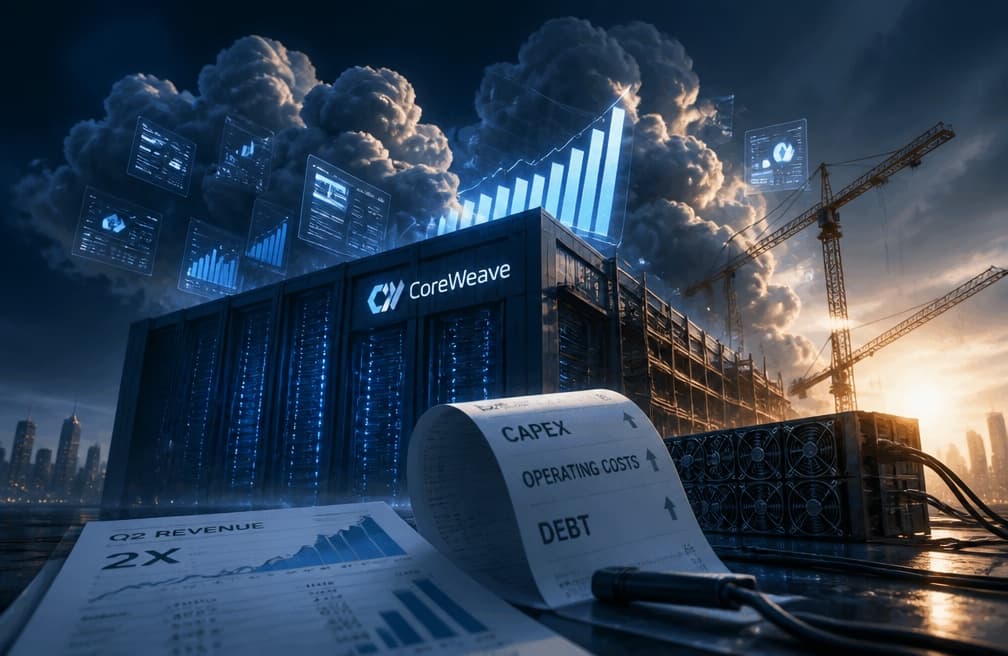
Twenty Years of the Chinese Internet and the Summer of Office Agent
Aug 12, 09:13
Hardcore Research Report: After a Stunning Start, Frame-by-Frame Breakdown of RobinhoodChain's Revenue Potential
Aug 11, 19:53
As Crypto Platforms Rush to Wall Street, UMX is Building Depth in Trading
Aug 11, 17:58Wang Xing's Nine-Year Thousandfold Yushu: From Unable to Enter the Venue to Front Row Seat
Aug 11, 17:45
Gold Price Returns to $4350, Has the Precious Metal Pullback Ended?
Aug 11, 17:31