By analyzing the 13F quarterly holdings report, the reason behind the downfall of the "AI Stock Guru" has been uncovered.

Original Title: "Today, the World Finally Saw Why the 'AI Stock God' Collapsed"
On August 15, Beijing Time, in the early morning, the fund Situational Awareness LP, once dubbed the "AI Stock God" by the market and managed by Leopold Aschenbrenner, officially released its 13F quarterly holdings report.
· The so-called 13F is a quarterly disclosure document that the U.S. Securities and Exchange Commission (SEC) mandates for funds with assets under management exceeding $100 million. The SEC requires that funds meeting the disclosure requirements must submit this document within 45 days after the end of each calendar quarter. Funds are required to focus on disclosing their holdings of U.S. listed stocks, long/short options, convertible bonds, and specific ETF positions held at the end of the previous quarter in the document.
However, just a few weeks ago, Situational Awareness LP experienced a dark moment—due to a significant pullback in AI-related stocks combined with high leverage, the fund suffered a major loss, was forced to unwind its public market positions on a large scale, and had already sold most of its stock portfolio at a discount to Ken Griffin's Citadel.
Although the temporary fall of the "AI Stock God" has become an established fact, for the market, this belated 13F quarterly holdings report still holds significant meaning—it fully presents the fund's static holdings on the eve of its fall (as of June 30), in other words, the market finally has a close-up view of how Situational Awareness LP transitioned towards a massive loss.
In the following text, Odaily will guide everyone to jointly interpret the holding structure of Situational Awareness LP in this quarter's 13F, analyze the changes in holdings compared to the previous quarter, and uncover the most authentic loss story of Situational Awareness LP.
Who is the "AI Stock God"? (Skip if familiar)
In March of this year, we first introduced Leopold Aschenbrenner in the article "SBF's Little Brother, Turning $225 Million into $5.5 Billion in One Year."
Leopold Aschenbrenner previously served at FTX's Future Fund in 2022 and remained with the team until the FTX DeFi Rug Pull. In 2024, Leopold Aschenbrenner authored a 165-page magnum opus titled "Situational Awareness: The Decade Ahead" and founded the eponymous Situational Awareness LP fund in the same year, where he assumed the role of Chief Investment Officer.
Situational Awareness LP focuses on investment opportunities in the AI industry chain. The fund's public holdings amounted to a "mere" $225 million in Q4 2024; however, in the holdings disclosure for Q4 2025 released in February of this year, this number skyrocketed to $5.5 billion. By the time the Q1 holdings were disclosed in May of this year, the figure had risen to $13.7 billion... While these figures are now meaningless, the nominal holdings value in the Q2 holdings report released today has reached an astonishing $20.2 billion.
· It is worth noting that in the context of U.S. 13F filings, the reported value of options assets typically represents the "Notional Value" of the underlying stocks and not the actual option premium paid by the fund.
With explosive investment performance, Leopold Aschenbrenner and Situational Awareness LP gained significant renown, becoming one of the most talked-about AI investment trends online. Leopold Aschenbrenner was even dubbed the "AI Stock God" by a market eager to deify.
Q2 Holdings Analysis: $20.2 Billion, Almost All-In on One Maneuver
As of June 30, Situational Awareness LP disclosed a total of 26 holdings in its 13F report, with a nominal holding value of approximately $20.24 billion. Further dissecting this "pre-rug-pull ledger," it is evident that the fund had doubled down on the continued surge of AI infrastructure with highly concentrated positions.
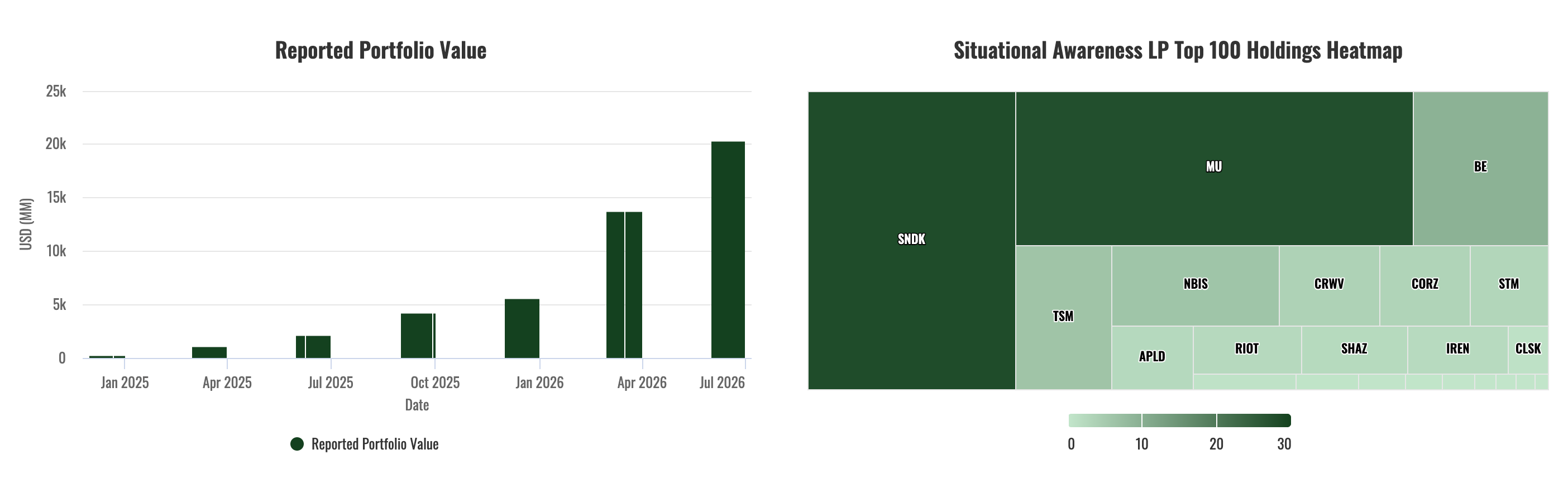
The most striking aspect of the holdings structure undoubtedly lies in the concentrated bets on Sandisk (SNDK) and Micron (MU) — the former with a holding of around $5.674 billion, comprising 28.0%; and the latter with approximately $5.574 billion, representing 27.5% — just these two companies together amount to over $11.2 billion, about 55.5% of the entire portfolio.
In other words, on the eve of the fund's collapse, Leopold Aschenbrenner had staked over half of the public market exposure on storage chips alone.
And upon further breakdown, Situational Awareness LP's investment thesis becomes even clearer: a position of approximately $18.99 billion in Bloom Energy, a bet on the power needs behind AI data centers; around $12.65 billion in TSMC, corresponding to advanced fabrication processes; approximately $12.33 billion in Nebius, as well as CoreWeave, Core Scientific, Applied Digital, IREN, among others, further covering AI cloud computing power, data centers, and energy infrastructure...
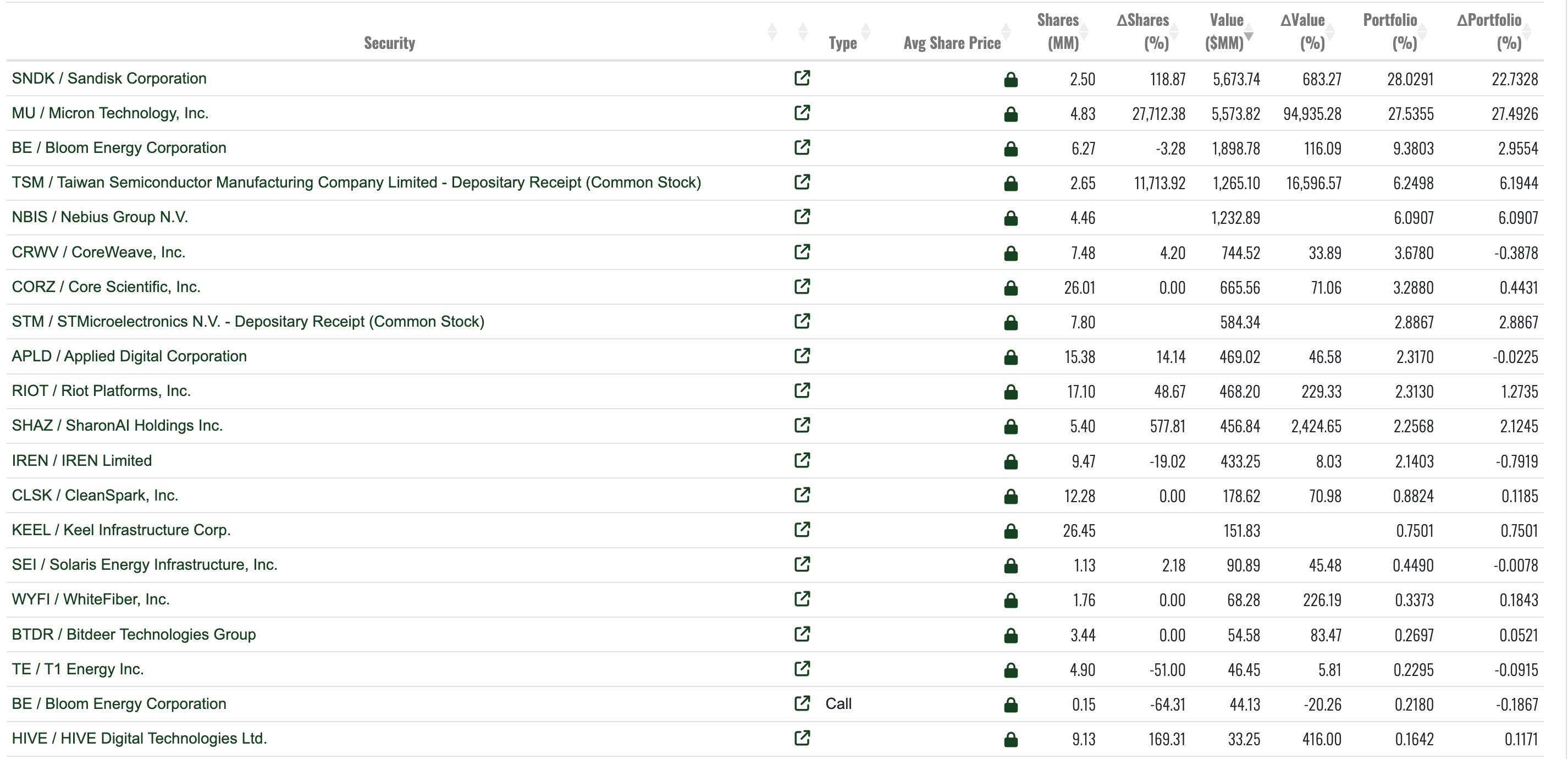
Therefore, on the surface, although Situational Awareness LP holds over 20 different stocks (including options), most positions actually point towards a single core thesis—if reclassified along the industry chain, the majority of the portfolio is directed towards one core judgment: the continuous surge in AI computing power demand, with the entire industry chain of chips, storage, computing power, electricity, and data centers expected to continue benefiting as a result.
This also signifies that Situational Awareness LP is essentially going all-in on the continued explosion in "AI infrastructure construction." During favorable times, this combination can indeed experience far greater elastic growth than a single stock; however, conversely, when AI infrastructure-related assets simultaneously pull back, the risks that were originally diversified across different companies can quickly resonate.
Especially in the presence of leverage, the combination of "high concentration" and "high leverage" can ultimately swiftly lead to a liquidity crisis, as we witnessed a few weeks ago.
Q1 Was Highly Cautious, Q2 Shifted to Overall Bullishness
Prior to the release of this quarter's 13F filing, I've always had a question.
In the Q1 holdings report disclosed in May of this year, Situational Awareness LP clearly expressed caution about the overheated short-term market for chips and storage—Situational Awareness LP had held nominal value exceeding $8 billion in chip and storage heavyweights' bearish options (covering SMH, NVDA, ORCL, AVGO, AMD, ASML, etc.) by the end of Q1, accounting for over 60% of the fund's nominal holdings. If this position was continued, the subsequent market downturn should have aligned with Leopold Aschenbrenner's prediction; why did it ultimately culminate in such a distressing outcome?
It wasn't until today, after the new 13F filing was released, revealing the position changes of Situational Awareness LP, that this question was finally answered—Leopold Aschenbrenner himself cut the insurance rope he had once tied.
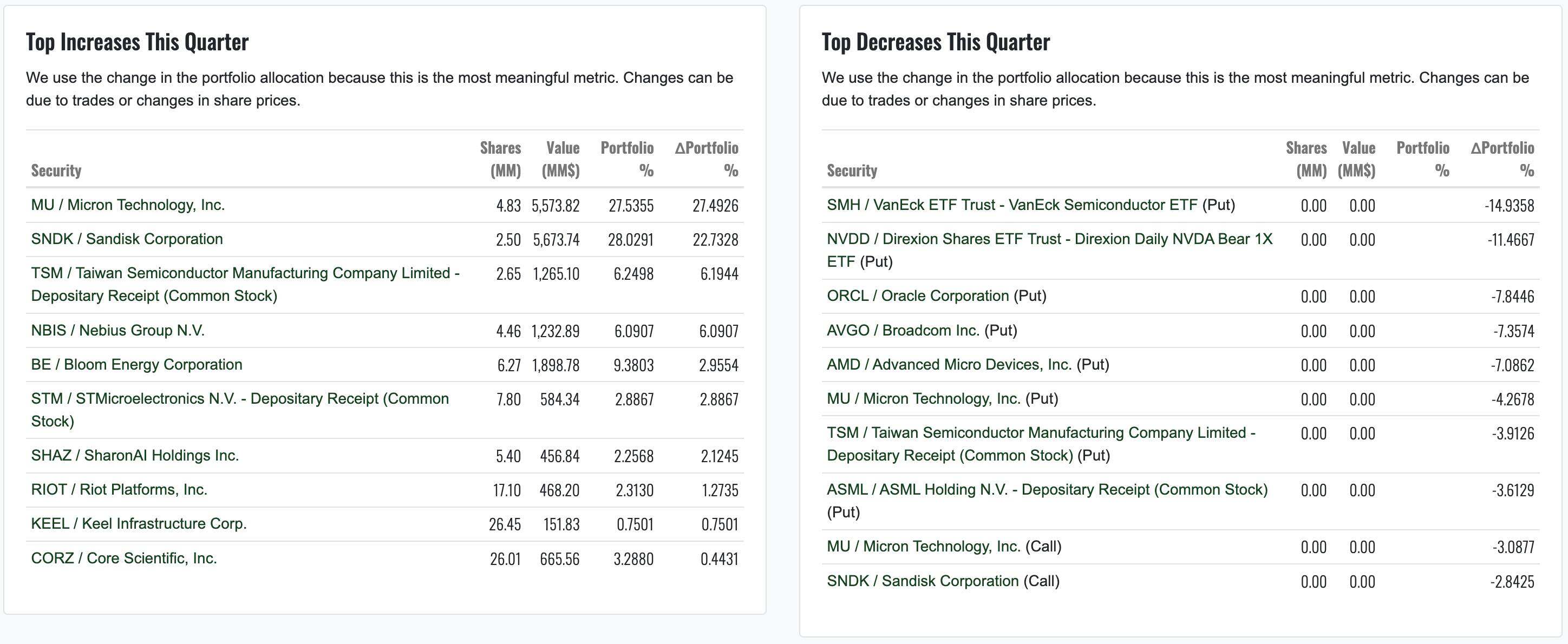
In the Q2 holdings report, Situational Awareness LP's "reduction list" was truly staggering—all chip and storage bearish options were liquidated. SMH Put (-14.94%), NVDA Bear ETF Put (-11.47%), ORCL Put (-7.84%), AVGO Put (-7.36%), AMD Put (-7.09%), TSM Put (-3.91%), ASML Put (-3.61%)...
These hedge positions that once formed the portfolio's risk floor were entirely abandoned by Situational Awareness LP in Q2. At the same time, the bullish options (Calls) on MU and SNDK, present in Q1, were also closed out (-3.09%, -2.84%), replaced by direct holdings—MU surged to become the second-largest position at $55.74 billion, while SNDK ascended to the top position with $56.74 billion.
The "addition list" further revealed the flow of funds—aside from the two storage stocks mentioned above, TSM ADR (+6.19%), Nebius (+6.09%, new), STMicroelectronics STM (+2.89%, new), SharonAI (+2.12%, new), Keel Infrastructure (+0.75%, new), and others all entered the portfolio. From European wafer fabs to a Russian-background AI cloud services provider, from power infrastructure to Bitcoin mining companies, Leopold Aschenbrenner completed a thorough shift from a "hedged portfolio" to an "unprotected long-only" position in Q2.
The cost of this shift was revealed at the end of July. When the AI sector experienced a systemic pullback, the bearish options insurance from Q1 could have partially absorbed the impact, but by Q2, the fund had no more short protection—being a fund of enormous scale, highly concentrated holdings, and highly uniform direction, under leverage, its vulnerability far exceeded market expectations.
Although 13F filings do not disclose leverage ratios, from this record of "clearing out bearish positions and maximizing long positions," we can already see that Situational Awareness LP's most ill-conceived move.
Defeat Is Inevitable, but Hope Is Still Alive
The later events are already very familiar to everyone.
After entering July, the AI and storage sectors experienced systematic sell-offs, causing severe damage to the positions held by Situational Awareness LP, including two major holdings, Micron and SanDisk. As of the June 30 closing price, by July 29, rumors of Situational Awareness LP facing a liquidity crisis began to spread. Micron (MU) had dropped from $1154 to $739, a decrease of approximately 35.9%, while SanDisk (SNDK) plummeted from $2274 to $1016, a staggering 55.3% decline.
With the leverage amplification, these declines quickly eroded Situational Awareness LP's entire safety cushion. Ultimately, the "AI Stock God's" past glorious record was discounted and taken away by Ken Griffin.
Fortunately, Leopold Aschenbrenner is still young, with a long life ahead. Most importantly, he still holds a key card—his investment in private companies, including Anthropic equity. For a 25-year-old investor, the first major defeat in the capital market may have already occurred, but this may not be the end of his investment career.
Original Article Link
Recommended
The price of gold has risen, why is the older gold jewelry still falling in price?
Aug 17, 19:03
Neocloud is starting to acquire the software layer, the New Cloud does not want to only sell computing power
Aug 17, 18:00Neocloud Economic Model Explained: Abundant Demand, Capital Efficiency Determines the Winner
Aug 17, 17:42AI Giant Interns' Daily Salary Revealed: Anthropic Exceeds $5000, While Kimi Can Only Make It to the Fourth Tier
Aug 17, 14:48
a16z New Post: From Crypto Mining Farms to AI Cloud, Why is the "New Cloud" Burning More Money as it Grows?
Aug 17, 11:48
Stripe's $7 Billion Acquisition of OpenRouter: Why is the Fintech Giant Interested in Model Routing?
Aug 17, 11:12