Neocloud is starting to acquire the software layer, the New Cloud does not want to only sell computing power
Original Title: Everybody Wants to Rule the (AI) Stack.
Original Author: David Levy
Editor's Note: As AI compute demands continue to surge, the competition among new cloud players is shifting from "who has more GPUs" to "who can control the entire technology stack from hardware to software." As raw compute leasing becomes increasingly mired in price competition, a more critical question emerges: what truly determines the value of AI infrastructure, the GPU itself, or the software layer that schedules, orchestrates, and optimizes GPU runtime efficiency?
In this article, author David Levy delves into transactions such as Nscale's acquisition of Anyscale for around $1.65 billion, Nebius acquiring Eigen AI, CoreWeave acquiring Weights & Biases, IREN acquiring Mirantis, and more. These acquisitions all point to the same trend: new cloud companies with GPU, power, and data center holdings are collectively extending into the realms of MLOps and AI orchestration.
The crux of this article's argument is that what these new cloud companies are buying is not just a piece of software or a batch of customers, but rather a shift from "charging by GPU hour" to "competing based on task outcomes." The scheduling system determines how many GPU hours a task consumes, as well as dictates compute utilization, customer costs, and platform profits. By mastering both the software and hardware layers, vendors can engage in collaborative optimization, retain the benefits of efficiency gains within the platform through deeper system integration, and increase customer migration costs.
Simultaneously, integration is also happening in reverse. Lightning AI merges with GPU provider Voltage Park, while inference platforms like Fireworks, Modal, and Baseten are to varying degrees building or controlling underlying compute power. Infrastructure companies are acquiring software upwards, while inference platforms are expanding downwards into hardware. Both are converging from opposite directions towards the same endpoint: simultaneously holding compute assets and orchestration software.
This implies that the next stage of new cloud competition is no longer just about GPU quantity, power contracts, and delivery speed, but about vying for control of the entire AI workload. The real barriers may come from those who can integrate chips, clusters, scheduling, and inference services into a more efficient, customer-stickier system. However, while the endpoint may be the same for both paths, the cost structures are starkly different: new cloud companies can fill gaps in software through acquisitions, while inference platforms looking to build infrastructure downstream must bear heavier capital expenditures. This also leaves a crucial question for the latter - as every company aims to control the full tech stack, who can find cheap enough funding to fuel this expansion?
The following is the original text:
Welcome to your own tech stack, from which there is no turning back.
The AI tech stack is moving towards a "one company does it all" direction, with both ends of the industry chain racing to build such full-stack capabilities. New cloud companies are extending upwards through acquisitions, while inference platforms are expanding from the software layer to the infrastructure layer. However, only one side of this equation is able to borrow enough money—but that's a story for later.
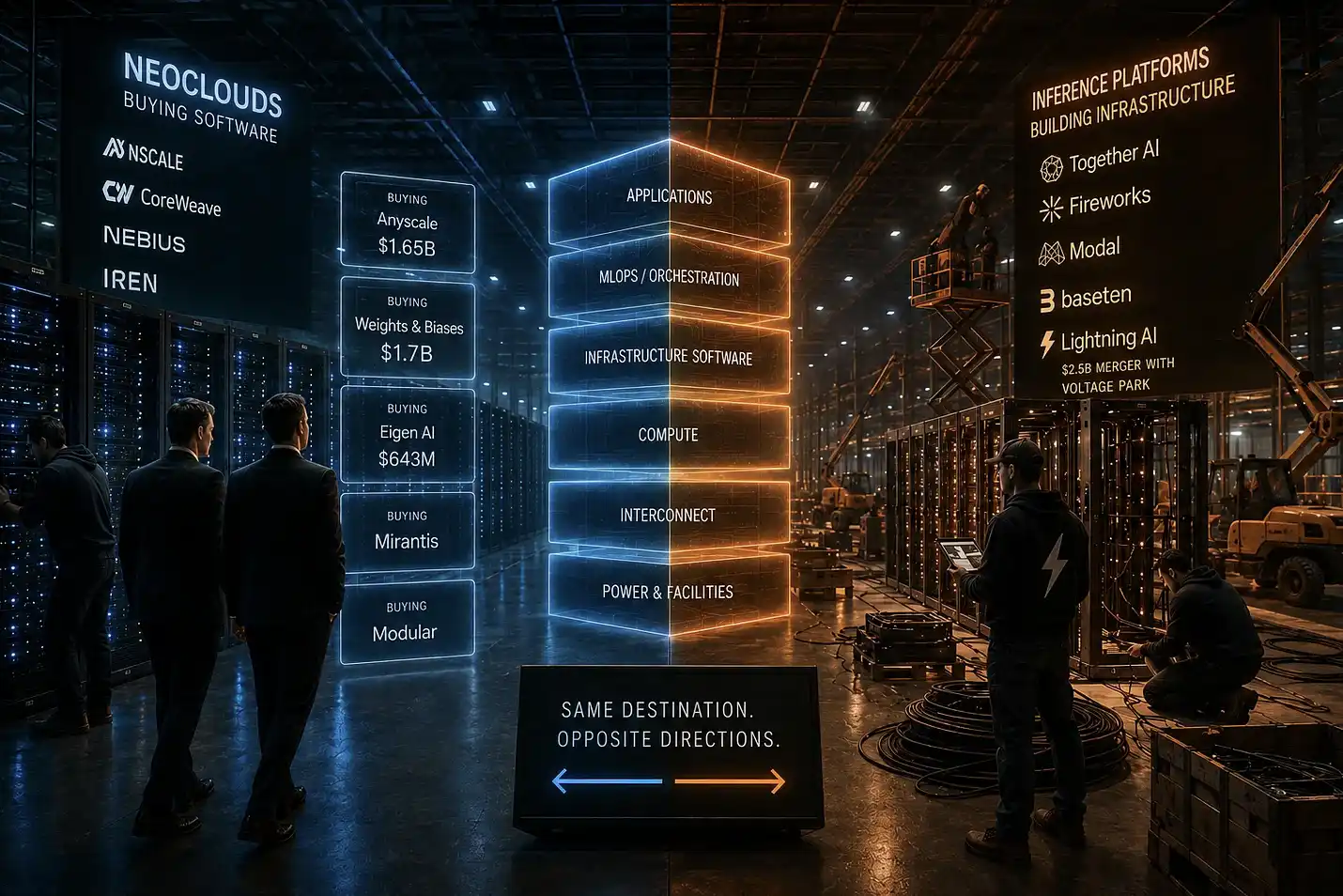
Last week, a new player in the cloud domain, Nscale, acquired AI orchestration software company Anyscale. This marks at least the fifth "AI infrastructure company acquiring an AI software company" deal in the past year or so.
In simple terms, it's the techies with pagers managing GPU clusters acquiring the techies in hoodies who are still coding at 2 a.m.—the software written by the latter determines how the clusters of the former actually operate.
Anyscale is the company behind the open-source AI workload orchestration framework Ray. Ray was developed by its founding team during their time at the University of California, Berkeley. According to Bloomberg, Nscale will spend around $1.65 billion to acquire Anyscale's commercial platform, engineering team, and clients such as Coinbase, Runway, and Bedrock Robotics.
Ray has transitioned to the PyTorch Foundation in 2025 and will remain open-source. Anyscale will continue to operate as Nscale's AI orchestration business and retain the Anyscale brand—even though after being acquired by Nscale, the "A" and "y" in its name seem somewhat redundant.
This is not an isolated transaction. In May of this year, Nebius acquired Eigen AI for $643 million, IREN acquired Mirantis, CoreWeave acquired Weights & Biases in 2025, and recently, Qualcomm completed the acquisition of Modular.
These five transactions all point in the same direction: those who control the underlying hardware want to further control the software layer that dictates how these hardware components operate.
By the way, I previously discussed this trend in an article, and I almost literally said: "Another AI infrastructure deal—but it's not just an infrastructure deal. To overlook this would be a mistake."
Of course, I talk a lot normally, so it's perfectly normal to be wrong once or twice.
A startup's tech launched by Porch Capital uses the monitoring tool STAX, which tracked the tech stacks of about 12,000 VC-backed companies. Among them, the MLOps category had scarce data: only 58 companies adopted related tools, accounting for about 0.5% of the sample. But look at who's in this 0.5%: Ray and Weights & Biases collectively contributed 60 out of 68 adoption records in this category. It's worth noting that some companies may use multiple tools simultaneously.
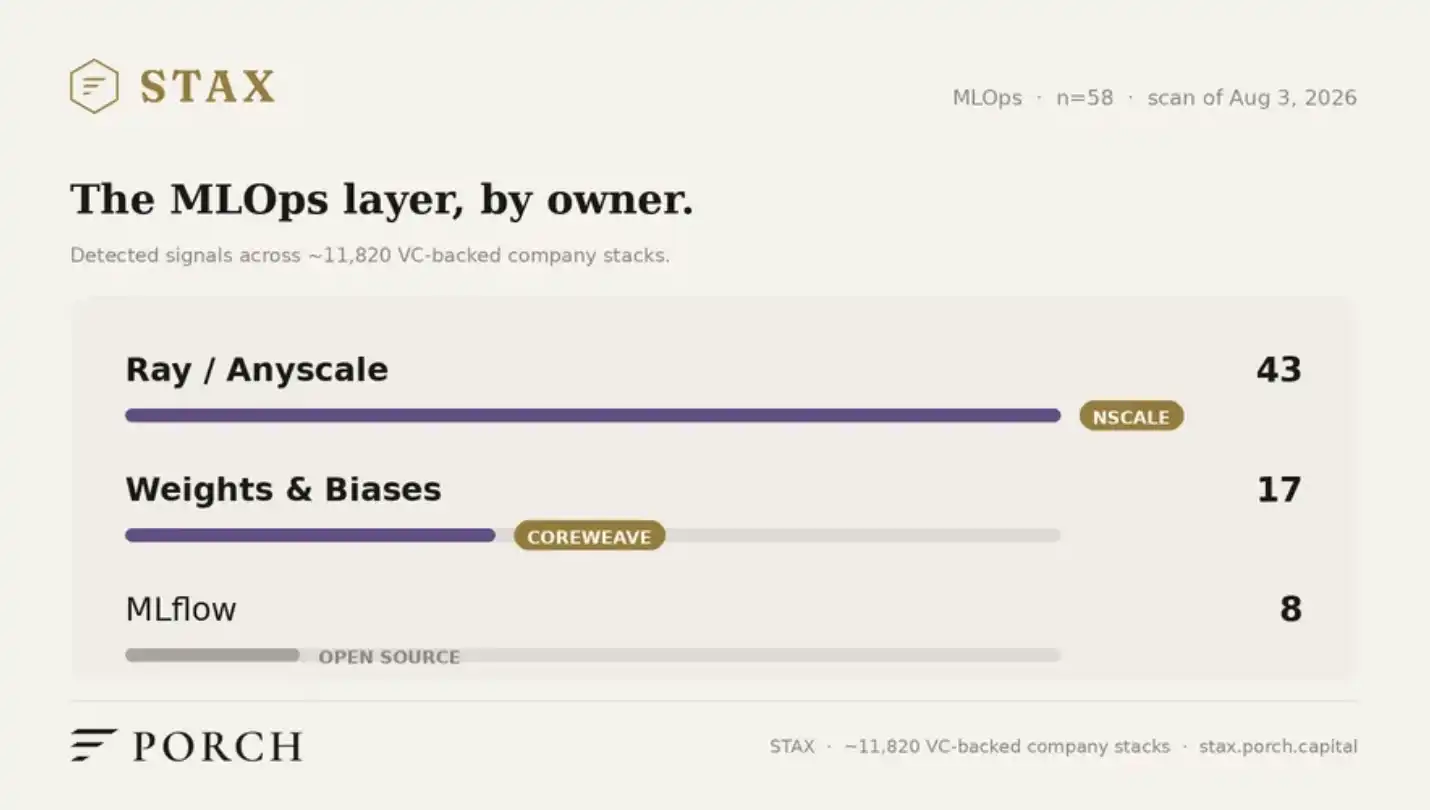
As of July 30, these two companies have already found their match: CoreWeave acquired Weights & Biases, while Nscale bought Anyscale. In other words, in just 18 months, almost the entire commercially viable MLOps layer in the STAX sample has changed ownership.
The transaction itself is news, but the real story is the transfer of control of the entire category.
On a side note, the scarcity of MLOps data in STAX is because application layer companies hardly run MLOps tools themselves—at least not visibly from the outside.
This, in itself, is also a noteworthy finding: startups usually just call models, rather than being responsible for deploying and operating them.
Many see bare GPU rental as a commoditized business: list a price, charge by the hour, and no moat.
This view may be too hasty. Power contracts, interconnect network topology, and compute delivery times are all real competitive barriers. Anyone who has truly tried to site a data center understands this.
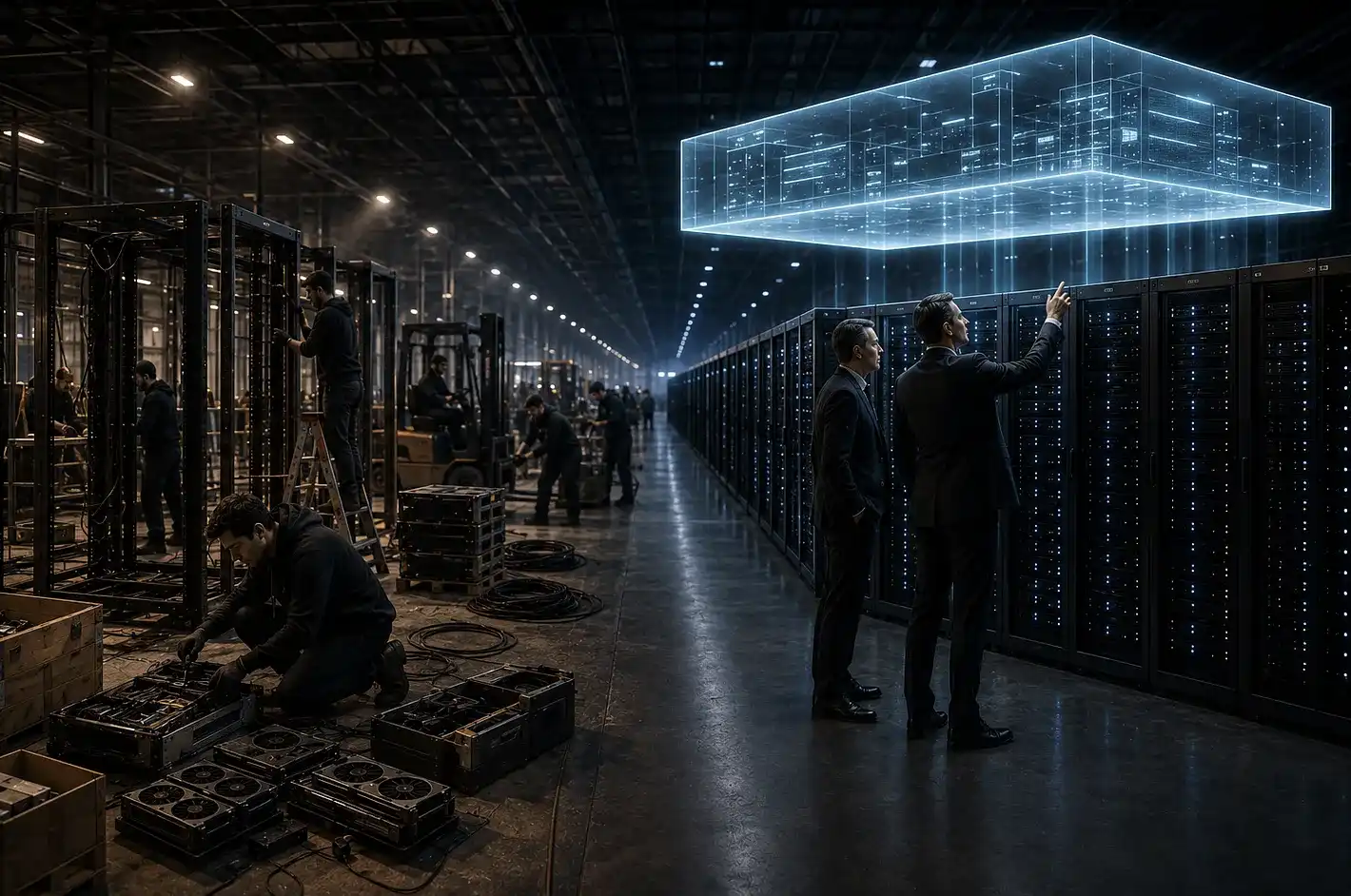
However, from a broader perspective, this assessment is not entirely wrong—at least every new cloud company is acting on this logic.
The value at the software layer is that it shifts competition from "how much per hour of compute" to "how much to complete a task." And once a customer completes system integration, they won't easily leave just because of another quote.
If a company holds both infrastructure and software layers, it can engage in co-design. This means that the efficiency gains can stay in-house rather than passing entirely to customers through lower bills.
That's why a company selling GPU hours is willing to pay $1.65 billion for a scheduling system.
Because the scheduling system determines exactly how many GPU hours a task requires.
An AI infrastructure company is buying software, while an AI software company is, in turn, constructing infrastructure.
Among these, Lightning AI and GPU infrastructure provider Voltage Park have completed a $2.5 billion merger deal, with Lightning AI surviving as the resulting entity.
Inference and model service platforms like Fireworks, Modal, and Baseten are now spread across a spectrum from “fully leased infrastructure” to “increasing proprietary assets.”
Some of these companies, out of strategic principles, adhere to a light asset model, while others are starting to build infrastructure on their own.
But their strategic endpoint is no different from Nscale, CoreWeave, and Nebius: to both own the underlying hardware and control the software layer orchestrating that hardware.
Everyone wants to own the entire AI stack.
New cloud companies extend upward through acquiring the software layer, while inference platforms expand downward by building infrastructure. Both roads lead to the same destination, but one path is far more expensive than the other.
Recommended
The price of gold has risen, why is the older gold jewelry still falling in price?
Aug 17, 19:03
Neocloud Economic Model Explained: Abundant Demand, Capital Efficiency Determines the Winner
Aug 17, 17:42AI Giant Interns' Daily Salary Revealed: Anthropic Exceeds $5000, While Kimi Can Only Make It to the Fourth Tier
Aug 17, 14:48
By analyzing the 13F quarterly holdings report, the reason behind the downfall of the "AI Stock Guru" has been uncovered.
Aug 17, 13:12
a16z New Post: From Crypto Mining Farms to AI Cloud, Why is the "New Cloud" Burning More Money as it Grows?
Aug 17, 11:48
Stripe's $7 Billion Acquisition of OpenRouter: Why is the Fintech Giant Interested in Model Routing?
Aug 17, 11:12