Neocloud Economic Model Explained: Abundant Demand, Capital Efficiency Determines the Winner
Original Title: Neocloud Economics
Original Author: APP ECONOMY INSIGHTS
Editor's Note: Generative AI is driving a continuous increase in computational demand, and the industry discussion is shifting from "Is the GPU sufficient?" to "Who can transform electricity, chips, and data centers into usable compute power at a lower capital cost." As order growth and a shortage of compute power gradually become consensus, a more critical question begins to emerge: for new cloud providers that need to invest billions of dollars before revenue realization, are they building the next-generation AI infrastructure or are they precariously meeting future demand through debt and capital expenditure?
Under App Economy Insights' "How They Make Money," CoreWeave, Nebius, and Cerebras' latest financial reports are dissected, breaking down three new cloud models:
CoreWeave relies on long-term contracts to lease NVIDIA GPUs, with a backlog of orders reaching $104 billion, but high capital expenditure and interest costs continue to drag down profits.
Nebius gains stronger pricing power through a self-built AI cloud platform, with customer prepayments and a shorter payback period improving capital efficiency.
Cerebras has shifted to cloud-based inference leveraging its proprietary chip, with cloud revenue surpassing hardware, but order conversion is still constrained by capacity construction.
All three companies face the same set of contradictions: demand far exceeds supply, but capacity must be built in advance, resulting in simultaneous increases in capital expenditure, debt, and depreciation. A massive backlog of orders does not equate to revenue, let alone cash flow.
As tech giants like Meta expand their self-designed chips and GPU clusters, new cloud providers need to prove that they are not merely temporary solutions to the compute power gap. The next phase of competition will not only look at revenue growth rates but also at three factors: capacity deployment speed, unit capital return, and financing costs.
Demand is already locked in, and capital efficiency will determine the ultimate winner.
Below is the original text:
The market's demand for compute power has exceeded what large cloud computing companies can provide.
This gap has driven the rise of Neocloud (new cloud providers). They are specialized service providers built around AI infrastructure, focusing on acquiring electricity, dedicated data center capacity, and AI accelerator clusters, rather than replicating the vast software ecosystems of AWS, Azure, or Google Cloud.
This week, three different types of new cloud players reported their performance, allowing us to see clearly how they are tackling the computing power bottleneck with different strategies:
CoreWeave: Specializes in renting out NVIDIA GPU clusters and relies on long-term contracts with enterprise customers to scale up.
Nebius: Built an AI cloud platform from scratch relying on international data center infrastructure.
Cerebras: With its custom-designed chips, is transitioning to provide cloud-based high-speed inference services.
The business logic of these three companies is somewhat counterintuitive. Computing facilities require upfront investment and construction months before they can generate revenue, so free cash flow is often negative. The importance of debt, leasing, depreciation, and customer concentration is almost as critical as revenue growth.
Let's take a look at the information disclosed this week.
CoreWeave is the purest representative of the new cloud model. It purchases NVIDIA GPUs, deploys them in data centers, and rents out the computing power to clients like OpenAI, Microsoft, and Meta.
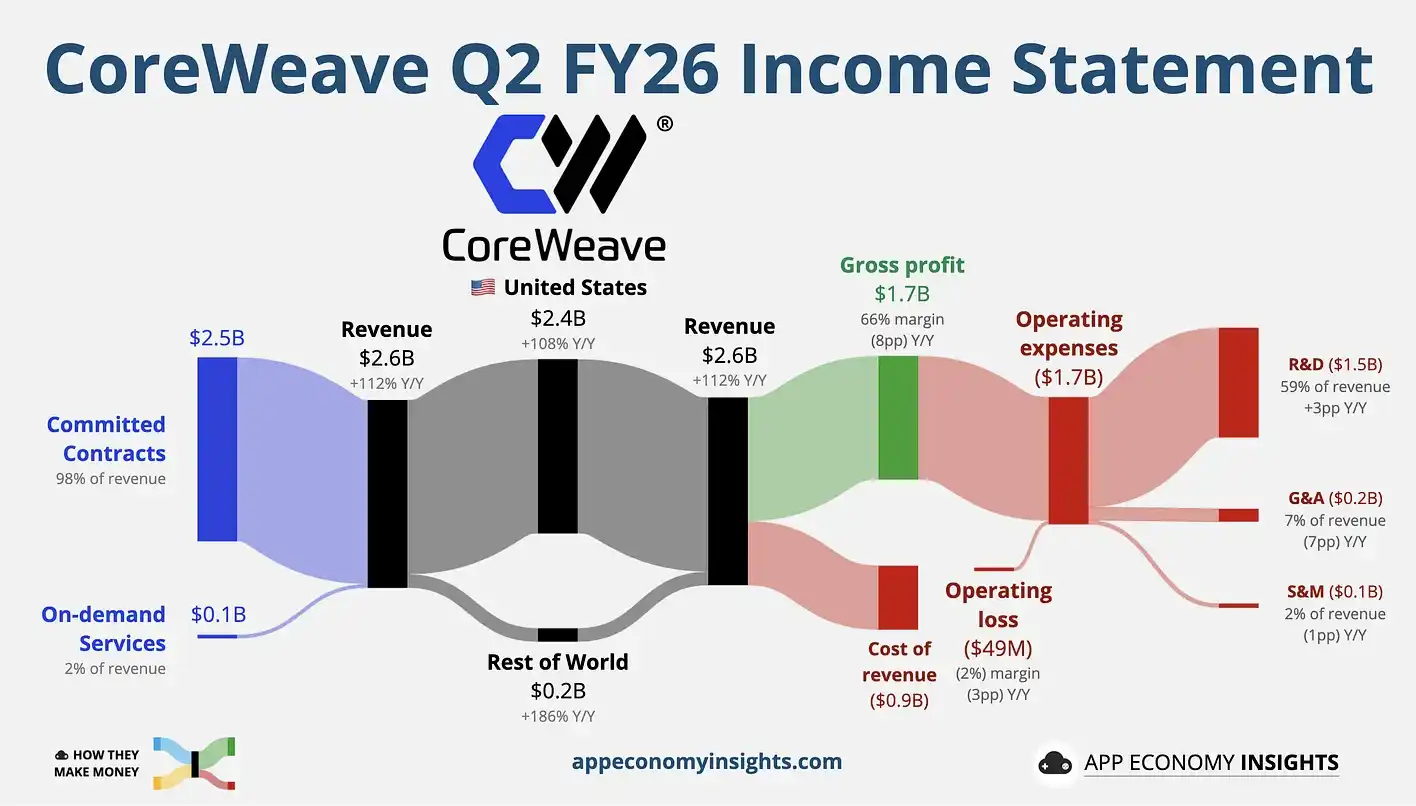
Most of CoreWeave's computing power has already been booked by clients. Long-term committed contracts accounted for 98% of second-quarter revenue, while on-demand usage contributed only 2%.
The company's revenue grew 112% year-over-year to $2.6 billion, but the gross margin decreased by 8 percentage points to 66%, as the growth rate of data center rent, power, and other expansion costs exceeded even the revenue.
CoreWeave recorded a $49 million operating loss and a $626 million net loss. Of this, $640 million in interest expense directly related to GPU collateral debt financing weighed heavily on the profit.
And the income statement only reflects part of the expenditure. CoreWeave's second-quarter capital expenditures reached $9.4 billion, more than three times the revenue for the quarter.
What do these numbers mean?
Demand growth continues to outpace capacity expansion: The company's order backlog reached $104 billion, a 246% year-on-year increase; entering early in the third quarter, the company signed $25 billion in customer commitments. The recent capacity is actually almost sold out.
Profit margins are poised for a turning point: CoreWeave has endured a decline in gross margin to accelerate the launch of new capacity. However, the adjusted operating margin has increased from 1% in the previous quarter to 5%. It is expected that the profit margin of new contracts in the second quarter will be 5 to 10 percentage points higher than recent contracts, not to mention about a 25% price increase in July.
Revenue Mix Shifting: Annual recurring revenue from Storage, CPU, Network, and Software businesses has crossed $400 million. Signed annual recurring revenue from Hosting Inference business has surged from $1 million to over $1 billion within one quarter.
Growth Remains Costly: CoreWeave has raised its 2026 capital expenditure outlook to $35 billion to $39 billion, aiming to increase its on-grid power capacity to over 1.85GW by the end of the year.
Key Takeaway: Compared to the company's targeted $19 billion annualized run rate by the end of 2026, the $104 billion backlog of orders seems almost absurdly large. However, order conversion is still constrained by physical capacity. CoreWeave's investment thesis ultimately hinges on: can it convert power and GPUs into revenue fast enough while avoiding financing costs eating into margin improvements.
Nebius was not initially a typical AI infrastructure startup.
Spawned from Yandex: Nebius emerged from the 2024 split of Russian tech giant Yandex. The Dutch holding company that listed on Nasdaq sold the Russian operations for $5.4 billion and retained a smaller set of international businesses, which later formed Nebius.
A Fresh Start as a Public Company: The remaining company retained its Nasdaq listing and was rebranded as Nebius Group, with Yandex co-founder Arkady Volozh at the helm.
Pivoting to AI Infrastructure: Rather than reconstructing the internet conglomerate of the past, Nebius, leveraging existing engineering talent, cloud computing expertise, and capital base, built a cloud platform tailored for AI.
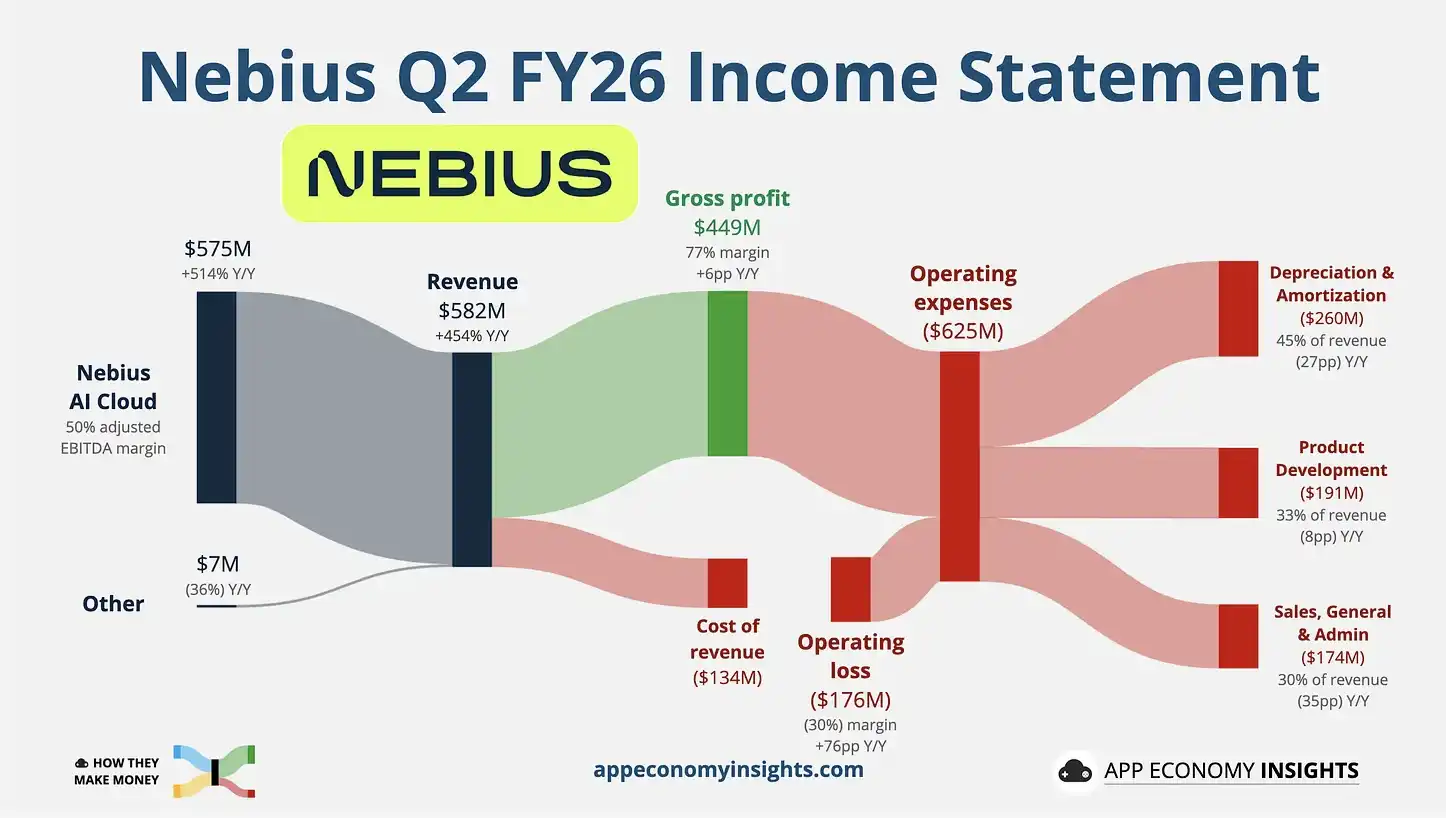
Nebius leases GPU computing power through its own cloud platform. In the second quarter, AI Cloud business revenue reached $575 million, accounting for 98% of total revenue.
The company's revenue grew 454% year-over-year to $582 million, gross margin expanded by 6 percentage points to 77%; adjusted EBITDA reached $236 million, corresponding to a 41% margin.
Nebius incurred an operating loss of $176 million. With multi-billion-dollar new infrastructure coming onto the balance sheet, depreciation and amortization alone reached $260 million.
What Do These Data Mean?
Hash Rate Prices Are Rising: The average value of the four new AI cloud contracts exceeds $1 billion, with a contract value per megawatt ranging from $20 million to $25 million. For shorter-term hash rate contracts, prices have reached as high as $40 million to $50 million per megawatt.
Investment Payback Speed Accelerating: Management anticipates that contracts signed in the second quarter will require approximately 22 months to recoup the corresponding capital expenditure and operating costs, a significant reduction from the previous two to three years payback period.
Massive Scale Expansion: Nebius's second-quarter capital expenditure reached $5.7 billion, nearly 10 times the quarterly revenue. The company still expects full-year capital expenditures to range from $20 billion to $25 billion.
Customers Assisting in Financing: Nebius expects to receive over $9 billion in customer prepayments by 2026, covering approximately 50% to 60% of the relevant capital expenditure.
Key Takeaway: Nebius is investing funds at an unprecedented scale, but the rising prices, shortened payback period, and customer prepayments are enhancing the economic value of each megawatt of added capacity. In the long run, this capital efficiency may be more critical than the 454% revenue growth.
Cerebras is a unique player among the new cloud vendors. Instead of purchasing NVIDIA GPUs, it has designed its own wafer-scale processor and commercialized it in two ways: by selling systems and by renting out compute power through Cerebras Cloud.
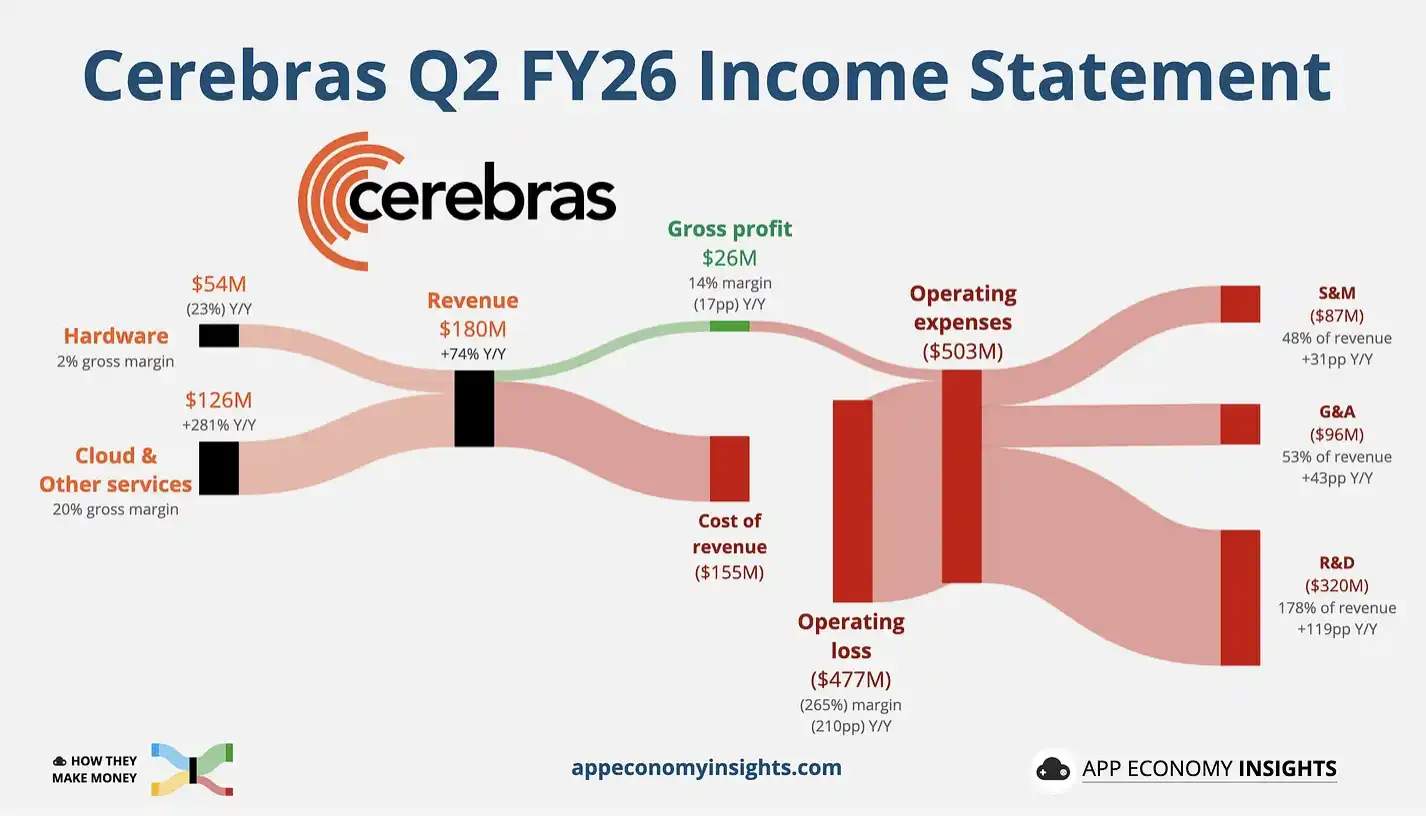
The company's revenue structure is rapidly evolving. Second-quarter revenue grew 74% year-over-year to $180 million. Cloud and other service revenue increased by 281% to $126 million, while hardware revenue declined by 23% to $54 million.
The company recorded an operating loss as high as $477 million, but this figure needs to be viewed in context. Cerebras went public in May, resulting in significant stock-based compensation expenses. Excluding these factors, its core operating loss was only $34 million, far lower than the $477 million under GAAP.
Core performance excludes stock-based compensation, customer warrant expenses, and some pass-through items. With the gradual settlement of the stock-based compensation granted at the IPO, this expense pressure is expected to normalize over the next few quarters.
Under the company's reporting standard, the gross margin was only 14%, but the core gross margin reached 41%, a year-on-year increase of about 9 percentage points, down from 46.5% in the first quarter. One reason is that, to meet the demand for cloud services, Cerebras temporarily needs to pay to lease back systems that have already been sold.
What Do These Data Mean?
Cloud services have become a growth engine: Core cloud business revenue nearly tripled to $128 million, surpassing hardware business for the first time.
Performance expectations have improved: Cerebras has raised its FY 2026 core revenue guidance to $880 million to $890 million, while also increasing gross margin and operating margin expectations.
Capacity remains a major bottleneck: As of 2027, the company has commissioned or signed data center capacity exceeding 600MW. The core gross margin is expected to bottom out in the third quarter, with the prospect of margin recovery as new capacity comes online and reliance on high-cost leasing compute power decreases.
Demand far exceeds current revenue: The company's remaining performance obligations amount to $25.4 billion. OpenAI remains its key customer, but to convert these backlogged orders into revenue, Cerebras still needs to invest heavily in infrastructure.
Key Takeaway: Cerebras is transitioning from a chip vendor to a high-speed inference cloud services provider. Equity incentives and other accounting adjustments have obscured this progress, but the real test is: as new capacity comes online, can the company convert the huge backlog of orders into revenue while restoring profit margins?
Three new cloud players all face the same dilemma: market demand has outstripped available compute power, but meeting these demands requires massive capital investment before revenue arrives.
A compute shortage is also driving large tech companies to build in-house capacity. Meta is expanding its custom chips and GW-scale GPU clusters, while SpaceX has begun selling rights to use its Colossus cluster externally.
The longer-term question is: once major tech companies' AI capacities are fully online, will new cloud players continue to exist as indispensable infrastructure partners, or are they just a temporary stopgap to fill the short-term compute gap?
The next stage of competition will depend on three factors: capacity, profit margins, and financing capability. New cloud players need to convert contracted demand into fully operational infrastructure, improve return on investment as utilization increases, and raise funds for the next round of expansion to avoid debt or equity dilution that could undermine the economic viability of the entire business model.
The demand has already been locked in, and capital efficiency will determine the winners.
Recommended
The price of gold has risen, why is the older gold jewelry still falling in price?
Aug 17, 19:03
Neocloud is starting to acquire the software layer, the New Cloud does not want to only sell computing power
Aug 17, 18:00AI Giant Interns' Daily Salary Revealed: Anthropic Exceeds $5000, While Kimi Can Only Make It to the Fourth Tier
Aug 17, 14:48
By analyzing the 13F quarterly holdings report, the reason behind the downfall of the "AI Stock Guru" has been uncovered.
Aug 17, 13:12
a16z New Post: From Crypto Mining Farms to AI Cloud, Why is the "New Cloud" Burning More Money as it Grows?
Aug 17, 11:48
Stripe's $7 Billion Acquisition of OpenRouter: Why is the Fintech Giant Interested in Model Routing?
Aug 17, 11:12