
Morgan Stanley Analysis: Half-Year Revenue Quadrupled, Has Smart Alpha Reached a Commercial Inflection Point?

TL;DR
·In the first half of 2026, SmartTech's revenue increased by 400% year-on-year to $954 million, with cloud deployment revenue growing by 2736% and becoming the key driver.
·As of August, the company's Monthly Annual Recurring Revenue (ARR) reached $1.6 billion, surpassing $2 billion on a weekly annualized basis, with year-end guidance raised to $2.4 billion.
·From the beginning of the year to August, platform token consumption increased more than 40-fold, API average price rose by approximately 101%, and paid daily active users grew by 603%.
·Unit inference cost decreased by 80% in the first half of the year, but the overall gross margin dropped from 50% to 26%, with R&D expenses still exceeding double the revenue for the same period.
·Morgan Stanley raised its target price from HK$1700 to HK$1800, projecting that SmartTech will not achieve profitability until 2028.
SmartTech's commercialization is significantly accelerating.
In a report released on August 31st, Morgan Stanley stated that SmartTech's Monthly Annualized Recurring Revenue (ARR) as of August had reached $1.6 billion, exceeding $2 billion on a weekly revenue annualized basis, significantly higher than the bank's previous expectation of $1.2 billion.
With model invocation volume, API prices, and paid users all growing simultaneously, SmartTech raised its ARR guidance to $2.4 billion by the end of 2026, up from previous levels. Shortly after, the bank raised its revenue forecast for the company for the next three years, increased the target price from HK$1700 to HK$1800, and maintained a 'Hold' rating.
This performance shows two parallel trends: the cloud business has entered a period of rapid expansion, with computing power efficiency also rapidly improving; however, due to high R&D investment and inference cost pressures, revenue growth has not yet been fully converted into profit.
In the first half of 2026, SmartTech achieved revenue of $954 million, a 400% year-on-year increase, essentially meeting Morgan Stanley's previous forecast of $967 million.
The growth mainly came from the cloud deployment business. During the period, cloud deployment revenue reached $825 million, a 2736% year-on-year increase, accounting for approximately 86% of total revenue; while on-premise deployment revenue declined by 20% year-on-year to $129 million.
This means that Smart Spectrum's revenue structure is transitioning rapidly from project-based, on-premises deployment to a MaaS business model centered around API calls and developer services. Compared to one-time delivery, cloud-based business models are more conducive to recurring revenue and have greater scalability.
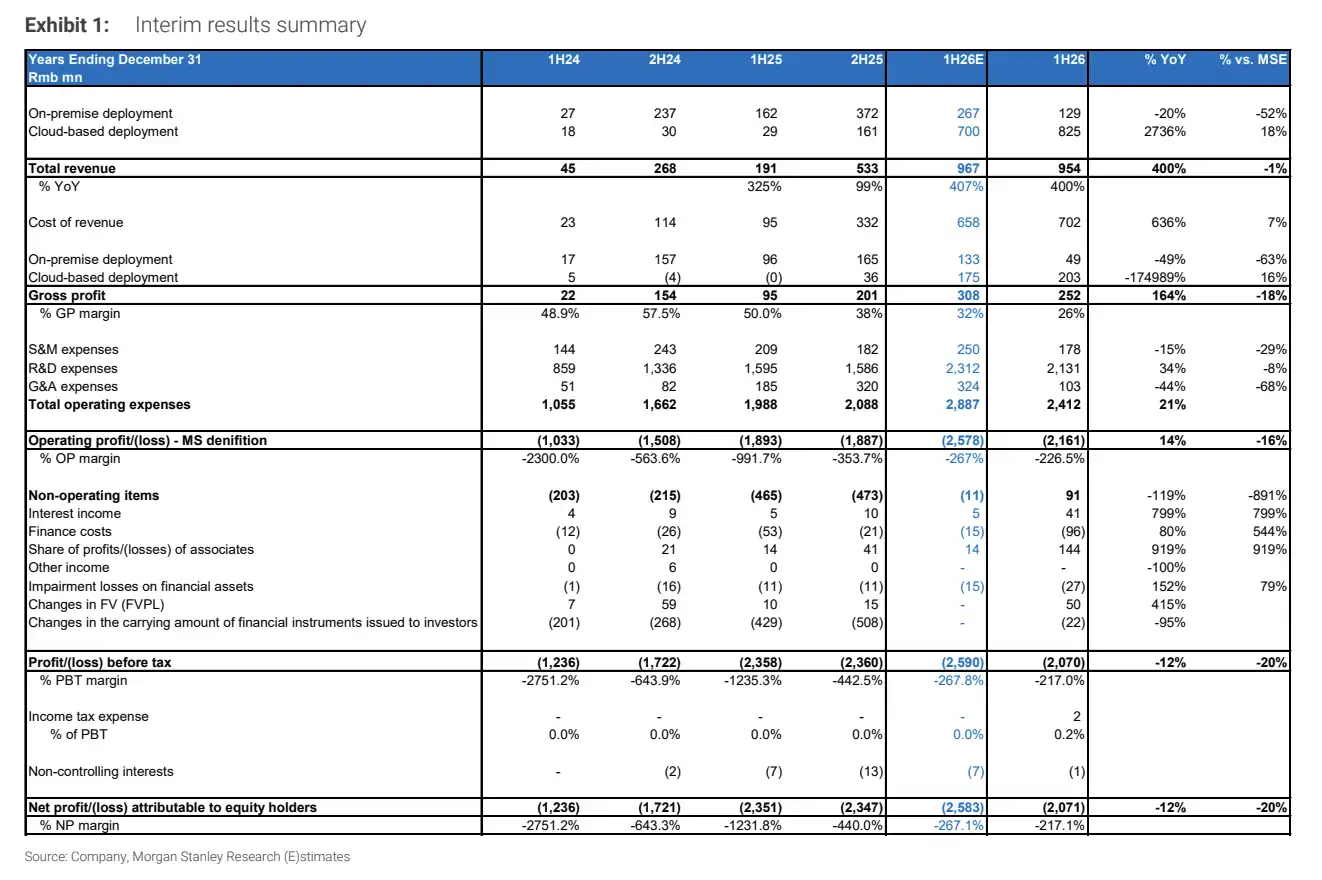
Smart Spectrum 1H 2026 Performance Summary. Smart Spectrum's revenue in the first half of the year increased by 400% year-on-year, with cloud deployment revenue growing by 2736%; however, the overall gross margin decreased from 50% to 26%. Source: Company, Morgan Stanley
However, the rapid expansion of cloud revenue has not yet led to an improvement in the overall gross margin.
In the first half of the year, Smart Spectrum achieved a gross profit of 252 million yuan, a year-on-year increase of 164%, but the overall gross margin decreased from 50% in the same period last year to 26%, lower than the 32% previously estimated by Morgan Stanley. Although the revenue growth rate is fast, the investment in inference services, computing power, and infrastructure is also increasing simultaneously.
R&D remains the company's largest expense item. R&D expenses in the first half of the year reached 2.131 billion yuan, a year-on-year increase of 34%, equivalent to about 2.2 times the revenue in the same period. The company recorded an operating loss of 2.161 billion yuan for the period; the net loss attributable to shareholders was 2.071 billion yuan, a year-on-year reduction of approximately 12%.
In other words, Smart Spectrum has validated the revenue growth potential of the cloud, and the next step is to prove whether, as the scale expands, the model calling business can generate sufficient gross profit and operating leverage.
Compared to the current profit, Morgan Stanley is more concerned about the changes in Smart Spectrum's commercialization indicators.
The management stated that from January to August this year, the Smart Spectrum platform's token consumption increased by more than 40 times, with programming package token usage increasing by more than 23 times. During the same period, the average API price increased by about 101%, indicating that the growth in usage is not solely achieved through price reduction.
User and revenue indicators are also growing rapidly:
MaaS platform users have grown by 144% over the years;
Daily active paying users have increased by 603%;
Daily average revenue has grown by 234 times in the past 12 months;
The open platform has attracted over 7.4 million users;
ZCode, in its first month of launch, has attracted over 1 million monthly active users.
Among the top ten largest contributing customers in revenue, the daily token usage has increased by approximately 98 times since the beginning of the year. The company also stated that Smart Spectrum has become the top global priority model supplier for four of China's top ten Internet companies.
The number of high-value customers is also increasing. As of the end of August, the customers contributing over $100,000, $500,000, and $1 million to ARR numbered approximately 115, 25, and 37 respectively; in addition, 8 customers had ARR contributions exceeding $10 million.
These metrics collectively drove SmartTech to raise its full-year ARR outlook. By the end of August, the company's monthly-calculated ARR reached $1.6 billion, its run rate surpassed $2 billion, and the year-end target was raised to $2.4 billion.
It is important to note that ARR is an annualized metric extrapolated from revenue over a certain period and does not equate to recognized annual financial revenue. Especially the run rate data may be affected by new product launches and short-term usage peaks. Its significance ultimately depends on customer retention, usage frequency, and the sustainability of revenue realization.
To support the growing demand for model inference, SmartTech has increased its infrastructure investment over the past six months.
The company stated that the unit inference cost decreased by 80% in the first half of the year. In the second quarter, the "compute multiplier" reached 0.46x, representing an approximately 14x year-over-year increase. This metric measures the API revenue generated per unit of expenditure on training and inference compute power. Although it has not yet reached 1x, the rate of improvement is evident.
The cost reduction primarily stemmed from multi-channel procurement of compute power, an increased usage of domestically-produced GPUs, and collaborative optimization at the model, network, and chip levels. The management also mentioned a potential plan for self-built data centers to further control infrastructure capabilities.
On the product side, improving cache hit rate, token throughput, and model service efficiency has also helped reduce the cost per inference.
The management anticipates that there is still room for the full-year gross margin improvement of the open platform and has proposed elevating the business's gross margin to over 50% in the next 12 to 18 months. Daiwa Securities believed that if the compute power supply exceeds expectations, SmartTech's year-end ARR could still surpass the $2.4 billion guidance.
However, looking at the first-half consolidated gross margin of 26%, the efficiency gains in infrastructure have not been adequately reflected in the financial statements. Subsequent observations are needed to see if API prices can be sustained, if the unit cost reduction can cover the expansion in usage, and if the cloud business gross margin can rebound as per management's target.
In terms of the product roadmap, SmartTech is positioning coding capabilities as an entry point into the professional AI market.
The management believes that the programming model needs to understand complex tasks, invoke tools, plan steps, and check execution results, and these capabilities can be transferred to fields such as cybersecurity, law, and finance. The company has stated that some of the capabilities of GLM-5.3 have already started being applied in cybersecurity scenarios.
Therefore, Spectra Intelligence has proposed a shift from "coding" to "cowork": evolving the programming assistant into a digital coworker capable of executing complex professional workflows. According to the company's estimates, the potential size of the global programming market is around $500 billion, and the market for professional collaborative intelligent agents could reach $50 trillion.
The company's future model development will continue to focus on expanding the base model scale while enhancing inference training, Token loop architecture, and post-training investment. The planned GLM-6.0 is positioned as a "fully self-training" model capable of self-assessment and self-correction, which the management sees as a significant milestone toward recursive self-improvement.
This narrative has opened up a larger potential market for Spectra Intelligence, but it still predominantly falls under long-term technical and business vision. Whether the model's capabilities can smoothly transition to professional fields such as law and finance remains to be seen, as it will face tests of reliability, industry data, compliance requirements, and customer willingness to pay.
Considering the first-half performance and higher-than-expected ARR, Morgan Stanley has raised its revenue forecasts for Spectra Intelligence for 2026, 2027, and 2028 by 20.4%, 25.6%, and 29.3%, respectively.
Morgan Stanley currently projects that Spectra Intelligence's revenue will reach ¥6.329 billion in 2026, increase to ¥19.313 billion in 2027, and further rise to ¥47.641 billion in 2028, corresponding to year-over-year growth rates of 773.8%, 205.2%, and 146.7%, respectively.

Morgan Stanley raises Spectra Intelligence's performance forecast. Taking into account the first-half performance and ARR growth, Morgan Stanley has increased its revenue forecasts for Spectra Intelligence for 2026 to 2028 by 20.4%, 25.6%, and 29.3%. Source: Morgan Stanley
Although the revenue forecasts have been significantly raised, the short-term pressure of losses is not immediately alleviated. Due to a downward revision in gross margin forecasts and increased research and development expenses, Morgan Stanley has instead widened its operating loss forecast for Spectra Intelligence in 2026 by 4.5%, expecting a net loss attributable to shareholders of approximately ¥4.303 billion for that year.
As revenue continues to expand, Morgan Stanley projects that the operating loss forecast for 2027 will narrow by 35.2%, anticipating a net loss attributable to shareholders of approximately ¥2.564 billion. By 2028, the company is expected to achieve an operating profit of ¥5.018 billion, with a net profit attributable to shareholders of approximately ¥4.730 billion, marking the first annual profit.
This forecast is built on three premises: continued rapid growth in cloud revenue, gradual margin recovery, and revenue expansion outpacing R&D expense growth. Any shortfall in any of these aspects could delay the company's profit inflection point.
Morgan Stanley values Alibaba based on a discounted cash flow model, assuming a weighted average cost of capital of 15% and a perpetual growth rate of 3%. The target price has been raised by 5.9% to HK$1800 from HK$1700.
Based on the closing price of HK$1195 on August 31, the target price represents approximately 51% upside, equivalent to about 35 times the 2027 estimated P/S ratio. Morgan Stanley believes that the current P/S ratio of around 25 times for 2027 does not fully reflect the long-term revenue growth potential of the company.
However, this valuation is highly dependent on model competitiveness and commercialization speed.
In an optimistic scenario, if Alibaba can launch models that lead the world, expand its customer base through cloud APIs, and continue to raise prices, Morgan Stanley estimates that the company's revenue could reach HK$33.75 billion in 2027, corresponding to a valuation of HK$3340.
In a base-case scenario, if Alibaba can continue to introduce models close to the world's advanced level, with revenue reaching HK$19.3 billion by 2027, the target price would be HK$1800.
In a pessimistic scenario, if model performance lags, and computing power supply is limited, with revenue only growing linearly, revenue in 2027 could be as low as HK$13.5 billion, leading to a valuation drop to HK$670.
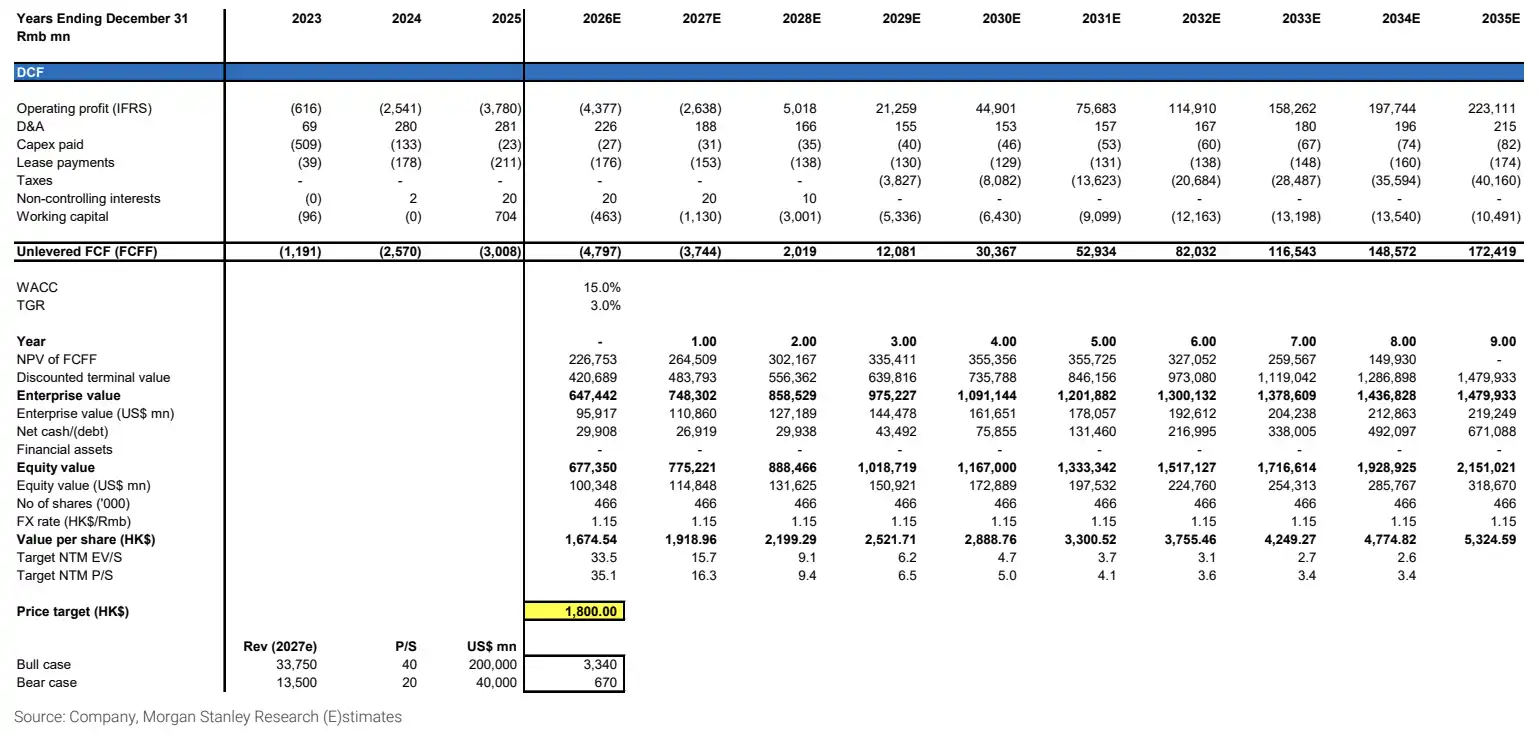
Alibaba's risk-return profile across three valuation scenarios. Morgan Stanley gives Alibaba a HK$1800 baseline target price; bull and bear market scenarios are HK$3340 and HK$670, respectively, with valuation dependent on model competitiveness and revenue growth rate. Source: Morgan Stanley
The biggest change for Alibaba in the first half of the year was that commercial growth began transitioning from expectations to financial data: cloud revenue, Token usage, paying users, and ARR all saw significant increases. At the same time, the company is still some distance away from stable profitability, and margin recovery and R&D investment efficiency will determine how much of this growth can translate into profit.
For investors, the $2.4 billion ARR guidance is just the starting point for the next phase. What truly needs validation is whether the rapid growth in model usage can translate into sustainable revenue, and whether Alibaba can, while maintaining model competitiveness, complete the transition from high investment expansion to profitability around 2028.
Recommended
AllianceDAO and FOMO Founder's Latest Portfolio: 70% in Stocks, Crypto Holdings Limited to BTC and Zcash
Sep 1, 17:13
$1.4 billion Flows into ETH ETF, Is this Just the Beginning of ETH's Liquidity Rally?
Sep 1, 15:54
Latest Non-Farm Payrolls Forecast: Job Growth Could Slow Down, Putting the Fed in a Tight Spot
Sep 1, 15:22
$300 million Follow-On Investment in Polymarket Revealed, Unveiling Trump's Eldest Son's 1789Capital
Sep 1, 14:30
Cook Steps Down, What's Next for Apple
Sep 1, 14:29
Non-Farm Payrolls Friday: Job Growth Cools – Can It Deter Fed's Hike?
Sep 1, 13:37