Capital as Production Capacity: Where Did the Money of America's Top 100 VCs and CVCs Go in the First Three Quarters of 2026?
One AI chip company doubled its valuation in 26 days; one personal Agent company tripled its valuation in 33 days; one data center company raised $3.9 billion in a single round.
That was Silicon Valley in the third quarter of 2026. In the same quarter, the Federal Reserve raised interest rates for the first time in 14 months, the 10-year Treasury yield closed at 5.27%, and the FTC opened cases against both OpenAI and Anthropic.
Capital is celebrating, interest rates are tightening, and the giants are postponing their listings.
This divergence is the reason we produced this report. We tracked 100 institutions in the core circle of American tech investing (70 VC/crossover funds and 30 CVC/sovereign capital), using public data to reconstruct the capital trends of the first three quarters of 2026.
The conclusion first: In 2026, the nature of American venture capital money changed. It is no longer just a vote to pick winners, but a means of production that directly buys compute, electricity, wafer capacity, and defense contracts.
1. Three Quarters, Three Kinds of MoneyIn the first three quarters of 2026, global startup financing reached $679 billion, the highest for the same period in history (per Crunchbase, 2026-10). Of that, American companies took roughly $515.8 billion, up about 44% year over year (per PitchBook-NVCA Venture Monitor, 2026-10).
But that $679 billion was not one kind of money.
**The first quarter was lab money.** U.S. venture capital hit $267 billion in a single quarter, with five deals taking 73% of it: OpenAI, Anthropic, xAI, Waymo, and Databricks (per PitchBook-NVCA, 2026-05). OpenAI completed a $122 billion financing at the end of March, at a post-money valuation of $852 billion—the largest private round in the history of human commerce.
**The second quarter was exit money.** SpaceX completed an $8.6 billion IPO on June 12, the largest ever; global single-quarter exit value hit a record $113 billion, including 32 billion-dollar IPOs and 24 billion-dollar M&A deals (per Crunchbase, 2026-07). Anthropic completed a $65 billion Series H on May 28, at a post-money valuation of $965 billion, surpassing OpenAI to become the highest-valued lab—on the same day, its listing preparation was also moving forward.
**The third quarter was production-capacity money.** No mega-rounds reappeared, but billion-dollar financings surged to a record 27 in a single quarter, accounting for about one-third of the quarter's total (per Crunchbase, 2026-10). Databricks and Safe Superintelligence (SSI) each took $5 billion, Crusoe took $3.9 billion, Mistral about $3.5 billion, Boring Company took $3 billion, and Cognition took over $2 billion. The money did not shrink; it simply spread from "mega-rounds" into an "oligopoly cluster."
Worth emphasizing is the structural signal of the third quarter: of the 27 billion-dollar financings, more than half pointed to the same class of assets—data centers, GPUs, and electricity. Crunchbase statistics show that in Q3, aerospace, robotics, data centers, semiconductors, and energy each saw over $10 billion in financing, and five of the companies with $3 billion-level financings were founded no more than four years ago.
Late-stage money is buying this era's scarcest input—production capacity—at a rhythm of "one round every six months, each round bigger than the last."
Jinqiu's tracking of a 25-VC sample provides a rare micro-slice: among 413 financings totaling about $54 billion in Q3 2026, the top 10 companies by amount took 39.2%; the full-sample average deal size was $137 million, while the median was only $23.98 million.
The mean is 5.7 times the median.
This gap explains the true shape of the 2026 market better than any aggregate figure. Under PitchBook's methodology, the shape is even more extreme: in the first half of 2026, of $412.7 billion in U.S. venture capital, 12 deals above $100 million took 87.5%; OpenAI and Anthropic alone accounted for 43% of global first-half venture capital.
Why must the money be this big? Because these companies' business models share one thing in common: capital can be directly converted into measurable capability.
Chip companies must tape out, build fabs, and deliver racks; compute companies must prepay years of electricity and equipment; defense companies must advance funds for delivery cycles. Etched is the most representative sample of the year: in July, Jane Street participated in its financing as an investor; by August, it had tested chips, received its first rack, and begun deployment, then became the lead investor of a new round—while Etched disclosed over $1 billion in customer contracts. Investment, validation, and orders reinforced one another in a single closed loop.
Crusoe's $3.9 billion Series F is the same logic: what it is buying is not growth, but the qualification to lock in energy, racks, and delivery cycles in advance.
In the late-stage AI market, financing capability itself is the core competitiveness.
3. Sectors: Applications Have the Most Projects; Infrastructure and Defense Carry the Highest Price TagsWhen Jinqiu Fund slices the 25 VCs' Q3 deal-by-deal data by sector, it yields two almost entirely different rankings.
By number of projects, AI 2B applications lead (73 companies)—AI is making more and more niche demands worth founding a company for; by financing amount, AI compute and infrastructure rank first ($10.836 billion, 20.1%), defense second ($5.991 billion), and AI 2B applications third ($5.181 billion). Models had only 7 financings, yet took $4.878 billion, averaging nearly $700 million each.
Three structural threads are worth recording separately.
**The first is the debt-ification of neoclouds.** In 2026, the financing structure of GPU clouds underwent a subtle change: Nebius issued $5.75 billion in convertible bonds, CoreWeave issued $3.7 billion in convertible bonds, Nscale issued $3.36 billion in convertible bonds (led by Third Point), and Lambda went with a $926 million Term Loan B. Equity capital, convertible bonds, and project debt are being mixed on the same balance sheet—risk capital is directly financing American digital infrastructure through financial engineering. CoreWeave's revenue backlog on its books has reached $99.4 billion, the shape of a "utility × leveraged buyout" hybrid.
**The second is the mainstreaming of defense.** Per Dealroom statistics, NATO and allied defense-tech financing has reached $27.1 billion so far in 2026, already 1.9 times the full-year 2025 figure, with the U.S. accounting for 75%. Anduril completed a $5 billion round in May at a $61 billion valuation; Shield AI completed two rounds of $1.5 billion each within a year; even Saudi-backed funds and pension funds like CPP Investments entered Helsing's $1.8 billion Series E. A venture industry that once avoided defense has now made it a core asset allocation.
**The third is the "barbell-ization" of applications.** Within AI 2B applications, the three financings of Cognition, Harvey, and Lovable totaled $2.95 billion, accounting for 56.9% of the sector's disclosed amount; the remaining large number of application companies still have single-round financings stuck in the range of a few million to tens of millions of dollars. The application sector is stratifying itself: a few companies receive "quasi-infrastructure" pricing, while the rest return to the conventional rhythm. Entrepreneurial opportunities are proliferating, but super-scale opportunities are not increasing in step—this is another explanation for why large VCs cling to top-tier projects.
We selected 100 core American tech-investing institutions by assets under management and 2026 public activity, and marked each with a verifiable signature move from this year.
The Q3 activity ranking shows a clear fault line. Y Combinator stands alone in its own tier with over 221 seed rounds—the runner-up, Antler, has only 31. YC has in effect become the "pre-seed infrastructure" of the entire ecosystem. Insight Partners co-led 18 rounds, a16z led 16 rounds with about $6.5 billion in lead amount, the highest in the market, and Sequoia led 10 rounds.
Note that these three kinds of "activity" are not the same kind of money: YC is the optionality of batch incubation, Insight is the density of co-leading, and a16z is the concentration of lead amount. The fundraising advantage of platform VCs (a16z, Sequoia, Lightspeed, General Catalyst) is equally exaggerated—a16z completed a record fundraising of about $15 billion across six funds in January; PitchBook data shows that 73% of Q1 market-wide institutional fundraising flowed to five top managers, and only 101 new U.S. first-time funds were formed in all of 2025, the fewest since 2011.
Bigger funds, fewer new funds. This trend will not be unfamiliar to Chinese readers.
5. The Biggest Backer Is Not a VC: CVC's 87.9%This may be the most easily underestimated number of 2026: per a PitchBook analyst note (2026-07), corporate venture capital (CVC) already accounts for 87.9% of U.S. AI venture deal value—a historical record; AI simultaneously accounts for over 90% of all CVC deal value.
The playbook falls into three categories. Cloud vendors use investment to lock in models and long-term cloud contracts: in Anthropic's $65 billion Series H, Google alone led a $10 billion tranche, and Amazon led a $5 billion tranche. Chip and infrastructure vendors use investment to bind the technology ecosystem: Nvidia alone made over $40 billion in corporate-level AI equity investments in the first four months of 2026, participated in about 67 venture deals in 2025, and appears on the investor list of almost every neolab and neocloud. Frontier labs themselves are also beginning to use capital as a market-entry strategy.
When industrial capital is simultaneously customer, supplier, and shareholder, the boundary of "independent judgment" is being rewritten. Nvidia's $30 billion to OpenAI, $10 billion to Anthropic, and $2 billion to xAI are, in essence, recycling chip profits into ecosystem control.
6. Exits and Macro: The Window Is Open, the Wind Is ShiftingPrimary-market money must ultimately find an exit in the secondary market, and the exit story of Q3 2026 is full of tension.
SpaceX completed the largest IPO in history with an $8.6 billion raise, with a market cap of about $2.02 trillion in late September—but its stock first surged, then fell below the issue price, then recovered, teaching all latecomers a lesson. OpenAI postponed its IPO to 2027, with the CFO telling all staff, "We will become a public company in 2027." Anthropic pushed its listing window to November, with reported target valuation of about $2 trillion and a raise of up to $10 billion, and its prospectus even disclosed an "existential risk" warning. The FTC opened investigations into both companies on September 30.
The macro coordinates are also worth recording: the Fed raised rates by 25 basis points in September, with the 10-year Treasury closing at 5.27% and the 2-year at 4.87%; inflation rebounded and oil prices stayed high; the two lab CEOs made a rare joint call in September to "slow down" frontier development.
The 27 billion-dollar financings were completed against this backdrop. This shows both the determination of capital and marks the coordinates of risk.
Judgment one: The "production-capacity-ization" of money is the most essential structural change of 2026. The way these companies are evaluated is shifting from TAM stories to capital-expenditure density and contract visibility. Whoever's financing can be converted into production capacity has an anchor for their valuation; whoever's cannot, no matter how compelling the story, will be exposed in this round of receding tide.
Judgment two: CVC's 87.9% is not a cyclical phenomenon, but the norm of capital organization in the AI era. Independent VCs' moats are being forced upward—either earlier (YC's 221 seed rounds), deeper (Eclipse's physical industries), or more concentrated (Benchmark-style all-in bets). Institutions in the middle are the most dangerous.
Judgment three: What observers should watch most is not the total, but the gap. The "mean/median 5.7x" gap and the gap of early-stage amounts accounting for only 12.5% show that this is a market extremely unfriendly to latecomers—big money has already bought up the key production capacity.
For early-stage tech investing in China, the opportunity window lies not in replicating mega-amounts, but in what mega-capital cannot buy: engineer density, supply-chain depth, and the application scenarios systematically missed by the American market's pricing mechanism.
Join the official Coincamps community:
Telegram: https://t.me/coin_camps
Recommended
a16z in Conversation with Circle CEO: How Can Blockchain Counterbalance Centralization in the AI Era?
Oct 20, 21:45ZachXBT Exposes Money Laundering Service FreedomXMR in Hyperliquid Ecosystem: 87% of Inflows Tied to Illicit Activity, Exceeding $20 Million
Oct 20, 20:38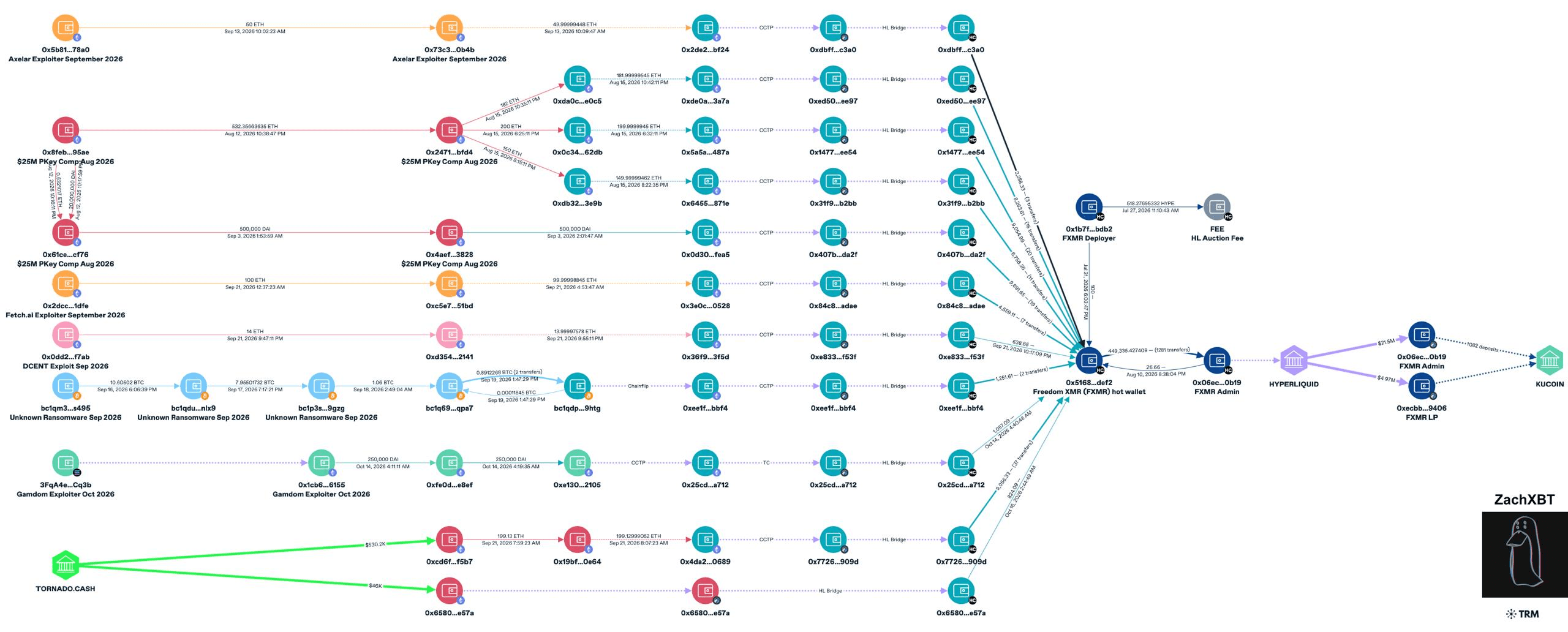
Bo Hines Tether: From White House Crypto Czar to USAT CEO
Oct 20, 20:29
Coinbase AgentKit vs Circle Agent Stack
Oct 20, 20:19
Intelligence Bureau: DeepSeek open-source inference framework banned by U.S. federal agencies; JPMorgan first includes Bitcoin in long-term return forecast
Oct 20, 20:06
Crossmint vs Privy vs Turnkey for Agent Wallets
Oct 20, 20:04