a16z in Conversation with Circle CEO: How Can Blockchain Counterbalance Centralization in the AI Era?
Circle's original goal was to bring the dollar onto the internet, so that dollars could circulate anywhere. After more than a decade of deep work in this field, the company's co-founder and CEO Jeremy Allaire began to wonder: what will happen to the world when the users of the internet increasingly become AI?
He sat down with Chris Dixon and Robert Hackett to explore the underlying logic of this new machine economy, and how credit, commerce, and global financial infrastructure will be affected. The following is the conversation:
Why build a new chain, Arc?
Robert Hackett: Joining us today are Jeremy Allaire, co-founder and CEO of Circle, which has just launched the mainnet of its self-developed blockchain Arc; and Chris Dixon, founding partner of a16z crypto.
Jeremy, I've known you since my days as a reporter at Fortune. I've watched Circle go through many transformations: from a bitcoin consumer business, to the Venmo-like payment product Circle Pay, to a trading business and acquiring an exchange. Ultimately, you built USDC, now one of the most influential stablecoins in the world. And now you're launching Arc, a new public chain.
First, I'd like to ask: why does the world need another blockchain? What is missing from existing infrastructure, and what can this new chain enable that wasn't possible before? What lessons along the way convinced you to build your own blockchain?
Jeremy Allaire: It goes back to the founding of Circle. In late 2012 to 2013, what drew me into this space was the idea of programmable money — the network itself becoming a computer that can run applications.
Our idea was to build an internet dollar protocol, essentially "the HTTP protocol of money." To achieve that, you need a computer network, and on top of it you build higher-level protocols, scale it, and make it easy to use.
Our philosophy gradually took shape: We wanted to ensure that the digital dollars we issue, along with the accompanying protocols, could run everywhere. We wanted USDC to be like Spotify or Netflix — users pick up a device and can use it directly. As long as there's a blockchain network, digital dollars can run properly and be easily integrated. After that, we built an interoperability layer to connect the various networks and enable secure movement of assets.
When stablecoins first appeared, people found that they solved the pain point of moving money, and demand for real, non-speculative use cases began to grow.
Then regulators began scrutinizing this space. If global financial institutions were going to plug into blockchains, the blockchains themselves had to meet a set of standards.
We started talking to a large number of institutions focused on stablecoins and their real-world applications, and found that no blockchain had been purpose-built for this coming mainstream era.
So we decided to build a brand-new operating system and network — Arc. This infrastructure can meet high standards, so that central banks around the world can recognize that this network can carry real money and investment contracts.
We wanted to build a network owned by a broad set of stakeholders, where users of the network are also owners. And in the process, we clearly realized that the network's primary users, software deployers, and operators are very likely to be AI in the future.
So we began researching all sorts of related questions, and we're still exploring them today. The core direction of our product design is the transition to an agent economy — that's the background of the project.
Arc: a compliant financial base layer for broad, global participation
Robert Hackett: Chris, you've seen countless pitches for new blockchain projects. What makes you believe there's still room in the market for a new public chain?
Chris Dixon: When we invest, what we value most is the team Jeremy has built.
I also share his vision. I've mentioned in many articles and talks that this is a new kind of computer — a global financial computer — with enormous platform potential that can spawn entirely new applications.
I also think Jeremy has a deep understanding of regulation and the international landscape. Money has extremely strong network effects, USDC itself has enormous influence, and the dollar is widely recognized around the world. Arc has the chance to become the base-layer network for global money.
Jeremy, I'd like to hear about your international strategy. How do you think about navigating the complex environment of governments and regulators across countries?
Jeremy Allaire: What's special about Arc is that to operate the network infrastructure — and in the future, to participate in staking and validation nodes — operators must meet stringent standards for operations, information security, compliance, and so on.
Infrastructure operators adhere to these standards and sign service-level agreements, which is what allows the network to achieve deterministic settlement finality in an extremely short time. For real-money transactions, this is critical.
On the other hand, what we envision is an internet-native economic operating system capable of carrying a full range of economic activity. Its function goes far beyond payments — all kinds of financial contracts, economic contracts, and governance decisions can run on it.
To reach internet-scale, the network must have diverse geo-economic and geopolitical distribution. The operation and governance of the infrastructure must remain credibly neutral toward all stakeholders — that's one of the commitments we've made.
Leading institutions in global capital markets, asset management, and payments, as well as major banks covering markets in Europe, the Americas, and Asia, have already come on board. This is only the beginning; we hope to bring in a more diverse set of infrastructure participants.
We look forward to a future where major geo-economic blocs around the world can operate this infrastructure, hold meaningful economic stakes in the network, and where leading local enterprises use it. This is crucial — without a diverse ecosystem, it's hard to achieve internet-scale adoption. Tools like blockchains and distributed governance happen to support this goal, and that's a core driver for us. Of course, everything is still in its early days.
The moat: stablecoin liquidity and CCTP cross-chain infrastructure
Robert Hackett: Jeremy, how do you view your moat and competitive barriers?
Jeremy Allaire: First is the stablecoin network, including USDC, the euro stablecoin, and other digital assets we issue. We also have tokenized bitcoin products, as well as leading-scale tokenized treasury and money market products. USDC is unquestionably the core of the entire system.
The more applications that plug into the network, the more useful it becomes. Developers will naturally choose this network going forward, because the ecosystem is rich enough, creating a powerful utility flywheel.
Our quarterly stablecoin minting and redemption volume reaches $150 billion, and we're connected to major banking systems around the world. Ample liquidity in on-chain primary and secondary markets gives us strong competitiveness. The deep underlying liquidity on platforms like Binance, Coinbase, and Hyperliquid improves capital efficiency, and other products that need efficient capital benefit as a result.
That's utility network effects and liquidity network effects. Beyond that, there's an infrastructure moat — we've built compliant infrastructure in multiple locations around the world, and that's a high barrier to entry.
There's also interoperability infrastructure. Circle's Cross-Chain Transfer Protocol, CCTP, is currently the most widely used cross-chain protocol across all blockchains and all asset classes. The reason it's so widespread is precisely that USDC is the digital currency with the largest volume moving across networks.
A major highlight of Arc is that any asset issued on Arc — whether tokenized equity, stablecoins, or tokenized credit products — can tap into CCTP's transfer capabilities.
Simply put, we've built a highway for value transfer. In the past, only one kind of vehicle — USDC — could drive on it. Now, all asset issuers can use this high-speed network and share in its interoperability and liquidity.
The stablecoin market is winner-take-most, but not winner-take-all. As the market grows from hundreds of billions to trillions of dollars, there will be multiple networks.
Coming back to Arc itself, I think the industry is entering a new phase. In my view, a blockchain is fundamentally an economic operating system that attracts developers and assets.
This space is still vast, and no one currently owns the developer mindshare. Compared to traditional internet platforms, the number of active developers on all public chains is very small — the industry is still in its very early days. So my judgment is that no one has an absolute moat.
Also, the core participants in the future ecosystem will be AI developing software. There may be humans behind the AI, or there may be scenarios where AI develops software autonomously; AI will act as an intermediary to carry out all kinds of economic work.
AI + blockchain, giving rise to new credit and economic models
Chris Dixon: I believe that over the next 10 to 20 years, the digital economy landscape will be restructured, and the rise of high-performance blockchains (like Arc) coincides exactly with this window. I'm used to understanding the industry through the framework of "skeuomorphic applications" and "native applications." In the early days of a new technology, people just move existing scenarios onto the platform — for example, trading and human payments.
But a few years later, the most exciting moment arrives: developers begin to truly unleash their imagination and create entirely new things.
Jeremy Allaire: I completely agree. We want to give developers and entrepreneurs fertile ground for free innovation.
Credit is one example. A brand-new blockchain operating system, a fully-reserved digital dollar base layer, plus AI — the combination of the three can create entirely new credit instruments, where the suppliers and demanders of capital can be humans or machines. This kind of credit market would look more like an ad-bidding platform than the traditional model of packaging and selling bonds.
Market structure, unit economics, distribution models, and reach will all be completely transformed. Tokenized real-world assets (RWA) have already enabled more people to participate in equity investment and given assets more ways to be used — we're already seeing early signs of this.
Robert Hackett: Jeremy, what's the strangest project you've seen developers building on Arc so far?
Jeremy Allaire: A few days ago I saw a project called Fly Brain — I don't know the background of the development team. The project compiles all the neural information of a fruit fly's brain, and the fruit fly brain's actual computational rules, into 16MB of bytecode and runs it on Arc.
The developers use AI to build an interaction layer, and these "fruit fly brain" agents evolve autonomously and interact with each other within the network. I haven't studied its token incentive mechanism yet, so I'm not sure of its design purpose.
My first reaction was: what is this actually for? I even asked about it on X. The project comes with a lot of explanation, claiming it could help achieve scientific breakthroughs; of course, it could also just be a gimmick. But the project itself represents a trend: when AI combines with this kind of computer network and economic mechanism, people will start trying all sorts of wildly imaginative innovations.
Robert Hackett: A fruit fly brain network on Arc gives "agent swarm" a whole new meaning.
Jeremy Allaire: There's another project coming to Arc soon, specifically an arbitration mechanism for AI work.
This mechanism can extend from AI jurors and AI arbitrators all the way to human arbitrators, with an accompanying staking security model. The design intent is to handle scenarios where AI hires AI, or humans hire AI, to complete tasks — when disputes arise, you need an arbitration mechanism, along with rules for fund custody and payment release.
Chris Dixon: In a sense, blockchain can hedge against AI's centralizing tendency.
Machines become the primary participants of the internet
Robert Hackett: Chris, you wrote "Read Write Own" a few years ago, when AI was still in its infancy. How have your ideas changed since then?
Chris Dixon: Actually, the book discusses AI extensively and lists it as one of the core directions. My core view is this: AI is powerful, but it inherently has a centralizing tendency — large companies with abundant capital and resources will form a huge advantage. Blockchain can counterbalance this trend to a certain extent.
Open source is crucial — it's the most inclusive trend in the history of technology, and Linux is the best example. Blockchain is similar to open source in that it's an open service, providing developers with a fair underlying environment, with features like low fees and global accessibility.
Robert Hackett: Please paint a picture of five years from now. With these new technologies converging, what changes will occur in the global financial system?
Jeremy Allaire: Frankly, no one can give a definitive answer at this stage. The pace of technological iteration has reached the peak of human history.
But I believe that in the coming years, a great deal of intellectual work, creative work, and all kinds of economic transactions and value exchange will be dominated by AI agents. This is the machine economy, and this infrastructure will support its realization. By then, the scale of economic output will far exceed today's, and the number of products and services available globally will increase by several orders of magnitude. That's the world I envision five years from now.
Chris Dixon: As Jeremy said, many future scenarios are hard to imagine, but the direction of the trend is clear. The vast majority of participants on the internet will very likely be machines. When these machines carry out activities, they naturally need economic capability — that's what I call the network of the machine age.
Join the official Coincamps community:
Telegram: https://t.me/coin_camps
Recommended
ZachXBT Exposes Money Laundering Service FreedomXMR in Hyperliquid Ecosystem: 87% of Inflows Tied to Illicit Activity, Exceeding $20 Million
Oct 20, 20:38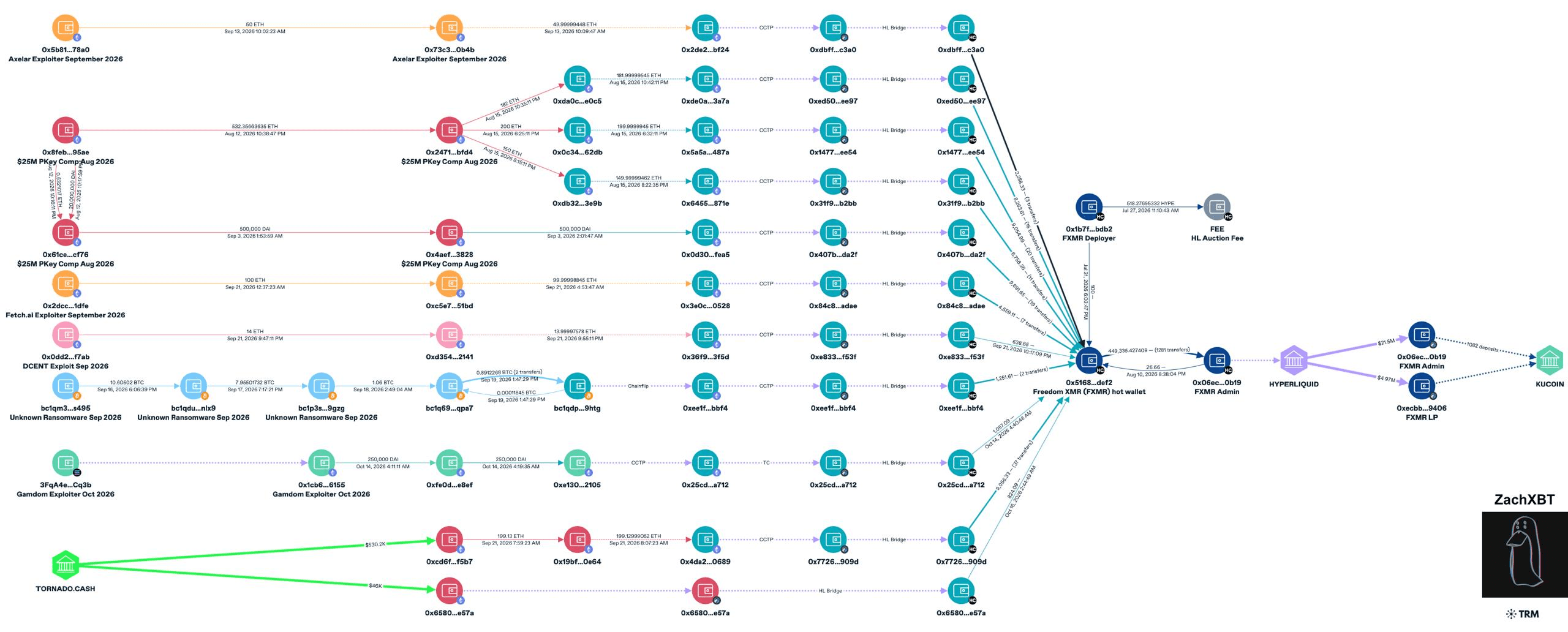
Bo Hines Tether: From White House Crypto Czar to USAT CEO
Oct 20, 20:29
Coinbase AgentKit vs Circle Agent Stack
Oct 20, 20:19
Capital as Production Capacity: Where Did the Money of America's Top 100 VCs and CVCs Go in the First Three Quarters of 2026?
Oct 20, 20:12Intelligence Bureau: DeepSeek open-source inference framework banned by U.S. federal agencies; JPMorgan first includes Bitcoin in long-term return forecast
Oct 20, 20:06
Crossmint vs Privy vs Turnkey for Agent Wallets
Oct 20, 20:04