Bo Hines Tether: From White House Crypto Czar to USAT CEO
Bo Hines runs USAT, the US stablecoin Tether launched in January 2026 through Anchorage Digital Bank. On 15 October 2026 a Wall Street Journal investigation reported that a consulting firm he co-owned earned about $6.3 million from a Tether deal, with the first payment landing while he was steering the GENIUS Act from the White House (crypto.news summary of the WSJ report).
No charge or regulatory action against Hines has been announced, and his firm denies he was involved. But the story lands on the one executive Tether picked to prove it can operate inside the US rulebook he helped write.
This profile maps Bo Hines Tether history from college football to two House races, the White House crypto council and the USAT chair. It lays out what the Journal reported, what USAT's numbers show, and our take on what the report means for Tether's American bet.
Key Takeaways
- Bo Hines has been CEO of Tether USAT since September 2025, after leading the White House crypto council from January to August 2025 (Tether; Wikipedia).
- The WSJ reported that Nxum, a firm Hines co-owned with a one-third stake, earned about $6.3 million under a Tether contract (crypto.news).
- Nxum says Hines was not involved in its Tether dealings while in government and received no Tether-derived funds then (Unchained).
- USAT supply was about $183.3 million on 20 October 2026, roughly 0.10% of USDT's $183.0 billion (DefiLlama; we calculation).
- The GENIUS Act gives US platforms until 18 July 2028 to stop offering stablecoins from non-permitted issuers, a window Hines reportedly pushed to lengthen (GENIUS Act text).
📌Our framing: USAT exists to show that Tether can run a federally supervised dollar under American leadership. That makes Hines the product as much as the token. A conflict story about him is a story about USAT's core pitch.
Who Bo Hines is
Robert Nicholas "Bo" Hines was born on 29 August 1995 in Charlotte, North Carolina. He holds a BA from Yale and a JD from Wake Forest University School of Law, which he received in 2022 (Wikipedia).
Tether's own biography calls him "a former standout athlete and public policy leader" with a record in law, governance and digital asset regulation (Tether). He was 29 when he worked on the GENIUS Act, as Fortune noted (Fortune).
His job today is narrow and high-stakes. He leads Tether USAT, the US business Tether said would be headquartered in Charlotte (CNBC).
From college football to two House races
Hines first made headlines as a wide receiver. As a freshman at NC State in 2014 he led the team with 45 receptions and 616 receiving yards and was named a Freshman All-American (Wikipedia).
He transferred to Yale in 2015 because of his interest in politics, caught 11 passes in four games, then lost most of two seasons to a shoulder injury and retired from football in 2017 (Wikipedia).
Politics came next. Hines won the 2022 Republican primary in North Carolina's 13th district with Donald Trump's endorsement and narrowly lost the general election to Democrat Wiley Nickel. In 2024 he finished fourth in the 6th district primary (Wikipedia).
Between those races he started a business. Nxum, the firm at the center of the WSJ report, was co-founded in 2022 by Hines, his father Todd Hines and marketing executive Gary Dennis, with equal stakes (Fortune).
Bo Hines career timeline
The table below pulls every dated step from public records, company releases and the October 2026 reporting. Where a claim comes from the Journal's investigation, it is labeled as reported.
| Date | Milestone | Source |
|---|---|---|
| 29 Aug 1995 | Born in Charlotte, North Carolina | Wikipedia |
| 2014 | NC State wide receiver; Freshman All-American | Wikipedia |
| 2015 to 2017 | Transfers to Yale; retires from football after a shoulder injury | Wikipedia |
| 2022 | Co-founds Nxum with Todd Hines and Gary Dennis; earns JD from Wake Forest | Fortune; Wikipedia |
| Nov 2022 | Loses NC-13 general election to Wiley Nickel | Wikipedia |
| 2024 | Finishes fourth in the NC-6 Republican primary | Wikipedia |
| 20 Jan 2025 | Becomes executive director of the President's Council of Advisers on Digital Assets | Wikipedia |
| Apr 2025 | Nxum partners meet Tether CEO Paolo Ardoino in New York (reported) | Fortune |
| 11 May 2025 | First $2.49 million Tether installment sent via Bitfinex (reported) | crypto.news |
| 18 Jul 2025 | GENIUS Act signed into law | GENIUS Act text |
| 9 Aug 2025 | Announces he is leaving the White House | Wikipedia |
| 19 Aug 2025 | Tether names him Strategic Advisor for Digital Assets and US Strategy | Tether |
| 12 Sep 2025 | Tether unveils USAT and names him CEO of Tether USAT | Tether; CNBC |
| 15 Sep 2025 | Anchorage Digital confirmed as USAT issuer | Anchorage Digital |
| 27 Jan 2026 | USAT launches on Bybit, Crypto.com, Kraken, OKX and MoonPay | Tether |
| 29 Jul 2026 | USAT goes live on Celo, its first chain beyond Ethereum | We |
| 15 Oct 2026 | WSJ publishes its Nxum and Tether investigation | crypto.news; Fortune |
Inside the White House: the GENIUS Act push
Trump named Hines executive director of the President's Council of Advisers on Digital Assets in December 2024, and he took office on 20 January 2025. Press accounts called the post the White House's digital policy czar (Wikipedia).
His signature file was stablecoins. Wikipedia says he helped shepherd the GENIUS Act into law (Wikipedia). Trump signed it on 18 July 2025 (GENIUS Act text).
He didn't stay long after the win. Hines announced his exit on 9 August 2025, 22 days after the signing (Unchained).
The move to Tether: adviser to USAT CEO
Tether hired him ten days later. On 19 August 2025 it named Hines Strategic Advisor for Digital Assets and US Strategy, effective immediately (Tether).
Paolo Ardoino framed the hire around Washington know-how: "His deep understanding of the legislative process, combined with his passion for practical blockchain adoption, makes him an invaluable asset as Tether enters the biggest market in the world" (Tether). The same release said Tether Investments had already reinvested almost $5 billion in the US. Ardoino's own path is in our Paolo Ardoino profile.
Less than a month later, on 12 September 2025, Tether unveiled USAT and named Hines its future CEO. Anchorage Digital Bank would issue the token, and Cantor Fitzgerald would act as reserve custodian and preferred primary dealer (Tether; Anchorage Digital).
USAT launched on 27 January 2026. "Our focus is stability, transparency, and responsible governance," Hines said in the launch release, which listed Bybit, Crypto.com, Kraken, OKX and MoonPay as first-phase venues (Tether).
CoinDesk reported that Tether was aiming for a $1 trillion USAT market cap within five years (CoinDesk). USAT's own site states that Tether Operations is not the issuer; Anchorage Digital Bank is (USAT.io).
USAT by the numbers under Hines
Here's how USAT has grown since launch, using DefiLlama's daily supply series. Every figure is linked to its source.
| Metric | Date | Value | Source |
|---|---|---|---|
| First DefiLlama reading | 29 Jan 2026 | $20.0 million | DefiLlama |
| Peak supply | 12 Jun 2026 | $187.5 million | DefiLlama |
| Celo launch | 29 Jul 2026 | About $185 million market cap | We |
| Latest supply | 20 Oct 2026 | $183.3 million | DefiLlama |
| USDT supply | 20 Oct 2026 | $183.0 billion | DefiLlama |
| USDC supply | 20 Oct 2026 | $72.18 billion | DefiLlama |
Our read: USAT grew about 9.4x from its first reading to its June peak, then went flat. It sits about 2.2% below that peak, and it equals roughly 0.10% of USDT, 0.25% of USDC and 0.06% of the $304.4 billion stablecoin market DefiLlama tracks (DefiLlama; we calculation).
One caveat. DefiLlama's USAT page lists Ethereum balances only, so any native Celo supply may sit outside these figures (DefiLlama).
Now set that against the $1 trillion goal CoinDesk reported. Getting from $183.3 million to $1 trillion by January 2031 means growing about 5,455x, or roughly 650% a year compounded for a little over four years (CoinDesk; we calculation). Nothing in the last four months of flat supply points that way yet.
For background on the token itself, see our USAT on Celo report.
🧭Pattern to watch: USAT's growth came in one burst between April and June 2026 and has stalled since. A CEO whose main asset is regulatory trust now has to sell that trust while a conflict story about him circulates.
What the WSJ reported about Nxum and Tether
The Journal's 15 October investigation rests on company documents, Signal messages, blockchain payment records and interviews (crypto.news). We has not reviewed those documents. What follows is what the report and follow-up coverage say.
The deal. In April 2025, marketing entrepreneur Peter Vincer arranged for Todd Hines and Gary Dennis to meet Ardoino near Central Park. A draft "Tether Comprehensive Brand Plan" proposed that Nxum lead "strategic lobbying and a full scale public relations and media awareness campaign" (Fortune).
The contract. The final agreement dropped lobbying and was signed by Vincer's agency, Notorious, as an intermediary. Tether agreed to pay $415,000 a month in six-month installments for at least two years (crypto.news).
The payments. The Journal traced three installments, summarized below. Nxum's earnings came to about $6.3 million, per the report (crypto.news).
| Date | Reported transfer | Hines's status | Source |
|---|---|---|---|
| 11 May 2025 | $2.49 million via Bitfinex to Vincer; he kept $498,000 and forwarded the rest to a Nxum wallet | Hines in the White House | crypto.news |
| Dec 2025 | $2.49 million to Nxum-controlled wallets | After he left government | crypto.news |
| Apr 2026 | $2.49 million to Nxum-controlled wallets | After he left government | crypto.news |
The messages. While in office, Hines took part in a Nxum Signal chat and relayed GENIUS Act talking points as his partners talked with Ardoino, the Journal reported (Unchained). Protos said it matched the first transfer to onchain records consistent with the report, while noting it could not be certain (Protos).
The denials. A Nxum representative told the Journal that Hines "did not receive any Tether-derived funds during that period, and had no economic relationship of any kind with Tether while serving in the White House." Nxum also said Tether could simply use its market weight to argue for a longer compliance period. Tether did not respond to the Journal (Unchained).
After the White House. The report says Nxum pitched Tether on buying 25% of the firm for $56 million, and that Fellowship PAC, chaired by Tether's head of government affairs Jesse Spiro, raised at least $11 million and paid more than $6.5 million to Nxum (crypto.news). A 25% stake at $56 million implies a $224 million valuation for Nxum (we calculation).
The 18 versus 36 month window, in dates
The most consequential claim is about timing. People involved in the negotiations told the Journal that Hines pushed lawmakers to stretch a key compliance window from 18 to 36 months, and that Tether benefited most (Unchained).
We put dates on it. The enacted law makes it unlawful, beginning 3 years after enactment, for a digital asset service provider to offer or sell a payment stablecoin in the US unless a permitted issuer issued it (GENIUS Act, Sec. 3(b)). With enactment on 18 July 2025, that date is 18 July 2028.
| Window | US platform deadline | Source |
|---|---|---|
| 18 months (original proposal, reported) | 18 Jan 2027 | Unchained |
| 36 months (enacted) | 18 Jul 2028 | GENIUS Act text |
| Extra time for non-permitted issuers | 18 months | We calculation |
That extra year and a half matters most to issuers that are not yet permitted, and the largest is Tether, with $183.0 billion of USDT in circulation today (DefiLlama). Nxum disputes the framing and says the longer period came out of talks among many stakeholders (crypto.news). For what the deadline means for holders, read what happens to USDT in the US after July 2028.
The downside: what the Nxum report means for USAT
Trust is the product. Tether unveiled USAT and named Hines in the same release, promising "American leadership from day one" (Tether). A US bank treasurer weighing USAT against USDC now has a governance question to answer before a yield or liquidity one.
More scrutiny is already queued. On 8 October 2026, Senator Richard Blumenthal, ranking member of the Permanent Subcommittee on Investigations, asked Cantor Fitzgerald, USAT's reserve custodian, for records on its Tether ties by 23 October 2026, including communications with members of the President's Council of Advisors on Digital Assets (PSI letter). The letter claims Cantor's 5% Tether stake rose from $600 million to an estimated $10 billion.
Ethics questions stay open. A CREW ethics counsel told the Journal that federal officials generally face limits on working on matters tied to their financial interests. Nxum says Hines recused himself and that ethics rules did not require him to divest; the White House said it expects officials to follow ethics laws (crypto.news).
Growth has stalled. USAT supply has stayed between $183 million and $188 million since June (DefiLlama). That's a thin base from which to absorb a reputational hit.
What we doesn't know. The Journal's documents are not public, Tether has not commented, and no regulator has announced an action against Hines. Readers should treat the payment trail as reported, not proven.
💡Our take: USAT's structure is sound on paper, with a federally chartered issuer and a named reserve custodian. The weak point is the person chosen to front it. Until Tether answers the Journal's questions in public, every USAT pitch to a US institution starts with Bo Hines rather than with the token, and that is a cost Tether chose when it hired the law's chief White House advocate a month after it passed.
Who should watch Bo Hines and USAT (and who can skip it)
Watch closely if you're a US exchange, fintech or bank choosing a GENIUS-aligned dollar for settlement. USAT is issued by a federally chartered bank, which is the core of its pitch, but its leadership is now part of the due-diligence file (Anchorage Digital).
Watch too if you hold USDT through a US platform, because the July 2028 deadline is when non-permitted coins must leave US platforms unless the foreign-issuer path applies (GENIUS Act text). What sits behind USDT today is covered in what backs Tether USDT.
You can skip the drama if you only use stablecoins outside the US. USAT is built for the American market, while USDT keeps operating globally (Tether).
Our take for Monday: if USAT is on your shortlist, ask Tether three things. Whether Hines had any role in the Nxum contract after he joined Tether, whether Tether still pays Nxum, and how Anchorage reports USAT's reserves.
FAQ
Who is Bo Hines?
Bo Hines is the CEO of Tether USAT, the US-regulated stablecoin business of Tether. He was executive director of the White House crypto council from January to August 2025 and earlier played college football at NC State and Yale.
What is Bo Hines's role at Tether?
He leads Tether USAT. Tether hired him as a strategic adviser on 19 August 2025 and named him CEO of Tether USAT on 12 September 2025.
What did the Wall Street Journal report about Bo Hines and Tether?
The Journal reported on 15 October 2026 that Nxum, a firm Hines co-owned, earned about $6.3 million from a Tether contract, with the first payment made while he worked on the GENIUS Act. Nxum denies he was involved or received Tether-derived funds while in office.
Is USAT the same as USDT?
No. USAT is a separate token built for the US market and issued by Anchorage Digital Bank, while USDT is Tether's global stablecoin. Cantor Fitzgerald is USAT's reserve custodian.
How big is USAT?
DefiLlama showed about $183.3 million of USAT on 20 October 2026, roughly 0.10% of USDT's supply. Supply peaked at about $187.5 million in June 2026.
What is the GENIUS Act deadline for stablecoins?
From 18 July 2028, US digital asset service providers may not offer payment stablecoins from non-permitted issuers, with limited exceptions. The law itself takes effect earlier, on the sooner of 18 months after enactment or 120 days after final rules.
Did Bo Hines break any law?
No charge or regulatory action against Hines has been announced. The Journal raised ethics questions, and Nxum says he recused himself and was not required to divest his stake.
This content is provided for informational and educational purposes only and does not constitute financial, investment, legal, or tax advice; no material herein should be interpreted as a recommendation, endorsement, or solicitation to buy or sell any financial instrument, and readers should conduct their own independent research or consult a qualified professional before any decision to buy or sell.
Join the official Coincamps community:
Telegram: https://t.me/coin_camps
Recommended
a16z in Conversation with Circle CEO: How Can Blockchain Counterbalance Centralization in the AI Era?
Oct 20, 21:45ZachXBT Exposes Money Laundering Service FreedomXMR in Hyperliquid Ecosystem: 87% of Inflows Tied to Illicit Activity, Exceeding $20 Million
Oct 20, 20:38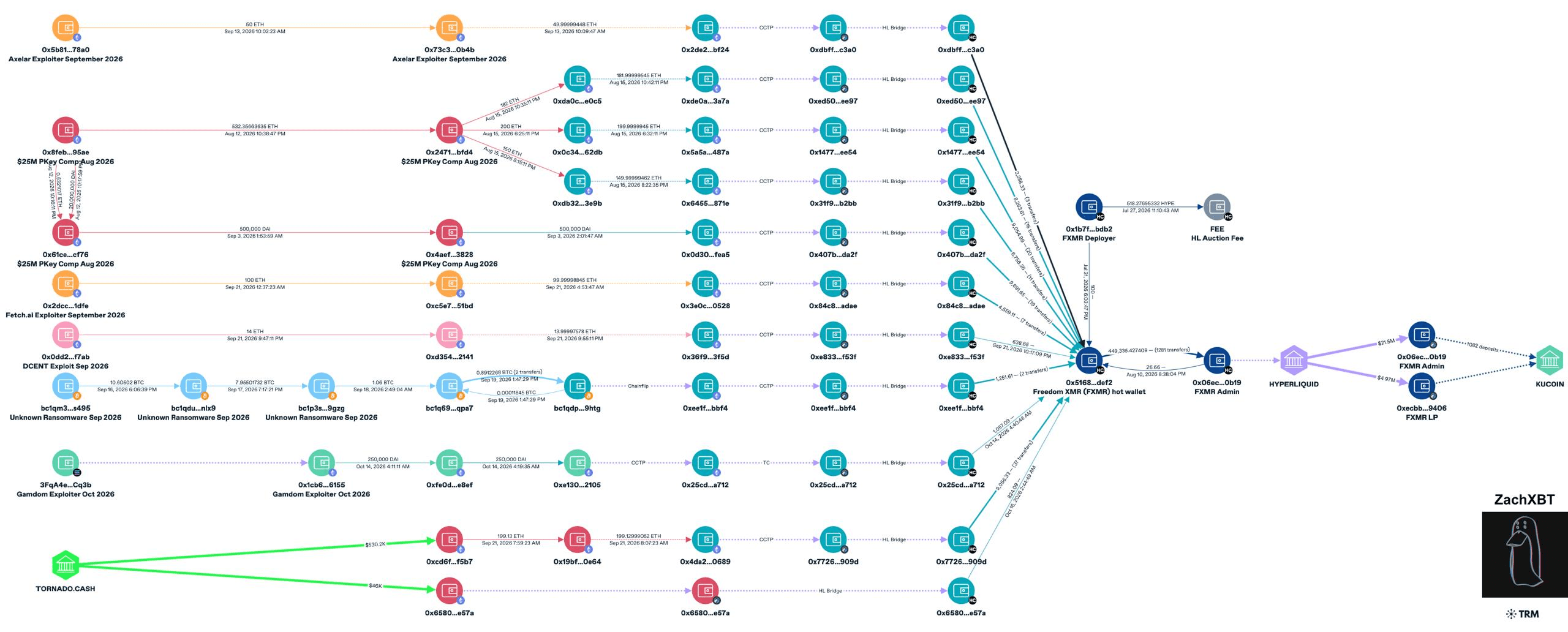
Coinbase AgentKit vs Circle Agent Stack
Oct 20, 20:19
Capital as Production Capacity: Where Did the Money of America's Top 100 VCs and CVCs Go in the First Three Quarters of 2026?
Oct 20, 20:12Intelligence Bureau: DeepSeek open-source inference framework banned by U.S. federal agencies; JPMorgan first includes Bitcoin in long-term return forecast
Oct 20, 20:06
Crossmint vs Privy vs Turnkey for Agent Wallets
Oct 20, 20:04