Programmable Trading Is Here: How Does Hook Become the 'Brain' of the Trading Pool?
Claus splits trading fees to fund buybacks, token burns, liquidity provision, and rewards for NFT holders.
Their financial mechanics are tightly linked to real-world weather patterns. Claus allocates trading fees across buybacks, burns, liquidity injection, and NFT holder rewards. At one stage, weather reports from London Heathrow Airport determined how much capital was burned versus recycled into the pool to support trading. Rain favored token burns, while clear skies favored liquidity. If weather data becomes unavailable, capital is split equally.
This was merely one feature plugged into Claus's trading pool. On October 14, the team announced they would disable arbitrage functionality while retaining the token contract address, trading pool, and all other features. Existing holders can keep their tokens without migrating. This seamless upgrade is made possible by Uniswap v4's upgradeable Hooks.
Before Hooks, developers could already give tokens custom logic, but integrating them seamlessly into the broader DeFi ecosystem proved difficult.
The first approach was hardcoding rules directly into the token contract. This spawned "tax tokens" on Ethereum—ERC-20 tokens that automatically deduct a fee whenever transferred. If you send 100 tokens to swap, the contract keeps 2, leaving only 98 to enter the pool. Meanwhile, the exchange router expects exactly 100, causing the trade to fail.
Uniswap v3 documentation notes that these tax tokens are incompatible with standard routing contracts. Developers had to rely on wrapper contracts or custom routers. While tax tokens can fund reward pools, they complicate trading, and many exchanges cannot accommodate automatic fee deductions.
Alternatively, developers could build standalone protocols around specific pools or modify exchange code to launch dedicated DEX forks. However, building an entirely new infrastructure costs far more than the functionality itself.
Hooks give developers a dedicated carrier for trading rules. They enable capabilities such as:
- Deducting fees only during swaps to fund buybacks or rewards, without taxing regular wallet transfers;
- Automatically adjusting trading fees based on market volatility;
- Distributing captured arbitrage profits to traders and liquidity providers;
- Restricting pool access to whitelisted wallets only;
- Lending idle liquidity to lending protocols to generate yield when not being swapped;
- Implementing these features within existing exchanges without deploying and maintaining separate DEXs.
Hooks have also birthed an entirely new business model: products whose core offering is customizable pool trading logic.
On October 14, Uniswap launched VolatilePair, a Hook that implements dynamic trading fees for both buyers and sellers, initially deployed on an ETH/USDC pool. According to official announcements, its predecessor, the StablePair Hook, generated $3.1 billion in trading volume within its first four weeks.
Other teams are also dynamically adjusting fees based on asset types.
Fables, a DEX on Robinhood Chain, adopts this approach. It supports trading tokenized stocks and other assets, using Hooks to adjust fees based on time, volatility, and other signals. When underlying stock markets are closed, tokenized stocks can still trade, but reliable pricing data and hedging opportunities become scarce.
The rationale behind dynamic fees is straightforward: providing liquidity during volatile periods involves fundamentally different risks compared to normal market hours.
Fables deploys via Hookr, a platform on Robinhood Chain offering 22 pre-built "Hook modules" for creators to toggle on. These include sniper protection, auto-burn mechanisms, and What The Hook—which captures inter-pool arbitrage before MEV bots and distributes profits to traders and LPs. Hookr’s token launch toolkit natively includes this service.
Third-party pools integrating What The Hook adopt default profit-sharing rules: 45% to LPs, 5% to traders, 40% to the treasury, and 10% to referrers. What The Hook is the only tool publicly tracking these metrics, with the majority of distributed arbitrage profits retained in its own treasury.
Solana Ecosystem
Uniswap protocol has not been deployed on Solana. Trading is scattered across multiple DEXs like Raydium, Orca, and Meteora. Without a unified PoolManager to mount Hooks, Solana embeds Hooks directly into the token itself.
Solana’s new Token-2022 standard supports adding transfer Hooks to tokens. Every time a token moves, the program executes, covering swaps, wallet-to-wallet transfers, and any other transfers. It can validate rules, such as checking if the recipient holds qualified status, and block transfers that don’t meet criteria.
Hocked is Solana’s token launch platform. Every token issued on the platform comes with a built-in transfer Hook. Creators can choose from 39 predefined rule sets, such as "hot potato" mechanics requiring a 15-minute holding period before selling, or use AI to generate custom rules. Each rule includes plain-language descriptions, and some tokens allow project teams or holders to vote on future rule updates. Every transaction charges a 1% fee, mostly allocated to buyback and burning the platform’s native Hocked token.
However, there are limitations. Unless approved by administrators, Raydium will not create trading pools for tokens with transfer Hooks. Meteora supports these tokens along price curves; however, once tokens migrate to main trading pools, the transfer Hook logic is stripped away. Hocked’s workaround is to keep tokens permanently on the curve, ensuring rules remain active indefinitely.
In Uniswap v4, rules are attached to the trading pool. The same token can trade in Hook-enabled pools or standard non-Hook pools. Users can choose their pool manually, or routing protocols can auto-select.
Solana’s transfer Hook logic operates differently: rules are bound to the token itself. Any token transfer triggers the rule, including wallet-to-wallet transfers. Both approaches have supporting ecosystems downstream: routing protocols decide which pool receives trades, while exchanges decide which token features to support.
Developers now have more tools to design markets, but their choices will ultimately determine whether projects attract users and liquidity.
What Upgradeable Rules Could Change
I believe the upgradeable nature matters far more than the Hook mechanism itself. Fixed Hooks are essentially enhanced tax tokens. They transform a token’s trading environment into something akin to an app that accepts version updates.
Previously, modifying token logic required migration. Projects deploy new contracts, request all holders swap tokens, ask exchanges to relist, and liquidity splits across old and new versions. For example, Polygon’s MATIC-to-POL migration in September 2024 required all holders to swap at a 1:1 ratio, and exchanges had to facilitate user transitions.
Migrations always leave some holders behind. Upgradeable Hooks allow projects to modify token trading behavior without mass migrations, drastically lowering trial-and-error costs.
The most valuable application of Hooks may not be Memecoins. I’m thinking of tokenized securities—real-world asset trading rules inherently evolve. A fund might open new investor quotas for different regions, requiring updated eligibility checks. Upgradeable Hooks can adjust these rules while keeping existing trading pools intact. They won’t alter investors’ legal rights or delete restrictions baked into the token contract, but they allow trading venues to adapt alongside regulatory changes. For long-running markets, this capability is far more practical than locking all rules at launch.
Funds may need to update trading rules, while Memecoin communities may want rules set in stone, immune to project team interference. Both demands are reasonable. With upgradeable Hooks, I’d scrutinize what controllers can modify. Updating investor eligibility is one thing; altering fee structures or rerouting reward funds exerts significantly stronger control over pool participants.
I want time to review updates that impact my capital, and the option to exit if I disagree. Projects can build notification waiting periods and limit developer modification scopes into the contract. Abolishing upgrade permissions entirely prevents future changes but also sacrifices the ability to patch vulnerabilities. Before depositing funds, I’ll carefully audit these clauses alongside expected fees and returns.
Claus calls Hooks the token’s "brain". In the future, project teams could let AI agents automatically update Hooks based on market conditions. For example, an AI could adjust fees within team-defined boundaries and explain every change. This automation is attractive, but I’d verify who sets the AI’s boundaries and who holds shutdown authority if it makes bad decisions.
Money has always had its own agenda. During the Great Depression in 1932, the Austrian town of Wörgl issued local scrip. To keep banknotes valid, holders had to purchase 1% face-value stamps monthly. Who wants to hold depreciating money? This design incentivized spending rather than hoarding.
Local government funded public works using this system and allowed residents to pay taxes, including back taxes, with the currency. In 1933, Austria’s central bank intervened, ending the experiment.
In that era, governments controlled monetary rules, shaping how people spent and saved. Today, blockchain enables developers to write custom rules for independent tokens and markets, allowing buyers to freely pick frameworks that match their needs.
Choosing a token is ultimately a judgment call on whether its rule framework aligns with your preferences.
Join the official Coincamps community:
Telegram: https://t.me/coin_camps
Recommended
a16z in Conversation with Circle CEO: How Can Blockchain Counterbalance Centralization in the AI Era?
Oct 20, 21:45ZachXBT Exposes Money Laundering Service FreedomXMR in Hyperliquid Ecosystem: 87% of Inflows Tied to Illicit Activity, Exceeding $20 Million
Oct 20, 20:38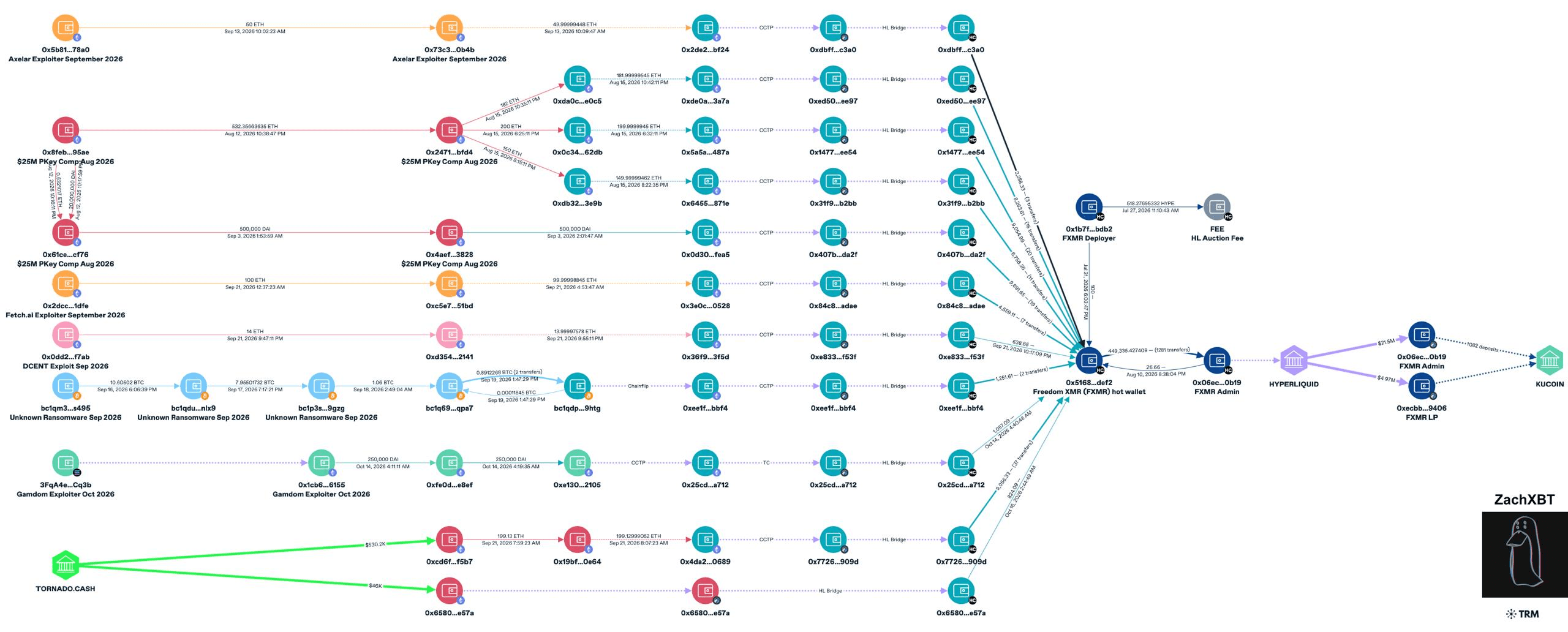
Bo Hines Tether: From White House Crypto Czar to USAT CEO
Oct 20, 20:29
Coinbase AgentKit vs Circle Agent Stack
Oct 20, 20:19
Capital as Production Capacity: Where Did the Money of America's Top 100 VCs and CVCs Go in the First Three Quarters of 2026?
Oct 20, 20:12Intelligence Bureau: DeepSeek open-source inference framework banned by U.S. federal agencies; JPMorgan first includes Bitcoin in long-term return forecast
Oct 20, 20:06