Solana Breakpoint 2026 London Notes: Solana's Coming of Age and the Token Supercycle

In November London, the rain pours with unapologetic persistence.
Olympia Convention Centre, this old Victorian venue has hosted countless major events, but crammed with over 8,000 crypto natives flying in from more than 100 countries, even the air feels charged.

Source: X @solana
After years of holding Breakpoint, the first-time departure from sunny climes to Europe landed right on London.
Solana Foundation President Lily Liu explained the location choice with just one sentence: "Modern capital markets were born here. The opportunity now is to build a global, round-the-clock market where anyone with an internet connection can participate."
Two years ago, this would have been dismissed as mere presentation rhetoric, but in London in 2026, Solana actually delivered on its promises.
Seven Years in Beta, Finally Shedding the Label
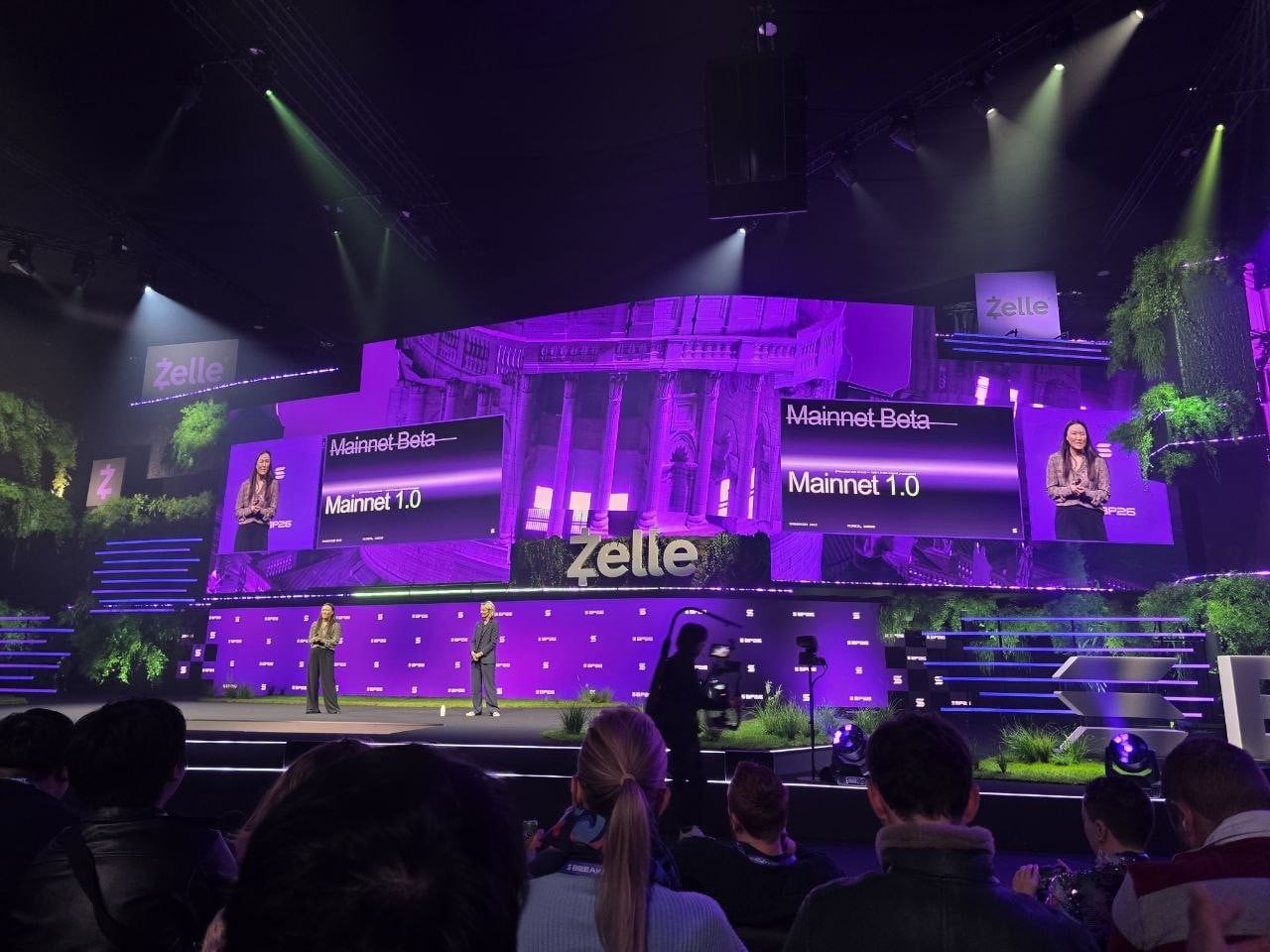
The bombshell announcement at the opening of the conference had nothing to do with token launches or fundraising: Solana's mainnet officially upgraded from Beta to 1.0.
Calculated from the Beta launch in March 2020, this chain ran under the "beta" label for approximately six years and eight months.
Through the years, it endured outages, was dragged into the mud by FTX, and faced repeated declarations of its demise.
When Lily Liu announced Mainnet 1.0 from the stage, the applause lasted a long time—a feeling of release reminiscent of an emotional reunion.
Source: X @stakecraft
The version number changed, and so did the underlying infrastructure.
A month before the conference, Solana had just completed a four-phase upgrade to achieve 200-millisecond block times. Officially activated on October 9 in Epoch 1053, its block production opportunities doubled from 2.5 to 5 per second.
The Alpenglow consensus protocol has also gone live on mainnet, squeezing transaction finality down to 150 milliseconds.
This chain's engine has been completely replaced.
A Two-Day Agenda, Sharply Divided
The theme for Breakpoint 2026 is "Token Supercycle," and the two-day agenda carefully outlines Solana's strategic intent.
The first day, titled "The Supercycle, Today," was dubbed "Boomer Day" by insiders.
On stablecoins, cross-border payments, tokenized RWAs, and macroeconomics, the panel featured Scott Lucas, Head of Digital Assets at Barclays; Malcolm Clarke, Global Head of Digital Assets at Western Union; Patrick Corker, Innovation Director at BNY Mellon; and Alexandra Lang, VP of Digital Asset Partnerships at Zelle.
This lineup would be fitting for any traditional financial summit, yet they sat at a cryptocurrency conference.
The focus shifted on the second day to "The Supercycle, Tomorrow," covering AI Agents, prediction markets, consumer applications, and programmable capital.
Balaji Srinivasan discussed network states, while Y Combinator Visiting Partner Nemil Dalal spoke about on-chain entrepreneurship—the tone made a complete shift.
The first day told traditional finance that "the pipes are connected," while the second day showed crypto natives that "imagination has no ceiling."
Institutions Are Now "Renovating"
The narrative around institutional adoption has been circulating for years.
The change in 2026 is that several major institutions have stopped peeking through the door and have instead brought in furniture to start renovating.
In February, SoFi became the first national bank in the U.S. to support direct on-chain Solana deposits.
In April, it launched SoFi Big Business Banking, partnering with Mastercard, BitGo, Fireblocks, and Jupiter.
In May, it issued the SoFiUSD stablecoin.
Within six months, a publicly traded bank managing hundreds of billions in assets integrated virtually the entire Solana ecosystem.
In June, MoneyGram became a Solana validator node, and in August launched MoneyGram Ramps, allowing users from 170 countries to send cross-border remittances via Solana.
CEO Anthony Soohoo personally traveled to London to take the stage and explain why a remittance company should become a blockchain node operator.
The leap from remittances to validators itself serves as the best footnote for 2026.
Bullish (NYSE: BLSH) pulled off something even bigger.
It acquired Equiniti for $4.2 billion. Equiniti serves as a transfer agent for roughly 3,000 publicly listed companies, covering about 35% of the S&P 500 and over 50% of the FTSE 100 constituents.
Bullish has already tokenized 151 million shares on Solana, moving stock clearing and settlement on-chain. This matter went straight from discussion to execution.
Zelle sent representatives as well.
The VP for Digital Assets at the U.S. interbank instant payment network took the Solana stage to discuss partnerships. With payment rails connecting nearly every major bank in the country, it was essentially having a conversation with a public blockchain.
The Numbers Behind Tokenized Stocks Are Already Impressive
Monthly trading volume for tokenized stocks on Solana surpassed $10 billion, capturing a 95% global market share. The total value locked in tokenized RWAs hit a record $5 billion in October.
A key driver behind these numbers is Backpack Securities.
Via its Sunrise platform, SpaceX's IPO was brought to Solana on the very day of listing.
While traditional investors were still waiting in line for broker allocations, on-chain users had already started trading.
The case of American defense tech company Powerus (Nasdaq: PUSA) was even more straightforward.
Within four hours of the tokenized stock going live, trading volume reached $8 million, surpassing the volume seen on Nasdaq over the same period.
CEO Andrew Fox delivered a keynote at Breakpoint. A Nasdaq-listed CEO flew specifically to London to explain to the crypto community why shares should be placed on a public blockchain.
By July, Backpack had secured a 73% market share in tokenized stock issuances.
Tokenized versions of BlackRock, Robinhood, and Strategy (MSTR) have since been listed.
A parallel capital market operating alongside traditional exchanges is coming increasingly into focus.
DeFi Veterans Haven't Been Idle
During Breakpoint week, Jupiter rolled out a major "Aggregate Everything" update.
Ticker baskets, yield vaults, Portfolio v3, and universal cross-chain transfers were all launched simultaneously.
Cumulative aggregated DEX trading volume broke $2 trillion, with TVL reaching $1.7 billion.
Moving from aggregating trades to aggregating everything, Jupiter made it clear it intends to become the super gateway for Solana.
As a leading lending protocol on Solana with a TVL of $1.16 billion, Kamino is now targeting fixed-rate lending, private credit, and RWA DEX functionality. It also launched a Build Kit SDK, enabling developers to build directly on its infrastructure.
Competition in DeFi is no longer about who has the highest TVL; it's about who can first assemble the complete suite of on-chain financial infrastructure.
A Guest List That Echoes Davos, An Atmosphere Like a Hackathon
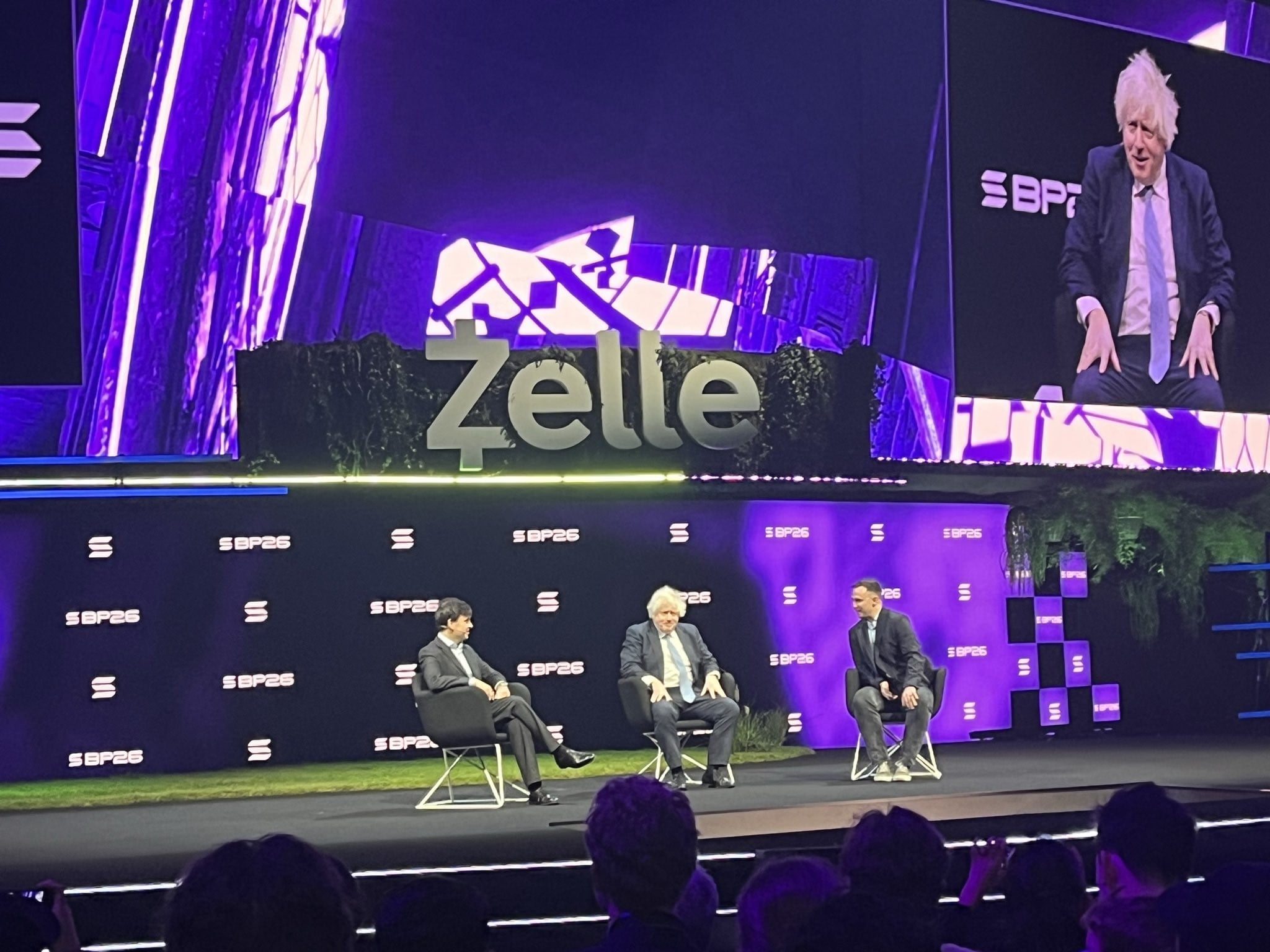
Michael Lewis arrived—the author of The Big Short—and took a seat on the Breakpoint speaker stage.
Boris Johnson attended, and former UK Chancellor of the Exchequer Sajid Javid was there too.
Source: X @xcavateprotocol
With guests including Revolut Chairman Martin Gilbert, the head of digital finance at Mitsui & Co., and Kazakhstan's Deputy Prime Minister Zhaslan Madiyev overseeing AI and digital development, reading through the guest list makes you forget this is a crypto conference.
Yet the vibe inside the venue could hardly be further from a formal financial summit.
Every attendee received a badge built around an ESP32-C5 chip—a programmable hardware development kit called the BP Badge.
You can write apps on it, run tasks, exchange digital cards, and earn rewards.
While other conferences hand out tote bags, Solana hands out dev boards.
Two weeks before the conference, the London Hacker House doors opened. For 12 consecutive days, developers worked inside, turning ideas into code.
With Demo Days, Intelligence Summits, an event called "200ms" (paying homage to the block time upgrade), and a "Scale or Die" gathering, all of London entered Solana time starting from early November.
Winding Down
Lily Liu once shared a set of data at this year's Hong Kong Web3 Carnival: out of 195 countries worldwide, 180 lack mature capital markets.
Twenty exchanges concentrate 94% of the global market cap, with two-thirds located in the United States.
She aims to build an "Internet Capital Market" where assets from anywhere can raise funds globally, be priced in U.S. dollars, and settle on open platforms.
These three days in London proved, at the very least, that this isn't just a pipe dream.
SOL didn't see much volatility during the conference, or rather, it had fallen enough beforehand that people weren't paying as close attention.
But anyone who has traded knows that real market moves rarely ignite the exact moment news drops.
Making sense of it all takes time, and the sheer volume of information from Breakpoint 2026 is substantial indeed.
Join the official Coincamps community:
Telegram: https://t.me/coin_camps
Recommended
$900 Million Options Bet on BTC Falling Below $60K as On-Chain Whales Aggressively Dump onto Exchanges
Nov 17, 12:23
Backpack Makes a Comeback to the US, Unveils First Compliant Perpetual Contracts
Nov 17, 11:20
Podcast Notes | Sam Altman: Jensen Huang is my hero, AI chip demand is overhyped, and OpenAI will eventually go public.
Nov 17, 11:16
As restrictions on Nvidia's computing power rentals tighten, the U.S. plans to regulate remote computing power in overseas data centers.
Nov 17, 11:14
Bitget UEX Daily | Nasdaq Drops 2.49%, AI Growth Expectations Tested Again; Bitcoin Hovers Below $65,000; Tonight's Focus on Retail and NVIDIA (November 17, 2026)
Nov 17, 11:11
The Money-Making Business Behind GTA VI: How One Game Has Kept a Company Profitable for Ten Years?
Nov 17, 10:57