
Gemini Earnings Report Breakdown: Credit Card Takes the Lead as Trading Volume Plummets
In the latest quarterly report released by the Gemini Space Station, a U.S.-listed cryptocurrency exchange, the most eye-catching aspect was not only the total revenue increasing to $45.475 million, but also a nearly inverted trend.
According to Gemini's Q2 2026 performance press release, this revenue grew by 37% compared to the same period last year. However, the platform's spot trading volume decreased by 66% from a year ago. While the trading activity on the exchange did not rebound, the revenue kept increasing. Where did the money come from?
Where Did the Revenue Come From If Trading Volume Didn't Rebound?
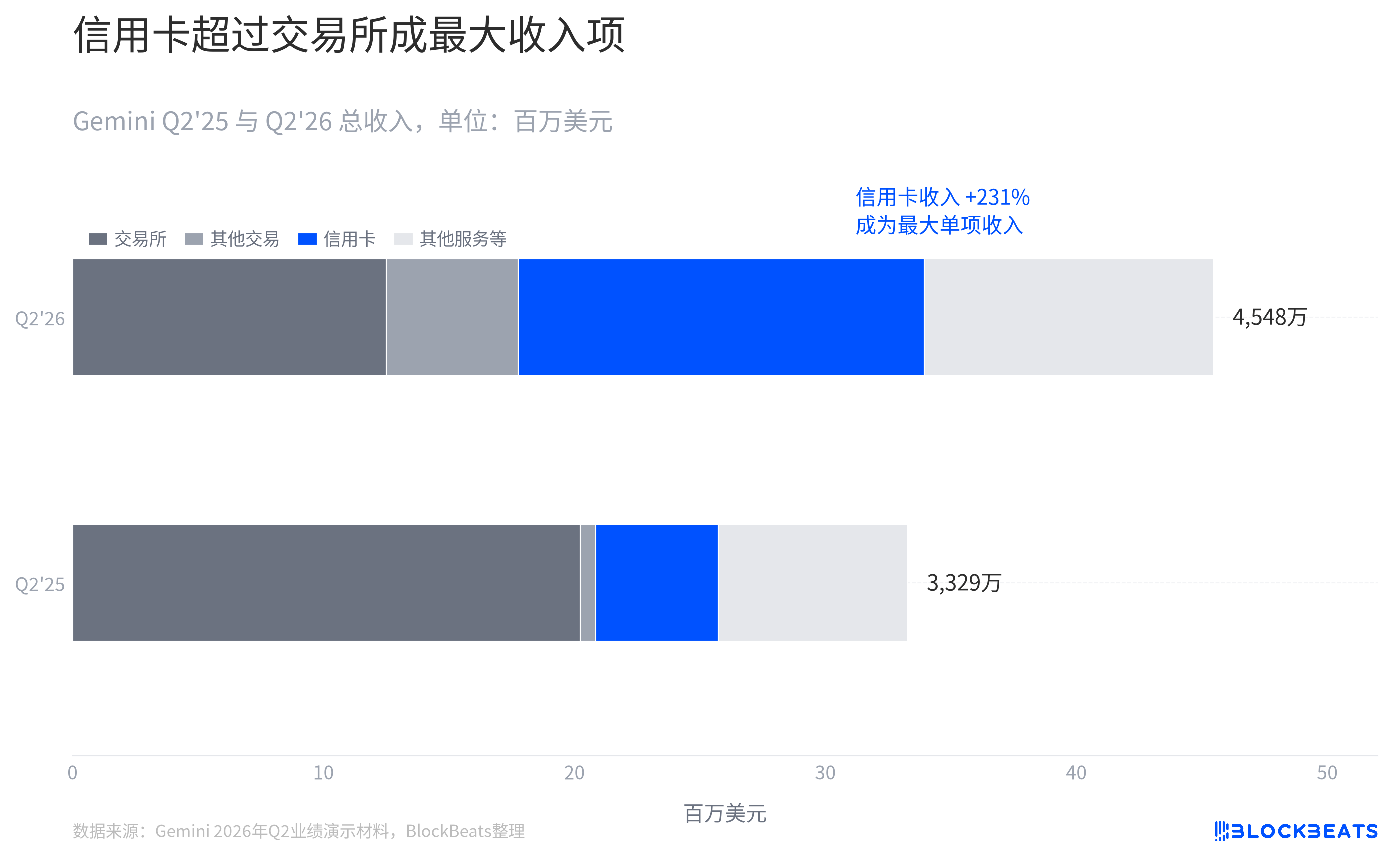
The answer lies first in the revenue breakdown. According to Gemini's Q2 performance presentation, credit card revenue has reached $16.178 million, surpassing the exchange revenue of $12.497 million. The blue segment is now longer than the gray trading platform revenue segment for the first time.
The same performance presentation indicates that a year ago, the situation was reversed. The exchange revenue was $20.233 million, while credit card revenue was only $4.882 million. Today's Gemini still operates a spot matching engine, but revenue is no longer solely linked to trading volume.
This rotation happened swiftly. Credit card revenue saw a 231% year-on-year growth, while exchange revenue saw a 38% year-on-year decrease, both figures from the company's performance presentation. The former made up for the gap left by the latter, making credit card revenue the largest single revenue stream.
There is another aspect of this chart that is easy to overlook. The material states that service and interest income accounted for 59.4% of net revenue and is a net revenue measure, not directly comparable to the stacked bar showing total revenue in the chart. It indicates that revenue sources are diversifying, but it does not independently prove that profitability has improved.
According to the company's performance materials, credit card revenue includes both card processing fees and interest income, which is not the same business as pure transaction fees. Their accounts receivable also expose Gemini to account quality and repayment speed risks.
Revenue and Trading Volume Are No Longer Aligned
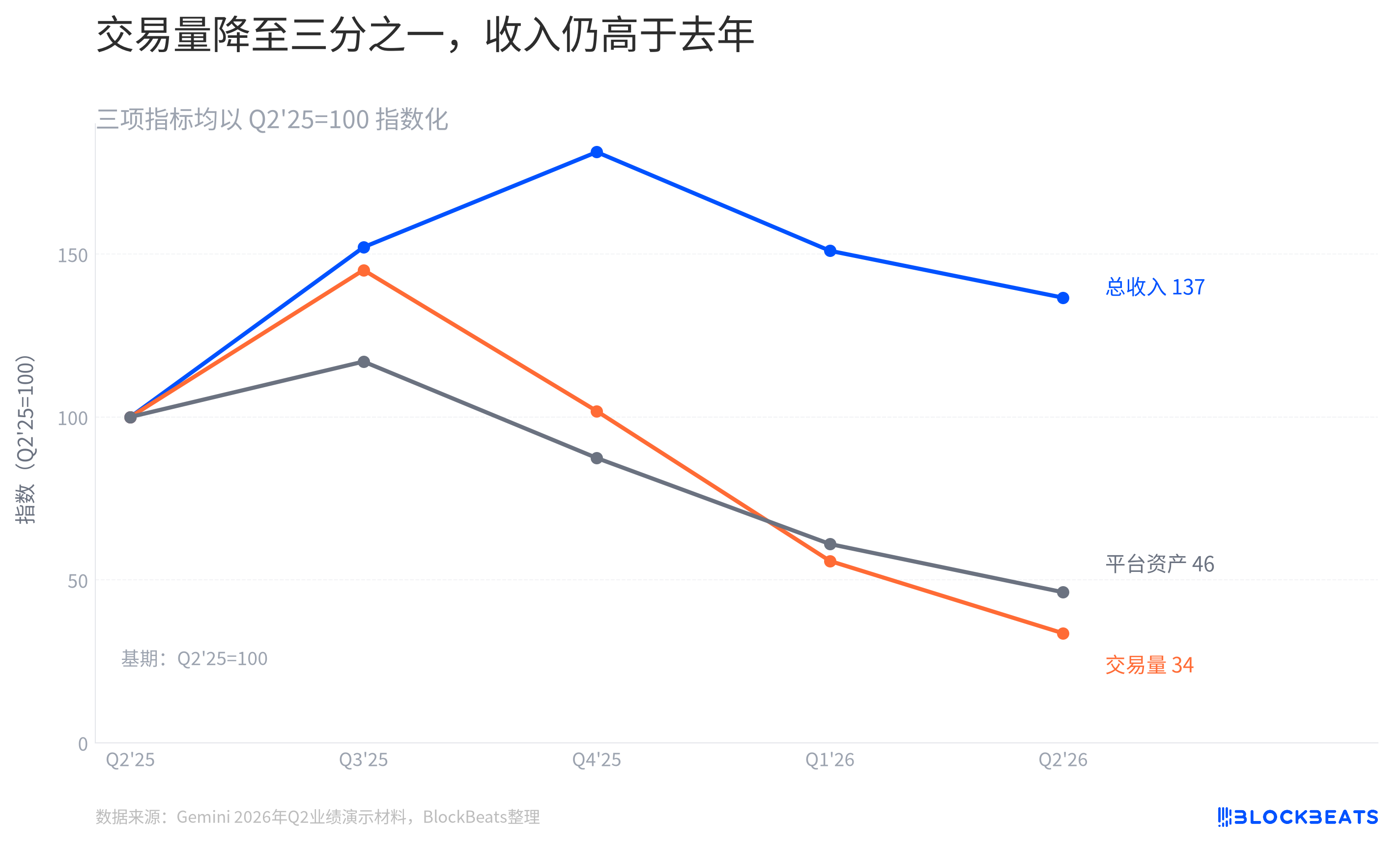
As per the company's performance materials, the total trading volume in the second quarter was $3.8 billion, compared to $11.3 billion a year ago. If we only focus on Gemini's most familiar metric, the trading platform, it is still clearly in a contraction phase.
When all three indicators are placed on the same baseline, the divergence in the chart becomes evident. The revenue line, after a high-level pullback, remains above the starting point, while the trading volume and platform assets are moving downward simultaneously. Trading volume is no longer the sole key to explaining Gemini's revenue; the product mix is starting to take over this explanatory power.
The user side has also experienced a similar divergence. According to company performance presentation materials, monthly active trading users increased from 523,000 to 580,000. However, the company's MTU metric covers users who have not engaged in revenue-generating activities over the past 30 days, or accounts that have generated revenue, including non-spot transactions such as credit cards, so it cannot be directly interpreted as spot trading users still being active.
This is also where product expansion has made a difference. The platform can generate revenue from a wider range of interactions, thereby weakening the interpretative power of the traditional metric of trading volume.
However, the platform's assets are not the company's own money. They include custody, staking, trading products, customer fiat custody assets, and GUSD reserves. Treating this line as cash freely available to Gemini, or interpreting the revenue divergence as a desensitization to the crypto cycle, would both cross the boundaries set by the financial report.
The change in revenue structure is real, but it is still too early to draw conclusions about detachment from the cycle. The five quarters shown in the chart are more like a hint that Gemini is now entrusting the story that used to be determined by a single trading curve to more business lines.
The new income account should be calculated from the cost of credit
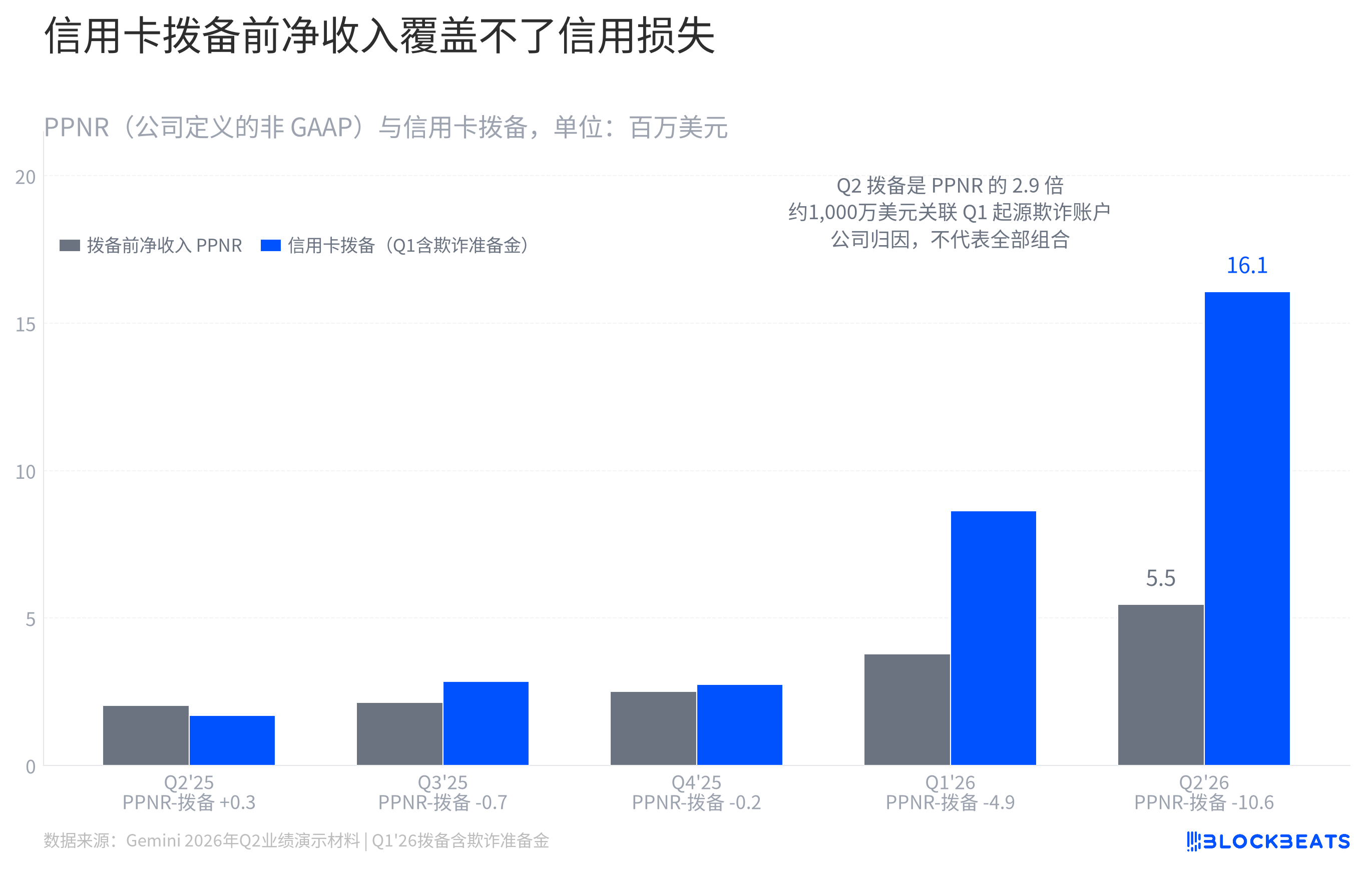
Growth in credit card revenue does not equate to the same level of profit contribution from credit cards. According to company performance presentation materials, the company's defined non-GAAP metric, PPNR, is the net credit card revenue minus financing debt interest and crypto reward expenses. In the second quarter, PPNR was $5.457 million, while credit card reserves amounted to $16.062 million.
Calculating based on the two metrics disclosed by the company, there is a $10.605 million difference between the two. The second row on the chart's x-axis reads "PPNR-Reserves," not Gemini's net profit. It only answers a narrower question—whether the net revenue generated by credit card business before accounting for credit costs is sufficient to cover this reserve.
According to the company's press release, approximately $10 million of the reserve is related to a batch of accounts opened in the first quarter involving identified identity fraud activities. This is management's attribution to a specific group of accounts and should not be extrapolated to represent widespread defaults across the entire card portfolio.
However, the use of qualifying language does not diminish risk management pressure. The percentage of receivables overdue by more than 30 days increased from 3.8% in the previous quarter to 9.4%, a change disclosed in the company's performance presentation materials. For a business that has just become the largest source of income, the revenue curve and the credit cost curve now need to be viewed together.
Gemini's sources of income have diversified, and the operational variables supporting this income have extended from trading activity to credit costs and risk management.
Recommended
BofA Analysis: Micron's $100 Billion Cash Flow, Can It Navigate the NAND Cycle?
Aug 14, 13:17
X Publicizes Full Recommendation Algorithm, How to Write Posts for High Exposure
Aug 14, 13:14
A $2.25 billion Green Bond, How Jane Street's Lease Made Its Way into the Financing Structure
Aug 14, 13:08
Before the AI Bubble Bursts, 'Big Short' Makes $100 Million from Subscription Fees
Aug 14, 12:48
Miner Outlook for the Second Quarter: Battling for AI Data Centers, Are They Making Money Yet?
Aug 14, 12:14
Still remember NFTs? The price of the new project has surpassed Bored Ape Yacht Club!
Aug 14, 11:49