
Podcast Notes | Chat with Justin Sun: How Ordinary People Can Bet on the AI Golden Age?
Organized & Compiled: TechFlow
Guest: Justin Sun (Founder of TRON, Global Advisor at HTX)
Host: William Joy / Guest Host
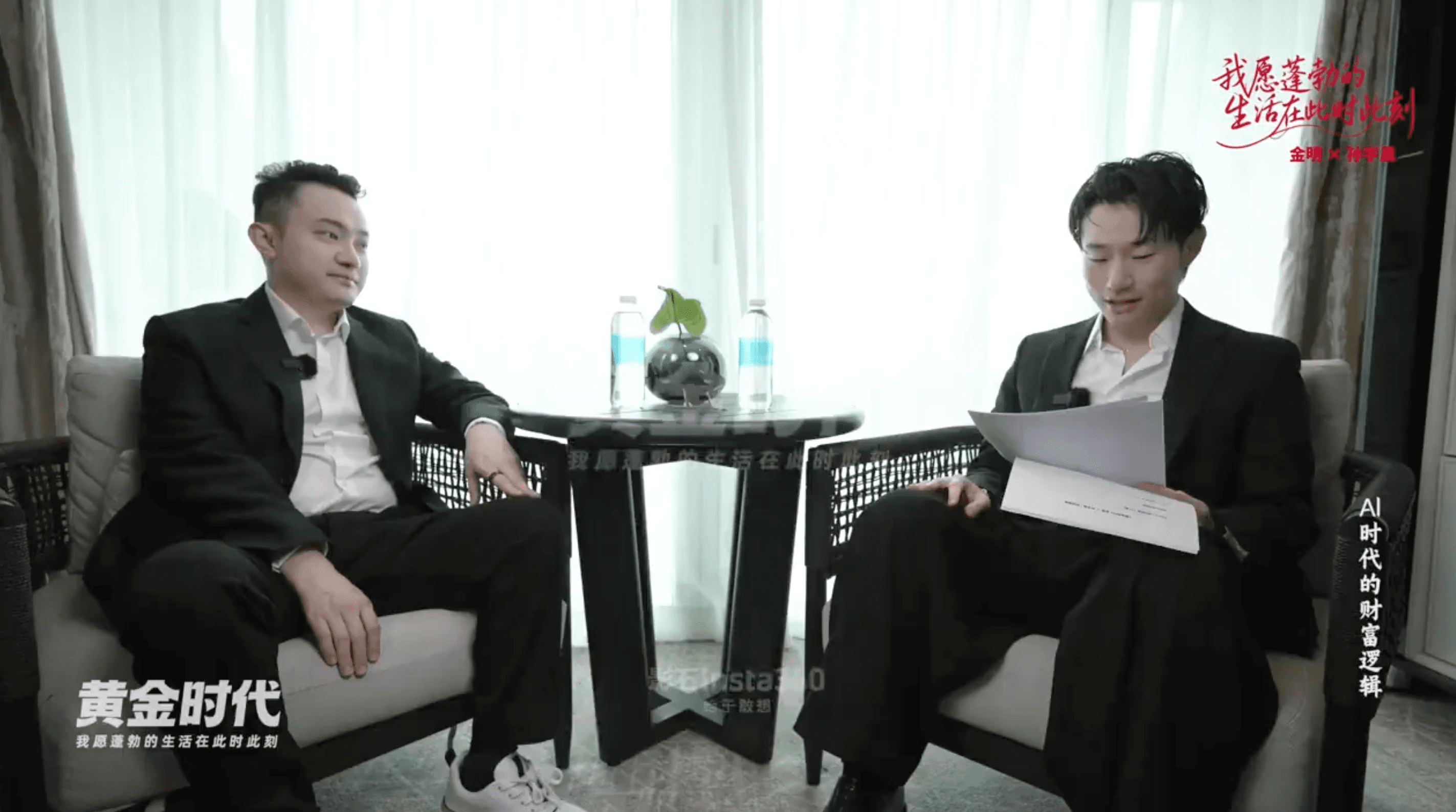
This article is compiled from an interview between Jin Ming and Justin Sun on the program "The Golden Age," originally supported by Insta360. Below are the key points organized by TechFlow. For the complete conversation and program details, please refer to the original link.
I. Executive Summary- Broader bearish outlook on BTC and algorithmic/quantum crisis: Justin Sun believes that AI algorithms (such as OpenAI's breakthroughs in mathematics) and quantum computing (QD) developments are highly likely to crack asymmetric encryption algorithms (elliptic curve cryptography) within 1 to 1.5 years. This could turn over 2 million BTC held by Satoshi Nakamoto and addresses with lost private keys into a massive sell-off pressure, while the entire financial market is currently severely underpricing this risk.
- Position management and "Bunker Mode": BTC is treated as a strategic core holding akin to Nvidia, with zero reduction. However, "Bunker Mode" has been fully activated (transferring funds to brand-new cold wallet addresses that have never signed transactions). For ETH, which acts as an interest-rate-sensitive and DeFi asset, 80-90% of the position was cleared when it bounced to a double-top structure around $3600–$4000, with funds redirected to US equities.
- US stocks, US Treasuries, and AI layout: Bullish on the infinite refinancing capability of US Treasuries (rooted in US tech/military dominance and AI control). Slightly bearish short-to-mid-term on the Nasdaq and AI hardware consolidation (such as overvalued sectors like memory and optical modules), while bullish on AI applications landing in real-world scenarios like health management.
- "Sunism" and the "Sun Prize" in the AI era: Defines "Sunism" as a zero-cost installed game theory and environmental evolution framework to help ordinary people progress from 0 to 1. Establishes the "Sun Prize" aiming to become the Nobel Prize of the AI age, employing a dynamic iterative strategy reminiscent of "looking at cards before betting in Texas Hold'em," combined with LEAN formal verification to enable automated machine problem-solving and award distribution.
- TRON ecosystem and RWA infrastructure: TRON's net value locked has exceeded $100 billion. It is deploying post-quantum algorithms on its mainnet and testnets, and plans to bring high-quality US equity assets like QQQ and S&P 500 on-chain as RWA in November.
- "It's a bit like playing Texas Hold'em, see the cards first, see the cards first." — Regarding why only a small portion of assets are allocated to establish the "Sun Prize", noting that technological evolution in the AI era is extremely rapid. One cannot bet all chips at once; instead, they must observe community and technological trends for dynamic iteration.
- "Like Sun Wukong, no matter how far you jump, you can't escape the palm of Tathagata Buddha." — When discussing US Treasuries and American hegemony, believing that as long as the US maintains ultimate control over the AI industry chain and military supremacy, there will always be buyers for US debt.
- "BTC belongs to core position allocation, much like Nvidia in the AI field. Unless the entire industry is completely dismissed, not a single share will be reduced." — Emphasizes keeping the BTC core position intact during portfolio rebalancing, but fully activating "Bunker Mode" for isolation.
- "Sunism is a game theory and evolutionary theory, a zero-cost operating system written for China's most ordinary young people, helping them achieve breakthroughs from 0 to 1." — Summarizes the essence and social responsibility of Sunism.
Latest Assessment on BTC: AI Algorithm Evolution and Post-Quantum (QD) Crisis
Host: Last time we met, you mentioned that due to miner selling pressure, your personal involvement in BTC wasn't as heavy as in DeFi and Ethereum. Two years have passed. Has your perspective on BTC changed? Are you more bullish on BTC now?
Justin Sun: If you ask about my personal view, I am slightly more bearish now. The reason is very simple: AI algorithms and QD (quantum computing). I believe BTC will find it hard to emerge unscathed from this situation. Moreover, I think the vast majority of industry insiders have underestimated the impact this poses to BTC.
Since BTC is now a relatively mature ETF product, many institutional investors like BlackRock who have little understanding of BTC hold large amounts. They don't actually grasp what QD entails, so the market lacks reasonable pricing. Including recent discussions on OpenAI's mathematical advancements, we may not even need to wait for QD. Through classical cryptanalysis and AI algorithms, unprotected early wallets or private keys could potentially be cracked within 1 to 1.5 years.
Currently, a vast number of exchange hot wallets still lack basic post-quantum protection, which is indeed quite dangerous.
2 Million BTC Sell-Off Pressure and Global Cryptographic Security
Host: To address this crisis, how do you view the market and community's preventive mechanisms?
Justin Sun: BTC only helps those who are willing to help themselves. For instance, BTC can introduce a new post-quantum address type for users to transfer funds; however, for Satoshi's address (approx. 1 million BTC) or historical addresses with lost private keys (like someone who lost 5,000 BTC), no one holds the private keys to actively transfer them.
Once QD or AI decryption arrives, these dormant assets would be breached, potentially causing a massive sell-off of over 2 million BTC in the market. Given BTC's high degree of decentralization, it is extremely difficult for the community and miners to reach a consensus to freeze, confiscate, or restrict circulation via a hard fork.
Host: Is this merely a cryptocurrency issue, or a global challenge?
Justin Sun: This is absolutely not just a crypto issue, but a challenge facing the entire internet and financial system. The mathematical foundation for SSL certificates used to access Google, China Merchants Bank, Bank of America, the NYSE, and all equity-based assets today rests on asymmetric encryption (such as elliptic curve algorithms). It resembles the Y2K crisis many of us experienced growing up—a global cryptographic challenge.
Justin Sun's Actual Positions and Response Strategy: "Bunker Mode" and Major 80-90% Rebalancing of ETH
Host: Facing this potential crisis, what is your Action Plan? Will you still maintain your BTC position?
Justin Sun:
- BTC Position: Zero reduction. We have not reduced our BTC holdings because BTC serves as a core position allocation, similar to Nvidia in the AI sector. Unless we completely lose faith in the entire industry, not a single share of the core position will be sold.
- Activating "Bunker Mode" (Bunker Mode): Our first step is isolation, transferring all involved BTC to brand-new cold wallet addresses that have never signed transactions or transferred funds. While this sacrifices interaction and trading liquidity, it ensures security at the algorithmic level. Since BTC lacks high-yield DeFi options, moving it to cold wallets incurs minimal yield loss.
- Future BTC Operations: Whether to sell will "wait and see the development of the tech community," shifting attitude from complete indifference to close monitoring.
- ETH Position: Major reduction of 80% to 90%. ETH is an asset sensitive to interest rate hikes and DeFi mining. During the last rally where ETH rebounded near $3600–$4000, we judged it formed a fragile double-top structure reliant on ETF and other positive catalysts, indicating momentum exhaustion. Therefore, we liquidated 80-90% of the ETH position, remain fully flat since then, and redirected capital to US equities.
- TRON and HTX Project Front: TRON and HTX have already deployed post-quantum algorithms on testnets, with formal mainnet rollout expected approximately 1 year before the crisis hits. In case of an extreme crisis, data backups will be performed in advance and a "consensus pause" enacted to restore safety protocols.
RMB, US Debt Credit, and AI Hegemony Logic
Host: Do you believe the RMB will strengthen or weaken in the future? Is the US debt credit crisis underpriced or overly worried about?
Justin Sun:
- RMB: I believe it will strengthen in the future.
- US Debt Credit: The market is overly worried about a US debt credit crisis. For an asset of US Treasury's scale, it can essentially be perpetually rolled over, constantly issuing new debt to pay off old debt. The core enabler is that the US maintains global tech and military hegemony.
- Humanity is heading toward AI, and the key to AI lies in chips, manufacturing processes, and the technology supply chain. Just as Sun Wukong cannot escape Tathagata Buddha's palm, as long as the US continuously maintains ultimate control over the AI supply chain, US Treasuries will never lack buyers.
View on US Equities and AI Consolidation: Slight Bearishness on Nasdaq, Bullish on AI Health Management Applications
Host: What is your main allocation in US equities? How do you view the current AI asset consolidation?
Justin Sun:
Heavily invested in US tech stocks like Nvidia, but slightly bearish on the Nasdaq and AI consolidation assets in the short-to-medium term. With high risk-free yields on US Treasuries, excessive capital clustering around general-purpose large models and hardware lacks a sense of security.
Legacy assets are viewed pessimistically across the board, while emerging assets are actively embraced. The ceiling for the world's largest single enterprise likely won't exceed half of the US debt market, meaning upside space is limited after surges in hardware stocks like Nvidia. Sectors like memory and optical modules are currently overvalued.
I predict AI investment will face divergence, with true bullishness directed toward application-side uses of AI in real life. For example, AI health management: collecting and mining data from devices like Oura Rings, followed by AI providing primary health decisions supplemented by expert second opinions, which will reshape the healthcare and insurance industries.
"Sunism", Game Theory, and Establishing the "Sun Prize" in the AI Era (Texas Hold'em Strategy)
Host: You recently established the "Sun Prize", but only allocate a tiny fraction of your wealth. Why not follow Alfred Nobel's example and donate most of your legacy?
Justin Sun:
It's somewhat like playing Texas Hold'em: look at the cards first, get a feel for the hand. Humanity is entering a new industrial revolution, with AI progressing at light speed (even generating achievements worthy of 50 Nobel Prizes in a day). There is no fixed template for establishing such awards. We start by allocating a small portion to test the waters, combined with LEAN formal verification to enable automated machine problem-solving and prize distribution, followed by dynamic iterations based on technological evolution.
Sunism draws inspiration from Ayn Rand's "The Fountainhead" and Wang Xiaobo's "The Golden Age". It is a "zero-cost installation system" written for China's most ordinary youth, helping them bootstrap to achieve progression from 0 to 1. Essentially, it is a game theory integrating contemporary environmental evolution to maximize individual benefits.
Currently, the biggest shortages are understanding and applications of AI (as well as love); the ultimate ideal is to perfectly integrate AI with current business operations; using AI to monitor body data to "maximize life value with dignity". Recommended reading list includes "The Fountainhead", "The Golden Age", and his own "Sunism".
TRON On-Chain Ecosystem and RWA (US Equities / S&P 500 Onboarding) Plans
Host: What is the current TVL and fee logic for TRON? What are the future layouts in the RWA sector?
Justin Sun:
TRON has become the core transfer infrastructure for global USD stablecoins, providing non-US countries with channels to access USD asset allocations. We plan to onboard high-quality US equity assets like QQQ and S&P 500 onto TRON in November of this year, allowing users in developing nations to easily allocate premium USD equity assets.
Although TRON transaction fees had previously increased, users can transfer funds for free via TRX staking, and transaction fees were already reduced by 60% last year. Users choose to stay on TRON due to trust in network security and brand premium. In the future, TRON will continue to reward users by providing value-added services like US equity RWA.
Join the official Coincamps community:
Telegram: https://t.me/coin_camps
Recommended
Why did Papertrade backfire on you?
Oct 17, 17:01
The 'Strict Father' of Northern Myanmar: This Company Deploys 200,000 "AI Best Actors" to Strike Back Against Scammers
Oct 17, 15:34
Intelligence Bureau: Anthropic's Growth Myth Shatters, Valuation Slashed to 1.5 Trillion; Tesla Roadster Can Fly, Roll, and Drive Backwards
Oct 16, 20:23
France Proposes 31.4% Tax on Stablecoins as Russian Central Bank Sets P2P Endgame
Oct 16, 18:02
Large-Screen Marketing Sparks Registrations Exceeding Approved Cap, Solana Shanghai Event Postponed
Oct 16, 17:59
UMX officially launched today and added Hong Kong stock trading, pioneering the industry with "hold coins, grant credit, buy stocks".
Oct 16, 17:07