Morgan Stanley Interpretation of Nebius Q2 Financial Report: AI Cloud Revenue Surges by 514%, Can the 5GW Expansion Promise Be Fulfilled?

TL;DR
· Nebius's Q2 total revenue grew by 454% year-on-year, with AI Cloud revenue reaching approximately $5.75 billion, a 514% year-on-year increase, contributing to about 99% of the revenue.
· The company has raised its 2026 signed power capacity target from over 4GW to 5GW and plans to deploy over 1GW of active power annually starting from 2027.
· Morgan Stanley maintains a $144 price target: Demand has been validated, and valuation going forward will depend on financing, approvals, and capacity delivery.
Nebius delivered a high-growth financial report for Q2 2026.
The total revenue reached $5.823 billion, a 454% year-on-year increase; of which, AI Cloud revenue was approximately $5.75 billion, a 514% year-on-year increase, accounting for about 99% of total revenue. The quarter-end Annual Recurring Revenue (ARR) reached $30 billion, representing a growth of about 56% from the end of Q1.
Beyond the revenue growth, what is worth noting is that Nebius has simultaneously raised its capacity target. The company plans to sign contracts for 5GW of power capacity by the end of 2026, higher than the previous "over 4GW" target; starting from 2027, the annual additional deployed active power will exceed 1GW.
This indicates that Nebius is transitioning from a fast-growing GPU cloud service provider to a larger-scale AI infrastructure operator.
However, the higher the growth target, the greater the requirement for funding and delivery capability. Morgan Stanley has raised its long-term revenue, adjusted EBITDA, and capital expenditure forecasts post-earnings, but still maintains an Equal-weight rating and a $144 price target for Nebius. The reason is simple: the market has already seen the demand, and the next step to validate is whether the company can turn contracted power into genuinely chargeable computing power on time.
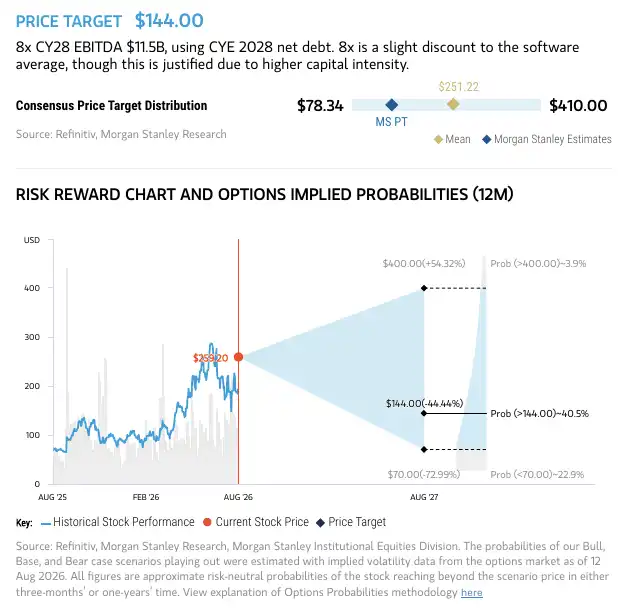
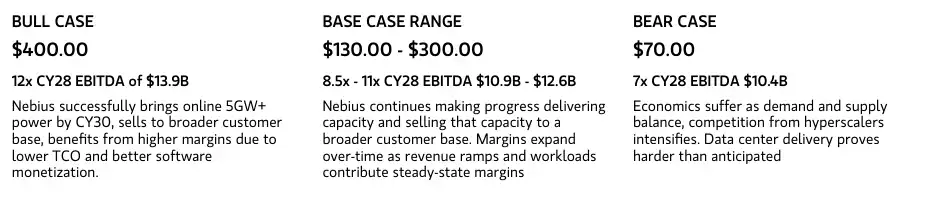
Morgan Stanley maintains a $144 price target for Nebius; Bull, Base, and Bear case scenarios correspond to $400, $130 to $300, and $70, respectively.AI Cloud Contributes to About 99% of Revenue, New Contract Pricing Continues to Rise
Nebius's current growth is almost entirely driven by its AI Cloud business.
In the second quarter, AI Cloud revenue was approximately $575 million, accounting for about 99% of the Group's total revenue. This also means that investors' assessment of Nebius is becoming simpler: as long as GPU computing power demand and leasing prices remain strong, the company can continue its rapid growth; once supply and demand weaken, its performance will become more sensitive.
Currently, the demand remains strong.
According to Morgan Stanley, Nebius signed four landmark AI Cloud deals in the second quarter, with contract durations ranging from 1 to 3 years and an average deal size exceeding $1 billion. The annualized contract value of new deals in the second quarter exceeded $20 million per MW, with short-term capacity transactions for 3 to 6 months in the third quarter further exceeding $40 million per MW.
The total value of new contracts in the second quarter was about four times that of the previous quarter, with the contract value from new customers growing by over 9 times. In addition to the scale expansion, the pace of capital recovery is accelerating: the estimated payback period for new deals in the second quarter is around 1 year and 10 months, significantly shorter than the previous 2 to 3 years.
This is particularly important for Nebius. AI cloud providers typically need to first purchase GPUs, build data centers, and secure electricity before gradually recovering their investment through customer leases. Higher contract prices, shorter payback periods, and some customers willing to make advance payments can alleviate the cash pressure from initial capital expenditures.
However, most of these new contracts will not come online until later in 2026, with limited contribution to the revenue for that year. Therefore, Nebius has not raised its full-year 2026 revenue and adjusted EBITDA guidance. The impact of new orders will be more reflected in 2027 and beyond.
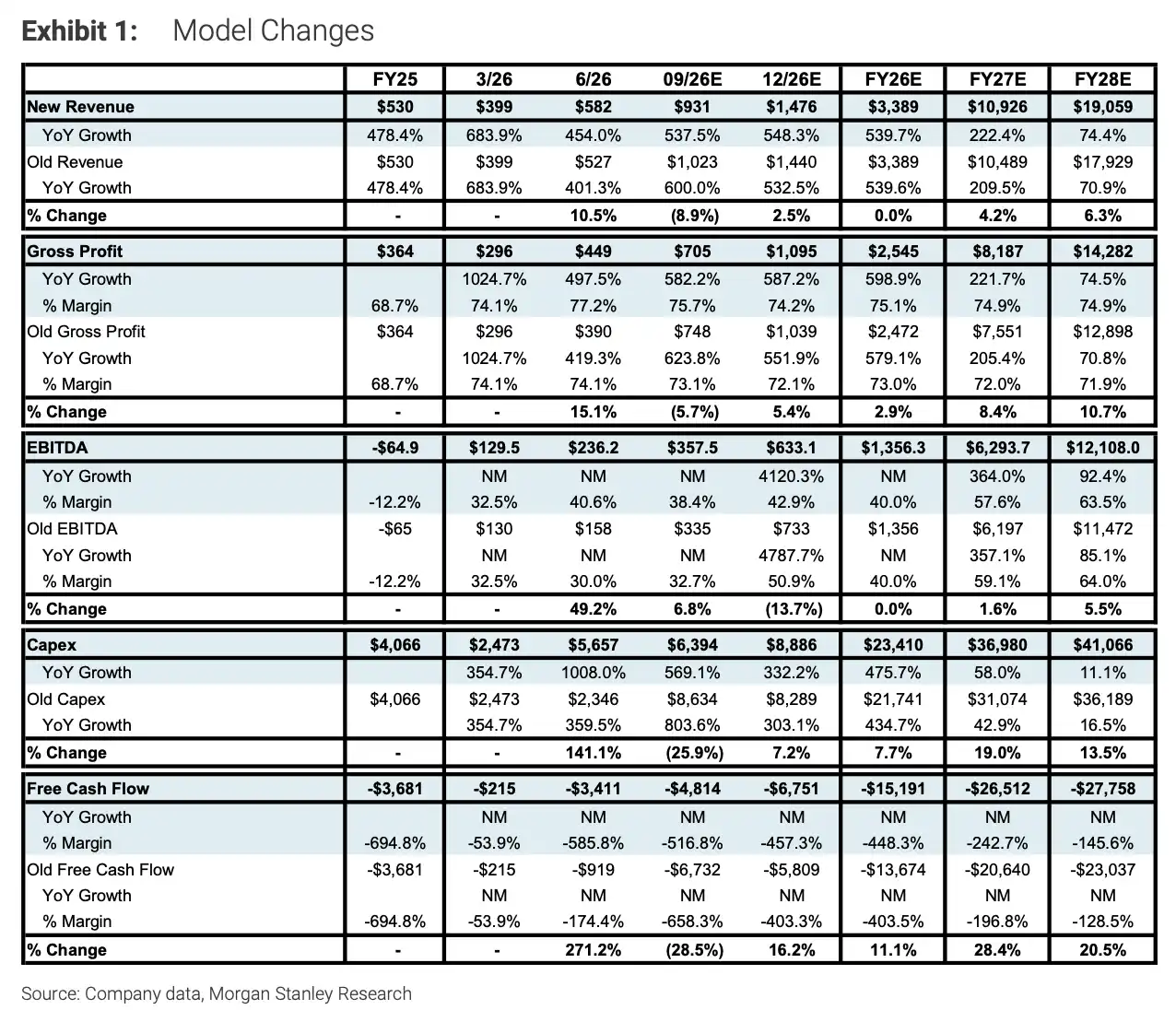
Morgan Stanley has raised Nebius's FY27 and FY28 revenue forecasts by 4.2% and 6.3% respectively, and capital expenditure forecasts by 19.0% and 13.5%.From 4GW to 5GW, the growth target signifies a heavier construction task
The most significant change for Nebius this quarter is the increase in the contracted power capacity target for 2026 from over 4GW to 5GW.
“Contracted power” can be understood as the electricity resources the company has pre-committed for future data centers and customer contracts. It represents potential expansion space but does not equate to already-built data centers, let alone computing power that can generate immediate revenue.
From contracted capacity to actual revenue, there are multiple steps involved, including site approval, power connection, GPU procurement, engineering construction, and customer onboarding.
According to the company's plan, starting from 2027, Nebius will add over 1GW of deployed active power annually. Morgan Stanley expects the company's active power to increase from 170MW in 2025 to 780MW in 2026, 1680MW in 2027, and 2620MW in 2028.
Along with capacity expansion, Morgan Stanley has raised its Nebius FY27 and FY28 revenue forecasts to $10.926 billion and $19.059 billion, respectively, with adjusted EBITDA forecasts raised to $6.294 billion and $12.108 billion.
However, higher revenue forecasts correspond to higher investments. Morgan Stanley currently estimates that Nebius' FY27 and FY28 capital expenditures will reach $36.98 billion and $41.066 billion, representing a 19.0% and 13.5% increase from previous forecasts.
This capital intensity has been reflected in the second-quarter data. Nebius achieved an adjusted EBITDA of $2.362 billion for the quarter, with a profit margin of 40.6%, significantly higher than the market's expectation of close to 30%; operating cash flow was $2.2461 billion, but spending on property, equipment, and intangible assets reached $5.657 billion.
In other words, Nebius has been able to generate significant cash flow through operations, but its construction speed is faster, and the scale of expenditure is larger. Prepayments can alleviate some pressure but cannot cover all funding needs.
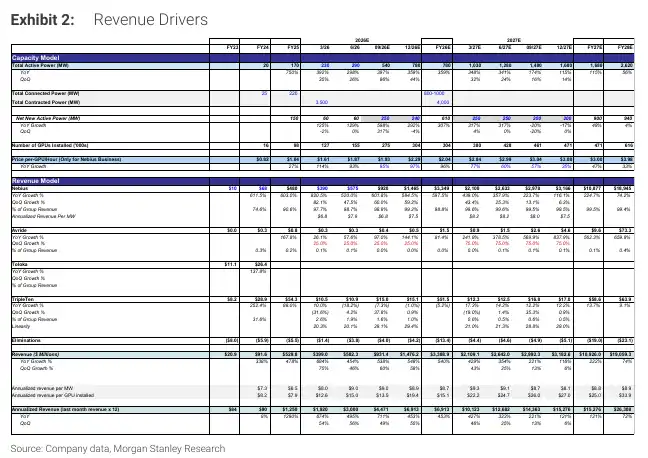
Capacity and Revenue Drive Model. Morgan Stanley expects Nebius' active power to increase from 170MW in 2025 to 2620MW in 2028, with revenue growing to $19.059 billion during the same period.Blackwell Short-Term Capacity Premium Significant but May Not Be Sustainable Long Term
Another positive sign for Nebius comes from Blackwell's computing power pricing.
According to Morgan Stanley citing management, the Blackwell price in the company's initial capacity auction was 15% higher than the previous highest price charged. The annualized contract value of some 3 to 6-month short-term capacity trades has exceeded $40 million/MW, which is about twice the average level of new signings in the second quarter.
This reflects the current supply-demand dynamics in the AI compute market: the latest generation GPUs are still scarce, and customers are unwilling to wait for data centers to be slowly built out. Therefore, they are willing to pay a higher price for instantly available compute power.
In the short term, higher prices, more prepayments, and shorter payback periods all contribute to improving Nebius's cash flow and profitability.
However, the sustainability of this premium remains uncertain in the long run. As new-generation GPU supplies like Blackwell increase, short-term capacity prices may fall. At the same time, Nebius also needs to maintain high GPU utilization to ensure that large-scale capital expenditures continue to yield returns.
Customer concentration is also a potential risk. Large contracts enhance revenue visibility but also make the company more dependent on the deployment pace, budget changes, and renewal decisions of a few customers. For newcomers to the AI cloud market like Nebius and CoreWeave, this has long been a market concern.
Despite Nebius's strong performance in the second quarter, Morgan Stanley maintains an Equal-weight rating and a $144 price target. This does not indicate pessimism about the shift in AI demand at Morgan Stanley but rather a belief that demand and pricing have been validated, with the current greater uncertainty coming from capacity fulfillment.
There is a significant divergence in its scenario valuations: a bull market target price of $400, a base-case valuation range of $130 to $300, and a bear market target price of $70.
In a bull market scenario, Nebius can ramp up over 5GW of power capacity by 2030, expand its customer base, and improve profitability through lower overall ownership costs and software services.
The bear market scenario presents another path: GPU supply and demand gradually balance, intense competition among large cloud providers, data center deliveries slower than expected, and existing short-term capacity premiums decline accordingly.
There are three main constraints that will determine whether Nebius can enter a bull market scenario.
The first is financing. Starting from 2027, the company needs to deploy over 1GW of active power annually, requiring additional funding through asset-backed financing, corporate debt, or equity-linked instruments. The higher the financing cost, the greater the potential pressure on shareholder returns and equity dilution.
The second is approvals and construction. Taking the New Jersey Vineland project planned at 300MW as an example, despite management's optimism about the approval progress, the project still needs to undergo public hearings, local approvals, power access, and engineering construction. Until it is officially operational, this capacity cannot be considered realized.
Third is the competition. Large cloud providers such as Microsoft, Amazon, and Google are also rapidly expanding their AI infrastructure investments, with advantages in funding, customer ecosystem, and GPU procurement. Once GPU supply becomes more abundant, the short-term price premium currently enjoyed by Nebius may be compressed.
The second quarter proved two things for Nebius: AI computing power demand remains strong, and the company has the ability to secure large contracts at higher prices.
However, as the 5GW contracted power goal increases, the subsequent test is not just "whether orders can be obtained," but "whether orders can be completed, launched, and converted into cash flow on time." This is also the core reason why Morgan Stanley has raised its forecast but has not yet raised the target price.
Recommended
Morgan Stanley Insights: AI Price War Escalates to Compute Layer, Why Amazon and Google Are Still Bullish?
Aug 13, 16:11
Hyperliquid, Will It Also Support Coin Staking Rewards?
Aug 13, 16:00
Intel CEO Pat Gelsinger's Latest Interview: After Missing Mobile, Cloud, and AI, We Can't Miss the Next Wave
Aug 13, 13:44
Why Did NeoCloud Experience the Largest Gain During This Round of Tech Stock Rebound in the U.S. Market?
Aug 13, 13:23
First Quarter Capital Expenditure: $5.6574 billion, where did Nebius's expansion funding come from?
Aug 13, 12:36
The valuation of RoboCop, known as the "First Stock of Humanoid Robots"
Aug 13, 12:28