Once Racing to Build L2s, Why Are Projects Now Returning to Ethereum Mainnet?
The Ethereum Name Service (ENS) has just completed the largest upgrade in its history. Notably, this upgrade was deployed directly on Ethereum mainnet, rather than on the layer-2 network that had been in preparation for years.
On Tuesday, October 27, ENS v2 officially went live on L1. Yet as early as nine months ago, ENS had already abandoned Namechain, the Rollup chain originally intended to carry this upgrade.
ENS is no isolated case. Over the past year, a growing number of projects have chosen to exit layer-2 networks, shelve plans to build their own L2s, or shut down dedicated chains already launched, migrating their core contracts back to Ethereum L1.
In short, this is a wave of returning to mainnet.
The backdrop to this trend: Ethereum's gas limit (the amount of computation a single block can carry) rose from 30 million to 60 million in 2025, and L1 transaction fees fell sharply as a result.
Ethereum raised the block gas limit from 30 million to 60 million in stages during 2025; the chart also marks key events such as Synthetix's post, Vitalik's article and ENS v2's launch on L1. The Glamsterdam upgrade has already reached a 200 million gas limit on the Sepolia testnet, but mainnet activation timing is undetermined.
At the same time, running your own public chain has proven extremely expensive. This month alone, two layer-2 networks, Blast and Abstract, announced shutdowns within four days of each other.
Below, let's walk through the full picture, starting with the latest domino to fall.
Why ENS chose to stay on Ethereum
As most people know, ENS turns long wallet addresses into readable, memorable names like "william.eth."
ENS v2 is a thorough re-architecture of the entire protocol. Put simply, every ENS name can now build its own independent registration system for its subdomains; name holders get granular permission controls, and can pay related fees in stablecoins such as USDC.
But the most discussion-worthy part of this article is where v2 was deployed. Back in May 2024, I wrote "Getting Started with ENS v2," covering ENS Labs' plan to move the protocol to a layer-2 network, which later materialized as the dedicated Rollup Namechain. At the time, I thought this upgrade might open a new phase in which ENS goes mainstream.
ENS v2 did open a brand-new phase — just not on L2. On February 6, ENS founder Nick Johnson explained the pivot: "Ethereum L1 is scaling, and scaling far faster than most people expected two years ago."
Facts confirm this: as Ethereum scales, the gas cost of ENS name registration has fallen 99% over the past year. In addition, Nick argued that layer-2 networks introduce extra trust assumptions that L1 itself does not have.
Vitalik Buterin publicly endorsed it the same day: "This is a wise decision!"
The dominoes falling one after another
ENS is the newest member of this "return list," but by no means the first.
A roundup of projects that migrated back to Ethereum mainnet from layer-2 networks (or planned L2s) over the course of 2026, noting the platform they left, the timing and migration progress.
Synthetix was an early mover. It launched on an Ethereum Rollup as early as 2021, yet in June 2025 it published an article titled "L2 Is Dead, Long Live Ethereum," which pointed directly at pain points such as liquidity fragmentation.
So Synthetix gradually wound down its L2 deployment that summer, and its brand-new perpetuals exchange landed on L1 in December. Founder Kain Warwick later admitted: "I spent two years pushing the L2 narrative, but that path didn't work for Synthetix, so we chose to return to mainnet."
Then in February, Vitalik Buterin published an article arguing that while L1 itself keeps scaling, layer-2 networks' march toward full decentralization is much slower and harder than initially imagined. He concluded that layer-2 networks' original vision, and their positioning in the Ethereum ecosystem, no longer holds.
Three days later, ENS halted the Namechain project.
This summer, Superseed became another typical case. Its original core mechanism was to offset user loans with fees from its own layer-2 chain. But the project officially retired that chain on August 15, and is now migrating its entire ecosystem back to Ethereum mainnet, replacing the chain-fee model with application-layer yield strategies.
In September, Trueo, the prediction market protocol behind the DefiLlama market, announced its "return to Ethereum" from Base. Vitalik expressed support for the plan.
October also brought a concentrated flurry of similar moves:
- ShapeShift: on October 1, moved the rFOX staking program from Arbitrum to L1, because the vast majority of FOX tokens are themselves custodied on mainnet.
- Blast: on October 2, announced a gradual shutdown, as on-chain revenue could not cover operating expenses.
- Nillion: on October 5, launched the Blacklight network on L1, with a roadmap showing it will phase out its own L2.
- Abstract: on October 6, announced it would shut down on December 15, judging that a standalone public chain model aimed only at ordinary users is not sustainable.
Some NFT projects within the Abstract ecosystem, such as Gigaverse's ROMs and BEARISH, have also announced migrations to L1.
Core state back to L1?
Behind these migrations lies a deeper trend: projects are separating state storage from computational execution.
Take Synthetix's new perpetuals: orders are matched off-chain, but user funds are custodied on Ethereum L1, and trades are ultimately settled on L1.
Then there's Derive V3, a project I analyzed earlier this month: to ensure trading speed, order matching happens off-chain; risk calculations are verified through zero-knowledge proofs; user funds sit in Ethereum L1 contracts.
ENS v2 follows the same approach: the domain NFTs themselves live on L1; subdomains can use the CCIP-Read standard to achieve gasless resolution on L2 or off-chain, lowering usage costs. CCIP-Read allows a name to point to data stored elsewhere.
In other words, the high-value core elements (asset custody, ownership attestation, trade settlement) return to L1, while computation-intensive heavy lifting runs in the cheapest, fastest environment available. This differs fundamentally from the traditional Rollup model: traditional Rollups carry both state and computation, so users must go through a cumbersome exit process if they want to retrieve their assets.
Three architectures compared: a traditional Rollup stores both state and execution on L2; the new hybrid application keeps core state such as funds and settlement on Ethereum L1 while moving complex computation off-chain; and an L1.5 ephemeral rollup has the user's wallet hold private state, with L1 storing only state commitments and validity proofs, with no persistent data storage in between.
Of course, some technical approaches are gradually dissolving the boundary between L1 and other environments.
Take the Ethereum Economic Zone (EEZ), which I introduced in March: its goal is to give Ethereum and its Rollups synchronous composability — that is, contracts on different chains can interact directly within the same transaction.
EEZ is not about pulling applications away from L2, but about making Rollups feel like part of L1. The plans are being implemented: in August, GnosisDAO voted to convert Gnosis Chain from an independent L1 into an EEZ-architecture Rollup.
There are also newer ideas that have yet to be battle-tested. This week, researcher namnc proposed the ephemeral rollup, also called L1.5, on the Ethereum Research forum, taking the state-computation separation idea to its extreme.
The logic of this design: L1 only stores user state commitments and verifies all proofs; users' wallets hold private state themselves; computation consists of short-lived tasks that leave no state behind once finished. Because L1.5 does not persistently store state, there is naturally no asset exit step.
There is one precondition for this return wave, however: Ethereum L1 must keep ample computation space. If projects pour in faster than L1 scales, gas fees will spike again and the whole situation could reverse.
Ethereum's major scaling upgrade, Glamsterdam, had its testnet launch plan delayed last week, and the Ethereum Foundation said mainnet activation timing is not yet determined.
But Glamsterdam has already raised the gas limit on testnet to 200 million, more than three times the current 60 million ceiling. Judging by the fee decline brought by the last doubling of the gas limit, if it later lands on mainnet, L1's capacity will be considerable.
However things evolve from here, the trend is clear: more and more projects are putting their most critical state data back on L1, and ENS is merely the latest.
Join the official Coincamps community:
Telegram: https://t.me/coin_camps
Recommended
BIT: Joins Hands with AMINA to Expand Switzerland's Digital Asset Market
Nov 2, 22:46Franklin Templeton: The Next Generation of Agents Has Arrived
Nov 2, 22:28ZachXBT: EU Institution Suspected of Losing Over $106 Million in Hack, Hackers Transferring Funds via ETH and Monero
Nov 2, 21:31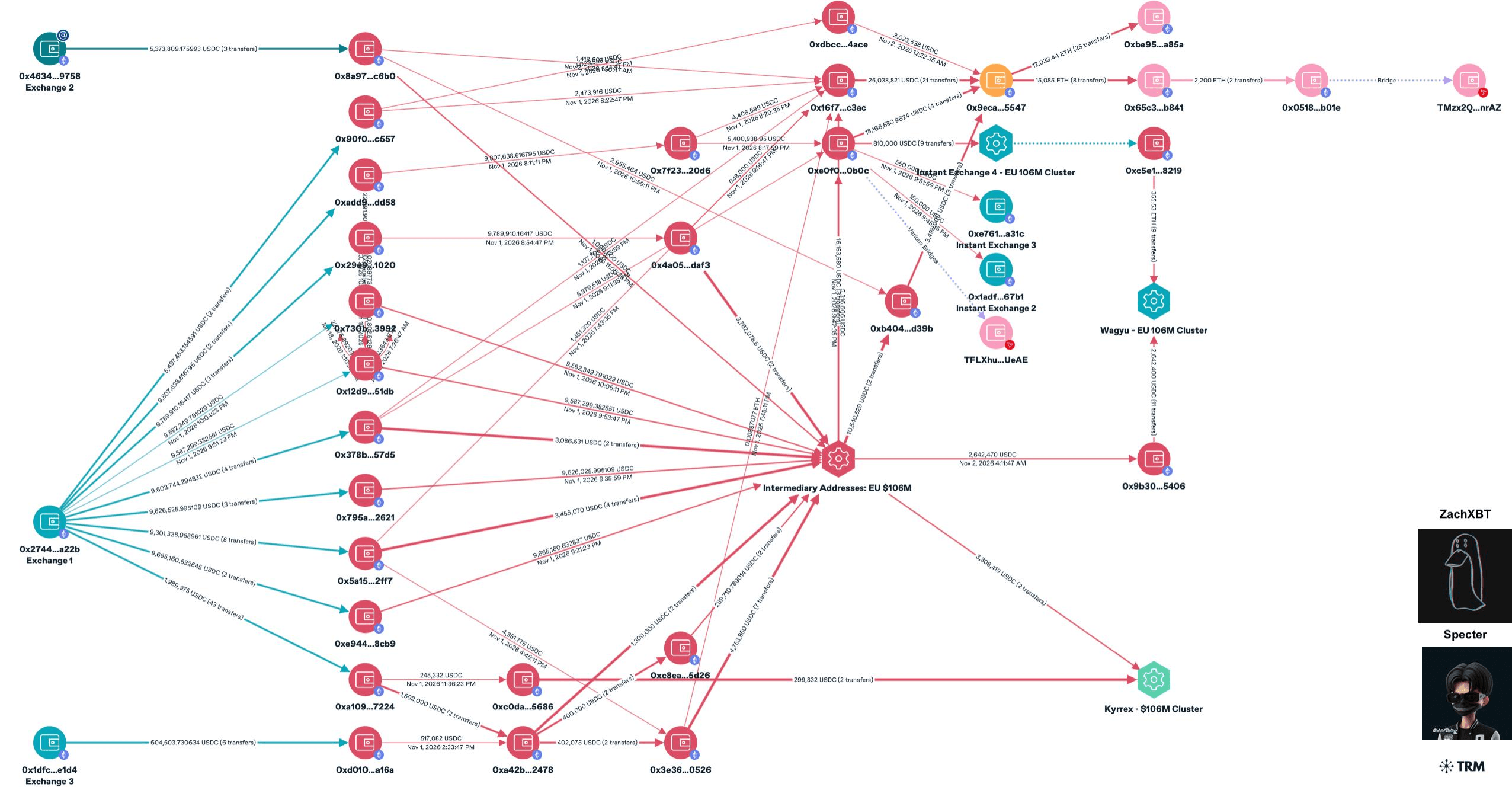
Polygon Agent Spend Controls: Budgets, Expiry, Limits
Nov 2, 21:30
Stealing $11.8 Billion in a Decade: How North Korea Became the Crypto World's Top Predator
Nov 2, 21:30Marvell Announces $115 Billion Acquisition of Lumentum to Build Optical Interconnect Giant in AI Computing Era
Nov 2, 21:19