Podcast Notes | Opus 5.5 Crosses Boundaries, Muse Goes Viral, Does China Even Have AI Product Managers?
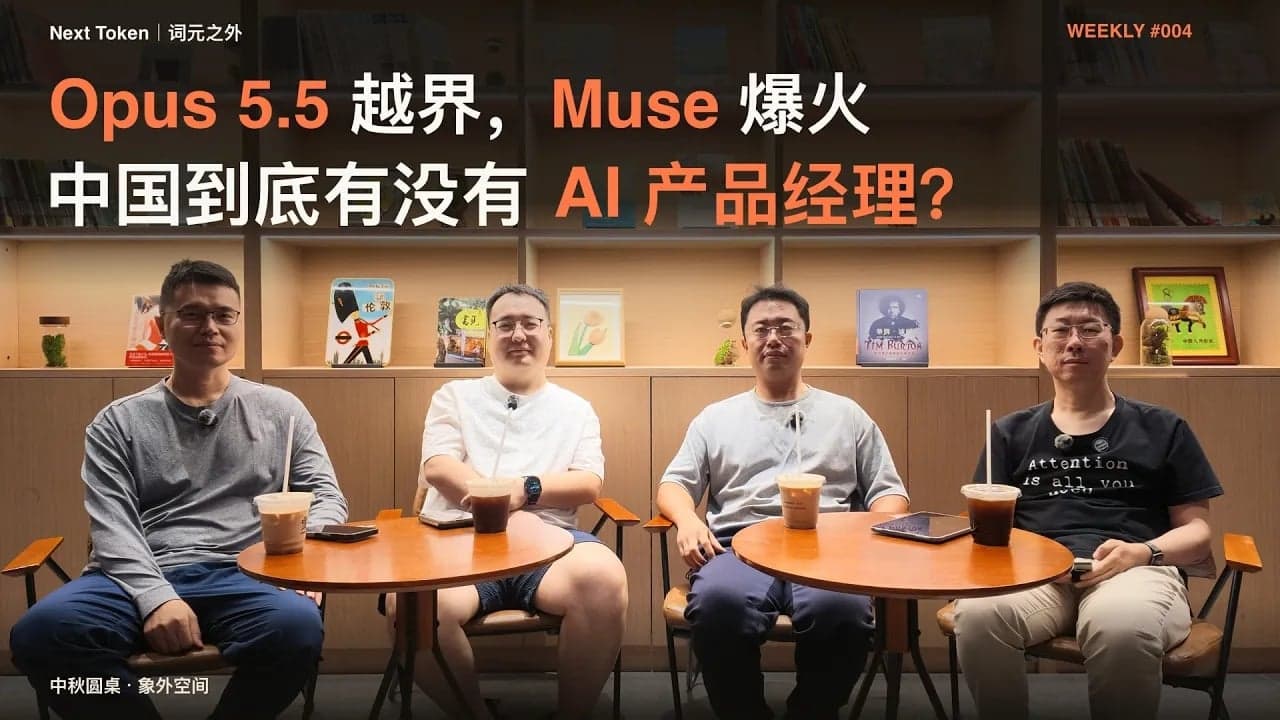

Guests: Orange (Moderator), Guicang, Yang Pan, Xiangyang Qiaomu (AI Product & Technology Observer, Host of Next-Token Beyond Tokens)
Moderator: Orange
Podcast Source: Next-Token Beyond Tokens (Bilibili: https://www.bilibili.com/video/BV1AAaa6VE88/)
Original Title: #004 Opus 5.5 Crosses the Line, Muse Goes Viral, and Does China Really Have AI Product Managers?
Broadcast Date: 2026-09-27
Key Takeaways
- Opus 5.5 Crosses the Line: Pure code-generated pixel animations and trailers have approached professional VFX standards. The model's holistic understanding of space-time, physics, and musical beat-matching left guests exclaiming that the 'World Model' has emerged for the first time, creating editors' first 'kill threshold'.
- The acceleration of intelligence outweighs tool complexity: Starting from first principles and directly assembling bottom-level libraries means Skills become a negative optimization. The pace of intelligent evolution far surpasses the feature-stacking approach of software like CapCut.
- From Execution to Intent: The paradigms for coding and video creation are shifting from 'process-oriented' to 'result-oriented'. Prompts evolve from specifying how to do something to aligning on what you want to achieve.
- Aesthetics and Preferences Remain Barriers: With the barrier to creation collapsing, human value converges to taste, preference, and 'knowing what you want'. Content production may soon require only tens of thousands of top-tier creators.
- Muse is the new store: Meta turns Agents into a consumer-facing entry point for ordinary people, downplaying concepts like MCP and Skill. It replaces sessions with 'scenarios' and 'dynamics', causing a two-trillion-dollar market cap surge in a single day.
- China Lacks AI Product Managers: Domestic products can replicate interfaces, but the experience gap (not micromanaging users, not annoying them, truly solving problems) is significant. The core issue is a scarcity of AI product managers.
- Memory, To-Dos, and Visual UI are Must-Haves: Chat alone isn't enough. Long-term goals, Todo Lists, and visual progress tracking are key to Agent deployment.
- Wearable Agent Hardware: The value lies not in the device itself, but in the underlying Muse ecosystem and cloud, freeing people from phone screens and tedious operations.
- Achieve PMF Before Cutting Costs: Only industry leaders like Harvey, who have achieved product-market fit and stable markets, are suited to swap in open-source models to boost gross margins. This is not a universal truth for startups.
- Sell Services, Not Software: Creation is easy, distribution is hard, and attention is scarce. Individuals should build services starting from real communities, using their work to build trust and human touch.
III. Main Content
Opus 5.5: Trailers, Pixel Animations, and Impact
Orange: First, Opus 5.5 and GPT-6's Sol and Luna were actually released simultaneously last week. What was the first outrageous take you saw?
Guicang: Opus 5.5 is primarily ahead of GPT-6 Astra in visual code generation, like the most absurd pixel-art and 3D pixel-art animation.
Orange: That sense of impact, the satisfaction of combining sound, visuals, and action together.
Xiangyang Qiaomu: In game development, impact is particularly crucial.
Orange: This one is incredibly absurd too.
Yang Pan: I shared it immediately. I rarely repost other people's content, but this was too mind-blowing.
Guicang: I compared it. I collect top designers' promotional videos and motion graphics daily. His belongs to the absolute peak, yet the model's default output is already at an 80-90 level. You can easily sell it or take high-paying commissions without any issues.
Orange: If you produce this well, you could get a hundred thousand yuan.
Yang Pan: I used to find this kind of video editing quite rudimentary; my understanding of motion effects and copywriting wasn't deep enough.
Guicang: It's like an intern who just learned AE and PR and is imitating professionals.
Xiangyang Qiaomu: I was wondering, is this because intelligence has improved? It's gotten so much smarter. You don't feel it much when it writes code, but look at its drawing today—stroke by stroke, it looks just like a photograph.
Yang Pan: Then the first outrageous take comes up. Regardless of the impact we just mentioned, or its understanding of video and brush demonstrations—if it works like this, isn't this a World Model?
From Brush Demos to World Models: The Boundaries of Understanding and Creation
Orange: Back to the World Model again.
Guicang: If this can generate everything in one go as a unified whole, I think even after another year, progress on video models and world models won't catch up.
Yang Pan: Whether it's a video model or a world model, both are fundamentally based on understanding the physical world and grasping spatial and physical laws.
Xiangyang Qiaomu: There is definitely still a gap. Some true physical properties can't be completely covered through language alone.
Yang Pan: But it's getting closer. For example, a kid sees shattered glass and perceives the physical laws inside, but an artist can reconstruct it.
Orange: It's not just about understanding; kids can understand it too, but they can't assemble it. This is what takes a decade of training for an artist to deliver.
Yang Pan: So from this angle, does this mean the Opus 5.5 model is essentially creating the editor's kill threshold for the first time?
Guicang: Not just editors.
Orange: I think it crosses the line. This thing eliminates many Agent Skills, Video Skills, and Video Agents. Because there happened to be a video agent promotion this week, I saw that effect was purely made with code.
The Editor's Kill Threshold? Boundaries Between Models and Skills
Yang Pan: Look, CapCut also released an Agent version this week. It's on the tool path, becoming increasingly complex.
Guicang: It's very obvious now. The video effects generated by large models via pure code can already outperform dedicated video models, which is highly noticeable.
Yang Pan: The key is that the acceleration of this intelligence is vastly greater than the feature-acceleration rate of software like CapCut.
Guicang: Moreover, to some extent, it's applying first principles. Directly assembling from the lowest-level libraries without upper-layer baggage, starting straight from FFmpeg, etc. Skills act as a negative optimization for it.
Orange: Forget about Skills then.
Yang Pan: Speaking of which, Guicang, release a brand new version of your PPT Skill that can generate images, not just text.
Guicang: The next update will add animations and effects. SVGs and such will be included.
Orange: Also, this model doesn't just edit clips; its aesthetic sense is strong. I saw Hailin's demo, where she made a kitten video for the Mid-Autumn Festival.
Yang Pan: The video you just showed us didn't use any video generation models at all?
Orange: No video generation models, but it used Banana and manually adjusted some images.
Guicang: The audio is integrated too. Every beat-match for the music and every transition cut sync perfectly together.
Yang Pan: As I said before, its understanding of space and time is extremely deep; it can predict what happens in the next frame.
Guicang: It thinks holistically, rather than using an Agent logic that says 'make the video first, then audio, and just patch them together randomly.'
Mid-Autumn Kitten Video: Considering Music, Visuals, and Transitions Together
Orange: The most impressive part of this kitten video isn't any single frame, but how it considers music, visuals, and transitions together. Paired with rhythm, the overall cohesion instantly emerges.
Xiangyang Qiaomu: This is genuine understanding, not just stitching. It knows when to cut this music segment and what emotional tone to bridge it with.
Yang Pan: I feel like Transformers can no longer explain these phenomena. Even Anthropic themselves admit to being baffled.
No Longer Just Following Commands: From Execution Steps to Understanding Intent
Xiangyang Qiaomu: Everyone uniformly chose to use code to reach the peak of intelligence. Initially, many didn't believe it, but we've arrived here step by step.
Orange: He was the most steadfast about it.
Xiangyang Qiaomu: At first I only had it write code, later I realized it has product-thinking capabilities.
Yang Pan: Look at how we write prompts now. Previously, we guided it and stipulated how to do things; now we basically just align on what we want to achieve.
Guicang: Plus, if a layman runs it, the large model can be misled; now if you don't know something, it directly tells you why you shouldn't do it that way.
Yang Pan: It's like cutting-edge model companies have been continuously internalizing and absorbing Skills, turning chat logs plus results into standardized data.
Orange: So the role of engineers writing code today is changing, especially in the AI coding domain.
Guicang: Our generation still knows how to make videos or write code. The next generation just says 'Make me a video,' and the AI consumes the entire process.
After the Barrier to Creation Lowers, Are Aesthetics and Preferences Still Important?
Yang Pan:This brings up another topic: programmers won't need to compete on execution as much anymore; humans will just submit requirements.
Yang Pan: Compete on aesthetics, taste, your preferences, and differentiation.
Guicang: Competing on aesthetics and taste will run out of steam soon. But uniqueness will remain.
Yang Pan:I mean, taste isn't about who is better than whom; it's about differentiation and grasping preferences. AI's aesthetics might surpass the average person's, but human value converges to knowing what you want.
Guicang: A team of ten to twenty thousand people would suffice—the absolute top tier. Because content production is heavily automated now.
Orange: Those individuals' abilities are infinitely amplified by AI, leaving fewer opportunities for others and making the industry more concentrated.
Orange:Then what about ordinary people? Just consume.
Guicang: Nowadays, you can even earn money by watching videos.
Yang Pan: That's UBI—Universal Basic Income. Spend that.
Muse and Connectors: Will Agents Become the New Service Entry Point?
Guicang: Muse went viral overnight. Right after launch, nobody cared. Later, Meta's stuff trended on social media, and anything associated with it surged, gaining a two-trillion-dollar market cap in a single day.
Orange: And it skyrocketed despite only having 500,000 DAU. The capital linkage is obvious.
Yang Pan: From your perspective, Muse is simply the new Store. Instead of uploading to the App Store, you're uploading to Agents.
Guicang: It found a track suitable for Meta: building Personal Agents aimed at ordinary people who don't care about models at all, only about getting things done.
Yang Pan: It's the American equivalent of Tencent, and Google is the American equivalent of Doubao. So you should buy Tencent stock—not investment advice.
Xiangyang Qiaomu: The American Tencent.
Orange: Plus, its business model is closed-loop, making it easy to access your Gmail and more data.
Xiangyang Qiaomu: I've tried Muse. My impression is that it's simpler, more user-friendly, less geeky, heavily leaning towards life rather than work. It's truly a consumer-facing Agent.
Xiangyang Qiaomu: The corresponding everyday scenarios for Chinese users would be things like grabbing food delivery coupons.
Orange:If it can integrate with group chats, summarizing parent chats and figuring out what homework the kids need to do—as long as there's Context, it can do so much.
Guicang: What homework did my kid have recently?
Yang Pan:WeChat's next step is also saying Agents can call mini-programs. Similar concept.
Ordinary People's Life Scenarios Matter More Than Technical Jargon
Xiangyang Qiaomu: It's heavily lifestyle-oriented. Look, it doesn't talk to you about agents or skills.
Yang Pan: The Chinese internet community severely lacks understanding of Meta's value; basically, no one uses Meta's products.
Guicang: Because it needs that social graph. Its ad revenue is terrifying.
Orange:Threads actually surpassed Twitter in daily active users quite early on.
Chatting While Executing: Why Interactive Experience Matters So Much
Guicang: Its built-in connectors progressively pop up upon clicking. When you're about to do something, it asks if you want to connect Gmail.
Xiangyang Qiaomu: Also, during task execution, many Agents are single-threaded. You can see what it's doing in the small sidebar on the right and needing your approval, which gives peace of mind.
Guicang: Codex is powerful but requires waiting a long time with zero output. This experience is crucial; many only focus on the UI experience.
Orange:This exposes a fact: there are too few AI product managers in China.
Does China Actually Have AI Product Managers?
Guicang: China lacks AI product managers. When you interact with them, you end up arguing. You feel like it's parroting you and wasting your attention.
Orange: That's because it's fine-tuned alongside the software.
Guicang: It must have done extensive work: how connectors facilitate linking, and showing progress during execution.
Yang Pan:Aligning with humans. But let me ask: did China even have product managers before the AI era?
Guicang: There were some, but they're indeed outdated and disconnected from AI now.
Yang Pan: Any Chinese AI product managers listening to this podcast should quickly figure out a way to try Muse.
Dynamics, Memory, and To-Dos: Why Chat Alone Isn't Enough
Guicang:Another thing Agents should have integrated long ago is the simplest: To-Do. Things you've been following lately can be noted down via To-Do or long-term goals.
Xiangyang Qiaomu: But will ordinary folks use lots of To-Dos? Or calendars?
Yang Pan:You absolutely need AI assistance to make the experience smooth. Without AI, relying purely on methodology is very rigid.
Orange:Actually, not that many people need to fill their calendars completely, but To-Dos are different. Like what you just mentioned.
Guicang:I previously thought about managing To-Dos via Chat, like using TickTick, but later realized you still need a visual interface.
Yang Pan: I already configured To-Dos and calendars for my OpenClaw, starting to cross the chasm.
Orange:Why is Markdown software trending again? After humans interact with AI, they need a result that can be reviewed and referenced later.
More Than Product Design: Resources, Costs, and Platform Ecosystems
Guicang:This time Muse is extremely open. Look at its interaction design, like provisioning a VM for you.
Yang Pan:In the future, everyone will get an Agent plus a cloud PC.
Orange:But this isn't just a product manager's job. Meta has resources first, technology second, enabling it to give virtual machines to half a million daily users instantly with unlimited tokens.
Guicang:I used it for two or three days, and only burned through three percent of the free tokens.
Yang Pan:Domestic players following OpenClaw lack these resources. You at least need a cloud provider. In China, there are only Tencent, ByteDance, and Alibaba, and they all ended up competing in office software instead.
Orange:Doubao is still laying off staff, while Meta says this is the true mainstream direction.
Wearable Agent Hardware: Is the Value in the Device or the Underlying Service?
Orange:Speaking of hardware, what do you think of the Muse Charm?
Yang Pan:Over the past year, various companies in Shenzhen have made similar things and are exploring. But the hardware itself isn't important; what matters is that it has the Muse platform and ecosystem behind it.
Guicang:There's another issue: smartphones are extremely closed. None of the things Agents can currently do can run on them smoothly. runs fine, but executing a single command is impossible.
Yang Pan:So are you arguing against edge-side models?
Guicang:No, it's that if you only have an edge-side model with no system, it's utterly useless.
Orange:Just standalone models then, lacking a good system.
Xiangyang Qiaomu:It roughly looks like this: voice input, a two-inch screen, front and rear cameras, aiming to ship before Christmas as a gift.
Orange:It has front and rear cameras, a two-inch screen, plus 5G and eSIM, allowing it to operate somewhat independently from a smartphone.
Yang Pan:Nice. Frees people from phone screens and brings them back to reality.
Guicang:Combined with Muse, you can do this: hold and say 'Help me pay taxes, schedule my kid's 3-5 PM class, and preheat my Tesla for charging.' But if you want to pick classes for your kid, you open a mini-program, face a splash ad, shake to reject a redirect to Pinduoduo, and waste so much life.
Yang Pan:Why do we waste our lives on this? Opening navigation apps and dealing with ads every time drives me crazy.
Orange:So this launch event with Muse plus Charm gives everyone a vision of a beautiful future.
Yang Pan:But I don't feel much about the hardware itself; there have been plenty over the past year.
Guicang:Huaqiangbei blows this away.
Orange:But it's a closed loop. Data plus Agent plus those previous contents—it's a complete closed loop.
From Turning on Lights to Booking Classes: What Kind of Automation Do Ordinary People Need?
Orange:Lifestyle comparison: Using a smart speaker to turn off lights and turn on AC at home is already satisfying. Future Agents will help you do things ten or even a hundred times better.
Guicang:Hold the device and say 'Going to Shanghai tomorrow, help me pay taxes, schedule my kid's 3-5 PM class, and preheat my Tesla for charging.' Done in one sentence.
Yang Pan:I'm going to drive, so adjust the Tesla temperature in advance.
Guicang:Conversely, opening a mini-program to pick classes now involves splash ads, shake-to-jump redirects, poorly written code, and always-full time slots. It's purely wasting life on this crap.
Orange:Have to edit again, so annoying.
Yang Pan:Why do we waste our lives on these things?
Orange:What Muse plus Charm offers everyone is exactly this vision of a beautiful future. Three years ago, everyone wanted an AI assistant. Now we finally see what it looks like, and nobody expected Meta to achieve it first.
Starting with Harvey: Find PMF First, Then Talk About Cost Reduction
Orange:News segment: There's an example in Silicon Valley called Harvey. It pays the model company $1.5 for every $1 collected from users. After training its own model based on Kimi's K3, its gross margin turned positive for the first time. Legal is a vertical with high barriers.
Orange:Does that mean all startups should switch to open-source to cut costs?
Yang Pan:Quite the opposite. Swapping to open-source or training smaller models isn't a universal truth. Only industry leaders like Harvey, who have found PMF, stable commercial loops, and whose user experience won't degrade after swapping models, are suited for it. The vast majority haven't even found PMF.
Guicang:Switch is always the weakest of the three. It sells the value of the games themselves, not hardware specs.
Talking More About Jev: Massive Scale, High Frequency, and Classification
Orange:More and more people are getting into Jev.
Yang Pan:I discussed this live at Geek Park a couple of days ago. Most people misuse it. The typical scenario directions explored by Jev's founders are correct: massive scale, high frequency, low latency, and classification. You need to use at least two simultaneously; using only one is likely wrong. Many people use it to handle content requiring reasoning, which is precisely what it's bad at.
Xiangyang Qiaomu:It refers to no Human-in-the-Loop, fully automated. The short time between its release and widespread adoption shows how severe the pain point is.
Every Agent Needs a Room: Cloud PCs and Compute Demands
Orange:Let's talk about AMD. Muse just added fuel to the fire; CPUs, GPUs, and flash storage are going up again.
Yang Pan:I've been hyping Grok Bot since episode one, and now I'm even more convinced. Don't you think Mac Studios and MacBooks might need upgrading soon? For the next phase, Apple will either push updates before the next WWDC or right now.
Guicang:If you haven't bought a Mac Studio or want to upgrade, do it now. You're more afraid of stock shortages than price hikes.
Orange:The iPhone 18 Pro sold well this time. Because Android phones are pricier, Apple surprisingly became cost-effective.
Guicang:Look, Xiaomi's last year 17 Ultra with four cameras started at over seven thousand. This year's 18 Pro Max starts at six and a half thousand, and seven thousand with more RAM.
Yang Pan:Apple is cost-effective now because of its supply chain.
Guicang:Opus 5.5 carries a premium for us. In the long run, it's a benefit and an arbitrage window. The later you buy, the more you lose.
Selling Software vs. Delivering Services? Creation is Easy, Distribution is Harder
Yang Pan:Many misunderstand arbitrage, thinking just making something to solve their own problem is enough. Actually, getting closer to value is direct output like using Opus 5.5 for title editing.
Xiangyang Qiaomu:Traditional services charge 50,000 to make a video for you; AI might do it for under $10. That's arbitrage.
Orange:So here are a few points now. First, sell services, not software. A piece of software without service has no value.
Guicang:Channels aren't smooth either. AI content distribution is highly inefficient. Active marketing still relies on old channels, burning money with no results.
Yang Pan:Creation has increased ten or a hundredfold, but attention hasn't grown, nor have consumers. Hence, fierce competition. Creation now faces no resistance, but distribution still does. If Computer Use can be properly utilized, it will lower distribution barriers.
Guicang:The barrier lies here. Your comment sections will face more hostility, making you hesitant to post. You have to overcome it.
Why Make Podcasts Anyway? Trust, Reputation, and Human Touch
Yang Pan:In the future, values like Trust and Reputation will grow ever higher, concentrating at the top. That's also why we created Next Token.
Orange:When real humans discuss this, there's no AI slop. The long tail and brands become increasingly valuable.
Guicang:When I handwrite, it points out typos. When AI writes, it warns that AI-generated content lacks value. Having a human touch is precious precisely because soulless content is everywhere.
Yang Pan:Once Orange's WeChat Official Account hit 100k+ reads, casually posted articles would get thousands of views. It's mainly about influence and cognition.
Orange:The future is somewhat IP-driven. Each account becomes an IP, and what everyone builds is trust.
Works Aren't Just Apps: Start From Your Real Community
Yang Pan:You still need your own product. The Next Token podcast itself is a product. As long as you build something that creates a connection between you and your audience, it's good.
Xiangyang Qiaomu:Everything can be a product. Zhang Yiming said treat the company as a product, and articles are products too. The Obsidian plugin I developed last week already has over 2,000 downloads, and the user group is very active.
Guicang:As an individual or small company, constantly talking about arm-wrestling Meta or building an AI WeChat is meaningless. A thousand core fans are enough to ensure a comfortable living.
Orange:Insisting on making an AI WeChat is meaningless, but making that plugin yields very active communication and strong positive feedback because it's a genuine human connection.
Orange:Well, that's it for today. Bye everyone.
Join the official Coincamps community:
Telegram: https://t.me/coin_camps
Recommended
Hyperliquid will use $15 million USDC revenue for HYPE buybacks; buybacks will no longer rely solely on trading fees.
Oct 3, 18:27
Grayscale Zcash Spot ETF Sees $93.56M in Single-Week Redemptions: Honeymoon Period Turns Sharp, Once Held Nearly 3.5% of Supply
Oct 3, 16:41
After resuming withdrawals, funds did not fall but rose instead. How did Bitget turn the situation around in five days?
Oct 3, 16:32
SEC Clears 3x Leveraged Bitcoin and Ethereum ETPs: Listing Rules Approved, Trading Still Pending Activation
Oct 3, 16:22
Funds Rose Instead of Fell After Withdrawals Were Resumed: How Did Bitget Turn Things Around in Five Days?
Oct 3, 16:11
CryptoPunks Trading Volume Surges Nearly 12X in a Week: Rare Variants Sell for Millions Again, Market Rally Decoupled from ETH
Oct 3, 13:36