JPMorgan Chase Decodes AI Hardware Costs, Memory Shortage to Persist Through 2028

TL;DR
· JPMorgan Chase raises its 2026-2028 global Memory TAM forecast by 4% to 8%, anticipating an exacerbation of the shortage in 2027 and marginal relief in 2028 but not complete disappearance.
· According to the report's model, memory as a proportion of CSP hardware capex could increase from less than 10% before the AI era to 31% in 2026 and 49% in 2027.
· SOCAMM and HBM spec reductions may alleviate delivery pressure, but are not sufficient to reverse the shortage; additional DRAM capacity remains the primary constraint on the supply side.
JPMorgan Chase raised its memory market size forecast in a global storage report released on August 9, stating that AI servers continue to drive up memory value density, and the global memory shortage may persist until 2028.
The most notable aspect of this report is not just the bullish view on storage prices but the internal reallocation taking place within AI capital expenditure: memory is evolving from a complementary item that was less than 10% in the past to potentially a core component occupying nearly half of CSP hardware spending.
For storage vendors, this means that revenue, profit, and bargaining power will continue to increase; for cloud providers, it means that AI capital expenditure is not just about buying GPUs, as HBM, server DRAM, and related memory solutions are also rapidly driving up the cost of the entire system.
JPMorgan Chase has raised its forecast for the 2026-2028 global Memory TAM by 4% to 8%. The report anticipates that the shortage will worsen in 2027, with slight improvement in 2028, but the previously accumulated absolute gap will not completely disappear. These numbers are all derived from a sell-side model and should not be directly construed as industry facts.
Over the past two years, discussions on AI capital expenditure have revolved more around GPUs, advanced packaging, and data center power. However, in AI servers, the rise in memory value density is becoming equally crucial.
Post second-quarter performance, the capital expenditure consensus of the three major cloud providers and Meta continues to rise. Meanwhile, based on JPMorgan Chase's calculations using Omdia hardware capex data, the proportion of the memory market dedicated to CSP in relation to its hardware spending has increased from less than 10% before the AI era to 31% in 2026, with a further expected increase to 49% in 2027.
This means that by 2027, for every $100 CSP invests in hardware capex, around $49 could be allocated to memory-related products. Figure 5 further illustrates that in this modeling scenario, this proportion could even rise to 60% by 2028.
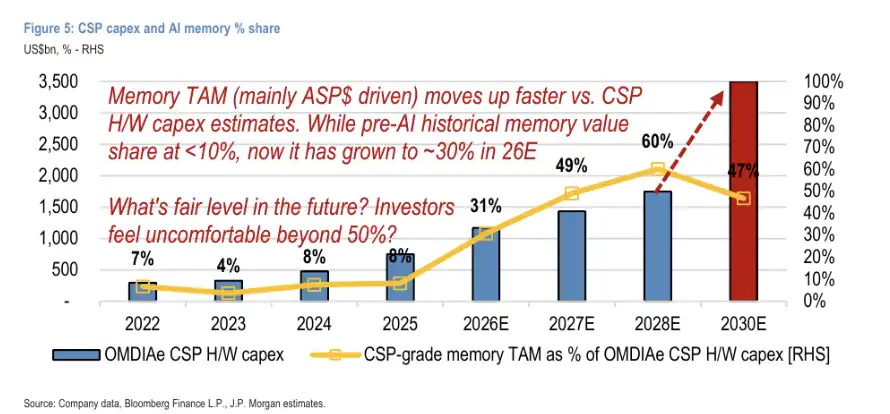
JPMorgan Chase estimates that the CSP-level memory TAM as a percentage of CSP hardware capex could increase from less than 10% before the AI era to 31% in 2026, 49% in 2027, and 60% in 2028. The report also points out that a share of over 50% may be difficult to sustain in the long term.
AI servers not only require more HBM but also more server DRAM, SOCAMM, and other memory solutions deployed around AI CPUs and accelerators. The more GPUs and AI CPUs shipped, the harder it becomes to maintain the traditional server-era memory configuration ratio.
However, JPMorgan Chase also acknowledges that a memory value share of over 50% may raise investor concerns about the sustainability of AI capex. In the future, if cloud providers cannot further increase their hardware budgets, they may continue to reduce the per-server memory capacity or turn to lower-cost tiered memory and storage solutions.
Therefore, the increase in memory share is not only a benefit to memory vendors but also indicates that CSPs are facing simultaneous increases in AI server costs and return on investment pressure.
One key reason for the recent volatility in storage stocks is the market's concern that the downgrading of AI server memory configurations signifies a cooling demand.
The report states that NVIDIA's Vera CPU SOCAMM capacity has been reduced from 1.5TB per chip to 768GB. Rubin Ultra may also reduce the number of compute dies and downgrade HBM4E configuration from 16-Hi or 12-Hi to 12-Hi or 8-Hi in some SKUs; Rubin may introduce two configurations of 288GB and 192GB.
Under a more conservative single-card memory assumption, JPMorgan Chase has lowered the HBM bit demand from 2026 to 2028 by 4% to 19%.
However, within the report's analytical framework, these adjustments are primarily seen as a way for customers to cope with shortages: reducing the memory configuration of individual chips or systems to support more GPU, CPU, and server deliveries, rather than a sudden lack of memory for AI training and inference.
JPMorgan Chase also acknowledges that specification downgrades indeed reduce per-unit memory requirements, narrowing the supply-demand growth delta. It's just that the increased shipments of new AI chips and servers may still offset the impact of declining per-machine memory capacity.
According to the updated model, the annual supply-demand delta for DRAM is around -3% in 2026, expanding to -7% in 2027. By 2028, the supply growth rate may exceed demand by about 3 percentage points. The annual supply-demand delta for NAND is approximately -3%, -5%, and -1% respectively.
This means that the marginal supply-demand situation for DRAM may improve in 2028, while NAND is still experiencing a slight gap. However, due to the previous shortages, JPMorgan Chase believes that both product types will not truly regain supply-demand balance by 2028.
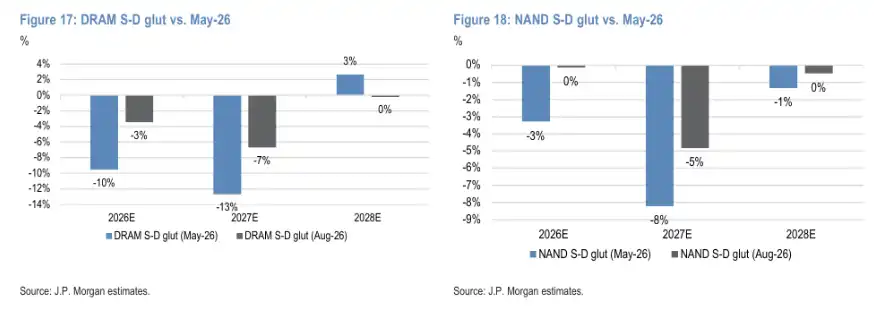
JPMorgan Chase's August model shows that the annual DRAM supply-demand delta decreases to -7% in 2027 and improves to +3% in 2028. For NAND, the delta changes from -5% in 2027 to -1% in 2028, but the previously accumulated absolute gap has not completely disappeared.
HBM follows the same logic. JPMorgan Chase's calculations indicate that the updated HBM supply-demand gap is approximately -15%, -14%, and -22% in 2026, 2027, and 2028 respectively. Compared to the May model, specification adjustments have narrowed the shortage, but the market has not yet shifted to oversupply.
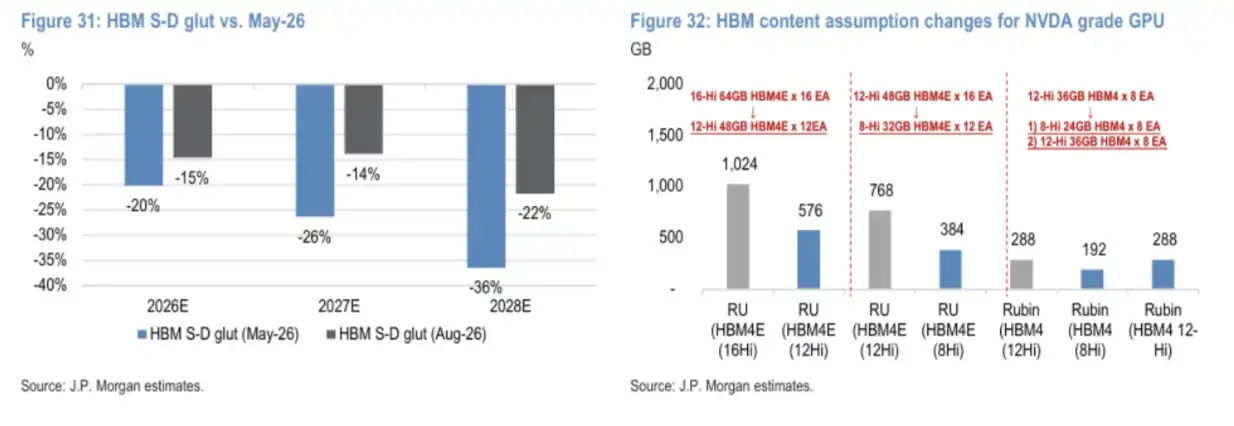
Under more conservative configuration assumptions, certain versions of Rubin Ultra with HBM have seen their capacity reduced from 1024GB or 768GB to 576GB or 384GB, and Rubin could be configured with 192GB or 288GB; even after the specification adjustments, the HBM market has not transitioned to oversupply.
In a scenario of prolonged shortage, HBM pricing is one of the key figures highlighted in the report.
JPMorgan Chase predicts that the average price of mixed HBM will increase by 42% year-on-year in 2027, with prices of equivalent products potentially rising by 30% to 40%. By 2028, the price increase for equivalent products may decrease to less than 10%, but product structure upgrades could still drive a 22% year-on-year increase in the mixed average price.
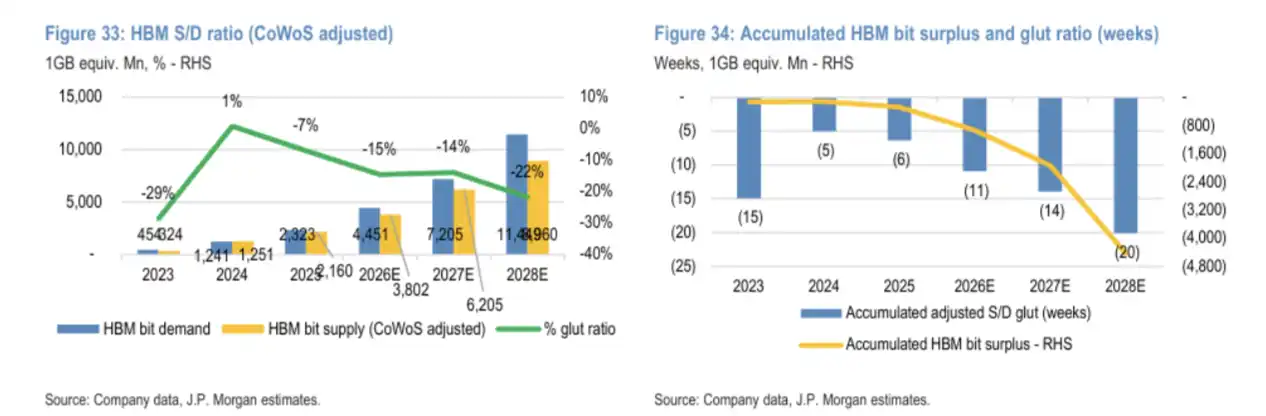
JPMorgan Chase predicts that the HBM supply-demand gap will be around -15%, -14%, and -22% in 2026, 2027, and 2028 respectively, with the cumulative shortage expanding. The average price of mixed HBM is expected to increase by 42% in 2027 and a further 22% in 2028 driven by product upgrades.
These numbers are all model predictions from the report and not a unified price list already determined by suppliers.
One of the reasons supporting prices is the slowed HBM product upgrade pace. The 8-Hi product lifecycle has been extended, the 12-Hi ramp-up rate has decreased, and the 16-Hi adoption has been delayed. In a situation of sustained supply constraints, this may actually strengthen the bargaining power of major suppliers.
Meanwhile, long-term agreements with major customers, known as LTAs, are also starting to change the traditional memory cycle of volatility.
The report indicates that prepayments disclosed in LTAs by Samsung Electronics and Micron account for approximately 20% to 25% of the contract value, with the proportion of covered or contributing shipment volumes in some agreements ranging from 50% to 70%. Most LTAs revolve around server and AI memory and follow a differentiated, flexible pricing structure.
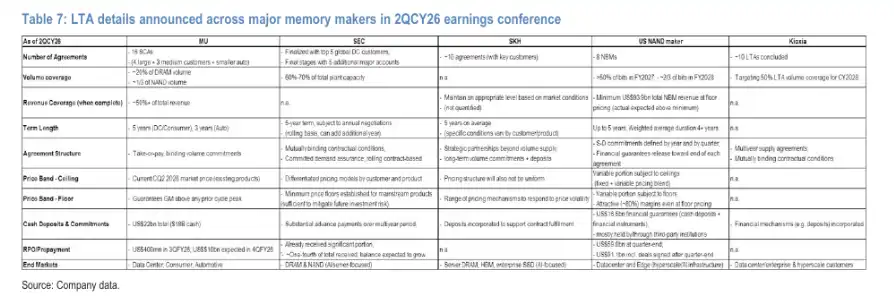
LTAs disclosed by major memory manufacturers exhibit differences in terms of duration, shipment coverage, prepayments, and pricing mechanisms, but overall contract terms are more favorable to suppliers, mainly targeting server and AI memory.
JPMorgan estimates that CSP and AI-related demand may account for over 70% of the total contract bit volume and over 85% of revenue. Server memory enjoys a significant price and margin premium compared to non-server applications.
For suppliers such as Samsung Electronics, SK Hynix, and Micron, LTAs can increase the visibility of orders and cash flow and make the price increase curve smoother. However, the report also acknowledges that the LTA pricing structure is not transparent, and the actual coverage ratio and flexible pricing mechanisms are still subject to observation.
If CSP capital expenditures slow down or AI servers continue to reduce memory configurations, the pace of contract execution and final prices may still adjust. Therefore, while LTAs can reduce the volatility of the memory cycle, they cannot completely eliminate it.
A key premise for the shortage continuing until 2028 is that new supply is difficult to land in a timely manner.
JPMorgan estimates that to achieve supply-demand balance for DRAM by 2028, the industry needs to add approximately 5.5EB of supply, corresponding to around 299,000 wafers per month of capacity; NAND, on the other hand, needs to add approximately 76EB of supply, corresponding to about 44,000 wafers per month of capacity.
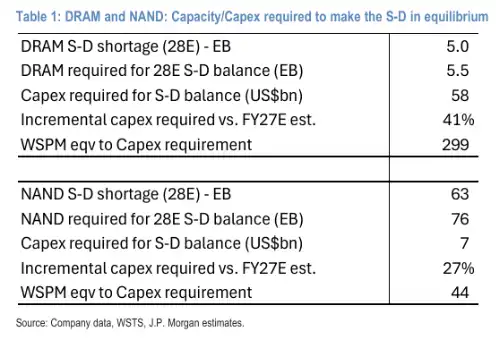
JPMorgan Chase estimates that, to achieve supply-demand balance by 2028, DRAM will need to add approximately 5.5EB of supply and 299,000 wafers per month of capacity, while NAND will need to add approximately 76EB of supply and 44,000 wafers per month of capacity.
The report suggests that even if all publicly announced expansion projects are included in the model, the additional supply would still not be sufficient to entirely close the gap.
Building new fabs is not a short-term endeavor. From groundbreaking to volume production, it typically takes 2 to 2.5 years. SK hynix's M15X has already begun contributing capacity gradually, the Xianyou cluster Phase 1 is expected to ramp up starting from March 2027; Samsung's P4 is still expanding, with the new P5 expected to start production in the fourth quarter of 2027; Micron's Boise ID1 and PSMC's P5 are both expected to gradually contribute capacity starting from the second quarter of 2027.
Even with these projects progressing as planned, JPMorgan Chase estimates that global monthly semiconductor wafer capacity for DRAM will only increase from around 1.9 million wafers at the end of 2025 to 2.85 million wafers by the end of 2028, still below the level required to achieve supply-demand balance.
HBM itself will further squeeze traditional DRAM supply. By the end of 2028, HBM-related wafers could account for approximately 32% of total DRAM capacity. Due to HBM's die penalty being about 3 to 4 times that of regular DRAM, producing the same capacity of HBM will consume more wafer resources, further constraining the supply of traditional server and consumer-grade DRAM.
The impact brought by Chinese manufacturers needs to be discussed separately.
JPMorgan Chase predicts that by 2028, CXMT's DRAM capacity and bit share will reach approximately 16% and 11% respectively, but they will still lag behind leading manufacturers by around 2 to 3 years in high-density server DRAM and products above HBM3E. Therefore, its short-term expansion will have limited direct impact on high-end AI memory.
In contrast, the report suggests that YMTC's NAND unit wafer bit output has roughly caught up with industry leaders. By 2028, its global NAND capacity and bit share may reach close to 16%, making NAND face higher Chinese new supply pressure than DRAM.
Another clue to the more tradable storage players in the capital markets is their potential for shareholder returns.
Samsung Electronics and SK Hynix have a current shareholder return policy that requires 50% of the accumulated free cash flow to be used for shareholder return. Samsung's current plan covers the years 2024 to 2026, while SK Hynix's plan extends to 2027.
According to JPMorgan's model, the annual cash yield for Samsung Electronics in 2026 and 2027 could be around 8% each year, totaling approximately 16% over two years; SK Hynix's cash yield in 2027 could rise to around 16.7%. The report therefore expects that the cumulative cash return rate of the two companies over the next two years could reach about 16% to 20%.
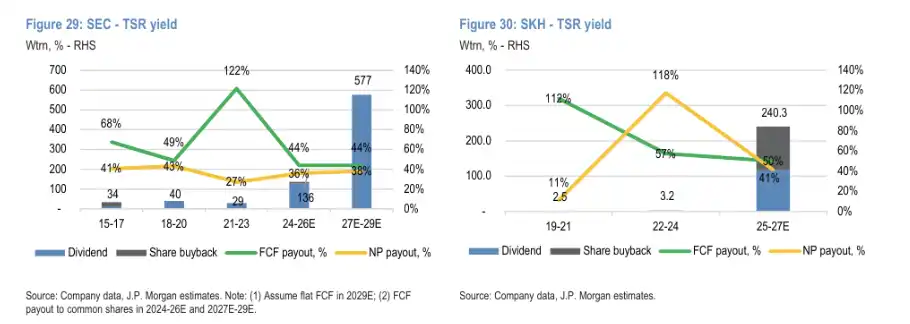
JPMorgan expects that memory manufacturers' shareholder returns over the next two to three years could significantly exceed historical levels, but these returns are based on assumptions of free cash flow, special dividends, and buybacks.
This could become a catalyst for storage stock valuation recovery. The memory stocks tracked by the report outperformed the AI industry chain for four consecutive quarters, but since the third quarter of 2026, they have experienced a pullback of about 25%. The pressure mainly comes from downward revisions in short-term profit forecasts, a slowdown in CSP AI capital expenditure, and market concerns about memory configuration optimization.
However, special dividends and buybacks ultimately depend on free cash flow, memory prices, and management decisions and should not be considered as guaranteed returns. If AI capital spending or LTA execution falls below expectations, shareholder returns may also be discounted.
The report by JPMorgan reveals not just another round of memory price hikes but an internal reallocation within AI capital expenditure: memory is moving from a supporting item that accounted for less than 10% in the past to a core component that may occupy nearly half of hardware expenditure.
For storage manufacturers, this presents an opportunity for profit and bargaining power growth; for cloud manufacturers, it means continued rising costs for AI servers. However, a near or over 50% share of memory value is also challenging to sustain in the long term, which may compel cloud manufacturers to further increase capital expenditures, reduce per-machine configurations, or adopt layered memory solutions like CXL, enterprise SSDs, and HBF.
Therefore, what truly needs to be observed is not just whether the shortage can persist until 2028, but rather which of CSP budget growth, memory specification optimization, and additional wafer capacity will be the first to alter the current supply-demand balance.
Recommended
Desk: Brent Crude Tops $110, Musk's Net Worth Drops 528.6 Billion in Four Days After Tesla Roadster Launch
Oct 17, 21:49
JST Fifth Buyback and Burn Successfully Concludes: Over 170 Million Tokens Worth Approximately $23.53 Million Burned, Buyback Mechanism Set for Comprehensive Upgrade
Oct 17, 20:10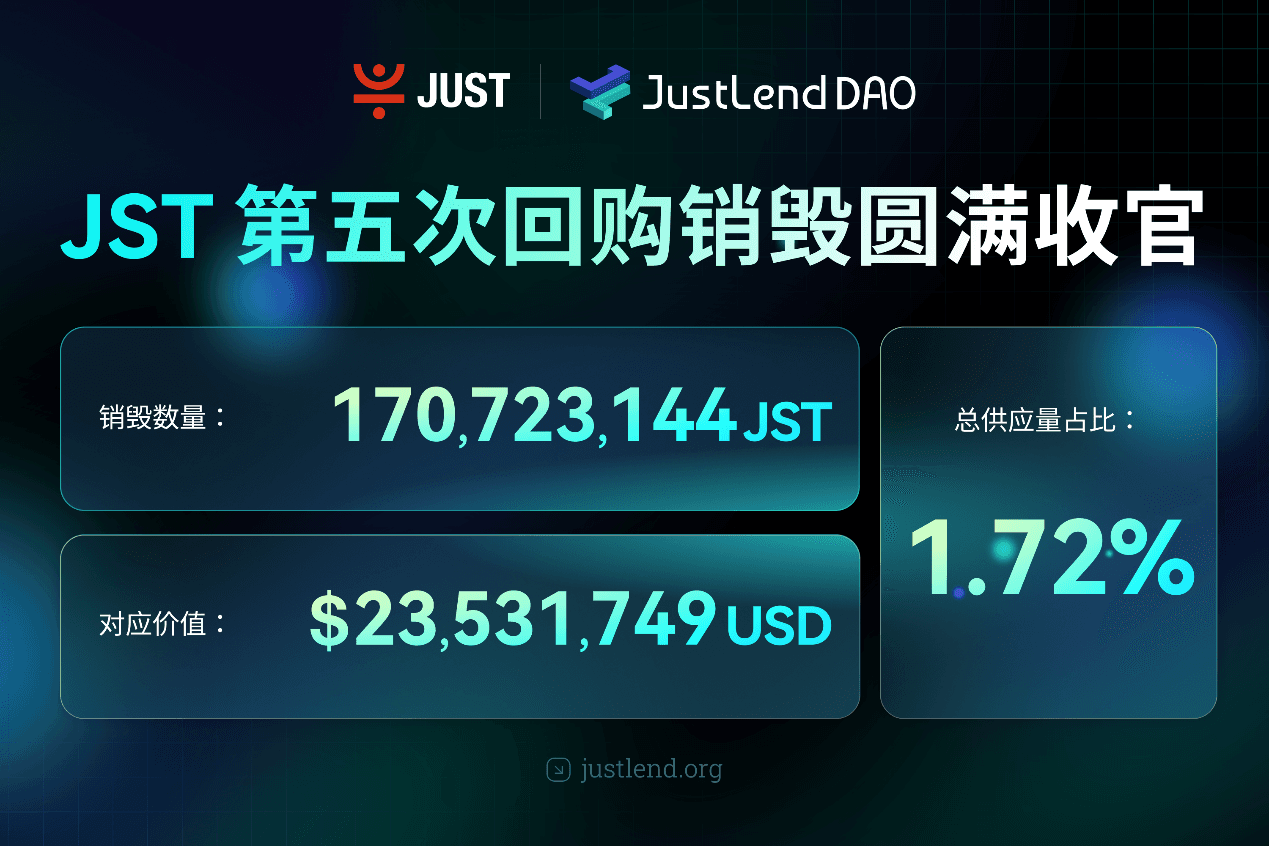
BitTorrent Brand Upgrade and Initial BTT Buyback & Burn Launch Simultaneously, Dual Engines Usher in New Era of Web3 Infrastructure
Oct 17, 20:00
Asia Market Daily: Japan's BOJ signals more rate hikes while Korea targets offshore perpetual platforms (2026/10/17)
Oct 17, 17:01Why did Papertrade backfire on you?
Oct 17, 17:01
The 'Strict Father' of Northern Myanmar: This Company Deploys 200,000 "AI Best Actors" to Strike Back Against Scammers
Oct 17, 15:34