BIT Trading Moment: BTC's Range Keeps Narrowing, Will a Breakout Have to Wait Until Next Week?
This article is jointly produced by us and BIT U.S. Stocks. BIT U.S. Stocks offers 10,000+ U.S. main-board stocks and ETFs, supports stablecoin deposits/withdrawals and traditional USD wire transfers, and provides full shareholder rights including dividends and voting rights.
If Bitcoin Fails to Hold the Lower Bound of Its Range, It Could Fall to the $76,000–$79,000 Zone
Dragged down by hotter-than-expected U.S. inflation data (September CPI up 3.7% year-on-year, PPI surging 6.3% year-on-year for its biggest gain since 2022) and the spreading panic over the bursting of the U.S. AI computing bubble, Bitcoin briefly dipped to $79,800 last week. As China's Q3 GDP growth of 4.5% year-on-year beat expectations this morning, and international oil prices pulled back from highs, Bitcoin temporarily held the $80,000 defense line, and market risk appetite recovered somewhat.
Bitcoin's oscillation range is currently narrowing, and it has been trapped between the 15-day and 50-day moving averages for 12 consecutive days. Multiple analysts view the area around $80,000 as the "lifeline" that bulls must defend at all costs. BIT points out that the weekly stochastic indicator has risen from the 20% oversold zone to the 90% overbought zone; if it falls back below 90% and crosses below the slow moving average, it often signals a shift from gains to losses. If Bitcoin's weekly close falls below $82,000, this bearish signal will be confirmed. However, the institution's longer-cycle view has not yet turned bearish, stating that as long as BTC holds above the mid-$75,000 level, the 1–6 month outlook remains positive, but the potential selling pressure from miners' nearly 1.8 million BTC, the October 28 FOMC meeting, and rising U.S. Treasury yields warrant near-term caution.
CoinMarketCap, meanwhile, cautions that investor risk appetite has declined significantly amid AI bubble concerns and the semiconductor sell-off, market sentiment remains weak in the short term, and Bitcoin faces the risk of breaking below its $81,000–$86,000 oscillation range. If Bitcoin fails to hold the lower bound of its range, it could face further downward pressure toward the $76,000–$79,000 zone. Some traders are even bearish down to $69,000 or even $53,000. The bull camp argues that the daily RSI has pulled back to a historically reliable rebound zone, and only a high-volume breakout above the dense resistance band of $82,500–$84,500 can reverse the pattern of lower highs and launch a counterattack toward $87,000 and above $90,000.
Today's Key Points:
-
This Week's Preview | Starknet community to vote on transitioning to an independent quantum-resistant L1; Robinhood Chain ecosystem trading platform Fables to hold TGE
-
Data: ZRO, XPL and other tokens to see large unlocks this week, with ZRO unlocking roughly $43.3 million
-
CME plans to launch Bitcoin Cash (BCH) and Uniswap (UNI) futures on October 19
-
Mint Blockchain to cease operations on October 20; users must withdraw assets before that date
-
Strive plans to increase its SATS preferred stock IPO to 7 million shares and raise $630 million on October 20
-
South Korean government to convene the five major crypto exchanges on October 20 to discuss virtual asset taxation
-
StandX to gradually cease operations on October 20; perpetual contracts to allow position reduction only, effective immediately
-
Kaito (KAITO) unlocks roughly 17.6 million tokens, worth about $5 million
-
LayerZero (ZRO) unlocks roughly 25.72 million tokens, worth about $47.3 million
-
Upbit 24-hour trading volume ranking: CT, XRP, BTC, GTC, ETH
-
Bitcoin spot ETFs saw net outflows of $229 million last week, with BlackRock's IBIT leading at $165 million in net outflows
-
Ethereum spot ETFs saw net outflows of $320 million last week, marking three consecutive weeks of net outflows
-
SOL spot ETFs saw net outflows of $25.5207 million last week, a record high
-
HYPE spot ETFs saw net outflows of $17.5724 million last week
-
XRP spot ETFs saw net outflows of $1.8375 million last week
Today's biggest gainers among the top 100 coins by market cap: ARB up 7.2%, VVV up 6%, PEPE up 5%, PUMP up 4.5%, ETHFI up 3.4%.
Overnight Rebound in U.S. Stocks Eases "Black Monday" Selling Pressure, Tech Sentiment Recovers
All three major U.S. stock index futures turned warmer before the Asian session, with Nasdaq futures up more than 1%, S&P 500 futures up nearly 0.60%, and Dow futures up 0.15%, as risk appetite briefly recovered from last week's AI sell-off.
This long-awaited warmth mainly came from expectations that the Trump administration would exempt Russian fuel sanctions, driving oil prices lower, combined with China's Q3 GDP and retail data both beating expectations, which greatly soothed market anxiety over global stagflation and prompted the VIX fear gauge to retreat quickly from its highs above 22.
BIT overnight data shows that the chip and AI computing sectors that were hit hardest last week have become the vanguard of capital re-entry, with the 3x long Korea ETF surging 14.94%, the 3x long semiconductor ETF soaring 7.74%, and the Philadelphia Semiconductor ETF rising 2.59%. Among specific names, AI cloud unicorn Nebius, which was brutally battered last week, rebounded 3.44% in overnight trading, while SK Hynix, SanDisk, and Intel all rose more than 3.3%, and AMD (+2.75%), Micron Technology (+2.59%), Nvidia (+1.60%), and TSMC (+1.50%) all advanced. SpaceX and Tesla also edged up 1.68% and 0.59%, respectively.
AI Selling Pressure Lingers, Crypto-Related Stocks Under Collective Pressure
The Nasdaq tumbled 2.14% last Friday (with a weekly plunge of 4.48%, its worst performance in 18 months), the S&P 500 fell 1.09%, the Dow slipped 0.34%, and the Philadelphia Semiconductor Index suffered its longest eight-day losing streak since 2008, with more than $2 trillion in market value wiped out in a single week. UBS's trading desk characterized this as crowding-driven "targeted deleveraging rather than de-risking," and Goldman Sachs strategist Louis Miller issued a stern warning: credit spreads for hyperscale cloud providers have widened to their widest levels of the year, and credit default swaps have hit record highs, implying related stocks still have 15% downside room.
Meanwhile, Fed Chair Warsh declined to give rate guidance before the quiet period, pushing the 10-year Treasury yield down 17 basis points last week to around 5.05%. Under the stock-bond seesaw effect, capital is frantically fleeing the highly leveraged AI sector and pouring into traditional defensive names like Chevron, ExxonMobil, and Coca-Cola, which hit record highs.
In this purge targeting high valuations and high financing costs, Nvidia-backed computing cloud unicorn CoreWeave plunged 11.91% on Friday (down nearly 25% for the week) as its five-year CDS spread surged past 1,100 basis points with an implied default probability above 60%, while peer Nebius also crashed 12.18% and Oracle fell 4.64%. Moderna tumbled 7.82% after the FDA declined to accept its seasonal flu vaccine application. Meta dropped 3.72% as the market expected Q3 free cash flow to turn negative (-$9.14 billion) amid massive debt-funded data center expansion, while Microsoft, Google, Amazon, and Nvidia all fell between 1.4% and 2.3%. Tesla, despite showcasing the "flying" stunt of its next-generation Roadster, saw its stock open high and close down 2.13% as JPMorgan and HSBC poured cold water, saying the production delay to 2028 does nothing for near-term earnings. Only Apple bucked the trend, rising 0.43% to a record high on strong consumer resilience, as pre-orders for its first foldable phone, the iPhone Duo, sold out within minutes and shipments were pushed back to December.
Hit by the triple blow of U.S. tech deleveraging, widening credit spreads, and Bitcoin's pullback, the U.S. "crypto-related stocks" sector collapsed across the board last Friday. According to BIT U.S. Stocks data, Bitcoin miners transitioning to AI data centers became the hardest-hit area of the sell-off amid concerns over high capital expenditure and financing costs. Riot Platforms plunged 11.48%, IREN tumbled 11.19%, Hut 8 Mining dropped 10.96%, and Cipher Digital (-10.56%) and CleanSpark (-10.16%) both fell more than 10%, while Marathon Digital (-9.60%), Canaan (-8.17%), Bitdeer Tech (-8.04%), and Terawulf (-7.45%) were all hit as well.
Strategy plunged 9.56% last Friday (though it has rebounded 2.52% in overnight trading today alongside BTC's recovery, and the iShares Bitcoin Trust ETF also rose 1.43% overnight), Coinbase fell 5.79%, Circle dropped 5.46%, and Robinhood closed down 4.92%.
Korean Stocks Stage a Dramatic Comeback, Japanese Stocks Weighed Down by Rate-Hike Expectations and Chip Valuation Reset
Asia-Pacific markets kicked off the new trading week on Monday with sharp divergence, as South Korean stocks staged a stunning reversal while Japanese stocks closed lower amid the Bank of Japan's hawkish hints and the aftershocks in chip stocks.
South Korea's KOSPI opened down as much as 3% in early trading, dragged by last week's U.S. AI crash, but as the South Korean finance minister stepped in to voice support, saying "South Korea's economic growth is expected to reach 3.4%–3.6% in 2026, stock market fundamentals are solid, and the chip boom will continue until 2027," combined with the won hitting its strongest level against the dollar in two years, the KOSPI index opened low and climbed throughout the day, ultimately closing sharply higher by 1.75%.
The earlier plunge in Samsung Electronics and SK Hynix had already caused the valuation of the National Pension Service's holdings to shrink by 182 trillion won (about $137 billion) since the end of June, and South Korea's Financial Supervisory Service warned on Monday that SK Hynix's U.S. subsidiary Solidigm could violate "dual listing" rules if it IPOs in the U.S. However, bargain-hunting capital flooded in today, pushing Samsung Electronics up 1.16% and SK Hynix up 0.39%, while Samsung Biologics (+8.71%), LG Energy Solution (+7.20%), and POSCO Holdings (+6.07%) led the market's surge. Tomorrow's KOSDAQ listing of South Korean cloud service provider Elice (raising 201 billion won, the year's largest IPO) will serve as a litmus test for Asian AI investor confidence.
Turning to the Japanese market, Bank of Japan Governor Kazuo Ueda reiterated in the morning that the stance of reducing government bond purchases remains unchanged and warned that he would closely monitor the pace of long-term rate increases to decide whether to intervene. Combined with the IMF urging the BOJ to accelerate rate hikes when inflation exceeds expectations, tightening expectations weighed on the Nikkei 225, which closed down 0.62%.
The most brutal story in the Japanese market is NAND flash leader Kioxia: caught in a double squeeze from doubts over AI capital expenditure returns and low-price capacity expansion by Chinese NAND makers, compounded by a stake reduction by major shareholder Bain Capital and a stampede of margin calls on highly leveraged Japanese retail positions, the giant that just a month ago surpassed Toyota to become Japan's most valuable company saw its market value evaporate by nearly 40 trillion yen from 60 trillion yen in just one month (a two-thirds collapse), sliding to fourth place in Japan. Daiwa Securities chief strategist Yugo Tsuboi said the market is repricing a peak in global memory prices. Although Kioxia edged up 1.68% today, Tokyo Electron (-2.63%), Fast Retailing (-2.29%), and SoftBank Group (-2.00%) still led the Nikkei's decline.
Turning back to the Chinese market, Hong Kong stocks were closed today for the Chung Yeung Festival holiday, while A-shares held relatively firm, boosted by better-than-expected Q3 GDP (+4.5%) and consumption data. The Shanghai Composite rose 0.39% and the Shenzhen Component Index edged up 0.13%, but the STAR 50 Index plunged 2.17% and the ChiNext Index fell 0.94% amid contagion from global semiconductor deleveraging, with combined turnover across Shanghai, Shenzhen, and Beijing shrinking to 1.45 trillion yuan and more than 3,100 stocks declining.
Catalyzed by the upcoming 2026 World Physical AI Conference, humanoid robot and reducer stocks hit their daily limits in a wave, with Unitree Technology surging 16.15% to reclaim a 200 billion yuan market cap, while more than ten stocks including Ningbo Dongli and Zhejiang Rongtai hit the daily limit, and military-equipment restructuring concept stocks also surged across the board. In addition, safe-haven capital continued to pile into high-dividend assets, pushing Industrial and Commercial Bank of China (+1.42%, market cap 3.07 trillion yuan) and China Construction Bank (+1.05%, market cap 3.03 trillion yuan) to record highs together. In contrast, semiconductor giant ChangXin Memory tumbled 7.77% (its 2.82 trillion yuan market cap slipping to third place in A-shares), while agriculture and real estate sectors also underperformed, with Rongfeng Holdings and Jinjian Rice both hitting the daily limit down.
What to Watch Next:
October 19 (Monday)
-
9:20: Hong Kong stocks closed, Stock Connect suspended; Dongxing Securities and Cinda Securities delisted.
-
German Chancellor Merz meets Jensen Huang: focus on whether German industrial AI, data centers, and sovereign computing cooperation translate into actual investment and orders.
-
15:00 State Council Information Office "Technology for Commerce" press conference: watch for technology applications and commercial policies, which could catalyze AI applications, retail digitalization, and consumer sectors.
-
Financial Street Forum opens, running through the 22nd: watch for policy statements from Pan Gongsheng, Wu Qing, and Zhu Hexin, especially on monetary policy, capital market reform, and growth-stabilization measures.
-
World Bank Global AI and Digital Summit and Shanghai Bund Summit run through the 22nd; RISC-V China Summit runs through the 20th: watch for AI financing and governance, global capital allocation, open-source chips, and domestic substitution, respectively.
October 20 (Tuesday)
-
Nvidia GTC Berlin opens, running through the 22nd: watch for AI chip architecture, inference, robotics, and European customer orders, and judge whether technological breakthroughs can translate into revenue.
-
APEC Finance Ministers' Meeting held in Hong Kong, running through the 21st; 12:15 ECB Chief Economist Lane speaks: watch for fiscal cooperation and digital infrastructure financing signals from Lan Fo'an's chairing of the meeting, as well as European monetary policy signals.
-
U.S. earnings: GE Aerospace, RTX, 3M, and General Motors before the open; Netflix and SpaceX after the close.
October 21 (Wednesday)
-
08:00 South Korea's first 20 days of October import/export data: focus on semiconductor exports to judge whether HBM, DDR5, and AI memory demand remains strong.
-
Jensen Huang's GTC keynote: European sovereign AI, inference demand, new architecture, and cooperation scale are the focus; the market needs concrete orders, not just long-term vision.
-
World Intelligent Connected Vehicles Conference opens; China-Europe Investment, Trade, and Technology Cooperation Forum runs through the 23rd: watch for autonomous driving, vehicle-road-cloud standards, and cross-border industrial cooperation.
-
Bessent and Druckenmiller attend the JPMorgan–Robinhood investor conference: the conference is closed to media; if public information emerges, watch for views on fiscal financing, interest rates, and market risk.
-
U.S. earnings: IBM and AT&T before the open; Meta, Tesla, Lam Research, and Texas Instruments after the close.
Join the official Coincamps community:
Telegram: https://t.me/coin_camps
Recommended
a16z in Conversation with Circle CEO: How Can Blockchain Counterbalance Centralization in the AI Era?
Oct 20, 21:45ZachXBT Exposes Money Laundering Service FreedomXMR in Hyperliquid Ecosystem: 87% of Inflows Tied to Illicit Activity, Exceeding $20 Million
Oct 20, 20:38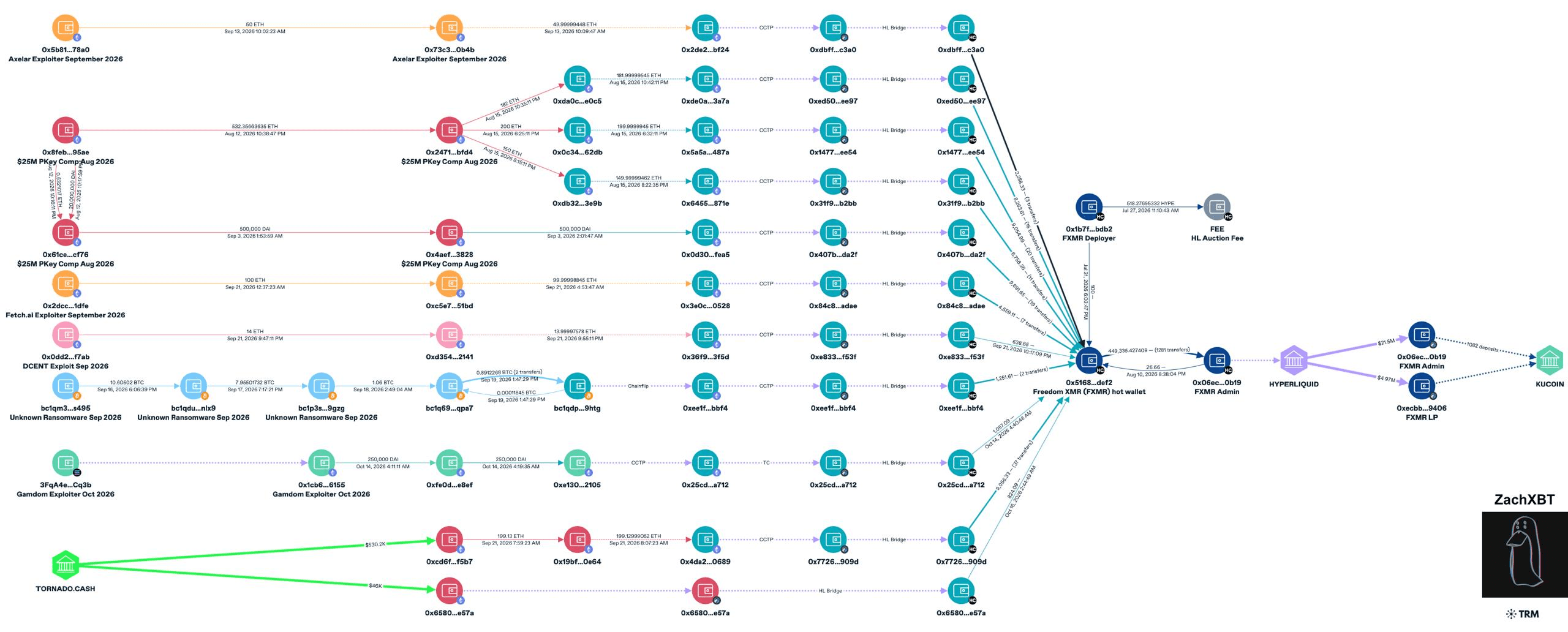
Bo Hines Tether: From White House Crypto Czar to USAT CEO
Oct 20, 20:29
Coinbase AgentKit vs Circle Agent Stack
Oct 20, 20:19
Capital as Production Capacity: Where Did the Money of America's Top 100 VCs and CVCs Go in the First Three Quarters of 2026?
Oct 20, 20:12Intelligence Bureau: DeepSeek open-source inference framework banned by U.S. federal agencies; JPMorgan first includes Bitcoin in long-term return forecast
Oct 20, 20:06