After a 97%+ crash, can Celestia turn things around with AI payments?
On October 16, modular blockchain Celestia announced the launch of Eden, a new high-performance EVM chain. The team positions it as an experimental sandbox for AI agent commerce (agentic commerce). AI agents have already begun transacting on-chain, and as they scale they will place higher demands on block space. Eden is being used to test the transaction environment AI agents need and their actual on-chain behavior.
Amid so many L1s and L2s, what makes this new chain different?
50 million block gas limit, TIA as the gas token
Eden is not just another ordinary EVM-compatible chain. It handles transaction execution and sequencing itself, while the Celestia mainnet is only responsible for data availability.
In other words, operations initiated by AI agents or users on Eden are processed and confirmed by Eden itself, and the resulting data is then relayed back to the Celestia mainnet for storage. Users need to deposit TIA through the official bridge before using it, and TIA is also Eden's native gas token.
According to the official documentation, Eden has a block time of 100 milliseconds and a block gas limit of 50 million. This means its block production speed is far faster than most EVM chains, making it suitable for scenarios requiring continuous, rapid interaction. The network supports native batch transactions and application-sponsored gas, so agents or users do not need to sign separately for every operation.
Eden currently uses a single sequencer, meaning there is only one place responsible for determining the order of transactions, and transactions are not made public before they are confirmed.
The first publicly announced experiment is a closed beta of Botfun. Participating agents can issue their own tokens and trade around narratives generated by other agents. Every model inference call is settled on-chain through the x402 protocol (a machine-native micropayment protocol based on HTTP 402 status codes, incubated by Coinbase).
Technically, the Evolve tech stack used by Eden is the iterative upgrade of Rollkit, Celestia's original official Rollup framework. In the Botfun closed beta (built on its Houston infrastructure), each AI agent has an independent wallet and can not only autonomously provide liquidity in the native DEX and earn fees settled in TIA, but every inference fee for calling a large language model (LLM) is also transferred in real time in TIA through the x402 protocol.
According to on-chain data, Eden has accumulated 2.59 million transactions since its stealth testing began in July this year (with a single-week peak of 516,000 in July), though the team has not yet separately broken out x402 settlement counts from total transaction volume for verification.
The July pivot
In July 2026, Celestia Labs acquired Sovereign Labs, a developer of high-performance blockchain frameworks, and Sovereign Labs co-founder Preston Evans became CTO of Celestia Labs.
Celestia Labs CEO and co-founder Nick White also stated that its custom high-performance blockchain business will focus on two verticals: Agentic Payments and on-chain markets. Among them, Agentic Payments is used to support high-frequency, massive microtransactions, enabling instant settlement without the need to establish billing relationships.
In addition, he said Celestia's go-to-market strategy has shifted, from primarily working with startups and independent developers to directly partnering with large applications and enterprises that have real business needs and distribution capabilities, providing them with full-stack blockchain infrastructure.
Unlike its past reliance on external ecosystem teams to build chains, Eden is a project that Celestia Labs has taken on directly after merging the original Rollkit team with the Sovereign Labs engineering team (led by new CTO Preston Evans) acquired in July this year. The ammunition backing this full-stack gamble is the "over $100 million treasury reserve" previously disclosed by Celestia Labs founder Mustafa.
The backdrop for this pivot is that agent payments are rapidly expanding beyond early experiments.
According to a report released by Chainalysis in October 2026, cumulative payments completed by AI agents through Coinbase's x402 protocol on the Base chain have grown from roughly 1,500 in mid-2025 to over 138 million in Q3 2026.
More than 87% of these transactions are between 0.01 cents and 10 cents each, falling within the micropayment range that traditional card networks find difficult to process economically.
Wallet activity is also rising. Among wallets that made their first top-up in Q2 2026, 89.3% received another top-up within 30 days; the median time from wallet top-up to completing the first x402 payment shrank from 73 days at the end of 2025 to 18 minutes in Q3 2026.
Against this backdrop, Eden is not simply adding another EVM chain. Celestia has historically served other chains primarily as a data availability layer, with limited fee revenue over the long term.
Eden, by contrast, has the team operating the execution environment itself, using TIA directly as the gas token and relaying the generated data back to the Celestia mainnet. Eden mandates TIA as the native gas consumption medium. Once the commercial loop is closed, it will establish a deflationary value-capture flywheel for TIA, transforming it from a "high-inflation governance token" into a "high-frequency, in-demand consumable."
The official website's agent payments page previously emphasized that the large volume of micropayments generated by AI agents may require higher throughput and lower-friction settlement capabilities.
Ethereum and conventional L2s are rigidly capped at 24KB of contract bytecode (the EIP-170 limit), so slightly more complex agent autonomous decision-making or multi-signature escrow contracts cannot be deployed. Eden directly raises the limit by more than fivefold to 128KB, allowing bloated Agent contracts to run normally.
At the underlying mechanism level, Eden uses 100-millisecond ultra-fast block production, 0x76 atomic batch execution, and gas sponsorship (Paymaster) to substantially smooth out the signature latency and capital friction of AI agents in high-frequency on-chain interactions. Whether these designs truly match the actual needs of agents currently depends on observing experimental data such as Botfun.
Price down over 97%, daily fee revenue of just $108
Eden's launch at this moment needs to be understood within Celestia's prior trajectory.
In May 2019, Mustafa Al-Bassam published the LazyLedger paper, proposing the separation of data availability from execution. That same year, Al-Bassam co-founded the project with Ismail Khoffi and John Adler, and it was renamed Celestia in 2021. In October 2023, after the Celestia mainnet launched, it briefly became a representative asset of the modular narrative, with TIA hitting a high of $21 in early 2024.
The turning point began with the massive unlock flood in October 2024. A huge volume of low-cost tokens flooded the secondary market, directly breaking through TIA's price support.
The fee revenue captured by the protocol has long been negligible, proving that relying solely on Rollup data publishing (Blob) simply cannot support a valuation model with a tens-of-billions FDV. According to the latest DefiLlama data, its on-chain fee revenue over the past 24 hours was just $108.
In June 2025, as TIA's price fell sharply from its 2024 high, Twitter user 0xCircusLover posted an exposé claiming that "Celestia's executive team unlocked all their tokens in October 2024, and in addition, Celestia founder Mustafa sold over $25 million worth of TIA tokens via OTC and moved to Dubai."
In response, Mustafa posted a statement saying, "I have been in the crypto space since 2010, and I know that surviving in this industry requires resilience and the ability to withstand all kinds of tests, because every token will experience a 95% drawdown at some point in its lifecycle. We have over $100 million in reserves, and our development path for the next six-plus years is already planned out, so we are prepared for a protracted battle, no matter how long it takes."
In July 2025, the Celestia Foundation repurchased its remaining TIA holdings (about 43.45 million tokens at roughly $1.44 each) from early investor Polychain Capital for $62.5 million, and redistributed the tokens to new investors.
Previously, Polychain had been criticized for selling large amounts of staking rewards while the initial tokens were still in their lockup period. During the same period, discussions also emerged in the market about team members and early holders selling tokens. The phase in which TIA's price fell more than 90% from its high further amplified doubts about the gap between tokenomics and actual usage.
Currently, TIA is still hovering around $0.63, down about 97% from its all-time high, with a circulating market cap of $580 million and an FDV of $735 million.
With a languishing token price and mainnet daily revenue down to just over $100, Celestia urgently needs a new narrative that can truly consume TIA, and Eden is its first answer in betting on AI agent payments.
Join the official Coincamps community:
Telegram: https://t.me/coin_camps
Recommended
a16z in Conversation with Circle CEO: How Can Blockchain Counterbalance Centralization in the AI Era?
Oct 20, 21:45ZachXBT Exposes Money Laundering Service FreedomXMR in Hyperliquid Ecosystem: 87% of Inflows Tied to Illicit Activity, Exceeding $20 Million
Oct 20, 20:38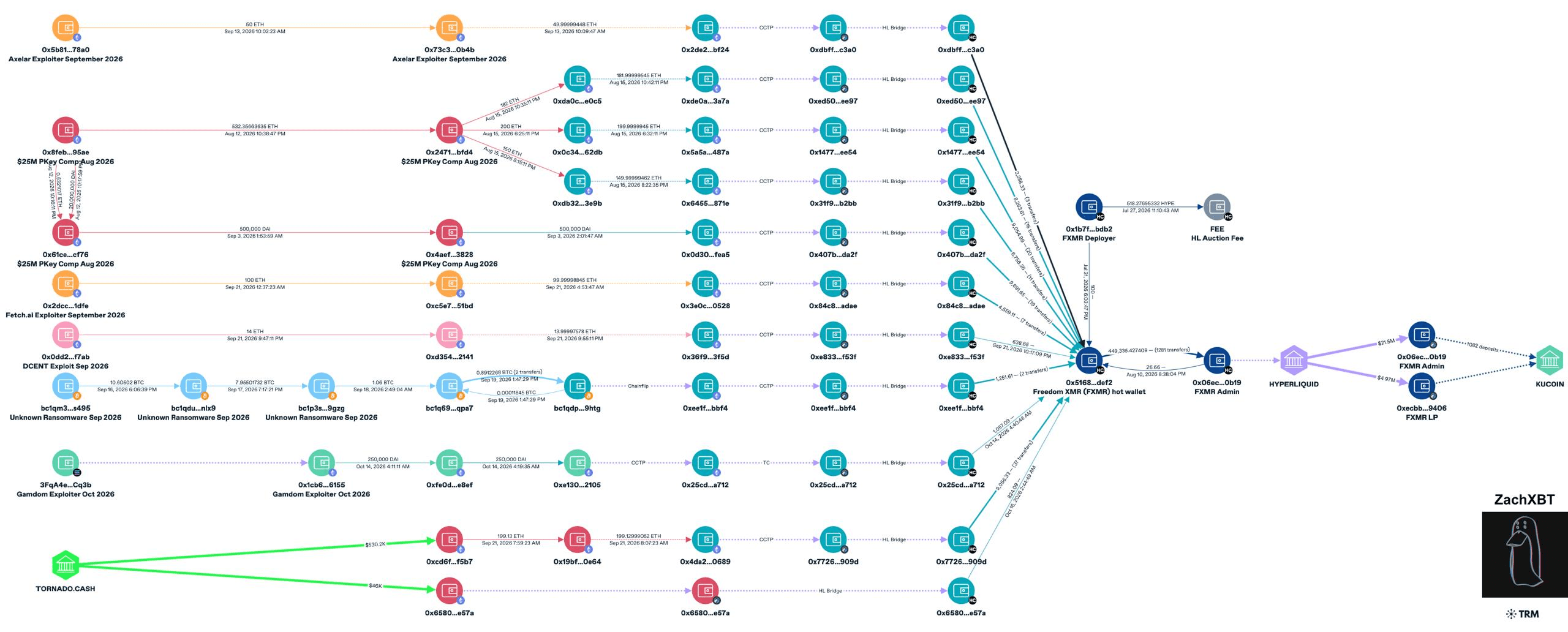
Bo Hines Tether: From White House Crypto Czar to USAT CEO
Oct 20, 20:29
Coinbase AgentKit vs Circle Agent Stack
Oct 20, 20:19
Capital as Production Capacity: Where Did the Money of America's Top 100 VCs and CVCs Go in the First Three Quarters of 2026?
Oct 20, 20:12Intelligence Bureau: DeepSeek open-source inference framework banned by U.S. federal agencies; JPMorgan first includes Bitcoin in long-term return forecast
Oct 20, 20:06